
This is part of a larger report on Americans and the 2026 midterm elections.
With congressional primaries already underway and the midterm elections coming up this fall, voters in both partisan coalitions are fairly split over whether they are looking for candidates who prioritize seeking common ground with the opposing party or for candidates who would push hard for the policies their voters want.
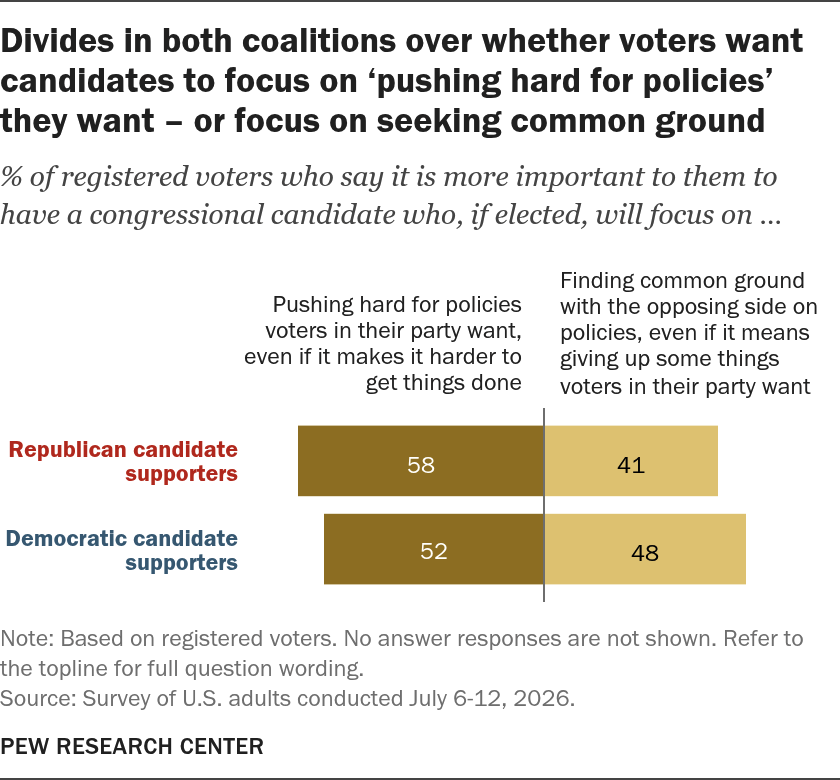
| Pushing hard for policies voters in their party want, even if it makes it harder to get things done | Finding common ground with the opposing side on policies, even if it means giving up some things voters in their party want | |
|---|---|---|
| Republican candidate supporters | 58 | 41 |
| Democratic candidate supporters | 52 | 48 |
Among registered voters who support Republican candidates for Congress:
- 58% say it’s more important that a candidate focuses on pushing hard for policies Republicans want – even if it makes it harder to get things done.
- 41% place more importance on candidates who focus on finding common ground with Democrats on policies, even if it means giving up some things Republican voters want.
Voters who support Democratic candidates are more evenly split: 52% want a candidate who would prioritize their voters’ policy preferences, while 48% prefer a candidate who would prioritize finding common ground with Republicans.
How voters differ
Voters who prefer candidates who would focus on pushing hard for policies their side wants are more engaged with the 2026 midterms so far than those who prefer candidates who seek common ground. This pattern is evident in both coalitions.
Republican voters
Among all registered voters who prefer a Republican candidate for Congress this fall, 69% say it “really matters which party wins control of Congress.”

| Really matters which party wins control of congress | Thought a lot about congressional elections | |
|---|---|---|
| Republican candidates supporters | 76 | 43 |
| Among those Republican candidate supporters who prefer a congressional candidate who would focus on pushing hard for policies | 80 | 46 |
| Among those Republican candidate supporters who prefer a congressional candidate who would focus on finding common ground | 71 | 39 |
| Democratic candidate supporters | 76 | 43 |
| Among those Democratic candidate supporters who prefer a congressional candidate who would focus on pushing hard for policies | 80 | 46 |
| Among those Democratic candidate supporters who prefer a congressional candidate who would focus on finding common ground | 71 | 39 |
Among pro-GOP voters who want a candidate who would focus more on fighting for the policies they want, this jumps to 80%. By comparison, a far smaller share (54%) of those who place more importance on seeking common ground say the outcome in November really matters.
Republican voters who prefer a candidate who would push hard for GOP policies have also given more thought to the election than those who want a candidate who would focus more on seeking common ground (30% vs. 15%).
Democratic voters
Among voters who support Democrats, there is a similar pattern – though it is slightly less pronounced.
Eight-in-ten Democratic voters who want a candidate who would prioritize fighting for their policies say it really matters which party wins. Among those who place more importance on compromise, 71% say this.
There is a similar gap when it comes to attention: 46% of Democratic voters who want a candidate who would focus on pushing for their own policies have given a lot of thought to the midterms so far. This drops to 39% among those who place more emphasis on compromise.
Demographic differences in both coalitions in candidate preferences
There are also differences within each voting coalition on this question.

** Estimates for Asian voters are representative of English speakers only.
Note: Based on registered voters. White, Black and Asian voters include those who report being only one race and are not Hispanic. Hispanic voters are of any race. Strong partisans are those whose partisanship matches their congressional vote choice who feel strongly attached to their party.
| group | Among Republican candidate supporters | Among Democratic candidate supporters | |
|---|---|---|---|
| Total | total | 58 | 52 |
| 18-34 | age | 58 | 70 |
| 35-49 | age | 54 | 52 |
| 50-64 | age | 62 | 45 |
| 65+ | age | 59 | 43 |
| White | race/ethnicity | 56 | 48 |
| Hispanic* | race/ethnicity | 62 | 57 |
| Black | race/ethnicity | 0 | 67 |
| Asian** | race/ethnicity | 0 | 38 |
| College degree | education | 53 | 47 |
| No college degree | education | 61 | 56 |
| Strong partisan | partisan | 67 | 60 |
| Not strong partisan | partisan | 44 | 49 |
** Estimates for Asian voters are representative of English speakers only.
Note: Based on registered voters. White, Black and Asian voters include those who report being only one race and are not Hispanic. Hispanic voters are of any race. Strong partisans are those whose partisanship matches their congressional vote choice who feel strongly attached to their party.
Among those who support Republican candidates – and strongly identify with the party – 67% want a candidate who will focus on pushing hard for policies rather than compromising with Democrats.
Republicans who are less strongly attached to the GOP are more likely to favor a candidate who would seek common ground.
Among those who support Democratic candidates, there is a similar pattern by partisan attachment.
In the Democratic coalition, there also are demographic differences in whether voters prefer candidates who place more importance on compromise or on pushing hard for policy priorities.
By a large margin, voters under 35 who back Democratic congressional candidates want an elected official who would focus on pushing for what Democrats want (70%). Older Democratic voters are far more split in their preferences.
Among those who back Democrats, Black voters are more likely than those in other groups to prefer candidates who would focus on pushing hard for priorities. Two-thirds say this, compared with a narrower majority of Hispanic Democratic voters (57%). White Democratic voters are roughly evenly split on this question, while Asian Democratic voters (38%) are less likely to prefer candidates who push hard over those who seek common ground.


