
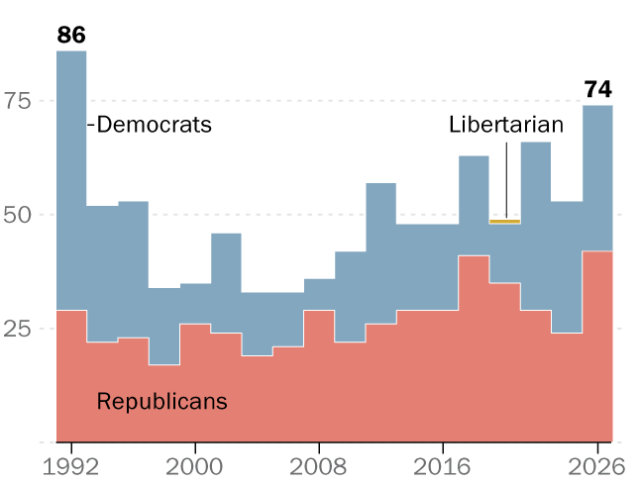
With primary season in the United States now over, control of the House of Representatives is still very much up for grabs. But before a single general-election vote has been tallied, 74 House members are already heading out the door – more than before any general election since 1992.
| Year | Democrat | Republican | Libertarian |
|---|---|---|---|
| 1992 | 57 | 29 | — |
| 1994 | 30 | 22 | — |
| 1996 | 30 | 23 | — |
| 1998 | 17 | 17 | — |
| 2000 | 9 | 26 | — |
| 2002 | 22 | 24 | — |
| 2004 | 14 | 19 | — |
| 2006 | 12 | 21 | — |
| 2008 | 7 | 29 | — |
| 2010 | 20 | 22 | — |
| 2012 | 31 | 26 | — |
| 2014 | 19 | 29 | — |
| 2016 | 19 | 29 | — |
| 2018 | 22 | 41 | — |
| 2020 | 13 | 35 | 1 |
| 2022 | 37 | 29 | — |
| 2024 | 29 | 24 | — |
| 2026 | 32 | 42 | — |
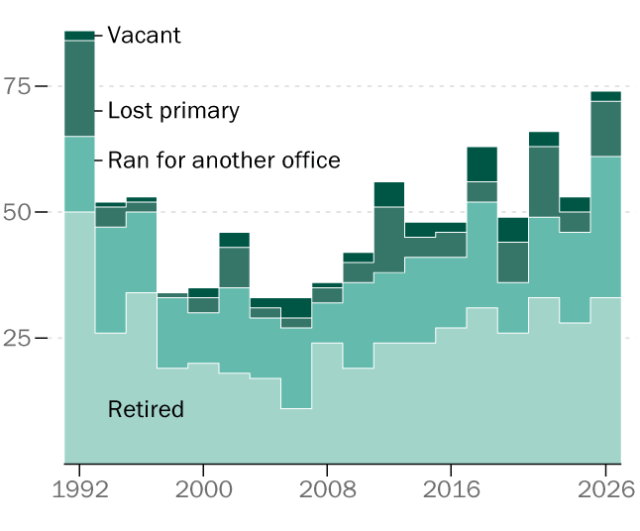
As of now, 42 Republicans and 32 Democrats won’t be returning to the House next year. That’s because they ran or are running for some other office instead; failed to win their primaries; resigned and haven’t been replaced via special election; or simply decided to retire from the House.
In 1992, 86 members were on their way out before the general election – more than in any election since. That election year was the first after House districts were redrawn following the 1990 census, which on its own created churn as states gained or lost seats and many incumbents found themselves in unfamiliar territory. In addition, the House banking scandal fueled widespread public outrage. In the end, 110 members either gave up or lost their seats, including 24 losses in the general election.
A notable driver of this year’s departures is the 28 members who chose to run for other offices rather than seek reelection. That’s the most in any election cycle we studied. By comparison, only 15 House members ran for other offices in the record-turnover year of 1992.
| Year | Retired | Ran for another office | Lost primary | Vacant |
|---|---|---|---|---|
| 1992 | 50 | 15 | 19 | 2 |
| 1994 | 26 | 21 | 4 | 1 |
| 1996 | 34 | 16 | 2 | 1 |
| 1998 | 19 | 14 | 1 | 0 |
| 2000 | 20 | 10 | 3 | 2 |
| 2002 | 18 | 17 | 8 | 3 |
| 2004 | 17 | 12 | 2 | 2 |
| 2006 | 11 | 16 | 2 | 4 |
| 2008 | 24 | 8 | 3 | 1 |
| 2010 | 19 | 17 | 4 | 2 |
| 2012 | 24 | 15 | 13 | 5 |
| 2014 | 24 | 17 | 4 | 3 |
| 2016 | 27 | 14 | 5 | 2 |
| 2018 | 31 | 21 | 4 | 7 |
| 2020 | 26 | 10 | 8 | 5 |
| 2022 | 33 | 16 | 14 | 3 |
| 2024 | 28 | 18 | 4 | 3 |
| 2026 | 33 | 28 | 11 | 2 |
This year, 16 House members have gone after Senate seats, 10 have aimed for governorships and two have sought other offices. Only 13, though, will be on general election ballots; the other 15 didn’t make it past their primaries.
The only state yet to hold its House primary is Louisiana, whose unique “jungle primary” is on Nov. 3, the same day as the general election nationally. Across all other states, 11 representatives who had sought reelection have lost their primaries, the fourth-most since 1992.
Another 33 representatives have decided to retire from the House. This is well below the 50 retirements in 1992, but it’s still more than in most other years we studied.
Texas has by far the most departing incumbents of any state. When the 120th Congress takes office in January, at least 13 of Texas’ 38 representatives will be new. That’s due in no small part to the redrawn congressional map Texas adopted last year, which prompted several House members to retire or seek other offices and ultimately could flip as many as five seats from Democratic to Republican. Texas’ move set off an unusual wave of mid-decade redistricting, prompting multiple members from other states not to seek reelection.
What does this mean for control of the House?
As we barrel toward Election Day, bear in mind that a lot of incumbents giving up or losing their seats doesn’t always mean a major shift in party control. Departing incumbents can be replaced by new members from the same party, and this often happens when they retire from “safe” seats or lose a primary.
In 1992, for instance, that 110-member turnover led to a net shift of just nine seats from Democrat to Republican. It was the next election, in 1994, that swung control of the House to the GOP: Though “only” 86 incumbents left Congress that year, Republicans picked up 54 seats – enough to end the Democrats’ four-decade lock on the House.