More than 100 countries around the world can be considered democracies, yet no two of them do democracy exactly the same way. Even so, the United States – which celebrates the 250th anniversary of the Declaration of Independence this year – stands apart from other democratic nations in several respects.
We looked at key aspects of the world’s 106 democracies (as defined by expert ratings from three organizations) to see how they compare with the U.S. and vice versa. Here are eight ways the U.S. political system differs from most – or all – of its peers.

| Democracy | ratio | ISO3 | pop_2026 | Region |
|---|---|---|---|---|
| Albania | 19650 | ALB | 2751000 | Europe |
| Andorra | 3000 | AND | 84000 | Europe |
| Antigua and Barbuda | 5588 | ATG | 95000 | Americas |
| Argentina | 179004 | ARG | 46004000 | Americas |
| Armenia | 27393 | ARM | 2931000 | Europe |
| Australia | 181513 | AUS | 27227000 | Asia-Pacific |
| Austria | 49765 | AUT | 9107000 | Europe |
| Bahamas | 9878 | BHS | 405000 | Americas |
| Barbados | 9433 | BRB | 283000 | Americas |
| Belgium | 78500 | BEL | 11775000 | Europe |
| Belize | 13839 | BLZ | 429000 | Americas |
| Bhutan | 17064 | BTN | 802000 | Asia-Pacific |
| Bolivia | 98069 | BOL | 12749000 | Americas |
| Botswana | 40046 | BWA | 2603000 | Africa |
| Brazil | 416302 | BRA | 213563000 | Americas |
| Bulgaria | 27783 | BGR | 6668000 | Europe |
| Canada | 117983 | CAN | 40468000 | Americas |
| Cape Verde | 7361 | CPV | 530000 | Africa |
| Chile | 128684 | CHL | 19946000 | Americas |
| Colombia | 294732 | COL | 53936000 | Americas |
| Costa Rica | 90789 | CRI | 5175000 | Americas |
| Croatia | 25311 | HRV | 3822000 | Europe |
| Cyprus | 17446 | CYP | 977000 | Europe |
| Czech Republic | 52640 | CZE | 10528000 | Europe |
| Denmark | 33654 | DNK | 6024000 | Europe |
| Dominica | 2063 | DMA | 66000 | Americas |
| Dominican Republic | 61105 | DOM | 11610000 | Americas |
| East Timor | 22108 | TLS | 1437000 | Asia-Pacific |
| Ecuador | 122152 | ECU | 18445000 | Americas |
| Estonia | 13178 | EST | 1331000 | Europe |
| Fiji | 17036 | FJI | 937000 | Asia-Pacific |
| Finland | 28110 | FIN | 5622000 | Europe |
| France | 115678 | FRA | 66746000 | Europe |
| Germany | 132768 | DEU | 83644000 | Europe |
| Ghana | 129341 | GHA | 35698000 | Africa |
| Greece | 32990 | GRC | 9897000 | Europe |
| Grenada | 7800 | GRD | 117000 | Americas |
| Guyana | 12938 | GUY | 841000 | Americas |
| Hungary | 48171 | HUN | 9586000 | Europe |
| Iceland | 6381 | ISL | 402000 | Europe |
| India | 2724402 | IND | 1476626000 | Asia-Pacific |
| Ireland | 30787 | IRL | 5357000 | Europe |
| Israel | 80400 | ISR | 9648000 | Middle East |
| Italy | 147315 | ITA | 58926000 | Europe |
| Jamaica | 44968 | JAM | 2833000 | Americas |
| Japan | 263286 | JPN | 122428000 | Asia-Pacific |
| Kiribati | 3067 | KIR | 138000 | Asia-Pacific |
| Kosovo | 13892 | XKX | 1667000 | Europe |
| Latvia | 18360 | LVA | 1836000 | Europe |
| Lesotho | 19908 | LSO | 2389000 | Africa |
| Liberia | 80192 | LBR | 5854000 | Africa |
| Liechtenstein | 1600 | LIE | 40000 | Europe |
| Lithuania | 19837 | LTU | 2797000 | Europe |
| Luxembourg | 11450 | LUX | 687000 | Europe |
| Malawi | 99502 | MWI | 22786000 | Africa |
| Malaysia | 163896 | MYS | 36385000 | Asia-Pacific |
| Malta | 8194 | MLT | 549000 | Europe |
| Marshall Islands | 1061 | MHL | 35000 | Asia-Pacific |
| Mauritius | 19167 | MUS | 1265000 | Africa |
| Micronesia, Federated States | 8143 | FSM | 114000 | Asia-Pacific |
| Moldova | 29317 | MDA | 2961000 | Europe |
| Monaco | 1583 | MCO | 38000 | Europe |
| Mongolia | 28230 | MNG | 3557000 | Asia-Pacific |
| Montenegro | 7728 | MNE | 626000 | Europe |
| Namibia | 32844 | NAM | 3153000 | Africa |
| Nauru | 632 | NRU | 12000 | Asia-Pacific |
| Nepal | 107742 | NPL | 29629000 | Asia-Pacific |
| Netherlands | 122993 | NLD | 18449000 | Europe |
| New Zealand | 42984 | NZL | 5287000 | Asia-Pacific |
| North Macedonia | 15033 | MKD | 1804000 | Europe |
| Northern Cyprus | 8100 | CYP | 405000 | Europe |
| Norway | 33450 | NOR | 5653000 | Europe |
| Palau | 1125 | PLW | 18000 | Asia-Pacific |
| Panama | 65155 | PAN | 4626000 | Americas |
| Paraguay | 88688 | PRY | 7095000 | Americas |
| Peru | 268631 | PER | 34922000 | Americas |
| Philippines | 370201 | PHL | 117724000 | Asia-Pacific |
| Poland | 82267 | POL | 37843000 | Europe |
| Portugal | 45196 | PRT | 10395000 | Europe |
| Romania | 56801 | ROU | 18801000 | Europe |
| Samoa | 4333 | WSM | 221000 | Asia-Pacific |
| San Marino | 567 | SMR | 34000 | Europe |
| Sao Tome and Principe | 4455 | STP | 245000 | Africa |
| Senegal | 117376 | SEN | 19367000 | Africa |
| Seychelles | 3971 | SYC | 135000 | Africa |
| Slovakia | 36340 | SVK | 5451000 | Europe |
| Slovenia | 23500 | SVN | 2115000 | Europe |
| Solomon Islands | 17160 | SLB | 858000 | Asia-Pacific |
| South Africa | 163633 | ZAF | 65453000 | Africa |
| South Korea | 172000 | KOR | 51600000 | Asia-Pacific |
| Spain | 136717 | ESP | 47851000 | Europe |
| Sri Lanka | 103769 | LKA | 23348000 | Asia-Pacific |
| St. Kitts and Nevis | 3133 | KNA | 47000 | Americas |
| St. Lucia | 10588 | LCA | 180000 | Americas |
| St. Vincent and the Grenadines | 4304 | VCT | 99000 | Americas |
| Suriname | 12647 | SUR | 645000 | Americas |
| Sweden | 30662 | SWE | 10701000 | Europe |
| Switzerland | 45040 | CHE | 9008000 | Europe |
| Taiwan | 203637 | TWN | 23011000 | Asia-Pacific |
| Tonga | 3433 | TON | 103000 | Asia-Pacific |
| Trinidad and Tobago | 36902 | TTO | 1513000 | Americas |
| Tuvalu | 563 | TUV | 9000 | Asia-Pacific |
| United Kingdom | 107588 | GBR | 69932000 | Europe |
| United States | 802379 | USA | 349035000 | Americas |
| Uruguay | 34172 | URY | 3383000 | Americas |
| Vanuatu | 6596 | VUT | 343000 | Asia-Pacific |
The U.S. Constitution is really hard to change.
In Pew Research Center surveys, Americans overwhelmingly favor several proposed changes to the U.S. political system, from term and age limits for government officials to campaign finance limitations. But many of those changes would require amending the Constitution, which is extremely difficult. The Constitution has been in effect for 237 years but has been formally amended just 27 times.
Using a classification scheme developed by the late political scientist Donald S. Lutz, we scored the amendment rules of 101 democratic constitutions. (The other five democracies have “uncodified” constitutions, meaning their governance rules are distributed across multiple statutes, legal precedents, customs and unwritten norms.) For constitutions that contain more than one amendment procedure, we used the “least difficult” path, which may or may not be the most frequently employed.
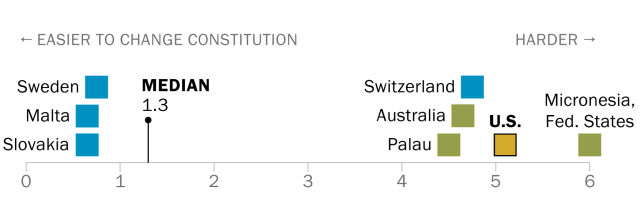
Of all 101 constitutions, the U.S. Constitution has the second-most onerous amendment process. Amendments must be approved by two-thirds votes in both the House and Senate – itself a tall order in these polarized times – and then be ratified by three-quarters of state legislatures, or 38 of 50.
| Democracy | Difficulty of amendment |
|---|---|
| Micronesia, Federated States | 6.00 |
| United States | 5.10 |
| Switzerland | 4.75 |
| Australia | 4.65 |
| Palau | 4.50 |
| Fiji | 3.80 |
| Costa Rica | 3.65 |
| Liberia | 3.60 |
| Romania | 3.35 |
| Grenada | 3.30 |
| Philippines | 3.30 |
| Marshall Islands | 3.25 |
| Belgium | 3.10 |
| Japan | 3.10 |
| Netherlands | 3.10 |
| Paraguay | 3.00 |
| Taiwan* | 2.90 |
| Brazil | 0.90 |
| Denmark | 2.75 |
| Northern Cyprus | 2.55 |
| South Korea | 2.55 |
| Ireland | 2.50 |
| Bolivia | 2.40 |
| Andorra | 2.55 |
| Ecuador | 2.30 |
| Liechtenstein | 2.30 |
| Colombia | 2.25 |
| Italy | 2.25 |
| North Macedonia | 2.25 |
| Greece | 2.20 |
| Argentina | 2.10 |
| Nepal | 2.10 |
| Lithuania | 2.00 |
| Montenegro | 2.00 |
| Peru | 2.00 |
| Dominican Republic | 1.80 |
| Chile | 1.75 |
| Ghana | 1.75 |
| Luxembourg | 1.75 |
| Solomon Islands | 1.75 |
| Uruguay | 1.75 |
| Poland | 1.70 |
| Estonia | 1.65 |
| Germany | 1.60 |
| India | 1.60 |
| Namibia | 1.60 |
| Finland | 1.55 |
| Croatia | 1.45 |
| Antigua and Barbuda | 1.30 |
| Monaco | 1.30 |
| South Africa | 1.30 |
| St. Lucia | 1.30 |
| Czech Republic | 1.25 |
| Iceland | 1.25 |
| Jamaica | 1.25 |
| Spain | 1.25 |
| Bulgaria | 2.00 |
| Guyana | 1.15 |
| Lesotho | 1.15 |
| Senegal | 1.15 |
| Albania | 1.05 |
| Armenia | 1.05 |
| Kosovo | 1.55 |
| Moldova | 1.55 |
| Slovenia | 1.05 |
| Bahamas | 1.00 |
| Barbados | 1.00 |
| Botswana | 1.00 |
| Malaysia | 1.00 |
| Tonga | 1.00 |
| Trinidad and Tobago | 1.00 |
| Bhutan | 0.90 |
| France | 0.90 |
| Mongolia | 0.90 |
| Panama | 0.90 |
| Austria | 0.80 |
| Belize | 0.80 |
| Cape Verde | 0.80 |
| Cyprus | 0.80 |
| Dominica | 0.80 |
| East Timor | 0.80 |
| Hungary | 0.80 |
| Kiribati | 0.80 |
| Latvia | 0.80 |
| Malawi | 0.80 |
| Mauritius | 0.80 |
| Nauru | 0.80 |
| Norway | 0.80 |
| Portugal | 0.80 |
| Samoa | 0.80 |
| Sao Tome and Principe | 0.80 |
| Seychelles | 0.80 |
| Sri Lanka | 0.80 |
| St. Kitts and Nevis | 0.80 |
| St. Vincent and the Grenadines | 0.80 |
| Suriname | 0.80 |
| Tuvalu | 0.80 |
| Vanuatu | 0.80 |
| Sweden** | 0.75 |
| Malta | 0.65 |
| Slovakia | 0.65 |
* The data in the table refers to the “Additional Articles of the Constitution,” which effectively rewrote the old 1947 Republic of China constitution.
** Although Sweden’s constitution formally consists of four “fundamental laws,” the data in the table refers specifically to the Instrument of Government, which contains most of the basic principles of government. However, the difficulty of amendment score applies to all four fundamental laws.
The only democracy whose constitution is even harder to change is the Federated States of Micronesia (FSM), a former U.S. trust territory in the South Pacific with about 76,000 inhabitants. The easiest path to changing the FSM’s constitution involves two separate two-thirds majority votes in the 14-person legislature, approval by the country’s president, and subsequent approval by three-quarters of voters in at least three of the FSM’s four states.
Other countries with constitutions that are nearly as hard to change are Palau, Switzerland and Australia. Like the U.S. and the FSM, these countries all require ratification at both the national and state levels.
At the other extreme, many countries with unicameral (single-chamber) legislatures can amend their constitutions much like how they pass regular laws, just requiring a larger majority in favor.
Almost everyone born in the U.S. is automatically a citizen.
| Country | Form of birthright citizenship, if any | Region |
|---|---|---|
| Albania | Not recognized | Europe |
| Andorra | Data unavailable | Europe |
| Antigua and Barbuda | Recognized | Americas |
| Argentina | Recognized | Americas |
| Armenia | Not recognized | Europe |
| Australia | Limited to those with parents who are legal residents | Asia-Pacific |
| Austria | Not recognized | Europe |
| Bahamas | Not recognized | Americas |
| Barbados | Recognized | Americas |
| Belgium | Limited to those with parents born in country | Europe |
| Belize | Recognized | Americas |
| Bhutan | Not recognized | Asia-Pacific |
| Bolivia | Recognized | Americas |
| Botswana | Not recognized | Africa |
| Brazil | Recognized | Americas |
| Bulgaria | Not recognized | Europe |
| Canada | Recognized | Americas |
| Cape Verde | Limited to those with parents who are legal residents | Africa |
| Chile | Limited to those with parents who are legal residents | Americas |
| Colombia | Limited to those with parents who are legal residents | Americas |
| Costa Rica | Recognized, but parents or individual must apply | Americas |
| Croatia | Not recognized | Europe |
| Cyprus | Not recognized | Europe |
| Czech Republic | Not recognized | Europe |
| Denmark | Not recognized | Europe |
| Dominica | Recognized | Americas |
| Dominican Republic | Limited to those with parents who are legal residents | Americas |
| East Timor | Limited to those with parents born in country | Asia-Pacific |
| Ecuador | Recognized | Americas |
| Estonia | Not recognized | Europe |
| Fiji | Not recognized | Asia-Pacific |
| Finland | Not recognized | Europe |
| France | Limited to those with parents born in country | Europe |
| Germany | Limited to those with parents who are legal residents | Europe |
| Ghana | Not recognized | Africa |
| Greece | Limited to those with parents born in country | Europe |
| Grenada | Recognized | Americas |
| Guyana | Recognized | Americas |
| Hungary | Not recognized | Europe |
| Iceland | Not recognized | Europe |
| India | Not recognized | Asia-Pacific |
| Ireland | Limited to those with parents who are legal residents | Europe |
| Israel | Limited to particular ethnic or religious groups | Middle East |
| Italy | Not recognized | Europe |
| Jamaica | Recognized | Americas |
| Japan | Not recognized | Asia-Pacific |
| Kiribati | Not recognized | Asia-Pacific |
| Kosovo | Limited to those with parents who are legal residents | Europe |
| Latvia | Not recognized | Europe |
| Lesotho | Recognized | Africa |
| Liberia | Limited to particular ethnic or religious groups | Africa |
| Liechtenstein | Not recognized | Europe |
| Lithuania | Not recognized | Europe |
| Luxembourg | Limited to those with parents born in country | Europe |
| Malawi | Not recognized | Africa |
| Malaysia | Limited to those with parents who are legal residents | Asia-Pacific |
| Malta | Limited to those with parents born in country | Europe |
| Marshall Islands | Not recognized | Asia-Pacific |
| Mauritius | Not recognized | Africa |
| Micronesia, Federated States | Not recognized | Asia-Pacific |
| Moldova | Recognized, but parents or individual must apply | Europe |
| Monaco | Data unavailable | Europe |
| Mongolia | Not recognized | Asia-Pacific |
| Montenegro | Not recognized | Europe |
| Namibia | Limited to those with parents that are legal residents | Africa |
| Nauru | Not recognized | Asia-Pacific |
| Nepal | Not recognized | Asia-Pacific |
| Netherlands | Limited to those with parents born in country | Europe |
| New Zealand | Limited to those with parents who are legal residents | Asia-Pacific |
| North Macedonia | Not recognized | Europe |
| Northern Cyprus | Data unavailable | Not recognized |
| Norway | Not recognized | Europe |
| Palau | Not recognized | Asia-Pacific |
| Panama | Recognized | Americas |
| Paraguay | Recognized, but parents or individual must apply | Americas |
| Peru | Recognized | Americas |
| Philippines | Not recognized | Asia-Pacific |
| Poland | Not recognized | Europe |
| Portugal | Limited to those with parents born in country | Europe |
| Romania | Not recognized | Europe |
| Samoa | Not recognized | Asia-Pacific |
| San Marino | Data unavailable | Europe |
| Sao Tome and Principe | Limited to those with parents who are legal residents | Africa |
| Senegal | Limited to those with parents born in country | Africa |
| Seychelles | Not recognized | Africa |
| Slovakia | Not recognized | Europe |
| Slovenia | Not recognized | Europe |
| Solomon Islands | Not recognized | Asia-Pacific |
| South Africa | Not recognized | Africa |
| South Korea | Not recognized | Asia-Pacific |
| Spain | Limited to those with parents born in country | Europe |
| Sri Lanka | Not recognized | Asia-Pacific |
| St. Kitts and Nevis | Recognized | Americas |
| St. Lucia | Recognized | Americas |
| St. Vincent and the Grenadines | Recognized | Americas |
| Suriname | Not recognized | Americas |
| Sweden | Not recognized | Europe |
| Switzerland | Not recognized | Europe |
| Taiwan | Not recognized | Asia-Pacific |
| Tonga | Not recognized | Asia-Pacific |
| Trinidad and Tobago | Recognized | Americas |
| Tuvalu | Recognized | Asia-Pacific |
| United Kingdom | Limited to those with parents who are legal residents | Europe |
| United States | Recognized | Americas |
| Uruguay | Recognized | Americas |
| Vanuatu | Not recognized | Asia-Pacific |
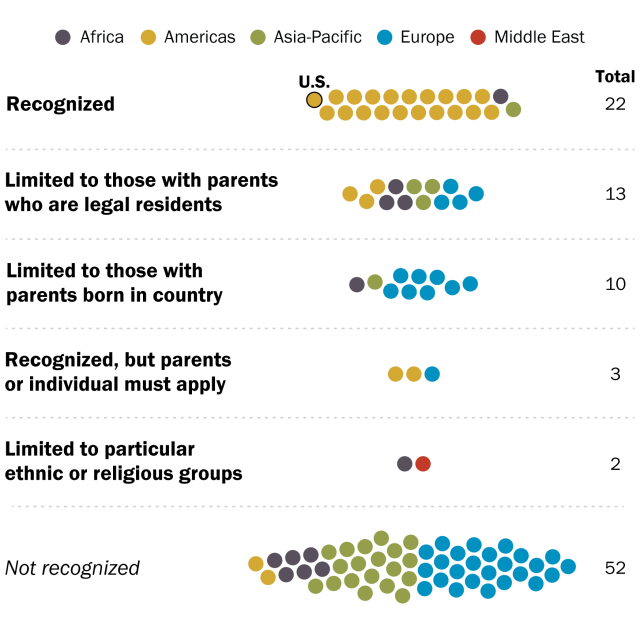
Only 21 other countries we classify as democracies have “birthright citizenship” in a form substantially like the United States. In those countries, most of them in the Western Hemisphere, virtually all children born there are automatically citizens, regardless of their parents’ citizenship or immigration status. In the U.S., birthright citizenship is guaranteed by the 14th Amendment, as the Supreme Court recently reaffirmed.
In three other democracies, nearly all children born to noncitizen parents are eligible to become citizens, but they or their parents must formally apply for it.
Another 25 democracies limit birthright citizenship to children whose parents are legal residents (13), whose parents were also born there (10), or who belong to specific ethnic or religious groups (2).
But nearly half of the 106 democracies (52) don’t recognize any kind of birthright citizenship. In all but one of those countries, newborns are automatically citizens only if at least one parent is also a citizen. (The remaining four democracies weren’t covered by the database of citizenship laws we used for this analysis.)
No other country fills its top executive position quite like the U.S.
| Democracy | Structure of government leadership | How leader is chosen |
|---|---|---|
| United States | Republic with combined head of state and government | Indirectly elected (by Electoral College) |
| Botswana | Republic with combined head of state and government | Indirectly elected (by legislature) |
| Marshall Islands | Republic with combined head of state and government | Indirectly elected (by legislature) |
| Micronesia, Federated States | Republic with combined head of state and government | Indirectly elected (by legislature) |
| Nauru | Republic with combined head of state and government | Indirectly elected (by legislature) |
| South Africa | Republic with combined head of state and government | Indirectly elected (by legislature) |
| Suriname | Republic with combined head of state and government | Indirectly elected (by legislature) |
| Switzerland | Republic with combined head of state and government | Indirectly elected (by legislature) |
| Argentina | Republic with combined head of state and government | Directly elected |
| Bolivia | Republic with combined head of state and government | Directly elected |
| Brazil | Republic with combined head of state and government | Directly elected |
| Chile | Republic with combined head of state and government | Directly elected |
| Colombia | Republic with combined head of state and government | Directly elected |
| Costa Rica | Republic with combined head of state and government | Directly elected |
| Cyprus | Republic with combined head of state and government | Directly elected |
| Dominican Republic | Republic with combined head of state and government | Directly elected |
| Ecuador | Republic with combined head of state and government | Directly elected |
| Ghana | Republic with combined head of state and government | Directly elected |
| Kiribati | Republic with combined head of state and government | Directly elected |
| Liberia | Republic with combined head of state and government | Directly elected |
| Malawi | Republic with combined head of state and government | Directly elected |
| Namibia | Republic with combined head of state and government | Directly elected |
| Palau | Republic with combined head of state and government | Directly elected |
| Panama | Republic with combined head of state and government | Directly elected |
| Paraguay | Republic with combined head of state and government | Directly elected |
| Peru | Republic with combined head of state and government | Directly elected |
| Philippines | Republic with combined head of state and government | Directly elected |
| Seychelles | Republic with combined head of state and government | Directly elected |
| South Korea | Republic with combined head of state and government | Directly elected |
| Sri Lanka | Republic with combined head of state and government | Directly elected |
| Uruguay | Republic with combined head of state and government | Directly elected |
| Albania | Republic with separate heads of state and government | Indirectly elected (by legislature) |
| Armenia | Republic with separate heads of state and government | Indirectly elected (by legislature) |
| Barbados | Republic with separate heads of state and government | Indirectly elected (by legislature) |
| Dominica | Republic with separate heads of state and government | Indirectly elected (by legislature) |
| Estonia | Republic with separate heads of state and government | Indirectly elected (by legislature) |
| Fiji | Republic with separate heads of state and government | Indirectly elected (by legislature) |
| Germany | Republic with separate heads of state and government | Indirectly elected (by assembly of national and local lawmakers) |
| Greece | Republic with separate heads of state and government | Indirectly elected (by legislature) |
| Hungary | Republic with separate heads of state and government | Indirectly elected (by legislature) |
| India | Republic with separate heads of state and government | Indirectly elected (by assembly of national and local lawmakers) |
| Israel | Republic with separate heads of state and government | Indirectly elected (by legislature) |
| Italy | Republic with separate heads of state and government | Indirectly elected (by assembly of national and local lawmakers) |
| Kosovo | Republic with separate heads of state and government | Indirectly elected (by legislature) |
| Latvia | Republic with separate heads of state and government | Indirectly elected (by legislature) |
| Malta | Republic with separate heads of state and government | Indirectly elected (by legislature) |
| Mauritius | Republic with separate heads of state and government | Indirectly elected (by legislature) |
| Nepal | Republic with separate heads of state and government | Indirectly elected (by assembly of national and local lawmakers) |
| Samoa | Republic with separate heads of state and government | Indirectly elected (by legislature) |
| San Marino | Republic with separate heads of state and government | Indirectly elected (by legislature) |
| Trinidad and Tobago | Republic with separate heads of state and government | Indirectly elected (by legislature) |
| Vanuatu | Republic with separate heads of state and government | Indirectly elected (by assembly of national and local lawmakers) |
| Austria | Republic with separate heads of state and government | Directly elected |
| Bulgaria | Republic with separate heads of state and government | Directly elected |
| Cape Verde | Republic with separate heads of state and government | Directly elected |
| Croatia | Republic with separate heads of state and government | Directly elected |
| Czech Republic | Republic with separate heads of state and government | Directly elected |
| East Timor | Republic with separate heads of state and government | Directly elected |
| Finland | Republic with separate heads of state and government | Directly elected |
| France | Republic with separate heads of state and government | Directly elected |
| Guyana | Republic with separate heads of state and government | Directly elected |
| Iceland | Republic with separate heads of state and government | Directly elected |
| Ireland | Republic with separate heads of state and government | Directly elected |
| Lithuania | Republic with separate heads of state and government | Directly elected |
| Moldova | Republic with separate heads of state and government | Directly elected |
| Mongolia | Republic with separate heads of state and government | Directly elected |
| Montenegro | Republic with separate heads of state and government | Directly elected |
| North Macedonia | Republic with separate heads of state and government | Directly elected |
| Northern Cyprus | Republic with separate heads of state and government | Directly elected |
| Poland | Republic with separate heads of state and government | Directly elected |
| Portugal | Republic with separate heads of state and government | Directly elected |
| Romania | Republic with separate heads of state and government | Directly elected |
| Sao Tome and Principe | Republic with separate heads of state and government | Directly elected |
| Senegal | Republic with separate heads of state and government | Directly elected |
| Slovakia | Republic with separate heads of state and government | Directly elected |
| Slovenia | Republic with separate heads of state and government | Directly elected |
| Taiwan | Republic with separate heads of state and government | Directly elected |
| Antigua and Barbuda | Constitutional monarchy | Hereditary monarch |
| Australia | Constitutional monarchy | Hereditary monarch |
| Bahamas | Constitutional monarchy | Hereditary monarch |
| Belgium | Constitutional monarchy | Hereditary monarch |
| Belize | Constitutional monarchy | Hereditary monarch |
| Bhutan | Constitutional monarchy | Hereditary monarch |
| Canada | Constitutional monarchy | Hereditary monarch |
| Denmark | Constitutional monarchy | Hereditary monarch |
| Grenada | Constitutional monarchy | Hereditary monarch |
| Jamaica | Constitutional monarchy | Hereditary monarch |
| Japan | Constitutional monarchy | Hereditary monarch |
| Lesotho | Constitutional monarchy | Hereditary monarch |
| Liechtenstein | Constitutional monarchy | Hereditary monarch |
| Luxembourg | Constitutional monarchy | Hereditary monarch |
| Monaco | Constitutional monarchy | Hereditary monarch |
| Netherlands | Constitutional monarchy | Hereditary monarch |
| New Zealand | Constitutional monarchy | Hereditary monarch |
| Norway | Constitutional monarchy | Hereditary monarch |
| Solomon Islands | Constitutional monarchy | Hereditary monarch |
| Spain | Constitutional monarchy | Hereditary monarch |
| St. Kitts and Nevis | Constitutional monarchy | Hereditary monarch |
| St. Lucia | Constitutional monarchy | Hereditary monarch |
| St. Vincent and the Grenadines | Constitutional monarchy | Hereditary monarch |
| Sweden | Constitutional monarchy | Hereditary monarch |
| Tonga | Constitutional monarchy | Hereditary monarch |
| Tuvalu | Constitutional monarchy | Hereditary monarch |
| United Kingdom | Constitutional monarchy | Hereditary monarch |
| Andorra | Constitutional monarchy | Other |
| Malaysia | Constitutional monarchy | Other |
* Switzerland’s Federal Council acts as a collective executive body. Each year the title of “president of the Confederation” rotates among the Council’s 7 members.
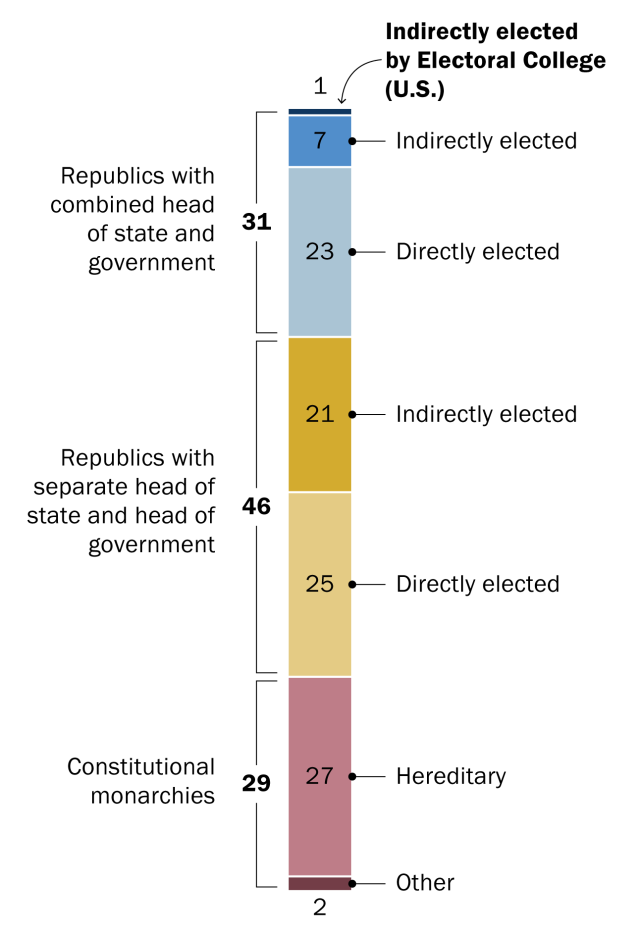
The U.S. president combines the roles of head of government (the political leader) and head of state (the symbolic leader of the nation). Only 30 other democracies have one person who fills both those roles. The others have a monarch, ceremonial president or similar figure as head of state, and a prime minister or similar official as head of government.
That in itself doesn’t make the U.S. too much of an outlier. However, of the 31 countries with combined heads of state and government (almost universally termed “presidents”), 23 are elected directly by the people, and another seven are chosen by the national legislature.
That makes the U.S. the only country where the people vote for a special body – the Electoral College – whose sole function is to choose the president. That means the popular vote for president doesn’t necessarily determine the Electoral College winner.
Four times since 1828, when U.S. presidential elections began to resemble today’s system, a candidate won the Electoral College and became president despite getting fewer popular votes than the runner-up. The most recent instance was in 2016, when Donald Trump won the electoral vote – and the presidency – 304 to 227 despite getting 2.9 million fewer popular votes than Hillary Clinton. (In Trump’s second win in 2024, he won both the Electoral College and the popular vote.)
Majorities of Americans have long favored abolishing the Electoral College, Pew Research Center surveys have found. The last time we asked this question, in 2024, more than six-in-ten (63%) said they preferred changing the system so that the person who wins the most votes nationally wins the presidency. About a third (35%) favored retaining the Electoral College system.
Related: As Trump turns 80, who are the oldest – and youngest – current world leaders?
Few countries draw legislative districts the way the U.S. does.
Until recently, redrawing the boundaries of U.S. House districts between decennial censuses has been fairly rare. But instances of midcycle redistricting have been more frequent in the current election cycle, and it’s already reshaping the 2026 midterm elections.
Most other democracies don’t – or can’t – experience anything similar.
| Democracy | District type | Region |
|---|---|---|
| Antigua and Barbuda | Mostly single-member districts | Americas |
| Australia | Mostly single-member districts | Asia-Pacific |
| Bahamas | Mostly single-member districts | Americas |
| Barbados | Mostly single-member districts | Americas |
| Belize | Mostly single-member districts | Americas |
| Bhutan | Mostly single-member districts | Asia-Pacific |
| Bolivia | Mostly single-member districts | Americas |
| Botswana | Mostly single-member districts | Africa |
| Canada | Mostly single-member districts | Americas |
| Dominica | Mostly single-member districts | Americas |
| France | Mostly single-member districts | Europe |
| Germany | Mostly single-member districts | Europe |
| Ghana | Mostly single-member districts | Africa |
| Grenada | Mostly single-member districts | Americas |
| Hungary | Mostly single-member districts | Europe |
| India | Mostly single-member districts | Asia-Pacific |
| Jamaica | Mostly single-member districts | Americas |
| Japan | Mostly single-member districts | Asia-Pacific |
| Lesotho | Mostly single-member districts | Africa |
| Liberia | Mostly single-member districts | Africa |
| Lithuania | Mostly single-member districts | Europe |
| Malawi | Mostly single-member districts | Africa |
| Malaysia | Mostly single-member districts | Asia-Pacific |
| Marshall Islands | Mostly single-member districts | Asia-Pacific |
| Micronesia, Federated States | Mostly single-member districts | Asia-Pacific |
| Nepal | Mostly single-member districts | Asia-Pacific |
| New Zealand | Mostly single-member districts | Asia-Pacific |
| Palau | Mostly single-member districts | Asia-Pacific |
| Philippines | Mostly single-member districts | Asia-Pacific |
| Samoa | Mostly single-member districts | Asia-Pacific |
| Seychelles | Mostly single-member districts | Africa |
| Solomon Islands | Mostly single-member districts | Asia-Pacific |
| South Korea | Mostly single-member districts | Asia-Pacific |
| St. Kitts and Nevis | Mostly single-member districts | Americas |
| St. Lucia | Mostly single-member districts | Americas |
| St. Vincent and the Grenadines | Mostly single-member districts | Americas |
| Taiwan | Mostly single-member districts | Asia-Pacific |
| Tonga | Mostly single-member districts | Asia-Pacific |
| Trinidad and Tobago | Mostly single-member districts | Americas |
| United Kingdom | Mostly single-member districts | Europe |
| United States | Mostly single-member districts | Americas |
| Albania | Mostly multimember districts | Europe |
| Andorra | Mostly multimember districts | Europe |
| Argentina | Mostly multimember districts | Americas |
| Austria | Mostly multimember districts | Europe |
| Belgium | Mostly multimember districts | Europe |
| Brazil | Mostly multimember districts | Americas |
| Bulgaria | Mostly multimember districts | Europe |
| Cape Verde | Mostly multimember districts | Africa |
| Chile | Mostly multimember districts | Americas |
| Colombia | Mostly multimember districts | Americas |
| Costa Rica | Mostly multimember districts | Americas |
| Croatia | Mostly multimember districts | Europe |
| Cyprus | Mostly multimember districts | Europe |
| Czech Republic | Mostly multimember districts | Europe |
| Denmark | Mostly multimember districts | Europe |
| Dominican Republic | Mostly multimember districts | Americas |
| Ecuador | Mostly multimember districts | Americas |
| Estonia | Mostly multimember districts | Europe |
| Finland | Mostly multimember districts | Europe |
| Greece | Mostly multimember districts | Europe |
| Guyana | Mostly multimember districts | Americas |
| Iceland | Mostly multimember districts | Europe |
| Ireland | Mostly multimember districts | Europe |
| Italy | Mostly multimember districts | Europe |
| Kiribati | Mostly multimember districts | Asia-Pacific |
| Latvia | Mostly multimember districts | Europe |
| Liechtenstein | Mostly multimember districts | Europe |
| Luxembourg | Mostly multimember districts | Europe |
| Malta | Mostly multimember districts | Europe |
| Mauritius | Mostly multimember districts | Africa |
| Mongolia | Mostly multimember districts | Asia-Pacific |
| Nauru | Mostly multimember districts | Asia-Pacific |
| North Macedonia | Mostly multimember districts | Europe |
| Northern Cyprus | Mostly multimember districts | Europe |
| Norway | Mostly multimember districts | Europe |
| Panama | Mostly multimember districts | Americas |
| Paraguay | Mostly multimember districts | Americas |
| Peru | Mostly multimember districts | Americas |
| Poland | Mostly multimember districts | Europe |
| Portugal | Mostly multimember districts | Europe |
| Romania | Mostly multimember districts | Europe |
| Sao Tome and Principe | Mostly multimember districts | Africa |
| Senegal | Mostly multimember districts | Africa |
| Slovenia | Mostly multimember districts | Europe |
| South Africa | Mostly multimember districts | Africa |
| Spain | Mostly multimember districts | Europe |
| Sri Lanka | Mostly multimember districts | Asia-Pacific |
| Sweden | Mostly multimember districts | Europe |
| Switzerland | Mostly multimember districts | Europe |
| Tuvalu | Mostly multimember districts | Asia-Pacific |
| Uruguay | Mostly multimember districts | Americas |
| Vanuatu | Mostly multimember districts | Asia-Pacific |
| Armenia | No districts (nationwide vote) | Europe |
| East Timor | No districts (nationwide vote) | Asia-Pacific |
| Fiji | No districts (nationwide vote) | Asia-Pacific |
| Israel | No districts (nationwide vote) | Middle East |
| Kosovo | No districts (nationwide vote) | Europe |
| Moldova | No districts (nationwide vote) | Europe |
| Monaco | No districts (nationwide vote) | Europe |
| Montenegro | No districts (nationwide vote) | Europe |
| Namibia | No districts (nationwide vote) | Africa |
| Netherlands | No districts (nationwide vote) | Europe |
| San Marino | No districts (nationwide vote) | Europe |
| Slovakia | No districts (nationwide vote) | Europe |
| Suriname | No districts (nationwide vote) | Americas |
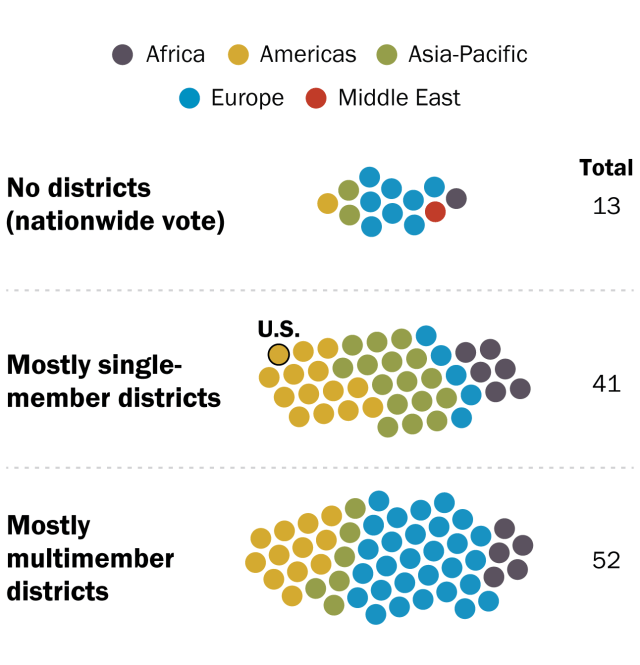
For one thing, only 40 democracies besides the U.S. elect all or even a substantial share of their lawmakers from single-member districts. Most countries – especially those that use proportional representation – rely on multimember districts or else vote nationwide. (This analysis looks at districting in the lower chamber of bicameral legislatures, like the U.S. House of Representatives, or the sole chamber in unicameral systems.)
Of the democracies that rely on single-member districts, only in the U.S. and the Federated States of Micronesia (again!) do state legislatures primarily draw the district lines. In most of the rest, the main responsibility lies with independent boundary commissions (22) or national election agencies (9).
Fifty-two countries in our dataset rely mainly on multimember districts. More than half of those (27) base those districts on existing provinces, regions or similar subdivisions. And in 13 countries, there aren’t any districts at all: The entire legislature is elected proportionally in a single, nationwide vote.
U.S. lawmakers represent more people than almost anywhere else.
Representative democracy is based on the idea that legislators represent, in some sense, the people. But how many constituents can an individual lawmaker effectively represent?
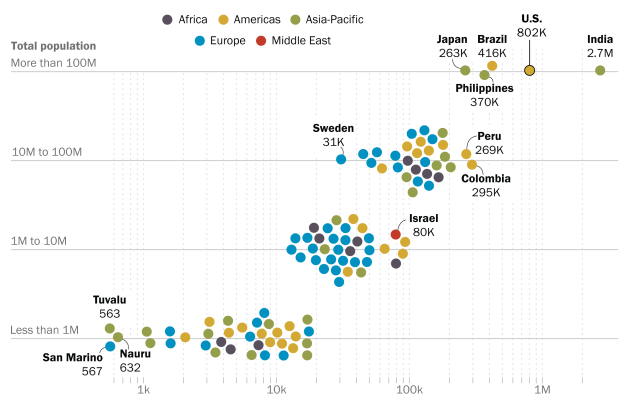
Based on United Nations population projections, each of the 435 voting members of the U.S. House of Representatives represents about 802,000 people. That’s a higher “representation ratio” than any other democracy except India, the world’s most populous country. The 543 members of the Lok Sabha, the lower house of India’s Parliament, each represent an average of 2.72 million constituents.
| Democracy | Representation ratio | Population | Region |
|---|---|---|---|
| Albania | 19650 | 2751000 | Europe |
| Andorra | 3000 | 84000 | Europe |
| Antigua and Barbuda | 5588 | 95000 | Americas |
| Argentina | 179004 | 46004000 | Americas |
| Armenia | 27393 | 2931000 | Asia-Pacific |
| Australia | 181513 | 27227000 | Asia-Pacific |
| Austria | 49765 | 9107000 | Europe |
| Bahamas | 9878 | 405000 | Americas |
| Barbados | 9433 | 283000 | Americas |
| Belgium | 78500 | 11775000 | Europe |
| Belize | 13839 | 429000 | Americas |
| Bhutan | 17064 | 802000 | Asia-Pacific |
| Bolivia | 98069 | 12749000 | Americas |
| Botswana | 40046 | 2603000 | Africa |
| Brazil | 416302 | 213563000 | Americas |
| Bulgaria | 27783 | 6668000 | Europe |
| Canada | 117983 | 40468000 | Americas |
| Cape Verde | 7361 | 530000 | Africa |
| Chile | 128684 | 19946000 | Americas |
| Colombia | 294732 | 53936000 | Americas |
| Costa Rica | 90789 | 5175000 | Americas |
| Croatia | 25311 | 3822000 | Europe |
| Cyprus | 17446 | 977000 | Asia-Pacific |
| Czech Republic | 52640 | 10528000 | Europe |
| Denmark | 33654 | 6024000 | Europe |
| Dominica | 2063 | 66000 | Americas |
| Dominican Republic | 61105 | 11610000 | Americas |
| East Timor | 22108 | 18445000 | Asia-Pacific |
| Ecuador | 122152 | 1331000 | Americas |
| Estonia | 13178 | 937000 | Europe |
| Fiji | 17036 | 5622000 | Asia-Pacific |
| Finland | 28110 | 66746000 | Europe |
| France | 115678 | 83644000 | Europe |
| Germany | 132768 | 35698000 | Europe |
| Ghana | 129341 | 9897000 | Africa |
| Greece | 32990 | 117000 | Europe |
| Grenada | 7800 | 841000 | Americas |
| Guyana | 12938 | 9586000 | Americas |
| Hungary | 48171 | 402000 | Europe |
| Iceland | 6381 | 1476626000 | Europe |
| India | 2724402 | 5357000 | Asia-Pacific |
| Ireland | 30787 | 9648000 | Europe |
| Israel | 80400 | 58926000 | Middle East |
| Italy | 147315 | 2833000 | Europe |
| Jamaica | 44968 | 122428000 | Americas |
| Japan | 263286 | 138000 | Asia-Pacific |
| Kiribati | 3067 | 1667000 | Asia-Pacific |
| Kosovo | 13892 | 1836000 | Europe |
| Latvia | 18360 | 2389000 | Europe |
| Lesotho | 19908 | 5854000 | Africa |
| Liberia | 80192 | 40000 | Africa |
| Liechtenstein | 1600 | 2797000 | Europe |
| Lithuania | 19837 | 687000 | Europe |
| Luxembourg | 11450 | 22786000 | Europe |
| Malawi | 99502 | 36385000 | Africa |
| Malaysia | 163896 | 549000 | Asia-Pacific |
| Malta | 8194 | 35000 | Europe |
| Marshall Islands | 1061 | 1265000 | Asia-Pacific |
| Mauritius | 19167 | 114000 | Africa |
| Micronesia, Federated States | 8143 | 2961000 | Asia-Pacific |
| Moldova | 29317 | 38000 | Europe |
| Monaco | 1583 | 3557000 | Europe |
| Mongolia | 28230 | 626000 | Asia-Pacific |
| Montenegro | 7728 | 3153000 | Europe |
| Namibia | 32844 | 12000 | Africa |
| Nauru | 632 | 29629000 | Asia-Pacific |
| Nepal | 107742 | 18449000 | Asia-Pacific |
| Netherlands | 122993 | 5287000 | Europe |
| New Zealand | 42984 | 1804000 | Asia-Pacific |
| North Macedonia | 15033 | 405000 | Europe |
| Northern Cyprus | 8100 | 5653000 | Asia-Pacific |
| Norway | 33450 | 18000 | Europe |
| Palau | 1125 | 4626000 | Asia-Pacific |
| Panama | 65155 | 7095000 | Americas |
| Paraguay | 88688 | 34922000 | Americas |
| Peru | 268631 | 117724000 | Americas |
| Philippines | 370201 | 37843000 | Asia-Pacific |
| Poland | 82267 | 10395000 | Europe |
| Portugal | 45196 | 18801000 | Europe |
| Romania | 56801 | 221000 | Europe |
| Samoa | 4333 | 34000 | Asia-Pacific |
| San Marino | 567 | 245000 | Europe |
| Sao Tome and Principe | 4455 | 19367000 | Africa |
| Senegal | 117376 | 135000 | Africa |
| Seychelles | 3971 | 5451000 | Africa |
| Slovakia | 36340 | 2115000 | Europe |
| Slovenia | 23500 | 858000 | Europe |
| Solomon Islands | 17160 | 65453000 | Asia-Pacific |
| South Africa | 163633 | 51600000 | Africa |
| South Korea | 172000 | 47851000 | Asia-Pacific |
| Spain | 136717 | 23348000 | Europe |
| Sri Lanka | 103769 | 47000 | Asia-Pacific |
| St. Kitts and Nevis | 3133 | 180000 | Americas |
| St. Lucia | 10588 | 99000 | Americas |
| St. Vincent and the Grenadines | 4304 | 645000 | Americas |
| Suriname | 12647 | 10701000 | Americas |
| Sweden | 30662 | 9008000 | Europe |
| Switzerland | 45040 | 23011000 | Europe |
| Taiwan | 203637 | 1437000 | Asia-Pacific |
| Tonga | 3433 | 103000 | Asia-Pacific |
| Trinidad and Tobago | 36902 | 1513000 | Americas |
| Tuvalu | 563 | 9000 | Asia-Pacific |
| United Kingdom | 107588 | 69932000 | Europe |
| United States | 802379 | 349035000 | Americas |
| Uruguay | 34172 | 3383000 | Americas |
| Vanuatu | 6596 | 343000 | Asia-Pacific |
* Population projections for the Turkish Republic of Northern Cyprus are not available from the United Nations. The projections above for Northern Cyprus and the Republic of Cyprus (the internationally recognized government that controls two-thirds of the island) were derived by splitting the projection for the entire island based on the ratio of the 2021 population estimates for the two places.
At the other extreme, the 16 members of Tuvalu’s Parliament each represent an average of just 563 people.
Up to the 1910s, the number of U.S. representatives grew steadily as the population expanded and more states joined the Union. But today’s House is the same size it was over a century ago, even though the population has more than tripled.
The median representation ratio for all 106 democracies was about 31,000 constituents per lawmaker. For the U.S. to have that representation ratio, the House would have to balloon to 11,360 members – far larger than any country’s current legislature.
In the U.S., Election Day is a regular day.
Since the mid-19th century, Tuesday has been the standard day for U.S. elections (with certain exceptions). Back when the nation was primarily rural, getting to a polling place often required long trips there and back. Sunday was out because many people were in church, and Wednesday was farmers market day. Tuesday seemed like the best fit.
| Democracy | Election day | Region |
|---|---|---|
| Albania | Saturday or Sunday | Europe |
| Andorra | Saturday or Sunday | Europe |
| Antigua and Barbuda | Ordinary weekday | Americas |
| Argentina | Saturday or Sunday | Americas |
| Armenia | Saturday or Sunday | Europe |
| Australia | Saturday or Sunday | Asia-Pacific |
| Austria | Saturday or Sunday | Europe |
| Bahamas | Ordinary weekday | Americas |
| Barbados | Ordinary weekday | Americas |
| Belgium | Saturday or Sunday | Europe |
| Belize | Ordinary weekday | Americas |
| Bhutan | Ordinary weekday | Asia-Pacific |
| Bolivia | Saturday or Sunday | Americas |
| Botswana | Weekday designated as national holiday | Africa |
| Brazil | Saturday or Sunday | Americas |
| Bulgaria | Saturday or Sunday | Europe |
| Canada | Ordinary weekday | Americas |
| Cape Verde | Saturday or Sunday | Africa |
| Chile | Saturday or Sunday | Americas |
| Colombia | Saturday or Sunday | Americas |
| Costa Rica | Saturday or Sunday | Americas |
| Croatia | Saturday or Sunday | Europe |
| Cyprus | Saturday or Sunday | Europe |
| Czech Republic* | Other | Europe |
| Denmark | Ordinary weekday | Europe |
| Dominica | Ordinary weekday | Americas |
| Dominican Republic | Saturday or Sunday | Americas |
| East Timor | Saturday or Sunday | Asia-Pacific |
| Ecuador | Saturday or Sunday | Americas |
| Estonia | Saturday or Sunday | Europe |
| Fiji | Weekday designated as national holiday | Asia-Pacific |
| Finland | Saturday or Sunday | Europe |
| France | Saturday or Sunday | Europe |
| Germany | Saturday or Sunday | Europe |
| Ghana | Saturday or Sunday | Africa |
| Greece | Saturday or Sunday | Europe |
| Grenada | Ordinary weekday | Americas |
| Guyana | Weekday designated as national holiday | Americas |
| Hungary | Saturday or Sunday | Europe |
| Iceland | Saturday or Sunday | Europe |
| India | Ordinary weekday | Asia-Pacific |
| Ireland | Ordinary weekday | Europe |
| Israel | Weekday designated as national holiday | Middle East |
| Italy | Saturday or Sunday | Europe |
| Jamaica | Ordinary weekday | Americas |
| Japan | Saturday or Sunday | Asia-Pacific |
| Kiribati | Ordinary weekday | Asia-Pacific |
| Kosovo | Saturday or Sunday | Europe |
| Latvia | Saturday or Sunday | Europe |
| Lesotho | Weekday designated as national holiday | Africa |
| Liberia | Ordinary weekday | Africa |
| Liechtenstein | Saturday or Sunday | Europe |
| Lithuania | Saturday or Sunday | Europe |
| Luxembourg | Saturday or Sunday | Europe |
| Malawi | Weekday designated as national holiday | Africa |
| Malaysia | Saturday or Sunday | Asia-Pacific |
| Malta | Saturday or Sunday | Europe |
| Marshall Islands | Ordinary weekday | Asia-Pacific |
| Mauritius | Saturday or Sunday | Africa |
| Micronesia, Federated States | Ordinary weekday | Asia-Pacific |
| Moldova | Saturday or Sunday | Europe |
| Monaco | Saturday or Sunday | Europe |
| Mongolia | Weekday designated as national holiday | Asia-Pacific |
| Montenegro | Saturday or Sunday | Europe |
| Namibia | Weekday designated as national holiday | Africa |
| Nauru | Saturday or Sunday | Asia-Pacific |
| Nepal | Weekday designated as national holiday | Asia-Pacific |
| Netherlands | Ordinary weekday | Europe |
| New Zealand | Saturday or Sunday | Asia-Pacific |
| North Macedonia | Weekday designated as national holiday | Europe |
| Northern Cyprus | Saturday or Sunday | Europe |
| Norway | Ordinary weekday | Europe |
| Palau | Ordinary weekday | Asia-Pacific |
| Panama | Saturday or Sunday | Americas |
| Paraguay | Saturday or Sunday | Americas |
| Peru | Saturday or Sunday | Americas |
| Philippines | Weekday designated as national holiday | Asia-Pacific |
| Poland | Saturday or Sunday | Europe |
| Portugal | Saturday or Sunday | Europe |
| Romania | Saturday or Sunday | Europe |
| Samoa | Weekday designated as national holiday | Asia-Pacific |
| San Marino | Saturday or Sunday | Europe |
| Sao Tome and Principe | Saturday or Sunday | Africa |
| Senegal | Saturday or Sunday | Africa |
| Seychelles | Saturday or Sunday | Africa |
| Slovakia | Saturday or Sunday | Europe |
| Slovenia | Saturday or Sunday | Europe |
| Solomon Islands | Weekday designated as national holiday | Asia-Pacific |
| South Africa | Weekday designated as national holiday | Africa |
| South Korea | Weekday designated as national holiday | Asia-Pacific |
| Spain | Saturday or Sunday | Europe |
| Sri Lanka | Ordinary weekday | Asia-Pacific |
| St. Kitts and Nevis | Ordinary weekday | Americas |
| St. Lucia | Ordinary weekday | Americas |
| St. Vincent and the Grenadines | Ordinary weekday | Americas |
| Suriname** | Other | Americas |
| Sweden | Saturday or Sunday | Europe |
| Switzerland | Saturday or Sunday | Europe |
| Taiwan | Saturday or Sunday | Asia-Pacific |
| Tonga | Ordinary weekday | Asia-Pacific |
| Trinidad and Tobago | Ordinary weekday | Americas |
| Tuvalu | Ordinary weekday | Asia-Pacific |
| United Kingdom | Ordinary weekday | Europe |
| United States | Ordinary weekday | Americas |
| Uruguay | Saturday or Sunday | Americas |
| Vanuatu | Weekday designated as national holiday | Asia-Pacific |
* The Czech Republic typically holds elections over a 24-hour period from Friday afternoon to Saturday afternoon.
** Suriname holds elections on a fixed date: May 25, which happened to fall on a Sunday in the most recent election year.
More recently, some lawmakers have proposed moving Election Day to a weekend or making it a national holiday. Supporters say the current schedule often forces people to take time off work to vote, and making Election Day a day off for everyone would boost turnout. (As of 2023, 12 states and Puerto Rico already make Election Day a paid day off for state employees; Kentucky also does so in presidential election years.)
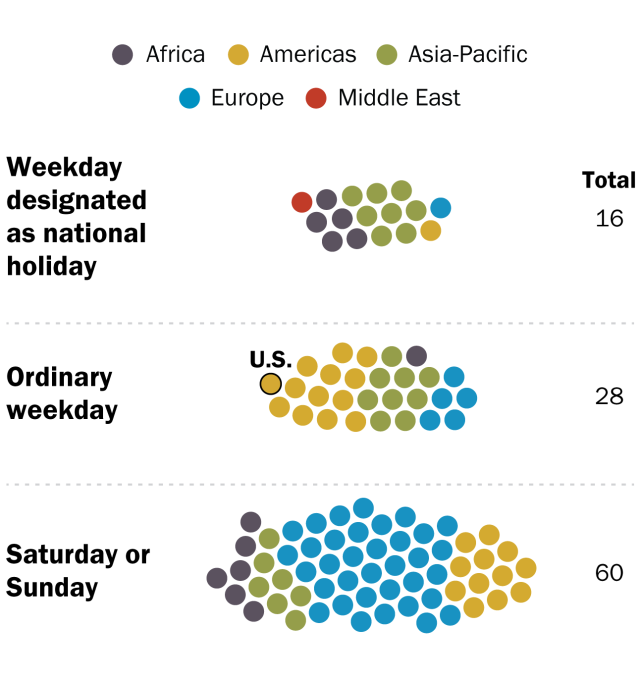
As it stands, the U.S. is one of 28 democracies that routinely holds national elections on non-holiday weekdays. By contrast, 60 countries typically hold elections on Saturdays or Sundays. (Then there’s the Czech Republic, which typically holds elections over a 24-hour period from Friday afternoon to Saturday afternoon.) Sixteen other countries hold elections on weekdays but declare them public holidays.
Some countries hold elections on a fixed date instead of a set day of the week. Suriname, for instance, has held its general election on May 25 every five years since 2000. Its most recent election, in 2025, happened to fall on a Sunday, but that was by chance rather than by deliberate choice.
The U.S. capital city doesn’t have full representation.
Washington, D.C., is the only national capital of any democracy whose residents have no voting representation in the national legislature.
The capital being a separate district isn’t unusual on its own. Nearly four dozen other democracies also give their capital cities some kind of special status. For example, they may be:
- Autonomous municipalities (such as Buenos Aires, Argentina)
- Distinct units of local government (such as Paris, France)
- The equivalent of states or provinces (such as Berlin, Germany)
- Capital districts apart from other states or provinces (such as Canberra, Australia)
But the people who live in all of those other capitals, as well as capitals that lack any special status, get to elect lawmakers just like people in the rest of their country. Not so for the 694,000 residents of D.C., whose lone delegate to Congress can participate in committees but has no vote on the House floor.
Granting D.C. voting representation would require either making it a state or changing the Constitution. A proposed amendment that would have given D.C. two senators and a representative failed in the 1980s. The only other country whose capital elects no lawmakers is Palau, but there’s a good reason for that: Ngerulmud, the island nation’s capital area, has no resident population, just a cluster of government office buildings.
The U.S. has the strictest limit on its national debt – on paper, at least.
It’s common for countries to try to limit how much debt they (and sometimes their local governments) can take on. Two-thirds of the 106 democracies (70) have some sort of debt limit, though some are more aspirations or goals rather than hard caps. (This figure includes all 27 members of the European Union, which are bound by the EU’s Stability and Growth Pact even in the absence of any domestic debt limit.)
Most of those 70 countries define their limits, in laws or formal policy documents, as a percentage of gross domestic product (GDP). Defining the debt limit this way allows it to grow with the economy.
In contrast, the United States and Denmark legally define their limits in absolute terms. And Denmark’s limit – 2 trillion kroner, or about $309.4 billion – is so far above its actual debt that it’s largely irrelevant.
The U.S. debt limit is much more rigid and often affects how its democracy functions. The debt limit is currently $41.1 trillion, but large and persistent budget deficits require the country to borrow more each year. That means Congress has to raise the debt limit every so often, which makes it a political issue.
For decades, increasing the debt limit was fairly routine, but in recent years both Republican and Democratic lawmakers have held up the process to try to win policy concessions. That has led to repeated clashes between Congress and the White House, contributed to government shutdowns, and brought the country close enough to defaulting on its national debt to unnerve the investors and financial markets its economy depends on.
Congress could by law change the debt limit to a percentage formula or eliminate it entirely. But no matter which party controls the legislature, it has shown little interest in giving up what many see as key leverage over the executive branch.