Trump’s job approval rating is low by historical standards
Trump’s job approval sits at 34%, lower than most recent presidents at comparable points, with a partisan gap of 78 percentage points.
Numbers, Facts and Trends Shaping Your World
Read our research on:

All
Publications
Trump’s job approval sits at 34%, lower than most recent presidents at comparable points, with a partisan gap of 78 percentage points.
Half of Americans currently hold an unfavorable opinion of the Supreme Court, while roughly as many view the court favorably.
A majority of Americans (56%) say the overall level of ethics and honesty in the federal government has fallen over the course of Trump’s term.
In the 10 years that we have asked this question, Americans overall have consistently been more likely to say their side is losing than to say it’s winning.
Republicans and Democrats tend to highlight different sources of pride – a partisan divide that is not as pronounced in most other countries.
Frustration is common across the political spectrum regardless of which party holds the presidency.
Democrats’ frustration with their own party is up sharply, as many say it hasn’t pushed back hard enough against Trump and the GOP. In contrast, 40% of Republicans say they are frustrated with their party.
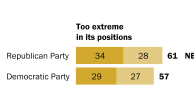
Just over half of Americans see left-wing (53%) and right-wing (52%) extremism as major problems.
Nearly three-in-four U.S. adults (74%) say economic conditions are only fair or poor, up slightly from 72% in January 2024.
The U.S. Postal Service, Park Service, Weather Service and NASA are viewed favorably by Republicans and Democrats, while views of ICE are deeply polarized.