

In 2020, most people in North America were Christians (63%). But we project that by 2070, Christians will decline to 46% of the population. And although Christianity will remain the region’s most common religion, growth in the religiously unaffiliated population – from 30% of all North Americans in 2020 to a projected 41% in 2070 – will narrow the gap considerably.
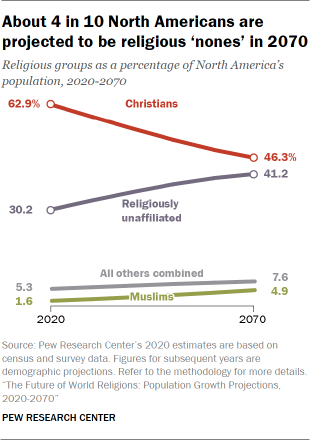
These projections for religion in North America, which includes the United States and Canada, come from Pew Research Center’s broader study of the future of religion around the world.88
We expect North America’s Christian population to decrease in absolute numbers from 238 million in 2020 to 188 million in 2070. Over the same period, the number of religiously unaffiliated people is projected to rise from 114 million to 167 million.
(The religiously unaffiliated – also called religious “nones” – do not identify with any religion. Their population includes people who identify as atheist or agnostic.)
In 2020, no other religious group in North America made up more than 2% of the population. But if recent trends continue, by 2070 North America will be home to about 20 million Muslims, representing nearly 5% of the region’s population, as well as about 9 million Hindus, making up roughly 2% of the population.
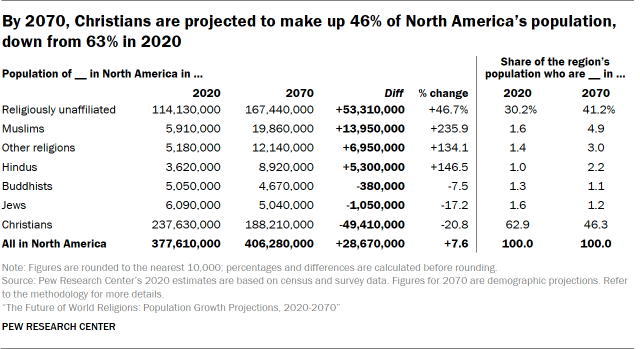
The region’s populations of Jews and Buddhists appear to be headed in the other direction. People who identify as Jewish by religion are projected to go from 1.6% of the population in 2020 to 1.2% in 2070, while Buddhists will go from 1.3% to 1.1%.89
People who identify with all other religions – an umbrella category that includes followers of Native American/Indigenous religious traditions as well as Sikhs, Baha’is, Wiccans and many other religious groups – are expected to more than double in number to about 12 million, or 3% of all North Americans.
The broader Center study examines how the size of seven religious groups will change globally between 2020 and 2070 if recent demographic trends continue. Our projections take into account the differences between religious groups’ age profiles, fertility rates, and patterns of religious switching and migration. (Religious switching and migration are assumed to continue at the same levels that have been recently observed.) We also incorporate mortality rates, applying the same rate to each religious group within a country. Read the methodology for more details about these projections and their limitations.
Overall, the population of North America is expected to grow about 8% over this time period, from 378 million in 2020 to 406 million in 2070. In absolute numbers, that’s an increase of 28.7 million people. By itself, net migration is projected to add 52 million people to the region’s population by 2070, but the long-term effects of low fertility rates and high median ages will subtract 23 million people from the projected size of North America’s population.
We also project that by 2070:
- Christians will fall by at least 5 percentage points as a share of the total populations in both the U.S. and Canada.
- Religiously unaffiliated people will rise by at least 5 points as a share of inhabitants in both countries. The Muslim population also will rise by that amount in Canada.
- By 2070, neither Canada nor the United States will have a majority religion. Christians will still be the largest group among people who identify with a religion, but they will no longer constitute a majority of residents in either country.
Read more about:
- North American countries where religious populations are expected to change the most
- North American countries where the religious majority is expected to change
- Key factors driving religious changes in North America
North American countries where religious populations are expected to change the most
This section looks at countries in North America where religious groups are projected to rise or fall substantially (by at least 5 percentage points) as a share of the overall population between 2020 and 2070.
Changes in Christian populations
In the United States, Christians are expected to go from nearly two-thirds of the population (64%) to a little less than half (48%), a drop of 16 percentage points.
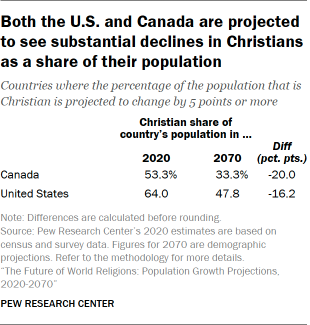
Meanwhile, in Canada, Christians are expected to go from a little over half the population (53%) in 2020 to about one-third in 2070, a drop of 20 points.
Changes in Muslim populations
In Canada, the percentage of Muslims in the overall population is expected to rise by 11 points. In 2020, 5% of Canada’s population was Muslim. In 2070, Muslims are projected to make up 16% of the country’s residents.
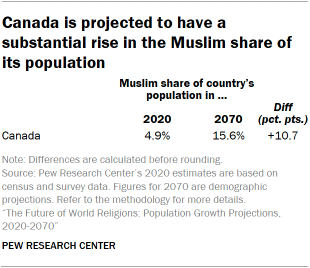
(In the U.S., the share of the population that is Muslim also is expected to increase. Muslims are projected to go from 1.2% of U.S. residents in 2020 to 3.7% in 2070.)
Changes in the population of religious ‘nones’
The religiously unaffiliated population is expected to rise substantially in both Canada and the U.S.
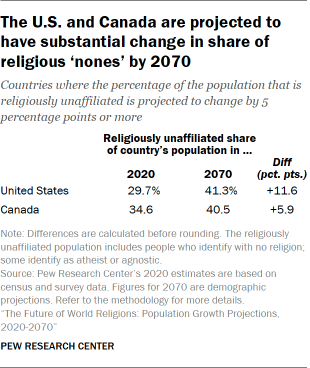
By 2070, “nones” are projected to make up approximately 41% of residents in each country, up from 35% of Canadians and 30% of Americans in 2020.
Refer to our sortable table to see how religious populations in both countries in North America are projected to change over time.
North American countries where the religious majority is expected to change
In 2020, most people in both the United States and Canada were Christians, but we project that neither country will have a Christian majority in 2070. This is due mainly to an expected decline of Christians and a concurrent rise of religious “nones” in the populations of both countries.
In the U.S., Christians will stop being a religious majority by 2065, according to our projections. In Canada, Christians are expected to drop below 50% of the population much sooner, by 2030.
Christians will remain the largest religious group in the U.S., while religious “nones” will outnumber Christians in Canada in 2070.
Refer to Pew Research Center’s broader study of the future of religion around the world for a global look at countries where the religious majority is expected to change.
Key factors driving religious change in North America
Several dynamics determine whether a religious group grows or shrinks in size. Demographic factors – such as age structure, fertility and mortality – shape populations through births and deaths. International migration also plays a role, as does “religious switching,” or people moving into and out of religious groups (including disaffiliation from religion altogether).
North America’s Christian, Jewish and Buddhist populations are expected to decline between 2020 and 2070 due to a combination of low fertility rates and relatively high median ages. These factors are expected to result in more deaths than births in coming decades, a situation demographers call “natural decrease.”
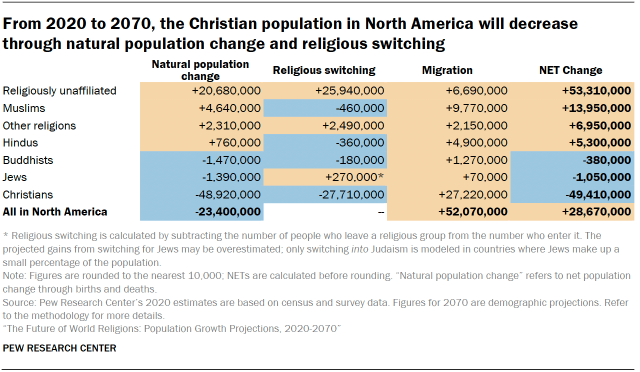
Natural decrease is projected to be responsible for a loss of about 49 million Christians between 2020 and 2070. The other two factors we analyze – migration and religious switching – are expected to come very close to canceling each other out among Christians in North America. If recent trends continue, religious switching will reduce the region’s Christian population by about 28 million people by 2070 (with most of the former Christians becoming religious “nones”), but this drop will be almost completely offset by net migration (the number of immigrants minus the number of emigrants), which will add 27 million Christians in North America by 2070.
Accounting for all these factors, the regional population of Christians is projected to decline by about 49 million, so that there will be 188 million Christians in North America in 2070. Christians will then make up 46% of the region’s population.
Religious “nones,” by contrast, are expected to be bolstered by all three of these factors, which will collectively add 53 million people to their population. If recent trends continue, there will be 167 million “nones” in North America in 2070, making up 41% of the regional population.
And while religious switching will reduce the Muslim population in North America by about 460,000 people by 2070, migration will add 9.8 million, and natural population change will produce an additional 4.6 million. The net increase of 14 million will bring North America’s Muslim population to 20 million, about 5% of the region’s overall population.
Hindus are also projected to see net growth in North America, mainly because of migration. The Jewish and Buddhist populations are expected to decline, mostly because of natural decrease (more deaths than births).
Natural population growth
Fertility
In our projections, we assume that children will inherit their mother’s religion. All else being equal, religions in which women have higher total fertility rates will experience more population growth.
The total fertility rate is the average number of children a hypothetical woman would have over her lifetime if she experienced the birth rates that were estimated for women of reproductive age during a particular period, such as 2020 to 2025. To maintain its size from generation to generation, a group typically needs a total fertility rate of 2.1 children per woman (the “replacement level”) in countries with low mortality rates for infants and children, independent of other factors like migration and religious switching.90
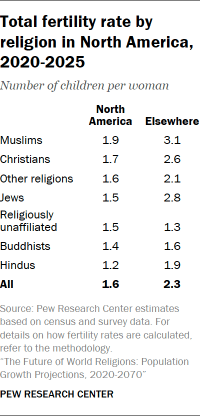
Muslims (1.9) have the highest total fertility rate of any religious group in North America, followed by Christians (1.7).
North American women have lower fertility rates than women elsewhere in the world (1.6 vs. 2.3). This is true for most religious groups in the region. For example, the total fertility rate among Muslims in North America is 1.9 children per woman, compared with 3.1 among Muslims living elsewhere.
These fertility rates are estimates for the 2020-2025 period.
Age structure
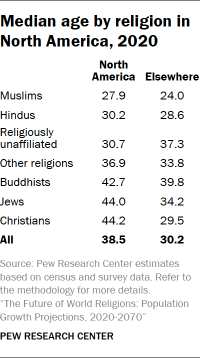
The age structures of religious groups in 2020 also factor into the projections. Among Muslims in North America, the median age is 28, the youngest of any major religious groups in the region.
Christians (44) and Jews (44), meanwhile, have the highest median ages of all North American religious groups. This is one reason why their populations are projected to decline by 2070.
Religious switching
Many people in North America have been leaving their childhood religions, in most cases becoming unaffiliated. This is the main reason that religious “nones” are projected to rise from 30% of the population in 2020 to 41% in 2070.
Without this religious switching – that is, in a hypothetical projection scenario where switching stopped entirely in 2020 – we estimate that the share of “nones” in North America would rise just 1 percentage point (from 30% to 31% of the population) rather than 11 points (from 30% to 41%).
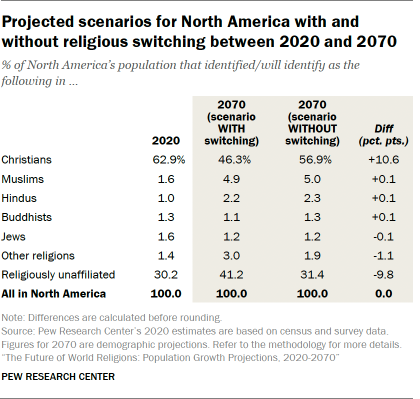
Religious switching also plays an important role in the expected decline of the Christian share of North America’s population, from 63% in 2020 to 46% in 2070. Without religious switching, the Christian population still would decrease – but less so, to 57%. (We acknowledge that this alternative scenario, in which there is no religious switching between 2020 and 2070, is unrealistic. The point of the scenario is to isolate the effect of religious switching on the projections, not to suggest that all switching will end.)
Both Canada and the United States would have more Christians in 2070 if there were no religious switching. For example, in Canada, without religious switching, the Christian percentage of the national population would drop 9 percentage points to 44% in 2070. With religious switching, we expect the Christian percentage to drop an additional 11 points, to 33%. In the U.S., the Christian share of the national population would decline 6 points to 58% without switching. With religious switching, we expect the Christian share to drop another 10 points, to 48%.
Meanwhile, our main projection is for religious “nones” to make up a nearly identical 41% of the populations in both countries in 2070 (up from 30% in the U.S. and 35% in Canada in 2020). Hypothetically, if all switching stopped, “nones” would make up 32% of the U.S. population and 30% of the Canadian population in 2070.
For more details, read “Key Factors Shaping the Global Future of Religions” in the broader study.
Migration
Continuing migration to North America is an important factor in the projected rise of Muslims from 1.6% of the region’s population in 2020 to 4.9% in 2070.
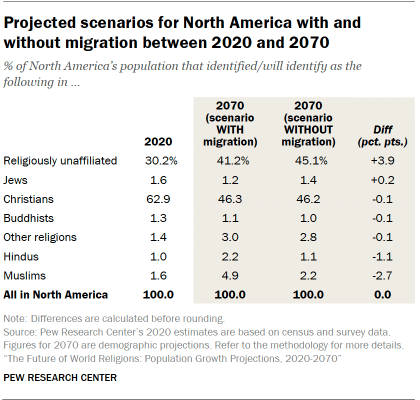
In a hypothetical scenario, if we were to remove all migration from the equation, the share of Muslims in North America would still rise – mainly due to natural population change – but only to 2.2% by 2070. The Muslim share in Canada would rise from 4.9% in 2020 to 8.4% in 2070 without migration, rather than to the 16% we project if migration continues. And in the U.S., the percentage of people who are Muslim would rise from 1.2% in 2020 to 1.6% in 2070 without migration, rather than to 3.7% if migration continues at recent rates.
(Again, we acknowledge that an alternative scenario with no migration between 2020 and 2070 is unrealistic. The point of it is to isolate migration’s effect on the projections, not to suggest all migration will end.)
The size of the region’s Hindu population also depends in large part on migration. In a hypothetical scenario involving no migration from 2020 to 2070, the number of Hindus in North America would grow modestly, remaining close to 1% of the region’s total population throughout the period from 2020 to 2070. With ongoing migration, the Hindu share of North America’s population would more than double, from 1.0% to 2.2%.
For more details, read “Key Factors Shaping the Global Future of Religions” in the broader study.


