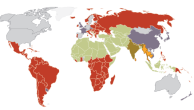
The Future of World Religions: Population Growth Projections, 2020-2070
Our projections detail why Muslims will soon become the world’s largest religious group and Christians will be the second largest.
Numbers, Facts and Trends Shaping Your World
Read our research on:

This dataset describes the number of people of all ages who identify with seven religious groups – Christians, Muslims, Hindus, Buddhists, Jews, followers of all other religions and religiously unaffiliated people – in each decade from 2010 to 2070. Followers of other religions include Baha’is, Daoists (or Taoists), Jains, Shintoists, Sikhs, Wiccans, Zoroastrians and many small groups, some of which can be described as folk or traditional religions. Religiously unaffiliated people – sometimes called religious “nones” – are those who do not identify with any religion.
Our study covers 201 countries and territories that had populations of at least 100,000 people in either 2010 or 2020. These places collectively account for 99.98% of the world’s population.
Figures for 2010 and 2020 are estimates based on national censuses and surveys. Numbers for subsequent years are demographic projections.
Our projections use baseline estimates of the size and age distribution of each religious group in 2020. We incorporated data on differences in fertility rates between religious groups and on past patterns of movement into and out of each group, known as “religious switching.” Our projections also drew on data from the United Nations’ 2024 revision of its World Population Prospects, global migration flow estimates from University of Hong Kong professor Guy Abel, and the Center’s previous research on the religious composition of the world’s migrants.
Our projection model was developed in collaboration with researchers in the Center for Advanced Studies of Population and Religion (CASPAR) at Krakow University of Economics.
In most countries and territories, it is not possible to precisely measure the number of people who identify with each religion. For reporting purposes, please use the figures in the rounded counts worksheet. For example, since the rounded count worksheet lists “<10,000” for values below 10,000, please report our estimates for these small populations as “less than 10,000.”
This work was produced by Pew Research Center as part of the Pew-Templeton Global Religious Futures project, which analyzes religious change and its impact on societies around the world. Funding for the Global Religious Futures project comes from The Pew Charitable Trusts and the John Templeton Foundation.
Read more about our projections methodology: https://www.pewresearch.org/religion/2026/11/18/methodology-future-of-world-religions/.
Download the R package used to produce the projections results: https://github.com/CASPAR-PL/measuringreligiouschange.
Hackett, Conrad, Marcin Stonawski, Yunping Tong and Stephanie Kramer. 2026. “Global Religious Futures Dataset: Estimates and Projections for 2010-2070.” Pew Research Center. doi: 10.58094/z4ze-b987.
Our projections detail why Muslims will soon become the world’s largest religious group and Christians will be the second largest.
This content requires a Pew Research Center account.