

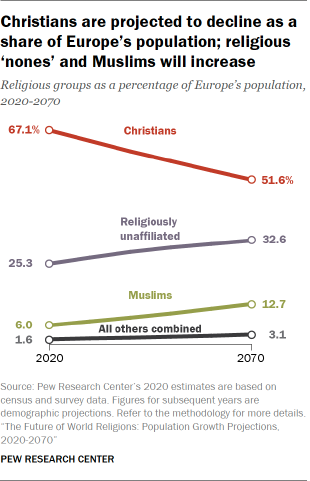
Europe has long had a Christian majority. In 2020, 67% of Europeans were Christians. But if recent demographic trends continue, the Christian proportion of Europe’s overall population will shrink to 52% by 2070, due primarily to low fertility rates, high median ages and religious switching (mostly by people leaving Christianity).
Migration is expected to increase the number of Christians in Europe, but not by enough to offset the losses of an aging population with a low birth rate.
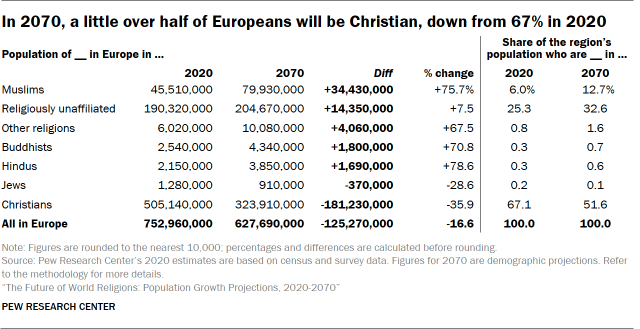
These projections are part of a broader Pew Research Center study on the future of religion around the world. The study anticipates that Europe’s Christian population will decrease by more than a third in absolute numbers in coming decades, from 505 million in 2020 to 324 million in 2070.
In 2070, the second-largest religious category in Europe will continue to be religiously unaffiliated people, also called religious “nones.” These are people who say they have “no religion” in surveys and censuses, some of whom are atheists and agnostics.
“Nones” are projected to grow from a quarter of Europe’s population in 2020 to about a third in 2070, with most of the increase coming from people who were raised as Christians but no longer identify as having any religion.
Meanwhile, Muslims are expected to rise from 6% of the European population in 2020 to 13% in 2070. Though outnumbered by religious “nones,” Muslims will continue to be the second-largest category among Europeans who identify with a religion, rising from 46 million to 80 million people.
Europe’s Jewish population is expected to decline in size, while we project some growth in numbers of Hindus and Buddhists, though each of these groups is expected to remain under 1% of the continent’s overall population in 2070.
Over the same period, followers of all other religions – an umbrella category that includes Sikhs, Baha’is and followers of many other faiths – are anticipated to grow from 0.8% to 1.6% of Europe’s population.
Not all countries will be equally affected by these trends. The religious makeup of some European countries may change relatively little. For example, we project that at least 90% of the population of four countries in Central and Eastern Europe – Moldova, Romania, Croatia and Serbia – will remain Christian from 2020 through 2070.77
The broader Center study examines how the size of seven religious groups will change globally between 2020 and 2070 if recent demographic trends continue. Our projections take into account the differences between religious groups’ age profiles, fertility rates, and patterns of religious switching and migration. (Religious switching and migration are assumed to continue at the same levels that have been recently observed.) We also incorporate mortality rates, applying the same rate to each religious group within a country. Read the methodology for more details about these projections and their limitations.
By 2070, we also project:
- In Europe, Christians will decline by at least 5 percentage points as a share of the population in 30 countries, while the Muslim share of the population will rise by 5 points or more in 21 countries.
- The religiously unaffiliated share of the population will rise by at least 5 points in 19 European countries.
- Eight European countries will either lose their previous religious majority or have a new one.
Due to lower fertility rates and an older population than other regions, Europe is the only major region in the world that we project will have a smaller total population in 2070 than it did in 2020. We anticipate a 17% drop in Europe’s population during this 50-year period, from 753 million in 2020 to 628 million in 2070.
Read more about:
- European countries where religious populations are expected to change the most
- European countries where the religious majority is expected to change
- Key factors driving religious change in Europe
European countries where religious populations are expected to change the most
This section looks at countries in Europe where various religious groups are projected to rise or fall substantially (by at least 5 percentage points) as a share of the overall population between 2020 and 2070.
Changes in Christian populations
There are 30 European countries where we expect the share of Christians in the overall population to drop substantially by 2070. In no European country is the percentage of people who are Christians expected to rise by 5 points or more.
The declines will be mostly concentrated in Western European countries. For example, in Spain, the Christian share will drop 28 percentage points to 41%, and in France, it will fall 22 points to 25%, according to the projections.
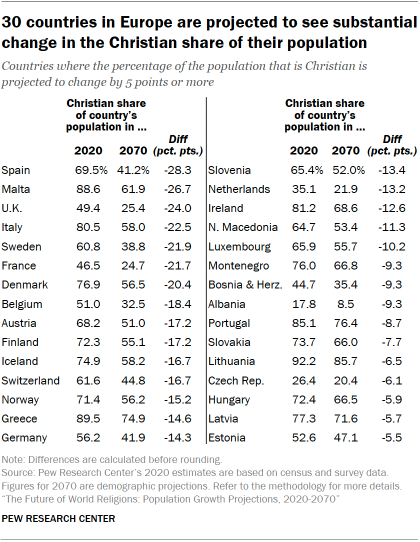
The Central and Eastern European countries with large projected declines include Greece, where the Christian share of the population will drop 15 percentage points to 75%, and Austria, where it will drop 17 points to 51%, if recent trends continue.
There are 20 European countries where Christians are expected to decline by at least 10 points as a share of the national population.
Changes in populations of religious ‘nones’
In 22 European countries, the percentage of the population that is religiously unaffiliated – which includes atheists, agnostics and other people who say in surveys and censuses that they have “no religion” – is projected to rise (19 countries) or fall (three countries) by at least 5 percentage points. Religiously unaffiliated people are also known as religious “nones.”
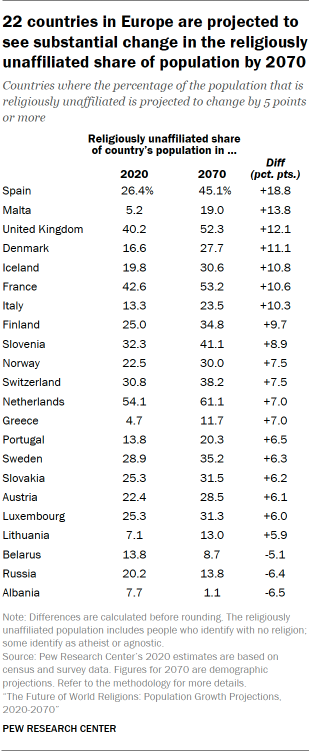
The three countries where “nones” are expected to grow the most as a share of the overall population are the same countries where the Christian share of the population is projected to decline the most: Spain, Malta and the United Kingdom.
For example, in the U.K., “nones” are expected to rise by 12 percentage points to 52% of the population, the third-highest increase in any European country. Meanwhile, the Christian share of the British population is expected to decline by 24 points to 25%, the third-largest decrease in any European country.
The three European countries where “nones” are projected to decrease as a share of the population are Albania, Russia and Belarus.
Changes in Muslim populations
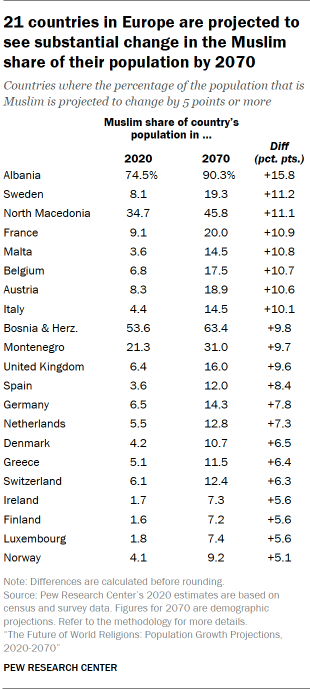
In 21 European countries, Muslims are expected to increase as a share of the national population by at least 5 percentage points. And in 13 countries, Muslims are projected to rise from single-digit to double-digit percentages of all inhabitants (i.e., to more than 10%). For example:
- In France, where Muslims made up an estimated 9% of the population in 2020, we project they will make up 20% in 2070.
- In Germany, Muslims are projected to go from 7% of the population to 14% during the same time span.
Muslims are expected to rise by at least 10 percentage points as a share of the population in eight European countries.
Refer to our sortable table to see how religious populations in 42 countries in Europe are projected to change over time.
European countries where the religious majority is expected to change
If recent trends continue, six European countries that had a Christian majority in 2020 will no longer have one by 2070, while religiously unaffiliated people will become a majority in two countries. For example:
- In Germany, the Christian share of the population will decrease from 56% in 2020 to 42% in 2070.
- In Spain, the Christian share will drop from nearly 70% in 2020 to 41% in 2070.
- In Sweden, the Christian share will drop from 61% to 39%.
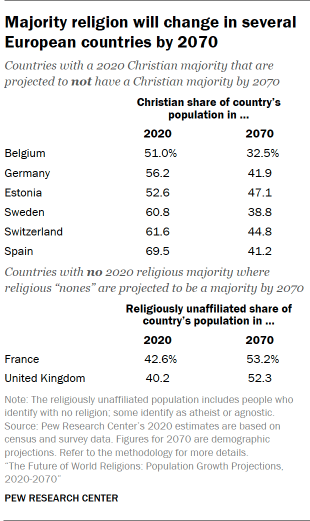
In these countries, the percentage of religious “nones” generally will rise, but not to a majority level. In Sweden, Germany and Spain, for example, “nones” will reach 35%, 40% and 45% of the country’s overall population, respectively.
The situation will be different in France and the U.K. Neither of these countries had a majority religion in 2020. (Christians had already declined to less than 50% of each population.) By 2070, however, religious “nones” are expected to become slim majorities in these countries (53% in France, 52% in the U.K.).
Refer to Pew Research Center’s broader study of the future of religion around the world for a global look at countries where the religious majority is expected to change.
Key factors driving religious change in Europe
Several dynamics determine whether a religious group grows or shrinks in size. Demographic factors – such as age structure, fertility and mortality – shape populations through births and deaths. International migration also plays a role, as does “religious switching,” or people moving into and out of religious groups (including disaffiliation from religion altogether).
The main reason we expect Europe’s Christian and Jewish populations to decline from 2020 to 2070 is that they are aging populations with relatively low fertility rates. When the number of deaths exceeds the number of births in a population, demographers call it “natural decrease.” In Europe, natural decrease is projected to be responsible for a decline of 160 million Christians and about 440,000 Jews between 2020 and 2070.
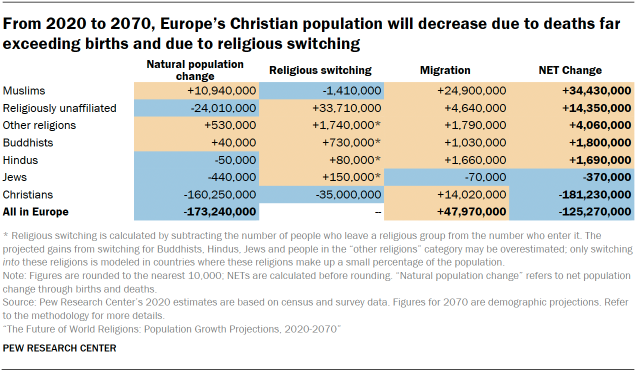
Moreover, Europe’s Christian population is expected to lose an additional 35 million people by 2070 due to religious switching, with most former Christians becoming “nones.” Migration to Europe will partially offset those declines by adding a net 14 million Christians to Europe’s population. Taking into account all these factors – natural decrease, religious switching and migration – the number of European Christians is projected to decline by 181 million from 2020 to 2070, while the number of European Jews is projected to decline by 370,000.
Muslims, by contrast, are expected to increase both in absolute numbers and as a share of Europe’s population, mainly because of migration from outside Europe but also because of natural increase. Like Christians, Muslims are projected to lose more people than they gain through religious switching in Europe, especially in Sweden and France.
Natural population growth
Fertility
In our projections, we assume that children will inherit their mother’s religion. All else being equal, religions in which women have higher total fertility rates will experience more population growth.
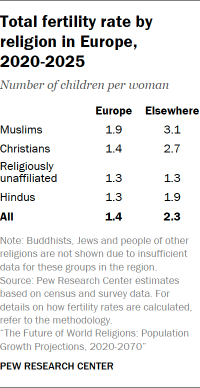
The total fertility rate is the average number of children a hypothetical woman would have over her lifetime if she experienced the birth rates that were estimated for women of reproductive age during a particular period, such as 2020 to 2025. To maintain its size from generation to generation, a population typically needs a total fertility rate of 2.1 children per woman (the “replacement level”) in countries with low mortality rates for infants and children, independent of other factors like migration and religious switching.78
All religious groups in Europe currently have fertility rates below the replacement level. However, Muslims have the highest rate of any religious group in Europe, at 1.9 children per woman. Fertility is lower among European Christians (1.4), religiously unaffiliated people (1.3) and Hindus (1.3). All these rates are estimates for the 2020-2025 period.
The average woman in Europe has nearly a full child less than the average non-European woman (1.4 vs. 2.3). And the fertility rates for most of the individual religious groups we measure are lower in Europe than they are for the same religious groups elsewhere in the world. This is a major reason why Europe’s total population is expected to decline by 2070.
Age patterns
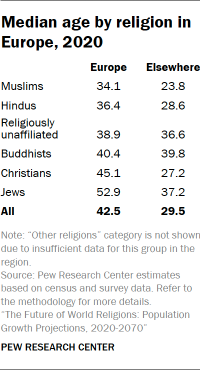
The age structures of religious groups in 2020 also factor into the projections. The median age of Muslims in Europe is 34, the youngest of any religious group in the region.
The European religious groups with the highest median ages are Jews (53) and Christians (45).
Religious switching
In Europe, many people are expected to leave their childhood religion. Religious switching is the main reason why religious “nones” are projected to rise from 25% of Europe’s population in 2020 to 33% in 2070, if recent trends continue.
Indeed, without “religious switching” – that is, in a hypothetical scenario where we remove it from the equation – we estimate that the share of “nones” in Europe would remain roughly the same in 2070 as it was in 2020 (25%).
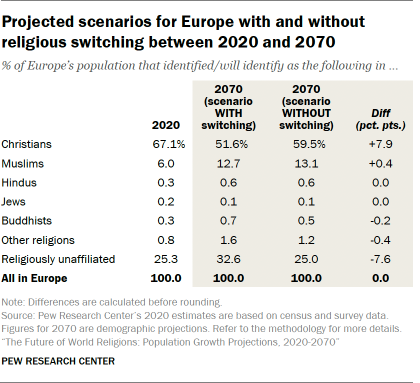
Without religious switching, Europe’s Christian population still would decrease, but somewhat less – dropping to 60% in 2070 without switching, rather than to 52% with switching. (We acknowledge that a halt to religious switching is unrealistic. The point of this alternative scenario is to isolate the impact of religious switching on the projections.)
Switching affects the future Christian population in Spain more than in any other European country. In 2020, Christians made up 69% of Spain’s population. If religious switching continues to occur at its existing rate, Christians are projected to decrease to 41% of Spain’s population by 2070. Hypothetically, if all switching stopped in 2020, 60% of Spain’s population would be Christian in 2070.
For more details, read “Key Factors Shaping the Global Future of Religions” in the broader study.
Migration
Migration is an important factor in the projected rise of Muslims from 6% of Europe’s population in 2020 to 13% in 2070.
In a hypothetical scenario in which we imagine no further migration either into or out of Europe from 2020 to 2070, the share of Muslims in Europe’s overall population would still rise over the coming decades, due to their low median age and their fertility rates, which are higher than the rates for other religious groups in Europe. But instead of 13%, Muslims would make up 9% of Europe’s projected population in 2070.
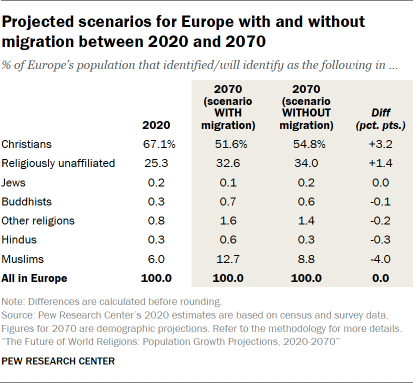
Assuming no migration between 2020 and 2070 would erase projected population gains for Hindus, who made up 0.3% of the European population in 2020 and are projected to double to 0.6%, largely because of immigration. In an imaginary situation in which all migration stopped in 2020, Hindus would remain 0.3% of the European population through 2070.79
Refer to the methodology to learn how these new projections vary from ones we made a decade ago.


