

In 2020, the Asia-Pacific region had more people than any other part of the world − about 4.5 billion, more than half of the global population.
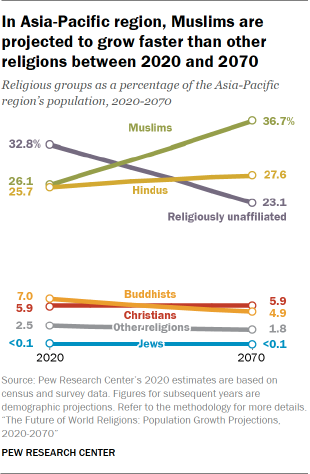
The largest religious category in this region is made up of people who don’t identify with any religion. Religiously unaffiliated people – sometimes called religious “nones” because they answer questions in censuses and surveys by saying they have no religion – make up about one-third of the Asia-Pacific population.
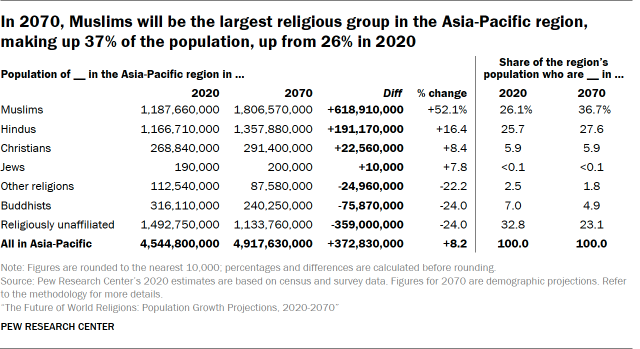
Religious “nones” across the region are expected to have many more deaths than births in the decades ahead. Consequently, their population will decrease from 1.5 billion to 1.1 billion from 2020 to 2070, according to Pew Research Center’s projections.
Most of the world’s “nones” live in China, and that country’s overall decline in population is a key reason why we project a global decrease in “nones.” The number of religiously unaffiliated people in China is expected to decrease from 1.3 billion in 2020 to 900 million in 2070.
By 2040, Muslims are expected to surpass religiously unaffiliated people to become the largest group in the region. The Muslim population will increase to 1.8 billion in 2070, up about 619 million in 50 years. The region includes countries with four of the five largest Muslim populations in the world: Pakistan, India, Indonesia and Bangladesh.
Hindus in the Asia-Pacific region will grow steadily to reach a population of nearly 1.4 billion in 2070, up 191 million since 2020. This will make Hinduism the region’s second-largest religion, after Islam. The region is home to the world’s only Hindu-majority countries, India and Nepal.
Like “nones,” Buddhists in Asia and the Pacific also are projected to decrease in population, dropping by about 76 million from an estimated 316 million in 2020 to 240 million in 2070. The region’s Christian population, on the other hand, is expected to rise by 23 million to reach 291 million in 2070, surpassing Buddhists to become the region’s fourth-largest religious group.
These findings are part of a broader Pew Research Center study examining how the size of seven religious groups will change globally between 2020 and 2070 if recent demographic trends continue. Our projections take into account the differences between religious groups’ age profiles, fertility rates, and patterns of religious switching and migration. (Religious switching and migration are assumed to continue at the same levels that have been recently observed.) We also incorporate mortality rates, applying the same rate to each religious group within a country. Read the methodology for more details about these projections and their limitations.
The Asia-Pacific region is the historic birthplace of many religions, including Hinduism, Buddhism and a variety of groups that are in our study’s other religions category, including Daoism (also spelled Taoism), Shintoism, Jainism, Sikhism, Zoroastrianism and many other faiths, some of which may be described as folk or traditional religions.
The region has remained the center of gravity for these religions’ populations throughout their histories, and that will still be the case in 2070, when most Hindus (99%) and Buddhists (96%) and nearly half (47%) of all people around the world who follow other religions will live in Asia and the Pacific.72
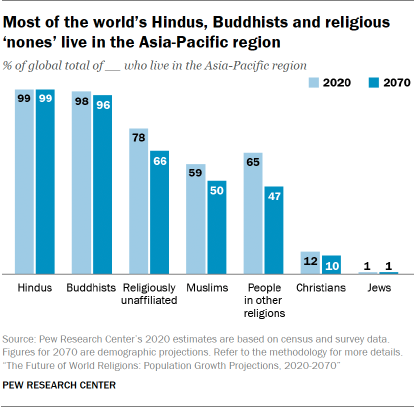
The region will also remain home to most of the world’s religious “nones” (66%) and about half of the world’s Muslims, according to the projections.
(The “other religions” category does not include Christians or Jews, who are measured separately. Jews make up only a very small fraction of the region’s population, and the Jewish population there is not projected to change appreciably between 2020 and 2070.)
The overall population in the Asia-Pacific region is expected to rise 8% between 2020 and 2070.73 Within the region, some countries’ populations are expected to increase because births will exceed deaths, while in other countries the opposite pattern (more deaths than births) will lead to shrinking populations.
For example, in East Asian nations such as China, Japan and South Korea, where “nones” are the largest religious group, the total populations are projected to decline by more than a quarter between 2020 and 2070. On the other hand, in Pakistan, Indonesia and India, which have large Muslim populations, the overall populations are expected to increase substantially (especially in Pakistan, whose population is projected to double).
Here are some other key projections:
- In India, Hindus will decline from 79% of the national population to 76%, while the percentage of Indians who are Muslim will rise from 15% to 20%, mostly because Muslims are younger and have more children than Hindus.74
- In Australia, religious “nones” will replace Christians as the largest religious group in the country. “Nones” are projected to rise from 42% of the population to 47%, while Christians are expected to decline from 47% to 29%.
- In Laos, people in the “other religions” category will make up about half the population (up from 34%), supplanting Buddhists as the country’s largest religious group. Buddhists will drop from 64% to 49% of the population.
Prior research suggests that many people who say in surveys and censuses that they have “no religion” do not mean they have no religious or spiritual beliefs and practices. For example, in China, the percentage of people saying they have “no religion” is much higher than the share who reject belief in any gods or say they never engage in spiritual activities. For more about the beliefs and practices of “nones,” refer to the chapter on nonreligion in our 2023 report “Measuring Religion in China” and go to our 2024 report “Religion and Spirituality in East Asian Societies” or our 2025 report “Many Religious ‘Nones’ Around the World Hold Spiritual Beliefs.”
In this study, you can read more about:
- Asia-Pacific countries where religious populations are expected to change the most
- Asia-Pacific countries where the religious majority is expected to change
- Key factors driving religious change in the Asia-Pacific region
Asia-Pacific countries where religious populations are expected to change the most
This section looks at countries in the Asia-Pacific region where various religious groups are projected to rise or fall substantially (by at least 5 percentage points) as a share of the national population between 2020 and 2070.
Changes in Buddhist populations
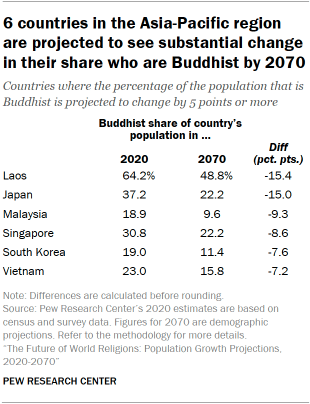
There are six Asia-Pacific countries (four in Southeast Asia and two in East Asia) where Buddhists are expected to decline substantially as a proportion of the overall population. The Buddhist share of the population is not expected to rise substantially in any Asia-Pacific countries.
The biggest projected decreases are in Laos and Japan, where 15-point drops would bring Buddhists down to 49% and 22% of those countries’ total populations, respectively.
Changes in Christian populations
Five countries (three in the South Pacific, one in Central Asia and one in East Asia) will see Christians drop, as a share of the overall population, by at least 5 percentage points between 2020 and 2070.
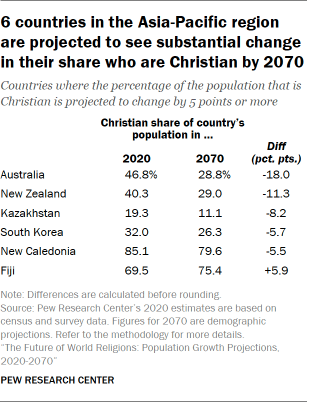
The biggest decreases will be in Australia (where Christians are projected to make up 29% of the population in 2070, down 18 points from 2020) and New Zealand (where Christians will also be at 29%, down 11 points from 2020). In Australia, Christians were the largest religious group in 2020; if current trends continue, the largest religious category in 2070 will be religious “nones,” accounting for 47% of all Australians.
One country is expected to see substantial growth in Christians. In Fiji, Christians are expected to make up 75% of the population in 2070, an increase of 6 points from 2020.
Changes in Muslim populations
In four Asia-Pacific countries, Muslims will rise by at least 5 percentage points as a share of the total population. Two of these countries, Malaysia and Singapore, are in Southeast Asia.
In Singapore, which in 2020 was the most religiously diverse country in the world, the Muslim percentage of the population will rise 9 points by 2070, to 25%. Muslims will then have supplanted Buddhists as the largest religious group in the country, according to the projections.
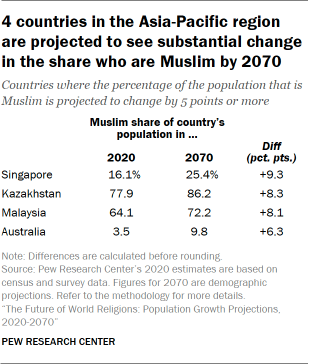
In Malaysia and Kazakhstan, which had Muslim majorities in 2020, the increases will raise the share of Muslims in the countries’ 2070 populations to 72% and 86%, respectively. In Australia, religious “nones” and Christians will be the largest and second-largest religious groups in 2070; the Muslim share of the population there is forecast to rise to 10% by 2070, a 6-point increase from 2020.
Changes in populations of religious ‘nones’
In four Asia-Pacific countries, the percentage of religiously unaffiliated people in the population will grow by at least 5 percentage points. The largest increases will be in South Korea – where “nones” will rise 12 points to 60% of the population by 2070 – and in Japan, where they will rise 12 points to 69% of the population, according to the projections.
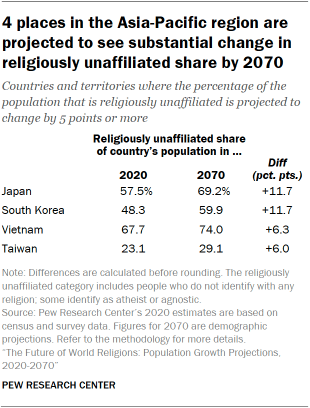
In South Korea, the increase in “nones” between 2020 and 2070 will be accompanied by long-term declines in the country’s Buddhist and Christian communities. In Vietnam and Japan, the increase in “nones” will occur alongside a decline in the Buddhist share of the population. And in Taiwan, it will happen alongside a declining share of people in the “other religions” category.
Changes in populations that follow other religions
Many religious groups cannot be presented separately in this study due to their relatively small size and a shortage of data on them in many national censuses and surveys. In Asia, these groups include Shintoists, Daoists (also spelled Taoists), Sikhs, Jains and Zoroastrians, among others.75
Because the groups in this category are very diverse, people in this category may not share the same beliefs and practices. Still, combining these groups into the umbrella category of “other religions” allows us to describe overall trends among people who are not Christian, Muslim, Hindu, Buddhist, Jewish or religiously unaffiliated.
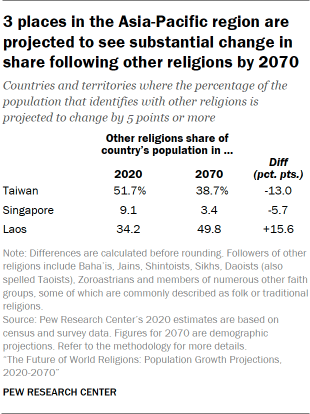
Three Asia-Pacific countries are expected to see substantial changes in the share of residents who identify with other religions. In Laos, people who follow other religions (including folk religions) will make up about half the population in 2070, 16 percentage points higher than in 2020. In Taiwan, where people in this category (many of whom practice Daoism or Chinese folk religions) made up just over half the population in 2020, they will decrease 13 points, to make up 39% of the population in 2070. And in Singapore, followers of other religions (including Daoism) will decrease 6 points and make up 3% of the population.
Refer to our sortable table to see how religious populations in 50 countries in the Asia-Pacific region are projected to change over time.
Changes in Hindu populations
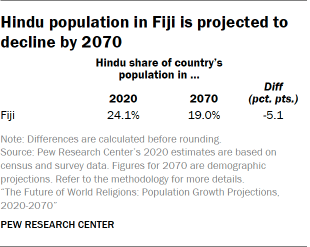
Fiji is the only country in the Asia-Pacific region where the percentage of Hindus in the population will change by at least 5 percentage points. Hindus made up nearly a quarter (24%) of Fiji’s population in 2020 but are projected to be 19% in 2070.
Asia-Pacific countries where the religious majority is expected to change
In four Asia-Pacific countries and territories, a religion (or nonreligion) will either lose or gain majority status between 2020 and 2070.
Two countries will no longer have a Buddhist majority. In Laos, where 64% of the population was Buddhist in 2020, just under half (49%) will be Buddhist in 2070. In Mongolia, where 51% of the population was Buddhist in 2020, Buddhists are projected to make up 49% of the population in 2070.
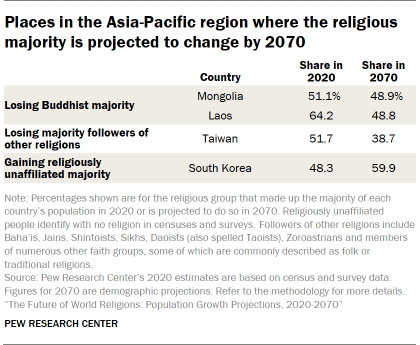
In Taiwan, followers of other religions will go from being a majority (52%) in 2020 to a minority (39%) in 2070 – though they will remain the largest religious category in Taiwan.
In South Korea, where just under half the population was religiously unaffiliated in 2020, unaffiliated people are expected to become a majority (60%) by 2070.
Refer to Pew Research Center’s broader study of the future of religion around the world for a global look at countries where the religious majority is expected to change.
Key factors driving religious change in the Asia-Pacific region
Several dynamics determine whether a religious group grows or shrinks in size. Demographic factors – such as age structure, fertility and mortality – shape populations through births and deaths. International migration also plays a role, as does “religious switching,” or people moving into and out of religious groups (including disaffiliation from religion altogether).
In the Asia-Pacific region, the main reason Muslims are expected to grow so much faster than other religious groups is “natural increase” (births outnumbering deaths). Natural increase is expected to bolster the Muslim population in Asia and the Pacific by 648 million people between 2020 and 2070.
Two factors will partially offset this increase. Net migration of Muslims away from the Asia-Pacific region – more moving out than moving in – will reduce the Muslim population by a projected 27 million people. Meanwhile, religious switching is expected to reduce the number of Muslims in the region by an additional 2 million.
Considering all these factors together, the overall population of Asia-Pacific Muslims is expected to go up by 619 million, from 1.2 billion to 1.8 billion. That’s a rise of 52% between 2020 and 2070.
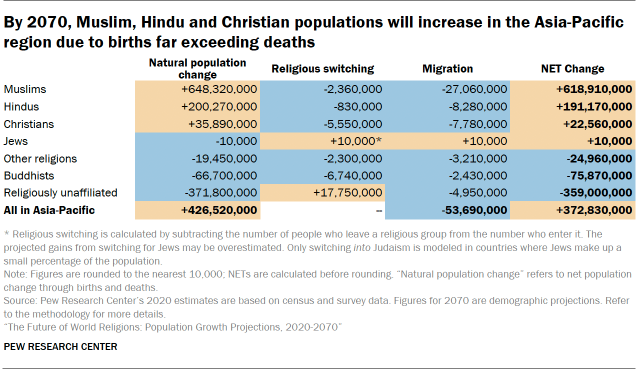
Hindus will have the second-largest growth rate in the region during this period. Most of it will result from natural increase, which is projected to add 200 million people to the Hindu population by 2070. Net migration will cost the Hindu population about 8 million people between 2020 and 2070, while religious switching will reduce it by less than a million. All told, the region’s Hindu population is expected to rise to nearly 1.4 billion – an increase of 191 million, or about 16%.
The projected decline in Buddhists and religiously unaffiliated people across the region between 2020 and 2070 will owe largely to these groups’ natural decrease (which occurs when deaths outnumber births). Natural decrease will account for a decline in the Buddhist population of 67 million by 2070, adding to losses from religious switching (7 million) and migration (2 million) for an overall drop of 76 million.
Natural decrease also will cause the population of religious “nones” in the Asia-Pacific region to drop by 372 million, and net migration will result in an additional reduction of about 5 million “nones.” Religious switching – in this case, people across the region leaving their childhood religion to become religiously unaffiliated – will partially offset the losses (+18 million). But when all factors are combined, the population of “nones” in the region is projected to decline by 359 million between 2020 and 2070.
Natural population growth
Fertility
In our projections, we assume that children will inherit their mother’s religion. All else being equal, religions in which women have higher total fertility rates will experience more population growth than other religions.
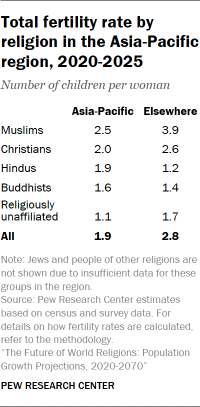
The total fertility rate is the average number of children a hypothetical woman would have over her lifetime if she experienced the birth rates that were estimated for women of reproductive age during a particular period, such as 2020 to 2025. To maintain its size from generation to generation, a population typically needs a total fertility rate of 2.1 children per woman (the “replacement level”) in countries with low mortality rates for infants and children, independent of other factors like migration and religious switching.76
In the Asia-Pacific region, Muslims were the only religious group with a total fertility rate above 2.1 children per woman during the 2020-2025 period. Muslims averaged 2.5 children per woman. Total fertility rates are lower among the region’s Christians (2.0), Hindus (1.9), Buddhists (1.6) and religiously unaffiliated (1.1).
The fertility rates of Muslims, Christians and religious “nones” in the Asia-Pacific region also are lower than among women in the same religious groups who live elsewhere in the world. However, Hindus and Buddhists across the region have higher average fertility than their counterparts in other parts of the world where we have data on Hindu and Buddhist fertility. The total fertility rate in Asia-Pacific region was 1.9 children per woman, nearly one less than the rate for women elsewhere in the world (2.8).
These fertility rates are estimates for the 2020-2025 period.
Age patterns
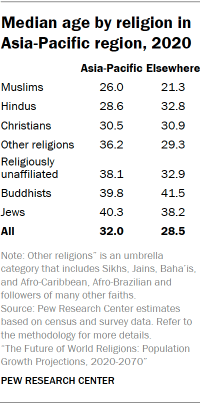
The age structure of each religious group also factors into our projections. Among Muslims in the Asia-Pacific region, the median age is 26, the youngest of any religious group in the region as of 2020.
Meanwhile, the highest median ages are found among Jews (40), Buddhists (40) and religious “nones” (38).
For more details, read “Key Factors Shaping the Global Future of Religions” in the broader study.


