

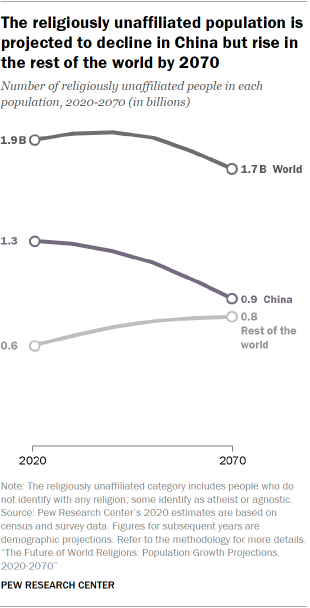
As of 2020, nearly 2 billion people worldwide do not affiliate with any religion, according to Pew Research Center estimates. By 2070, the Center projects that the number of unaffiliated people will rise in most countries and territories. But our projections suggest that all the increases in unaffiliated people around the world will be entirely offset by declining numbers in one country: China.
In censuses and surveys, unaffiliated people are those who answer a religious identity question by saying that they are atheist or agnostic, or that they have no religion. Many people in this group – sometimes called religious “nones” – do hold some religious or spiritual beliefs and engage in some religious or spiritual practices. But they don’t describe themselves as followers or adherents of any religion.42
If current trends continue, “nones” will make up 17% of the world population by 2070, down from 24% in 2020. The absolute number of unaffiliated people is projected to decline globally by 181 million.
Over the same period, the number of unaffiliated people is projected to rise in 141 countries and territories, about 70% of all the places analyzed. And 37 countries and territories will see the percentage of their population that is religiously unaffiliated increase substantially (i.e., by at least 5 percentage points).
Despite their growth in most countries, “nones” are projected to shrink globally due to population decline in China, where most of the world’s “nones” currently live. China is projected to experience a drop of more than 421 million people in its overall population between 2020 and 2070, primarily from what demographers call “natural decrease” (when the number of deaths in a population exceeds the number of births).
China’s unaffiliated population is expected to shrink at roughly the same rate as its general population, falling from 1.3 billion to 917 million. As a result, unaffiliated people are expected to make up about the same share of the Chinese population in 2070 (91%) as they did in 2020 (90%).
Our demographic projections point to several additional changes in the unaffiliated population in the decades ahead. By 2070, we project …
- “Nones” will no longer be the largest religious group in Asia and the Pacific, with Muslims exceeding them in number and as a percentage of the region’s population as soon as 2040.
- France, South Korea and the United Kingdom will join 10 other countries and territories with unaffiliated majorities.
- The share of the U.S. population that is unaffiliated will grow by 12 percentage points, narrowing the gap between Americans who identify with no religion (projected at 41% in 2070) and those who identify as Christians (projected at 48%).
These findings are part of a broader Pew Research Center report examining how the size of seven religious groups will change globally between 2020 and 2070 if recent demographic trends continue. Our projections take into account the differences between religious groups’ age profiles, fertility rates, and patterns of religious switching and migration. (Religious switching and migration are assumed to continue at the same levels that have been recently observed.) We also incorporate mortality rates, applying the same rate to each religious group within a country. Read the methodology for more details about these projections and their limitations.
Read more about our projections for the religiously unaffiliated population:
- Which regions of the world will have the most religious “nones”?
- Which countries will have the most religious “nones”?
- Where will the religiously unaffiliated share of the population change the most?
- Countries where religious “nones” will become the majority
- Key factors driving change in the religiously unaffiliated population
Which regions of the world will have the most religious ‘nones’?
The Asia-Pacific region currently is the geographic center of the unaffiliated population. In 2020, 78% of “nones” worldwide lived in that region. Most “nones” are still expected to live in the Asia-Pacific region in 2070, but the share is projected to fall to 66%.
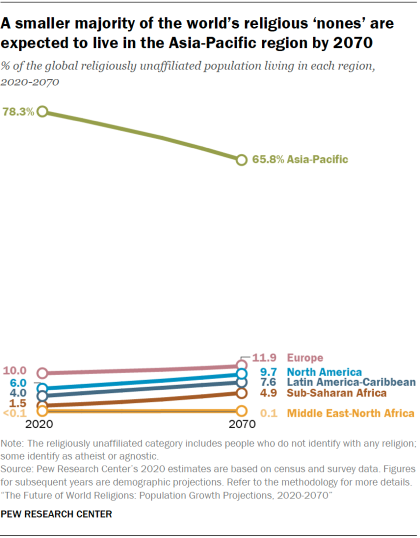
North America, the Latin America-Caribbean region and sub-Saharan Africa are all expected to hold slightly larger portions of the world’s “nones” in 2070 than they did in 2020.
The percentage of the global unaffiliated population living in Europe also is expected to increase slightly, while the small share living in the Middle East-North Africa region is expected to remain stable.
Projected change in the religiously unaffiliated population within regions
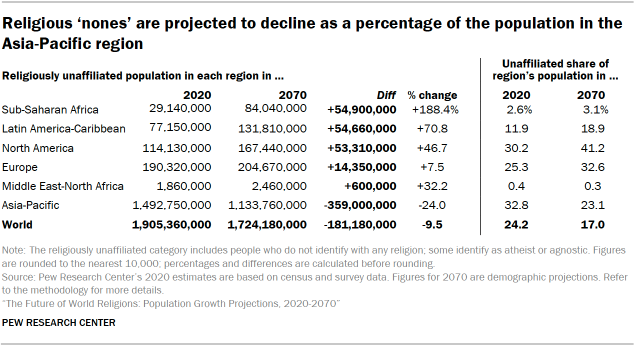
Another way to analyze change is to look at populations within regions. Between 2020 and 2070, the percentage of the population that is religiously unaffiliated is projected to grow in most large regions of the world.
If current demographic trends continue, 41% of North Americans will be religiously unaffiliated in 2070, up from 30% in 2020. Europe is expected to undergo a similar change: 33% of Europeans are projected to be unaffiliated as of 2070, up from 25% in 2020.
Asia and the Pacific is the only region where the number of religiously unaffiliated people is expected to decline, by 359 million. This region also is projected to see a large decline in the percentage of its population that is unaffiliated. About a quarter of all people living in the region are projected to be “nones” by 2070, down from a third in 2020. “Nones” in Asia and the Pacific have exceptionally low fertility rates, especially compared with Muslims, who are expected to surpass unaffiliated people as the largest religious group in the region by 2040.
The Middle East and North Africa is the only other region that is expected to see the portion of its population that is unaffiliated shrink, from 0.4% to 0.3%.
Which countries will have the most religious ‘nones’?
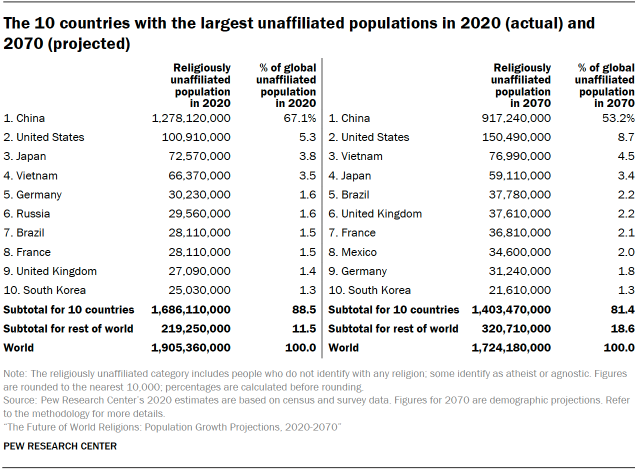
China currently has by far the largest population of religiously unaffiliated people, with 1.3 billion “nones” as of 2020. The United States (101 million), Japan (73 million), Vietnam (66 million) and Germany (30 million) round out the top five.
If current demographic trends continue, China will retain its first-place rank in 2070, though it will hold a smaller portion of the world’s unaffiliated population: 53%, down from 67% in 2020. The three other Asian-Pacific countries on the list of 10 countries with the largest unaffiliated populations (Japan, Vietnam and South Korea) are projected to remain in the top 10, but Japan and Vietnam are expected to swap places in the rankings.
By our projections, the U.S. will still have the second-largest population of “nones” in 2070. The country’s unaffiliated population is expected to grow significantly, by 50 million, over the projection period.
Meanwhile, the United Kingdom is projected to rise from ninth to sixth place, and Russia is expected to drop out of the top 10. Mexico will join the list, ranking as the country with the eighth-largest unaffiliated population in 2070.
Refer to our sortable table to see how 201 countries and territories rank in the size of their unaffiliated populations.
Where will the religiously unaffiliated share of the population change the most?
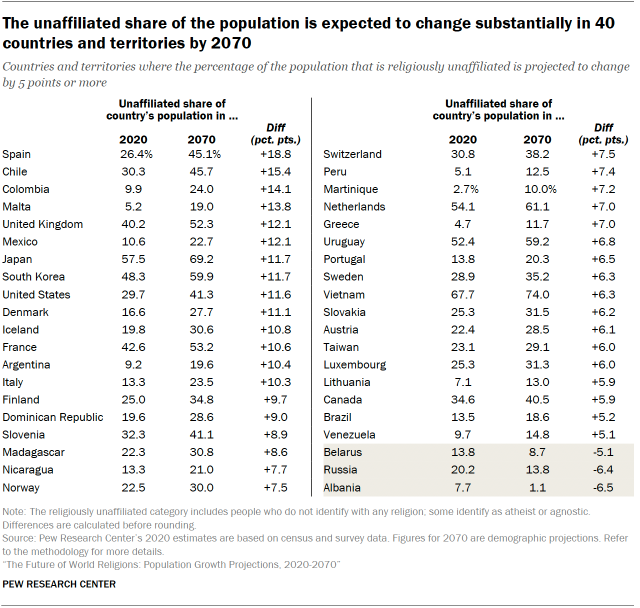
In 40 countries and territories around the world, the share of people who are unaffiliated is expected to change substantially (by at least 5 percentage points) by 2070. In nearly all these places, the percentage of the population that is religiously unaffiliated is projected to grow, ranging from a 5-point increase in Venezuela to a 19-point increase in Spain.
Only three countries will see substantial decreases: Albania, Russia and Belarus. In these three former Soviet bloc countries, the decline in the unaffiliated share of the population is partially driven by religious switching, mostly from the unaffiliated category into Christianity.
Most countries where a rising percentage of the population is religiously unaffiliated are in Europe (19) or Latin America and the Caribbean (11). The two North American countries, the U.S. and Canada, also are projected to see substantial increases in the share of their inhabitants who are unaffiliated (up 12 percentage points in the U.S. and 6 points in Canada).
Countries where religious ‘nones’ will become the majority
Religiously unaffiliated people are projected to grow into a majority in three countries:
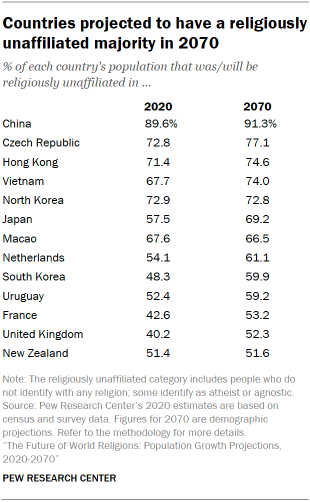
- South Korea, where 60% of people are projected to identify with no religion in 2070
- France, where 53% of the population will be unaffiliated
- The U.K., where “nones” are expected to make up 52% of the population by the end of the projection period
Ten other countries and territories had unaffiliated majorities in 2020 and are expected to remain majority-unaffiliated in 2070.
Most of these countries have small or midsize populations, but the list also includes the highly populous countries of China, Vietnam and Japan.
Key factors driving change in the religiously unaffiliated population
Several dynamics determine whether a religious group grows or shrinks in size. Demographic factors – such as age structure, fertility and mortality – shape populations through births and deaths. International migration also plays a role, as does “religious switching,” or people moving into and out of religious groups (including disaffiliation from religion altogether).
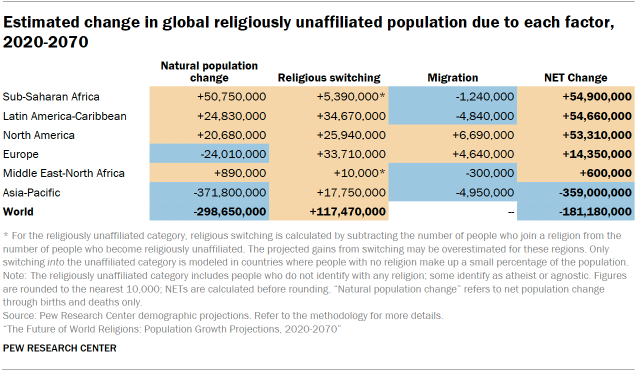
The global unaffiliated population is projected to decline between 2020 and 2070, largely because of a drop in the overall population of East Asia (including China and Japan, where deaths outnumber births).
The unaffiliated population is projected to grow in every other region. In sub-Saharan Africa, for example, the number of “nones” is expected to rise by nearly 51 million through natural increase (i.e., births exceeding deaths) and by an additional 5 million through religious switching (in this case, disaffiliation from religion altogether).
Natural population change
The youthfulness of a population is an important factor in future growth. All else being equal, a population that begins with a relatively large percentage of people who are in – or soon will enter – their prime childbearing years will grow faster than a population that is older.
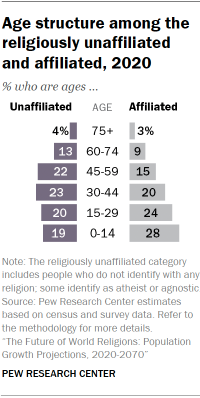
Globally, unaffiliated people tend to be older than people who self-identify with a religion. As of 2020, about four-in-ten “nones” (39%) are under 30, compared with 52% of religiously affiliated people.
The age profile (or “age structure”) of religious “nones” varies somewhat around the world. In sub-Saharan Africa, the median age of unaffiliated people as of 2020 is 19 – younger than “nones” in other regions. European “nones” (with a median age of 39) are older than “nones” living elsewhere.
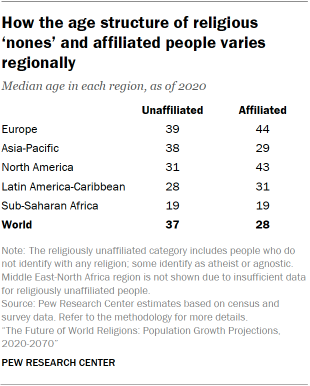
Within most regions, “nones” tend to be younger than religiously affiliated people. In North America, for example, the median age of unaffiliated (31) and affiliated people (43) differs by more than a decade. The Asia-Pacific region is an exception: “Nones” have a higher median age than people who affiliate with a religion in that region (38 vs. 29).
Refer to our accompanying data explorer to see how the age structure of the religiously unaffiliated population is projected to change over time.
The global population of “nones” also has a low total fertility rate at 1.3 children per woman, according to our demographic estimates for the 2020-2025 period. (The total fertility rate is the average number of children a hypothetical woman would have over her lifetime if she experienced the birth rates that were estimated for women of reproductive age during a particular period, such as 2020 to 2025.)
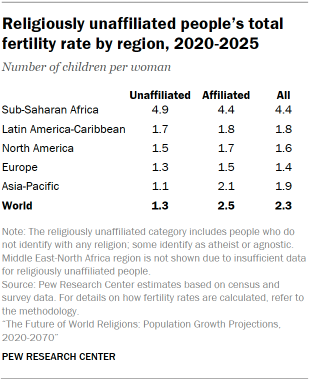
This is significantly lower than the rate among all religiously affiliated people worldwide (2.5) and below the replacement level, which is generally estimated at 2.1 children per woman in countries with low mortality rates for infants and children.43
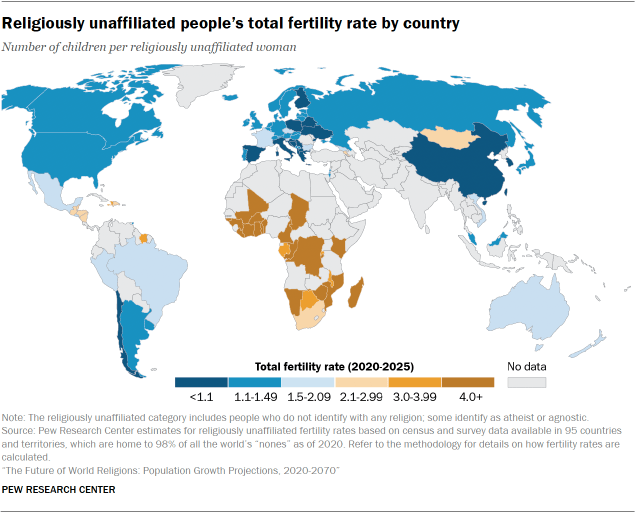
“Nones” in sub-Saharan Africa stand out for having a high fertility rate, averaging 4.9 children per woman. Fertility rates are particularly high among unaffiliated people in the sub-Saharan African countries of Mali (7.0), the Democratic Republic of the Congo (6.8), Chad (6.4) and Burundi (6.2).44
The unaffiliated population’s fertility rate is below 2.1 children per woman in all other regions, as well as in 61 of the 95 countries and territories for which reliable fertility data is available for “nones.” This includes eight places with fertility rates considered to be ultralow, or below one child per religiously unaffiliated woman: Croatia, Malta, Taiwan, Ukraine, Italy, Hong Kong, South Korea and Singapore.
Religious switching
Religiously unaffiliated people have a relatively high retention rate, globally. Based on recent surveys, we estimate that 92% of people who were raised with no religion are still unaffiliated as adults. (Muslims and Hindus are the only major religious groups with higher retention rates, at 99% each.) Worldwide, we estimate that about 8% of people who were raised as “nones” now affiliate with a religious group as adults.45
In the coming decades, “nones” living in the Latin America-Caribbean region, Europe and North America are projected to experience especially large gains from religious switching. If current trends continue, then between 2020 and 2070, more people in Latin America and the Caribbean will disaffiliate from religion (61 million) than join a religion after being raised as “nones” (27 million).
One way to illustrate the relative impact of religious switching in population projections is to compare the main projection scenario, which models religious switching, with a hypothetical scenario in which there is no switching.46
For instance, in the main projection scenario – which assumes that switching into the unaffiliated category (in other words, disaffiliating from religion) will continue at the same rate observed in 2020 – “nones” are expected to make up 41% of North America’s population in 2070. If there were no more religious switching after 2020, “nones” would make up a much smaller share of the North American population in 2070 (31%).
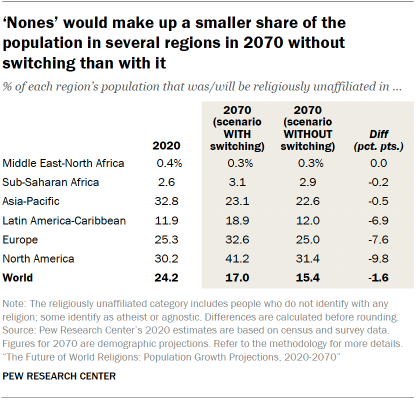
Unaffiliated populations especially benefit from religious switching in certain countries. For instance, Chile’s overall population would have a much smaller proportion of “nones” if there were no more switching: 27% in 2070, rather than the 46% in the main projection scenario. The unaffiliated population in Spain similarly would be smaller in 2070 under the hypothetical “no switching” scenario (28%) than in the main projection scenario (45%).
Our main projection scenario assumes that recently observed switching rates will continue. However, changes in religious switching patterns could be very consequential for the religiously unaffiliated. For example, in most Muslim-majority countries, it is extremely rare for people to publicly report leaving Islam. Doing so can have severe social and legal consequences. But if people were to begin disaffiliating from Islam at a significant rate, religiously unaffiliated populations could decline at a slower rate or even grow.
Migration
While migration doesn’t have much effect on the size of the global unaffiliated population, it does impact regional populations.47 More than 19 million “nones” are expected to move between regions by 2070. Most of them are forecast to move to North America (9 million) or Europe (7 million).
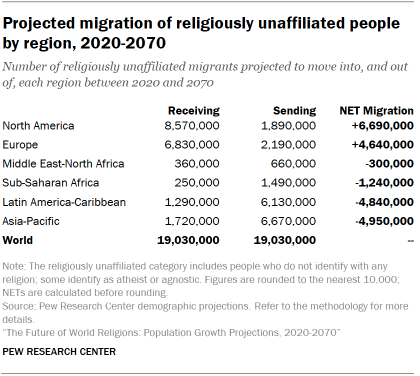
Asia and the Pacific, meanwhile, is projected to see the largest number of unaffiliated people leave the region (7 million).
One way to illustrate the impact of migration on unaffiliated populations is to compare the main projection scenario with an alternative scenario that excludes all migration.48
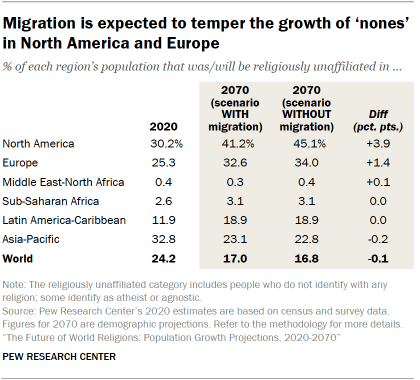
In North America and Europe, “nones” would make up a larger percentage of the population in 2070 if there were no migration than they would in the main projection scenario. This is because migrants moving into these two regions are much more likely than the overall population to be religiously affiliated.


