

Christianity is currently the world’s largest religion, with nearly 2.3 billion followers as of 2020. Compared with other religious groups, Christians are fairly evenly dispersed across the globe. But this is changing. By Pew Research Center’s projections, within a few decades a majority of the world’s Christians (54%) will live in sub-Saharan Africa.
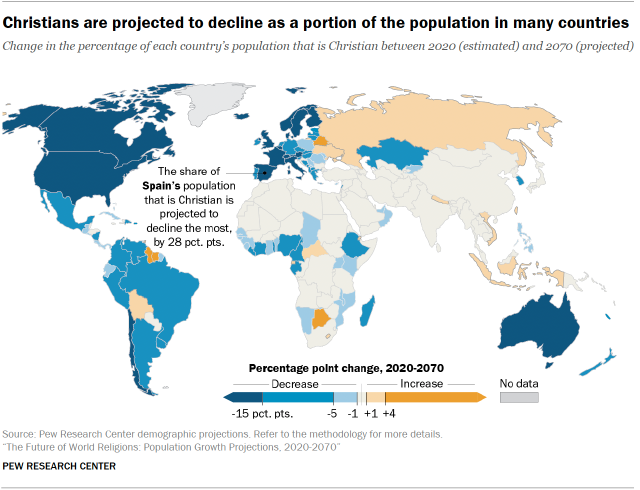
If current demographic trends continue, Christians will decline as a percentage of the population in many countries. Between 2020 and 2070, Christians are projected to shrink substantially (by 5 percentage points or more) as a share of residents in 61 countries, and to grow by 5 points or more as a share of the population in only four countries.
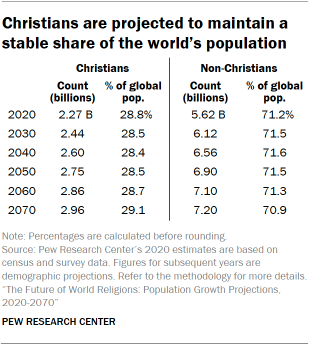
Yet, globally, Christians are expected to increase in number by about 687 million people over the same projection period, growing roughly on pace with the rest of the world’s population. As a result, Christians will account for about the same percentage of the world’s total population in 2070 as they did in 2020 (29% in both years, after rounding).
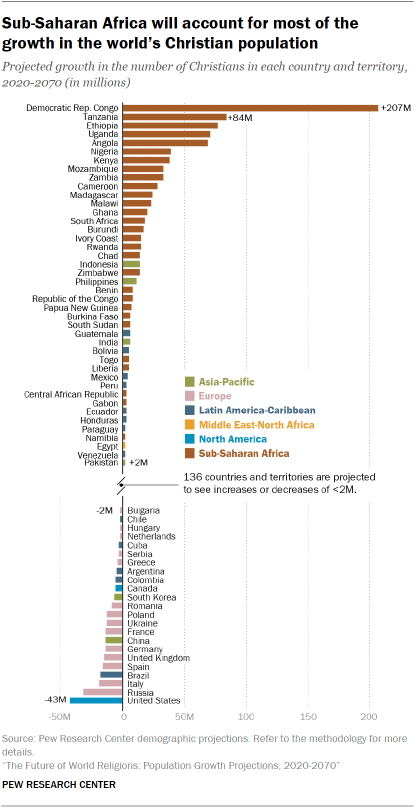
This seeming paradox – global stability despite declining percentages of Christians in many countries – results from a striking geographic shift. Most of the future growth in the world’s Christian population is projected to occur in sub-Saharan Africa.
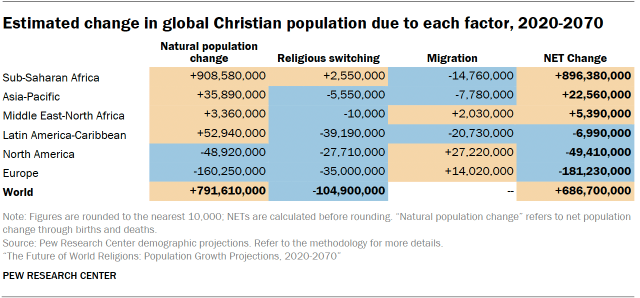
By 2070, the number of Christians living in sub-Saharan Africa is expected to rise by 896 million, while the number of Christians in the rest of the world is expected to fall by 210 million. The relatively young age profile and high fertility rates of African Christians are behind this projected change.
Our demographic projections point to several additional changes in the world’s Christian population in the decades ahead. By 2070, we project …
- The Democratic Republic of the Congo will surpass the United States as the country with the largest number of Christians.
- Christians will no longer form a majority in the U.S. and nine other countries.
- The share of Europeans who are Christian will decline by 15 percentage points.
- Christians will no longer be the world’s largest religious group; by 2035, Muslims will exceed Christians both in absolute number and as a percentage of the global population.
These findings are part of a broader Pew Research Center study examining how the size of seven religious groups will change globally between 2020 and 2070 if recent demographic trends continue. Our projections take into account the differences between religious groups’ age profiles, fertility rates, and patterns of religious switching and migration. (Religious switching and migration are assumed to continue at the same levels that have been recently observed.) We also incorporate mortality rates, applying the same rate to each religious group within a country. Read the methodology for more details about these projections and their limitations.
Read more about our projections for Christians:
- Which regions of the world will have the most Christians?
- Which countries will have the most Christians?
- Where will the Christian share of the population change the most?
- Countries where Christianity will no longer be the majority religion
- Key factors driving change in the Christian population
Which regions of the world will have the most Christians?
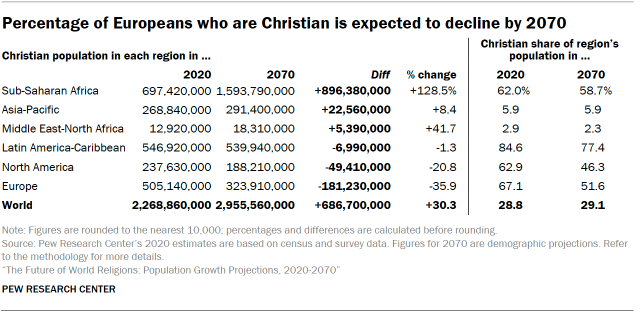
In 2020, Christians were fairly evenly dispersed around the globe. But in the coming decades, they are projected to become concentrated in sub-Saharan Africa: By 2070, 54% of all Christians are expected to live on the African continent south of the Sahara Desert and its nearby islands, up from 31% in 2020.
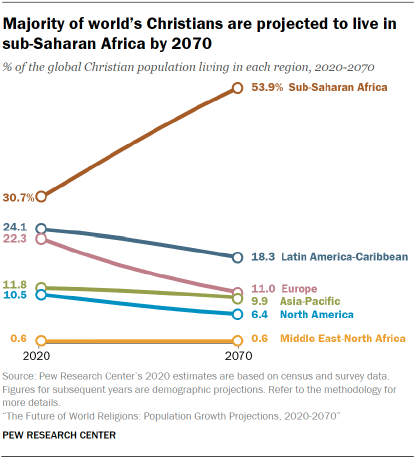
The Middle East-North Africa region is expected to retain the same very small percentage of the world’s Christians in 2070 as it held in 2020 (less than 1%), but all other regions will see their shares decline.
The steepest decline is expected to occur in Europe. If current trends continue, by 2070 Europe will be home to 11% of the world’s Christian population, down from 22% in 2020.
Projected change in the Christian population within regions
Another way to analyze change is to look at the Christian population within each region. Between 2020 and 2070, Christians are not expected to grow as a percentage of the overall population in any of the world’s six major geographic regions.
This is true even in sub-Saharan Africa, where Christians are forecast to more than double in number, from 697 million to 1.6 billion. Despite the numerical increase, Christians are expected to make up a slightly smaller share of sub-Saharan Africa’s total population in 2070 (59%) than they did in 2020 (62%) because religiously unaffiliated people and Muslims are expected to grow even faster than Christians there.
The absolute number of Christians also is expected to rise in Asia and the Pacific (+23 million) and the Middle East-North Africa region (+5 million), but Christians will remain relatively stable as a proportion of those regions’ populations (at 6% and 2%-3%, respectively).
Christians are projected to decrease both in number and as a percentage of the population in all other regions. This includes North America, where Christians will no longer form a majority, though they will still be the largest religious group. If current demographic trends continue, Christians will make up 46% of the North American population in 2070, down from 63% in 2020. (Over the same period, religiously unaffiliated people will grow as a percentage of the region’s population, from 30% to 41%.)
Which countries will have the most Christians?
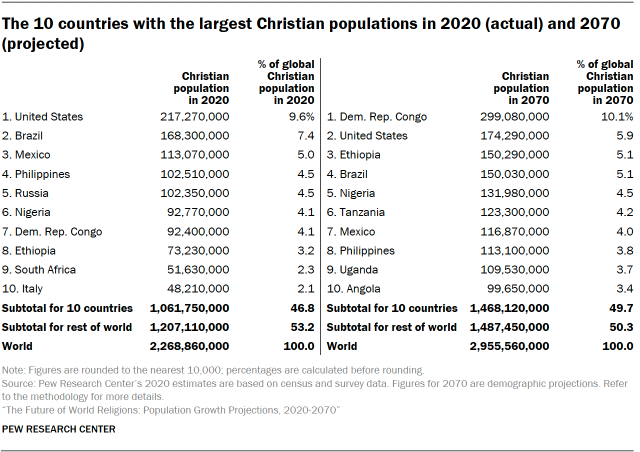
The United States currently has the largest Christian population of any country in the world, with an estimated 217 million Christian residents as of 2020. Brazil (168 million), Mexico (113 million), the Philippines (103 million) and Russia (102 million) round out the top five.
The Democratic Republic of the Congo is projected to assume the top slot by 2070, when it will have 299 million Christians, or 10% of all Christians globally. Several other sub-Saharan African countries (Ethiopia, Nigeria, Tanzania, Uganda and Angola) also will climb in the top 10 rankings.
Meanwhile, the two European countries that were in the top 10 as of 2020 (Russia and Italy) are forecast to drop off the list by 2070, and no European countries are projected to join the top 10.
Refer to our sortable table to see how 201 countries and territories rank in the size of their Christian populations.
Where will the Christian share of the population change the most?
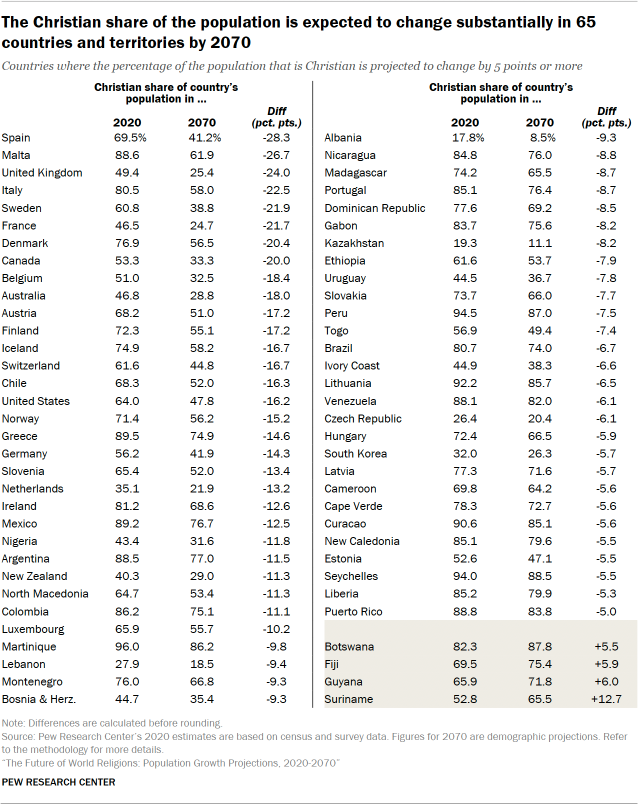
Between 2020 and 2070, the share of the population that is Christian is expected to change substantially (meaning it will increase or decrease by 5 percentage points or more) in 65 countries and territories, or roughly one-third of all the places studied.
In almost all 65 places, the percentage of Christians in the overall population is projected to decline, ranging from a 28-point drop in Spain to a 5-point decrease in Puerto Rico. Only four countries are expected to see Christians make up a substantially larger percentage of their national populations: Suriname, Guyana, Fiji and Botswana.
The countries where Christians are projected to shrink as a share of the population are scattered across every region, but most are in Europe (30 countries) or Latin America and the Caribbean (13 countries). The two North American countries, Canada and the U.S., are expected to see especially large drops in the portion of their populations that are Christian (down 20 percentage points and 16 points, respectively).
Countries where Christianity will no longer be the majority religion
Ten countries that had a Christian majority in 2020 are expected to see Christians fall below 50% of their inhabitants by 2070 – including the U.S., where 48% of the population is projected to be Christian by 2070. In all these places, a growing proportion of people are religiously unaffiliated.
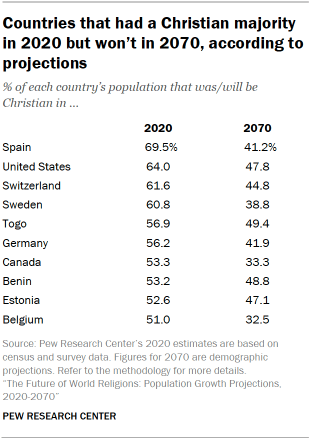
The other 110 countries and territories that were majority-Christian in 2020 are expected to remain so in 2070. Most of these countries have small or midsize populations, but the list includes several highly populous countries, such as Ethiopia, Brazil, Mexico and the Philippines, each of which is home to at least 100 million people.
Christians are not projected to become a majority of the population in any additional countries or territories between 2020 and 2070.
Key factors driving change in the Christian population
Several dynamics determine whether a religious group grows or shrinks in size. Demographic factors – such as age structure, fertility and mortality – shape populations through births and deaths. International migration also plays a role, as does “religious switching,” or people moving into and out of religious groups (including disaffiliation from religion altogether).
Globally, Christians are projected to grow in number between 2020 and 2070 because their overall gains via natural increase are expected to offset losses from religious switching. (Natural increase occurs when births outnumber deaths in a population, due to a high fertility rate, a low mortality rate, or both.)
The picture is more varied on the regional level, with major losses expected in Europe and North America from both demographic factors (i.e., aging populations with low birth rates) and religious switching. Although these two regions are expected to see large inflows of migrants, they will not be large enough to offset or “cancel out” losses from natural population decrease (i.e., the number of deaths exceeding the number of births) and switching.
For instance, Europe is projected to lose 160 million Christians through natural decrease and an additional 35 million through disaffiliation between 2020 and 2070. The 14 million Christian immigrants the region is expected to gain over this time span will not fill the gap.
In Asia and the Pacific, meanwhile, net gains from natural increase are projected to be large enough to offset expected losses from religious switching and Christian emigration.
Natural population change
The youthfulness of a population is an important factor in future growth. All else being equal, a population that begins with a relatively large percentage of people who are in – or soon will enter – their prime childbearing years will grow faster than a population that is older.
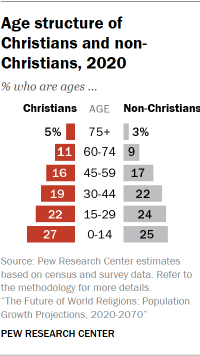
The overall age profile (or “age structure”) of Christians largely mirrors that of non-Christians, according to our 2020 demographic estimates. About half of all Christians and non-Christians are under 30. But Christians are slightly more likely than non-Christians to be ages 60 and older (16% vs. 12%).
Still, the age profile of Christians varies considerably around the world. In sub-Saharan Africa, the median age of Christians is 20 – younger than Christians in any other major region, as of 2020. In all other regions for which data is available, the median age of Christians is 30 or older. European Christians are notably older than those elsewhere, with a median age of 45.
Refer to our accompanying data explorer to see how Christians’ age structure is projected to change over time.
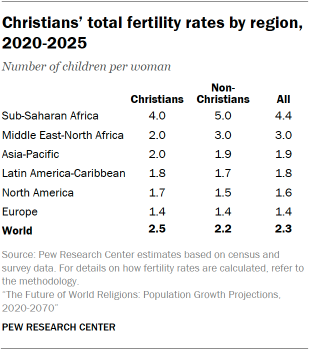
The global Christian population also is buoyed by a relatively high total fertility rate of 2.5 children per woman, according to our demographic estimates for the 2020-2025 period. (The total fertility rate is the average number of children a hypothetical woman would have over her lifetime if she experienced the birth rates that were estimated for women of reproductive age during a particular period, such as 2020 to 2025.)
Christians’ total fertility rate is slightly higher than the rate among non-Christians worldwide (2.2) and above the replacement level, which is generally estimated at 2.1 children per woman in countries with low mortality rates for infants and children.36
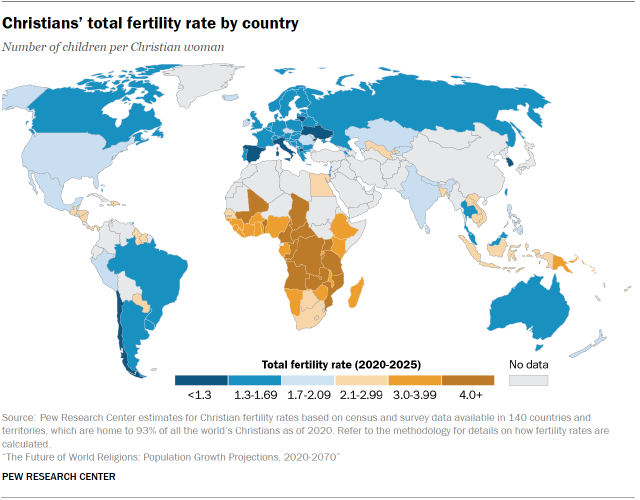
Christians’ high global fertility is heavily influenced by birth rates in sub-Saharan Africa. Christians in sub-Saharan Africa have more children per woman (4.0) than Christians in any other region of the world, though non-Christians in sub-Saharan Africa – most of whom are Muslims – tend to have even higher fertility, averaging 5.0 children per woman.
Christian fertility rates are particularly high in the sub-Saharan African countries of the Democratic Republic of the Congo (6.1), Chad (6.1) and the Central African Republic (6.0).
Rates are below 2.1 children per woman in all other major regions, as well as in 77 of the 140 countries and territories around the world for which Christian fertility data is available. This includes three places with Christian fertility rates considered to be ultralow, or below one child per woman: Hong Kong (0.7), South Korea (0.8) and Singapore (0.9).
Religious switching
Globally, Christians have one of the lowest retention rates of any religious group. Based on recent surveys, we estimate that 85% of people who were raised Christian still identify that way as adults. That compares with more than 90% among all other major religious groups except Buddhists, whose retention rate is 83%. The 15% of people who were raised Christian but no longer identify as Christian have either disaffiliated from religion altogether (13%) or switched to a different religion (2%).37
In the coming decades, Christians in Latin America and the Caribbean, Europe, and North America are projected to experience larger net losses through religious switching than Christians in other regions.
One way to determine the relative impact of religious switching is to compare the main projection scenario with a hypothetical scenario in which there is no switching.38
For example, if there were no more religious switching after 2020, Christians would make up 57% of North America’s population in 2070 – 11 percentage points higher than in the main projection scenario (46%), which assumes that Christian switching will continue at the same level recently observed.39
Data on rates of religious switching is unavailable for many countries in sub-Saharan Africa and the Middle East-North Africa region. Furthermore, there is little evidence of people leaving or joining religions in the countries there where we do have data on switching. As a result, population projections in sub-Saharan Africa and the Middle East-North Africa region are similar with and without religious switching.
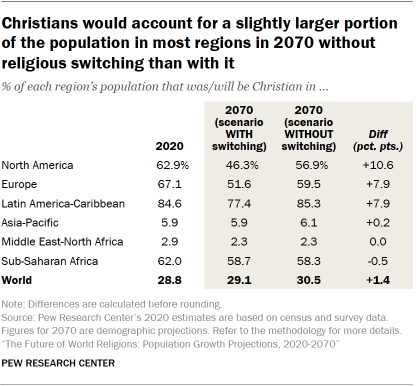
Christian populations in certain countries have especially high rates of religious switching. For example, if there were no switching, the United Kingdom would have a much higher share of Christians in 2070: 40%, rather than the 25% projected in the main scenario. And five of the 10 countries where Christians are expected to no longer form a majority by 2070 would retain a Christian majority under the hypothetical “no switching” scenario: Spain, the U.S., Switzerland, Germany and Sweden.
Migration
While migration doesn’t have much effect on the size of the global Christian population, it does impact regional populations.40 More than 71 million Christians are expected to move between the world’s major geographic regions by 2070. Most of them are forecast to move to North America (32 million) or Europe (19 million). The Latin America and Caribbean region, meanwhile, is projected to see the largest outflow of Christians (24 million).
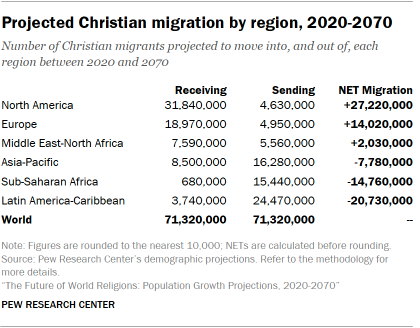
One way to illustrate the impact of migration on Christian populations is to compare the main projection scenario with a hypothetical scenario that excludes all migration.41
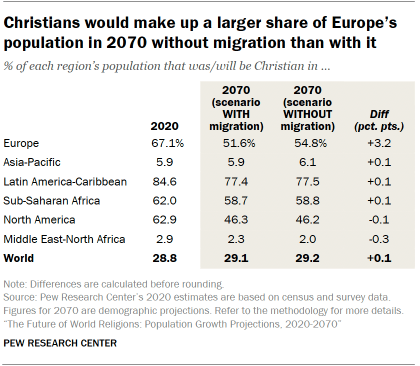
If there were no more migration, Europe would have a larger percentage of Christians in 2070 than it would under the main projection scenario (55% vs. 52%). This is because Europe is expected to gain considerably more non-Christians than Christians through migration over the projection period.


