

Loyal Liberals have broadly progressive political values across many issue areas and a strong allegiance to the Democratic Party. Highly educated and relatively secure economically, they are strong supporters of the United States’ traditional diplomatic alliances.
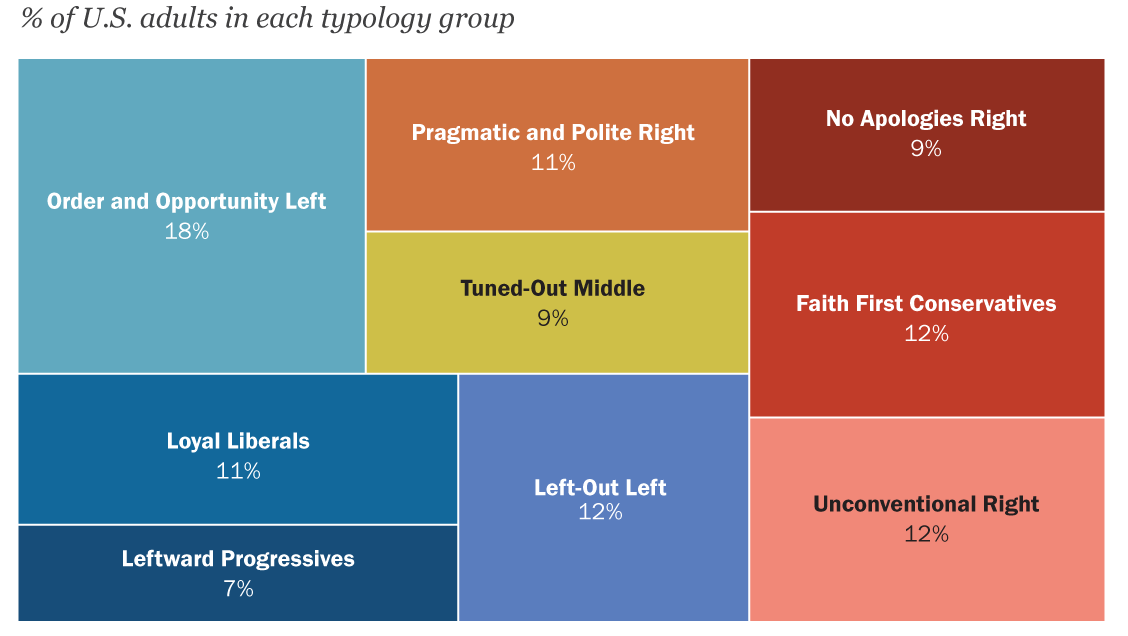
Loyal Liberals are one of nine groups in Pew Research Center’s 2026 Political Typology. To learn more about the typology, start with the overview. To find which group is your best fit, take the quiz.
Loyal Liberals generally favor a government with a strong social safety net. Like Leftward Progressives, they see healthcare as a federal government responsibility and say federal assistance to people in need should be increased. But they are far more likely than Leftward Progressives to believe the current system can provide a pathway to prosperity for Americans.
Loyal Liberals hold progressive views on many key cultural issues. They overwhelmingly see same-sex marriage as good for society, strongly support abortion being legal and want to see more done to ensure equal rights for Black Americans. But while they broadly support transgender rights, they express less comfort than Leftward Progressives with transgender athletes.
Loyal Liberals are:
- Less cynical than most other groups about why elected officials ran for office. They’re the least likely to say all or most ran for office to make a lot of money.
- Among the most engaged with politics and the news. They are the most likely group to say they have paid for news in the past year.
- One of the more economically secure groups. And more than six-in-ten (61%) have a college degree or more education – far higher than for any other typology group.
- Overwhelmingly White – 73% are non-Hispanic White.
Political affiliation, voting and engagement
Loyal Liberals are overwhelmingly Democratic (97% identify with or lean toward the Democratic Party). They are far more likely than those in other groups to consider themselves strong Democrats (45%).
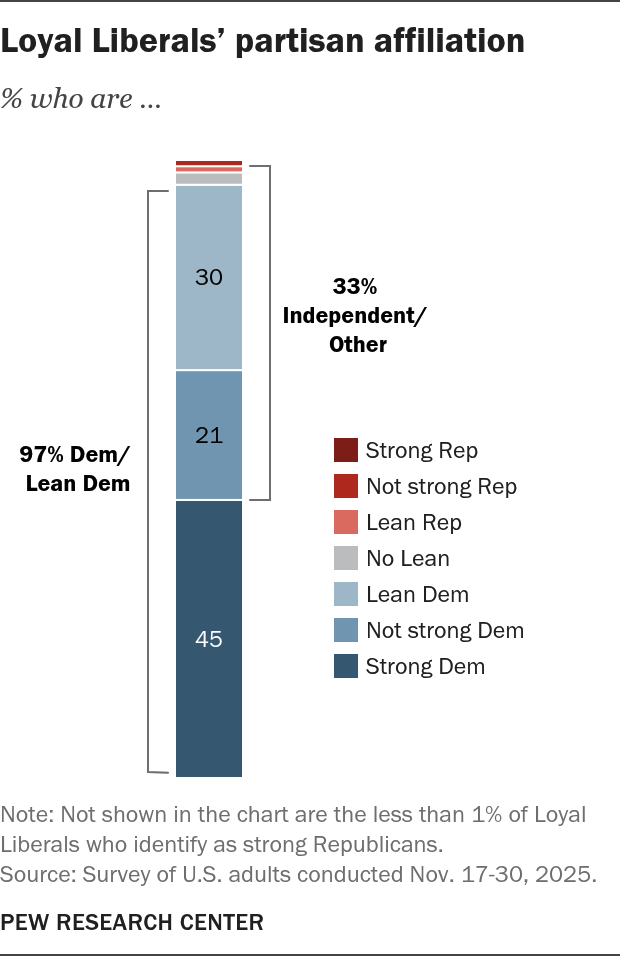
| Strong Dem | Not strong Dem | Lean Dem | No Lean | Lean Rep | Not strong Rep | Strong Rep | |
|---|---|---|---|---|---|---|---|
| Loyal Liberals | 45% | 21% | 30% | 2% | 1% | 1% | <1% |
Two-thirds (66%) describe their political views as liberal, with 20% saying they are “very liberal.” Most of the remaining characterize their views as moderate (30%)
Loyal Liberals are more politically engaged than other Americans. They are more likely to:
- Follow what’s going on in government. Roughly two-thirds (68%) say they follow what’s going on in government most of the time.
- Vote. A large majority (79%) voted for president in 2024. Among those who did vote, nearly all (98%) went for Kamala Harris.
- Say it really matters who wins control of Congress in 2026 – 86% say this (one of the top groups, along with No Apologies Right). Registered voters in this group almost universally back Democrats in November (95%).
Key attitudes and beliefs
Loyal Liberals are more likely than any other group to say the Democratic Party represents people like them well, cares about people like them and has good ideas. They are also among the most likely to say that in recent elections, there have consistently been candidates who share their views.
| Leftward Progressives | |
| Loyal Liberals | |
| Left-Out Left |
| Order and Opportunity Left | |
| Tuned-Out Middle | |
| Pragmatic and Polite Right |
| Unconventional Right | |
| Faith First Conservatives | |
| No Apologies Right |
The Democratic Party represents interests of people like you well
In recent elections, there is always/often a candidate who shares your views
They oppose suspending all asylum applications
Tax rates on large businesses and corporations should be raised
Same-sex marriages being legal in the U.S. is good for society
Russia is an enemy of the U.S.
| Typology group | The Democratic Party represents interests of people like you well | In recent elections, there is always/often a candidate who shares your views | They oppose suspending all asylum applications | Tax rates on large businesses and corporations should be raised | Same-sex marriages being legal in the U.S. is good for society | Russia is an enemy of the U.S. |
|---|---|---|---|---|---|---|
| Leftward Progressives | 68% | 20% | 98% | 97% | 90% | 48% |
| Loyal Liberals | 82% | 41% | 96% | 92% | 82% | 73% |
| Left-Out Left | 55% | 9% | 83% | 82% | 44% | 47% |
| Order and Opportunity Left | 54% | 19% | 77% | 74% | 27% | 48% |
| Tuned-Out Middle | 49% | 19% | 59% | 54% | 10% | 31% |
| Pragmatic and Polite Right | 33% | 22% | 66% | 62% | 17% | 59% |
| Unconventional Right | 14% | 19% | 51% | 51% | 15% | 43% |
| Faith First Conservatives | 4% | 32% | 42% | 35% | 2% | 51% |
| No Apologies Right | 2% | 42% | 24% | 21% | 6% | 56% |
Like other typology groups oriented toward the Democratic Party, Loyal Liberals overwhelmingly say the government should expand the services it currently provides (80%). Nine-in-ten or more say the government has a responsibility to provide clean air and water (99%), reliable energy (96%), quality K-12 education (93%) and health insurance (95%) to all Americans. And a similar share (92%) supports raising tax rates on large corporations.
Their social and cultural values are firmly progressive, though less so than Leftward Progressives. Most (82%) say same-sex marriages being legal in the U.S. is good for society – a view shared with Leftward Progressives. They also support abortion being legal and are generally comfortable with someone using the pronouns “they/them” instead of “he” or “she.” Compared with the broader public, they express higher levels of comfort with transgender athletes competing on sports teams that don’t match their sex at birth (28% say they’re extremely/very comfortable, 33% somewhat comfortable, 38% not too/not at all comfortable). But they are not as comfortable with this as Leftward Progressives (77% extremely/very comfortable).
Loyal Liberals are more likely than other groups to see the nation’s relationship with its allies in a positive light and to value multilateral institutions like NATO. They are the most likely group to say Russia is an enemy to the U.S. (73% say Russia is an enemy, compared with 51% of Americans overall) and to see Russia’s invasion of Ukraine as a major threat to U.S. interests (62% say this vs. 31% overall).
Loyal Liberals are generally pro-immigration. Wide majorities oppose the Trump administration’s pauses on asylum and visa applications and ramped-up deportations. And a majority says legal immigration should be increased.
High levels of trust in institutions

| Leftward Progressives | Loyal Liberals | Left-Out Left | Order & Opportunity Left | Tuned-Out Middle | Pragmatic & Polite Right | Unconventional Right | Faith First Conservatives | No Apologies Right | General public | |
|---|---|---|---|---|---|---|---|---|---|---|
| They trust the information they get from national news organizations a lot or some | 64% | 82% | 53% | 67% | 52% | 64% | 49% | 37% | 27% | 56% |
| They have a great deal of confidence in scientists to act in the best interests of the public | 55% | 67% | 31% | 32% | 17% | 29% | 20% | 9% | 5% | 28% |
Loyal Liberals have greater trust and confidence in many institutions than other Americans and other Democratic-oriented typology groups. For example:
- 82% say they trust the information they get from national news organizations a lot or some, compared with 56% of Americans overall.
- 67% have a great deal of confidence in scientists to act in the public’s best interest. Overall, 28% of Americans share that confidence.
Jump to the detailed tables to learn more about Loyal Liberals and the other typology groups.


