

As their name suggests, Leftward Progressives hold progressive views across nearly every issue area. Deeply supportive of expanding government services and the social safety net, they overwhelmingly support legal abortion and rights for lesbian, gay, bisexual and transgender people. This majority White group is deeply concerned about racial and ethnic discrimination in U.S. society.
Leftward Progressives are one of nine groups in Pew Research Center’s 2026 Political Typology. To learn more about the typology, start with the overview. To find which group is your best fit, take the quiz.
Leftward Progressives stand out for the strength and intensity of their views. For example, while most Democratic-oriented typology groups are generally concerned about economic inequality, Leftward Progressives are the most concerned about it and the most supportive of changes to address it. And their support for expanding government services often goes beyond where others who support the Democratic Party stand.
They are the staunchest critics of the Trump administration. Barely any (fewer than 1%) voted for Donald Trump in 2024. They almost universally disapprove of his performance on every issue and rate him negatively on every personal trait. They’re the most likely group to say it’s important for Democratic elected officials to “push back” on Trump, and the least likely to say it’s important for Democrats to find common ground where they can work with the administration.
Leftward Progressives are:
- Overwhelmingly Democratic in their orientation, but not very satisfied with the Democratic Party. Just two-in-ten say there are often political candidates who share their views, and they feel less warmly toward the party than Loyal Liberals.
- Younger and online. About eight-in-ten (79%) are under age 50, making them by far the youngest typology group. And 61% say they’re online almost constantly.
- Largely religiously unaffiliated, with 63% saying they are atheist, agnostic or “nothing in particular” and very few (6%) saying they attend religious services weekly or more often.
- Majority White (67%). Another 13% are Hispanic, 7% are Black and 6% are Asian.
- Highest share LGBTQ group in the typology: 36% of Leftward Progressives identify as gay, lesbian, bisexual, transgender or queer. By comparison, no more than 15% of adults in any other group identify as LGBTQ.
Political affiliation, voting and engagement
| Strong Dem | Not strong Dem | Lean Dem | No Lean | Lean Rep | Not strong Rep | Strong Rep | |
|---|---|---|---|---|---|---|---|
| Leftward Progressives | 27% | 28% | 40% | 3% | 1% | <1% | <1% |
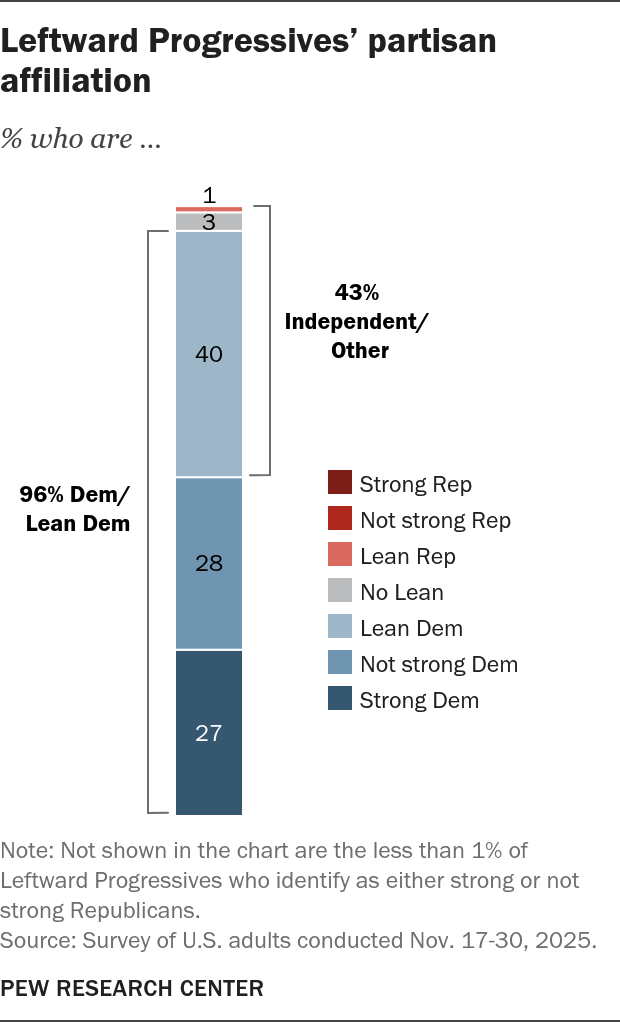
Nearly all Leftward Progressives (96%) are Democrats or independents who lean toward the Democratic Party. But that includes a large share (40%) who identify as independent or “something else” and say they lean Democratic when asked to choose between the two major parties.
They overwhelmingly describe their political views as liberal (83%), including half who say they are very liberal.
Leftward Progressives tend to be politically engaged:
- 82% follow what’s going on with government at least some of the time.
- 70% voted in the 2024 presidential election, and nearly all of those who turned out supported Kamala Harris (97%).
- 76% say it really matters who wins control of Congress in the 2026 elections.
Key attitudes and beliefs
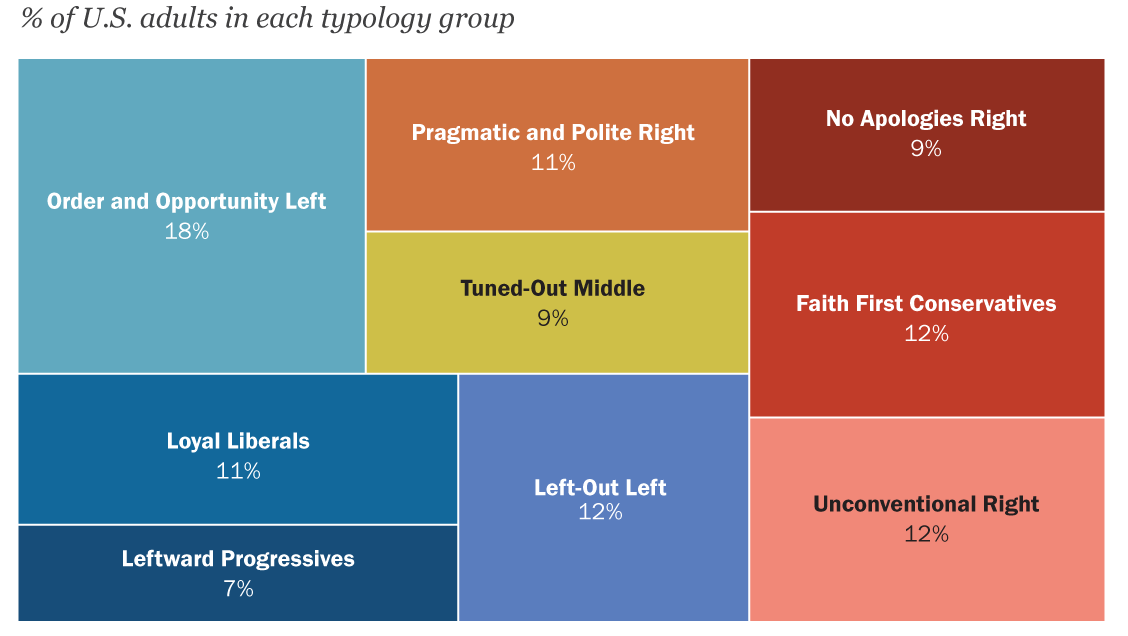
Leftward Progressives see the economic system as unfair and want the government to provide greater benefits to more Americans. About half of Americans overall (51%) say the U.S. economic system is not too or not at all fair, and that number peaks at 92% among Leftward Progressives. Across many measures, they are more likely than other groups – even other deeply Democratic groups – to back an expansive social safety net.
| Leftward Progressives | |
| Loyal Liberals | |
| Left-Out Left |
| Order and Opportunity Left | |
| Tuned-Out Middle | |
| Pragmatic and Polite Right |
| Unconventional Right | |
| Faith First Conservatives | |
| No Apologies Right |
The economic system in this country is not fair
Social Security benefits should be expanded
U.S. efforts to solve problems around the world usually make things worse
Abortion should be legal in all or most cases
Extremely/very comfortable with transgender athletes competing on sports teams that don’t match their sex at birth
They often wish there were more political parties to choose from
| Typology group | The economic system in this country is not too/not at all fair | Social Security should cover more people with greater benefits | U.S. efforts around the world usually end up making things worse | Abortion should be legal in all or most cases | Extremely/very comfortable with transgender athletes competing on sports teams that don’t match their sex at birth | They wish there were more political parties to choose from in this country |
|---|---|---|---|---|---|---|
| Leftward Progressives | 92% | 78% | 79% | 98% | 77% | 70% |
| Loyal Liberals | 77% | 51% | 50% | 95% | 28% | 50% |
| Left-Out Left | 81% | 62% | 71% | 83% | 8% | 55% |
| Order and Opportunity Left | 60% | 58% | 53% | 70% | 7% | 33% |
| Tuned-Out Middle | 42% | 47% | 46% | 49% | 20% | 24% |
| Pragmatic and Polite Right | 37% | 32% | 33% | 51% | 3% | 29% |
| Unconventional Right | 34% | 31% | 29% | 56% | 2% | 35% |
| Faith First Conservatives | 24% | 25% | 24% | 16% | 1% | 25% |
| No Apologies Right | 16% | 14% | 23% | 26% | 1% | 27% |
Leftward Progressives do not see U.S. foreign policy as solving global problems. Most (79%) say U.S. efforts to solve problems around the world are making things worse, while the public overall is roughly split between seeing U.S. efforts as making things better or worse.
Leftward Progressives hold particularly progressive stances on gender identity and transgender rights. Majorities among Leftward Progressives (92%) and Loyal Liberals (69%) say they are extremely or very comfortable with people using the pronouns “they/them” instead of “he” or “she,” and wide majorities in both groups say someone’s gender can be different than their sex at birth. But there is more divergence between the two groups when it comes to transgender athletes competing on sports teams that don’t match their sex at birth: Most Leftward Progressives (77%) are very comfortable with this, while a far smaller share (28%) of Loyal Liberals say the same.
Leftward Progressives want more political choices in the U.S., having the highest share (70%) who say they wish there were more political parties to choose from.
Democratic socialism and critique of billionaires
Leftward Progressives’ economic populist views extend to their support for democratic socialist political leaders and views about corporate profits and billionaires.

| Leftward Progressives | Loyal Liberals | Left-Out Left | Order & Opportunity Left | Tuned-Out Middle | Pragmatic & Polite Right | Unconventional Right | Faith First Conservatives | No Apologies Right | General public | |
|---|---|---|---|---|---|---|---|---|---|---|
| They like political leaders who identify as democratic socialists | 66% | 53% | 22% | 11% | 15% | 4% | 4% | 1% | 1% | 17% |
| It’s bad for the country that some people have personal fortunes of a billion dollars or more | 82% | 61% | 46% | 24% | 31% | 15% | 16% | 10% | 4% | 30% |
About two-thirds (66%) say they like politicians who identify as democratic socialists – a far higher share than for any other group. Loyal Liberals are the next-highest group (53% say this). Overall, 17% of Americans say they like politicians who adopt the label.
About eight-in-ten Leftward Progressives (82%) say it is bad for the U.S. that some people have personal fortunes of $1 billion or more. Just 30% of Americans say the same, though a narrower majority of Loyal Liberals (61%) share this view.
They are also the only group in which a majority (63%) says being extremely rich is morally wrong.
Jump to the detailed tables to learn more about Leftward Progressives and the other typology groups.


