

The 2026 Pew Research Center political typology reveals a rich portrait of how Americans view the nation’s place in the world, the strength and use of its power, its relationships with other nations and many current foreign policy hotspots.
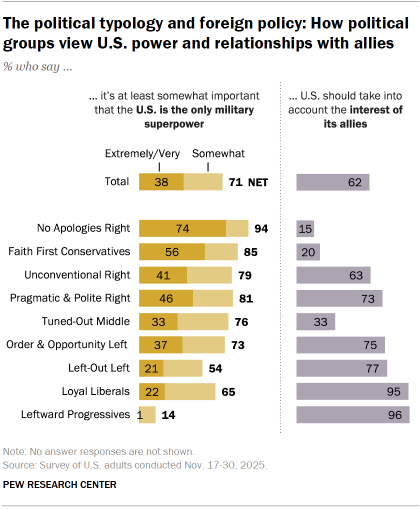
While some foreign policy dynamics in the typology track traditional ideological and partisan divides, that is not always the case. In some cases, foreign policy attitudes reveal splits within the partisan coalitions.
This analysis is part of Pew Research Center’s 2026 Political Typology. To learn more about the typology, start with the overview. To find which group is your best fit, take the quiz.
U.S. as superpower, U.S. as ally
Most Americans say it is at least somewhat important for the United States to be the only military superpower in the world (71%).
At the same time, 62% of Americans hold the view that the U.S. should take into account the interests of its allies, even if it means making compromises with them.
These are the majority positions across five of the nine political typology groups – including some groups that are more to the right in their overall values, and some that are more to the left:
- Loyal Liberals
- Left-Out Left
- Order and Opportunity Left
- Pragmatic and Polite Right
- Unconventional Right
The other groups diverge from this pattern:
- The 7% of the public that are Leftward Progressives stand apart as the only group that does not subscribe to the view that it is at least somewhat important for the U.S. to be the world’s dominant military superpower. Just 14% say this.
- They do, however, align with most other groups when it comes to the United States’ relationships with its allies. They overwhelmingly say the U.S. should take allies’ interests into account, even if it means making compromises.
No Apologies Right and Faith First Conservatives follow the opposite pattern.
- These two groups – the most supportive of President Donald Trump and the Make America Great Again movement – say that America’s military superpower status is very important. They place even more importance on this than other groups.
- But they diverge from most other groups – including other groups with a generally Republican orientation – when it comes to the country’s relationship with allies. Overwhelming majorities in both groups say the U.S. should follow its own interests, even when its allies strongly disagree.
Tuned-Out Middle also are more likely than other groups to say the U.S. should follow its own interests.
How does the U.S. compare with other countries?
For many groups in the typology, the most common view about how the U.S. compares with other countries is that it is “one of the greatest countries in the world, along with some others.”
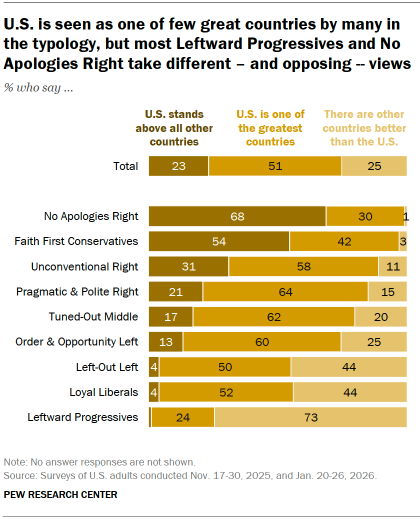
But nearly three-quarters of Leftward Progressives say instead that there are other countries in the world that are better than the U.S. They are the only group in which a majority says this. No more than 44% in any other group – even other liberal-oriented groups – hold this view.
Faith First Conservatives and – especially – No Apologies Right diverge from other groups in the opposite direction: Majorities in these groups, including 68% of No Apologies Right, say the U.S. stands above all other countries in the world.
Do other countries treat the U.S. fairly?
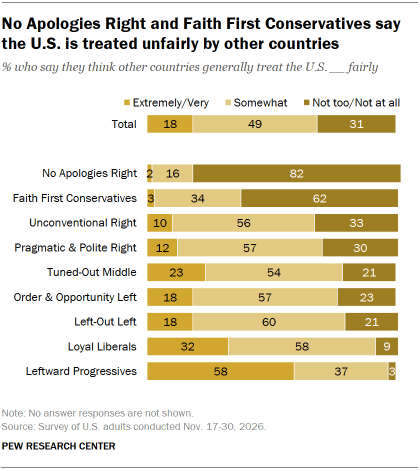
Most Americans – and majorities in six of the nine typology groups – think that other countries treat the U.S. “somewhat fairly.” But Leftward Progressives, No Apologies Right and Faith First Conservatives again stand out as having different views.
About eight-in-ten No Apologies Right (82%) say other countries do not treat the U.S. fairly – the highest share of any typology group. A narrower majority (62%) of Faith First Conservatives also say this.
On the other end of the spectrum, Leftward Progressives stand out as the only group in which a majority (58%) say other countries generally treat the U.S. very or extremely fairly. (Loyal Liberals are the next-most likely group to say this, at 32%.)
International alliances and organizations
Views about international relationships are reflected in attitudes about multilateral organizations – for instance, in views of NATO.
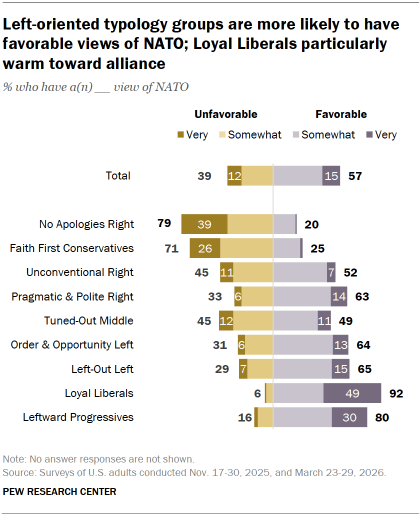
Most typology groups hold a favorable view of the international security alliance, but positive views are particularly pronounced among Loyal Liberals.
About half of Loyal Liberals – the most institutionalist-oriented of the Democratic-oriented groups – have a very favorable view of NATO.
In the other direction, No Apologies Right and Faith First Conservatives have the most negative views of NATO. Seven-in-ten or more say they have an unfavorable view.
By comparison, the two other groups that have more Republicans than Democrats – Pragmatic and Polite Right and Unconventional Right – have generally favorable views of NATO. This difference in orientation is also reflected in views of some specific foreign policy issues.
Foreign policy flashpoints: Ukraine, Israel, Iran
Several international conflicts that have emerged across the globe in recent years divide the typology groups. Some both emphasize the gaps between the coalitions and reveal divides within them.
Russia and Ukraine
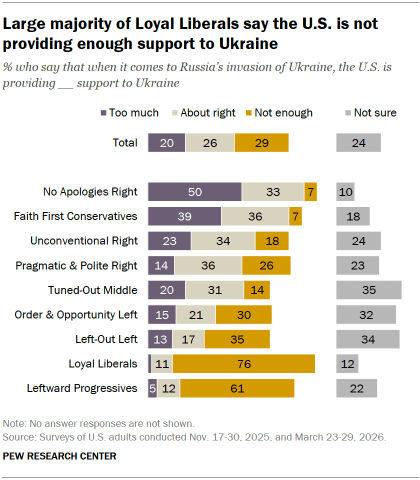
While there have been consistent partisan gaps in views of U.S. support for Ukraine following that country’s invasion by Russia four years ago, the typology provides a nuanced view of these differences.
For example, Loyal Liberals are the group most likely to say the U.S. is not providing enough aid to Ukraine – and one of the groups most likely to have an opinion on the matter. Leftward Progressives are largely aligned with Loyal Liberals on this question.
On the other side of the spectrum, 50% of No Apologies Right say the U.S. is providing too much support to Ukraine, as do 39% of Faith First Conservatives. Only small shares say it is not providing enough.
Other typology groups are more divided on this question.
Confidence in Putin and Zelenskyy
Only very small shares of adults – in any typology group – express confidence in Russian President Vladimir Putin to do the right thing regarding world affairs. Leftward Progressives and Loyal Liberals are more intensely negative than other typology groups.
But there are far bigger differences in views of whether Volodymyr Zelenskyy, the president of Ukraine, does the right thing regarding world affairs.
Shares with at least some confidence in Zelenskyy:
- No Apologies Right: 24%
- Faith First Conservatives: 22%
- Unconventional Right: 43%
- Pragmatic and Polite Right: 63%
- Tuned-Out Middle: 39%
- Order and Opportunity Left: 51%
- Left-Out Left: 51%
- Loyal Liberals: 88%
- Leftward Progressives: 79%
Israel and Gaza
Views about the conflict between Israel and Hamas in Gaza, as well as about the Israeli and Palestinian people, differ widely across the typology groups. And these views reveal splits within both groups on the left and groups on the right.
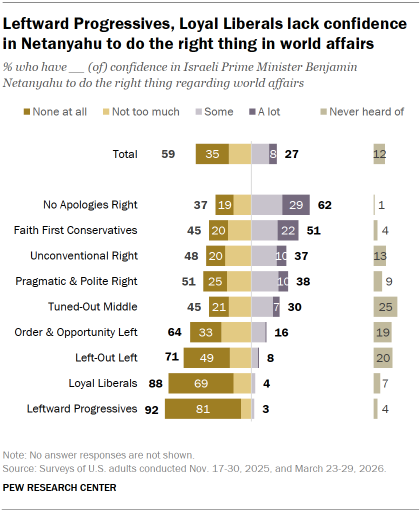
According to our March 2026 survey, Americans’ overall views of Israeli Prime Minister Benjamin Netanyahu are more negative than positive – 27% of Americans have at least some confidence in him to do the right thing in world affairs, while 59% do not.
But nearly all Leftward Progressives and Loyal Liberals say they have little confidence in Netanyahu, as do more than six-in-ten Left-Out Left and Order and Opportunity Left.
Both Pragmatic and Polite Right and Unconventional Right also are more negative than positive in their evaluations of Netanyahu. The two most conservative groups (No Apologies Right and Faith First Conservatives) offer the most positive opinions of the Israeli leader.
A survey conducted in September 2025 included questions about perceptions of the Israeli and Palestinian people – distinct from their governments.
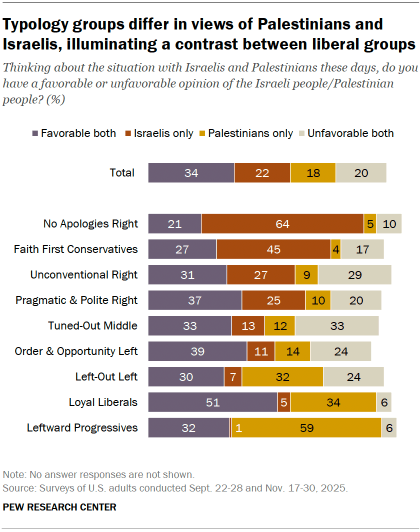
Overall, Americans expressed more favorable views of Israeli and Palestinian people than their respective governments. For example, 35% of adults said they had a favorable view of the Israeli government, while 56% of adults said they had a favorable view of Israelis.
In views of the Israeli people and Palestinian people, about a third of U.S. adults (34%) held a favorable view of both groups. Slightly smaller shares held a favorable view of only Israeli (22%) or Palestinian people (18%).
There is a clear contrast between the two most liberal groups:
A 59% majority of Leftward Progressives said they held a favorable opinion of the Palestinian people and an unfavorable opinion of the Israeli people. Roughly a third (32%) had favorable opinions of both groups.
By comparison, 51% of Loyal Liberals had a favorable opinion of both peoples. About a third said they had a favorable view of Palestinians only.
On the right, No Apologies Right stood out for being particularly likely to have positive views of Israelis alongside negative views of Palestinians.
Iran
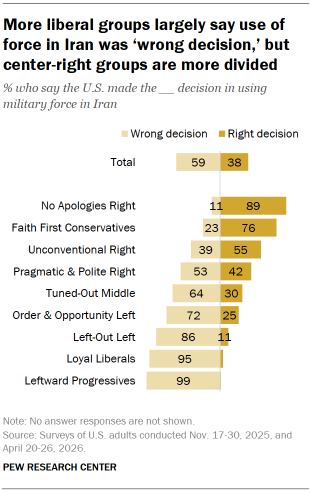
Several months into the U.S. military conflict with Iran, the typology groups see the war in terms that mostly align with their partisanship. In a survey conducted in April of this year, 59% of Americans say using military force there was the wrong decision, while 38% say it was right.
More likely to say it was the right decision:
- No Apologies Right
- Faith First Conservatives
- Unconventional Right
More likely to say it was the wrong decision:
- Leftward Progressives
- Loyal Liberals
- Left-Out Left
- Order and Opportunity Left
- Tuned-Out Middle
- Pragmatic and Polite Right


