
More than four years into the war between Russia and Ukraine, a new Pew Research Center survey finds that Republicans and Democrats continue to hold differing opinions about the conflict.
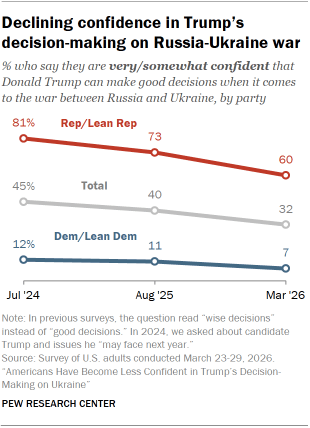
Republicans and Republican-leaning independents are more likely than Democrats and Democratic leaners to say the United States is providing too much support to Ukraine and to have confidence in President Donald Trump’s decision-making about the war.
This confidence has decreased in recent months. About three-in-ten Americans overall (32%) are very or somewhat confident that Trump can make good decisions about the war, down from 40% in August 2025. Confidence has dropped among both Republicans (-13 percentage points) and Democrats (-4 points) over this period.
Here are more key findings from the survey:
- Democrats are more likely than Republicans to say the Russia-Ukraine war is important to them personally (62% vs. 49%).
- Americans, including eight-in-ten or more in each party, still hold broadly negative views of both Russia and its leader, President Vladimir Putin. Opinion has not changed significantly over the past year.
- Half of U.S. adults have confidence in Ukrainian President Volodymyr Zelenskyy to do the right thing regarding world affairs, while 40% do not. Democrats continue to express more positive views than Republicans about Zelenskyy.
Views on a few issues have changed over time:
- More Americans now say the U.S. is not providing enough support to Ukraine in its war with Russia (29%) than said this in February 2025 (22%).
- Since 2024, the share of Americans who say the war is important to them personally has decreased.
- While Democrats are more likely than Republicans to say Russia is an enemy of the U.S., as opposed to a competitor or partner, a January 2026 survey found that partisans have moved closer together on this question: More Republicans say Russia is an enemy than in 2025, while fewer Democrats say the same.
Related: Republicans have become less likely to say NATO membership benefits the U.S.
What is the right level of U.S. support for Ukraine?
Americans have mixed views of how much support their country should provide Ukraine, now more than four years after Russia’s military invasion.
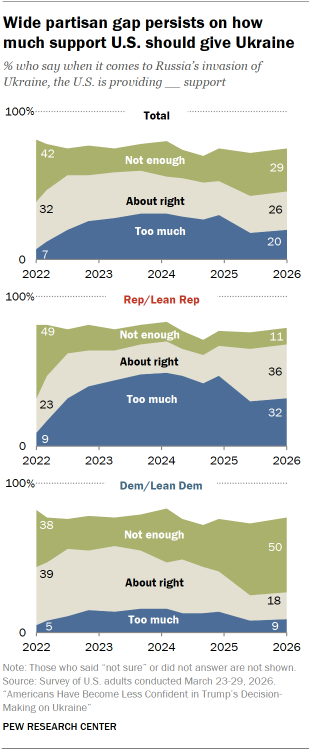
About three-in-ten (29%) say the U.S. does not provide enough support to Ukraine, 26% say it provides about the right amount of support, and 20% say it provides too much support.
The share of Americans who say the U.S. is providing too much support to Ukraine is on par with sentiment in August 2025. But it’s down overall from February 2025, when 30% said the U.S. was providing too much support. The share of Americans who say the U.S. is not providing enough support to Ukraine has also held steady since August but saw a jump between February and August last year.
Wide partisan gaps remain
Democrats are more than four times as likely than Republicans to say the U.S. is not providing enough support to Ukraine (50% vs. 11%). Though Democrats have been more likely than Republicans to say this for several years, that partisan gap increased in 2025 and remains similarly large in 2026.
Is the Russia-Ukraine war personally important to Americans?
A majority of Americans (54%) say the war is at least somewhat important to them personally, while 34% say it is not. Another 12% are not sure.
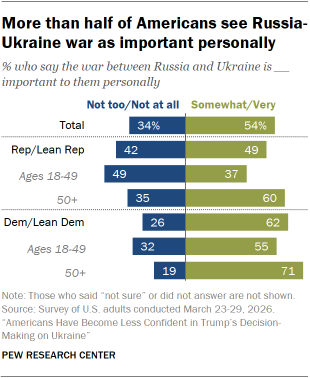
Slightly fewer Americans see the Russia-Ukraine war as important to them personally now than did in 2024 (54% vs. 59%). But the share who say the war is important to them did not change significantly from 2025 to 2026.
Democrats (62%) are more likely than Republicans (49%) to say the war is important to them personally.
Among partisans, there are significant differences by age. Democrats ages 50 and older (71%) are more likely than those ages 18 to 49 (55%) to say the war is important to them. Likewise, older Republicans (60%) are much more likely than younger Republicans (37%) to hold this view.
Do Americans have confidence in Trump to make good decisions on Ukraine?
About two-thirds of Americans (66%) are not confident Trump can make good decisions when it comes to the war between Ukraine and Russia. Confidence in Trump on this issue ranks among the lowest across the 12 foreign policy issues we asked about.
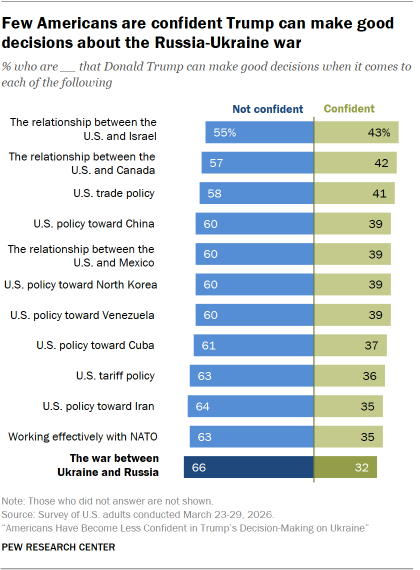
About a third (32%) say they are at least somewhat confident in Trump on the Russia-Ukraine war.
As with views of Trump’s decision-making on other foreign policy issues, opinions are deeply divided along partisan lines: 60% of Republicans say they are confident in Trump’s ability to make good decisions about the war, compared with 7% of Democrats.
Conservative Republicans are much more likely than their moderate and liberal counterparts to be confident in Trump’s decision-making on this issue (68% vs 46%).
Related: Do Americans think Trump can make good decisions about various foreign policy issues?
Confidence in Zelenskyy
Half of U.S. adults express confidence in Ukrainian President Volodymyr Zelenskyy to do the right thing regarding world affairs, while 40% lack confidence in him. Another 9% say they have never heard of the Ukrainian leader.
Views of Zelenskyy have remained stable in recent years, following a slight decline between 2023 and 2024 that occurred primarily among Republicans. While Democrats (69%) are more likely than Republicans (34%) to express confidence in Zelenskyy, Republicans’ views have warmed slightly since last year (+4 points). Roughly the same share of Democrats express confidence in Zelenskyy today as did in 2025.
Is Russia seen as an enemy, competitor or partner?
Around half of Americans (51%) say they think of Russia as an enemy of the U.S., while 39% view it as a competitor and 7% see it as a partner, according to a survey conducted in late January 2026.
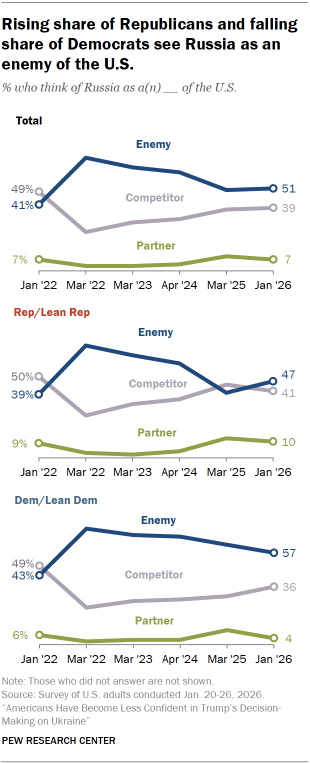
While these figures are largely unchanged from last year, the partisan divide on views of Russia as an enemy has decreased since last year, from 22 points to 10 points. This is because Republicans have become more likely to say Russia is an enemy of the U.S. over the past year (40% vs. 47%) while Democrats have become slightly less likely to say this (62% vs. 57%).
More Republicans now say Russia is an enemy than a competitor – the first time we have seen this balance of opinion among them since 2024.
Younger Americans have slightly more positive views of Russia than older Americans on this question: 40% of adults under 50 see Russia as an enemy, compared with 62% of those ages 50 and older.
Views of Russia and Putin
When asked whether they have an overall favorable or unfavorable view of Russia, 83% of U.S. adults say the latter, including large majorities of Republicans and Democrats.
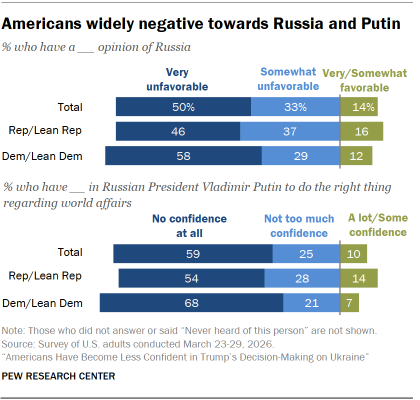
Similarly, large majorities in both parties express little or no confidence in Putin to do the right thing regarding world affairs.
Opinions of Russia and Putin have generally not changed over the past year and have been consistently negative since before the war between Russia and Ukraine began.


