

The 2026 Pew Research Center political typology identifies nine distinct groups in the American public, some highly ideological and partisan, others more ideologically mixed.
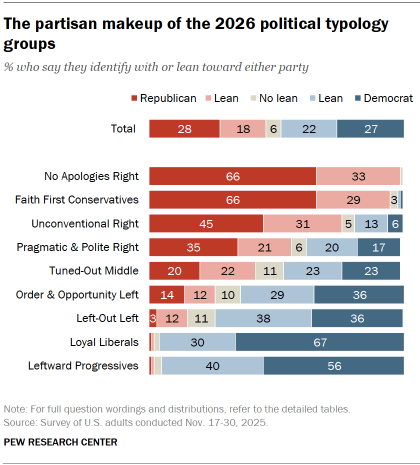
While partisan affiliation was not a factor in developing the nine typology groups, some groups are firmly in the Democratic camp, while others are overwhelmingly Republican. But several groups include sizable shares of both Republicans and Democrats – reflecting that they are made up of individuals with an ideologically mixed set of values who may be pulled in some ways to the Democratic Party and in other ways to the Republican Party.
This analysis is part of Pew Research Center’s 2026 Political Typology. To learn more about the typology, start with the overview. To find which group is your best fit, take the quiz.
Views about the effectiveness of politics and the parties themselves also vary across the typology groups – in ways that not only reflect a group’s underlying partisan composition, but also their overall feelings about the political system.
How groups feel about partisan representation
Most Americans say they are at least somewhat well-represented by one of the two major parties, but about a quarter (25%) feel that neither party represents them particularly well – and this differs across the typology groups.
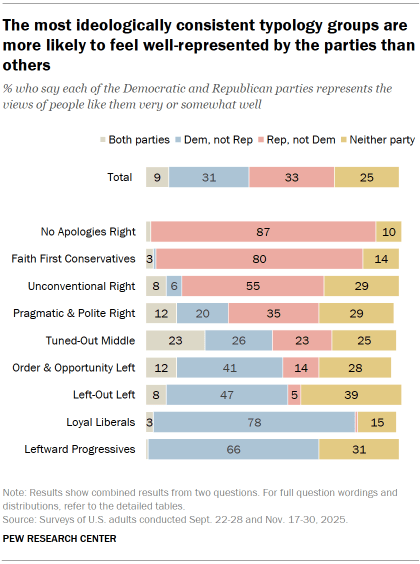
In general, groups that hold a mix of values that cross traditional partisan and ideological lines – like the Order and Opportunity Left and the Pragmatic and Polite Right – are more likely to say they don’t feel well-represented by the parties. But beyond that overall dynamic, two groups stand out.
Even as they are liberal on nearly all dimensions and almost universally back Democrats over Republicans in elections, Leftward Progressives are among the groups least likely to feel well-represented by either party – 31% say this.
Another majority Democratic group – Left-Out Left – are the most likely of all the typology groups to say neither party represents them well. Even as they hold liberal to moderate views on issues and back Democratic candidates by wide margins, nearly four-in-ten (39%) say neither party represents them well.
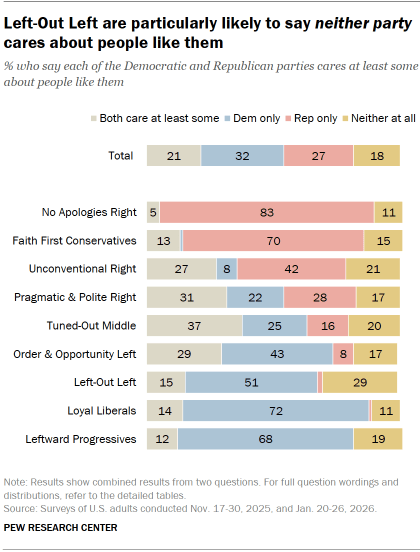
Left-Out Left are also particularly likely to say neither party cares about people like them: 29% say this, compared with 18% of the public overall and a similar share of most other groups.
Loyal Liberals and No Apologies Right are much less likely to say this (11% each).
At the same time, about two-in-ten Americans say both parties care at least some about people like them. This number is higher than the public overall among:
- Tuned-Out Middle (37%)
- Pragmatic and Polite Right (31%)
- Order and Opportunity Left (29%)
- Unconventional Right (27%)
How big are the differences between the two parties?
In the new typology, some groups see more of a distinction between the two parties than others.
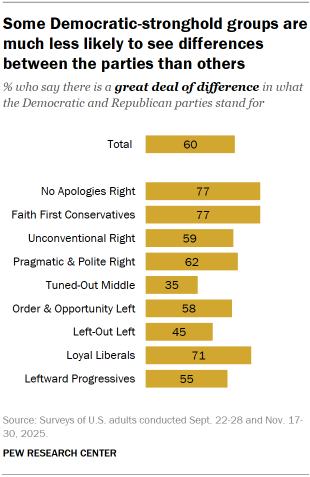
Though six-in-ten Americans say there is a great deal of difference in what the Democratic and Republican parties stand for, that rises to at least seven-in-ten among Loyal Liberals, Faith First Conservatives and No Apologies Right.
Left-Out Left again stand out on this measure. They are far less likely to see a difference than most other groups: 45% say there is a great deal of difference between the parties. Only the largely disengaged Tuned-Out Middle are less likely to see a big difference.
Feelings toward the parties
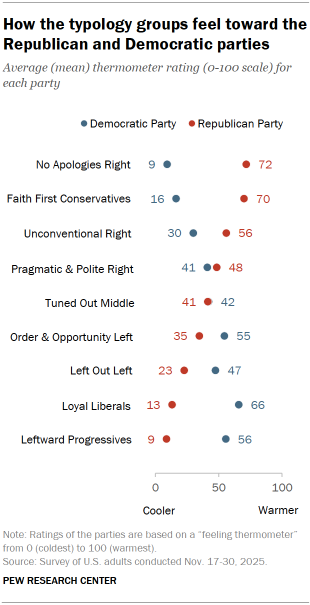
On a “feeling thermometer” rating of both parties – where values closer to 0 indicate “cool” ratings and scores closer to 100 indicate “warm” ratings – feelings about the parties largely reflect the partisan leanings of each typology group.
For example, No Apologies Right and Faith First Conservatives give the Republican Party much higher ratings than the other groups do – and also rate the Democratic Party much more negatively.
But the pattern breaks somewhat among left-tilting groups – Leftward Progressives are not nearly as warm to the Democratic Party as Loyal Liberals (56% vs. 66% respectively).


