The 10th annual joint survey of the American and German publics by Pew Research Center and Körber-Stiftung finds that views of the two countries’ relationship continue to cool among Americans, while Germans remain deeply pessimistic about the current state of bilateral affairs.
“Americans Increasingly See Strains in U.S.-Germany Ties as Germans Remain Pessimistic”
| Year | Country | Good | Bad |
|---|---|---|---|
| 2017 | United States | 68 | 22 |
| 2018 | United States | 69 | 25 |
| 2019 | United States | 74 | 17 |
| 2020 | United States | 74 | 21 |
| 2021 | United States | 85 | 12 |
| 2022 | United States | 80 | 15 |
| 2023 | United States | 86 | 10 |
| 2024 | United States | 84 | 9 |
| 2025 | United States | 71 | 24 |
| 2026 | United States | 62 | 33 |
| 2017 | Germany | 42 | 56 |
| 2018 | Germany | 24 | 73 |
| 2019 | Germany | 34 | 64 |
| 2020 | Germany | 18 | 79 |
| 2021 | Germany | 71 | 24 |
| 2022 | Germany | 82 | 13 |
| 2023 | Germany | 77 | 19 |
| 2024 | Germany | 74 | 22 |
| 2025 | Germany | 27 | 73 |
| 2026 | Germany | 21 | 77 |
“Americans Increasingly See Strains in U.S.-Germany Ties as Germans Remain Pessimistic”
One-third of Americans now say the relationship between the United States and Germany is bad, the highest such measure in a decade of surveys. Still, 62% of Americans say the relationship is good, though that’s down from 71% in 2025 and 84% in 2024.
Democrats and independents who lean toward the Democratic Party drive much of this decline. In 2024, during the Biden administration, 91% of Democrats said relations with Germany were good. But in 2025, that figure dropped to 65% and it stands at 51% today.
Among Republicans and Republican leaners, 76% now say relations are good, statistically similar to the share in 2025 (81%) but down since 2024 (84%).
“Americans Increasingly See Strains in U.S.-Germany Ties as Germans Remain Pessimistic”
| Year | Good | Bad | |
|---|---|---|---|
| Dem/Lean Dem | 2023 | 91 | 8 |
| Dem/Lean Dem | 2024 | 91 | 5 |
| Dem/Lean Dem | 2025 | 65 | 31 |
| Dem/Lean Dem | 2026 | 51 | 46 |
| Rep/Lean Rep | 2023 | 85 | 12 |
| Rep/Lean Rep | 2024 | 84 | 12 |
| Rep/Lean Rep | 2025 | 81 | 17 |
| Rep/Lean Rep | 2026 | 76 | 18 |
“Americans Increasingly See Strains in U.S.-Germany Ties as Germans Remain Pessimistic”
Germans, for their part, remain deeply skeptical of the countries’ current relations, with 21% saying they are good and 77% saying they are bad. These attitudes are similar to what they were early in the first Trump administration.
And while there are partisan divides in Germany on a variety of topics related to foreign policy – especially between Alternative for Germany (AfD) supporters and nonsupporters – Germans are relatively aligned in the view that relations with the U.S. are bad.
Are the U.S. and Germany seen as partners on global issues?
In the past few years, fewer Americans and Germans see their countries as partners on various international issues.
- Free trade: 54% of Americans say Germany is a partner on promoting free trade, down from 72% in 2023. Around a quarter of Germans (23%) say the U.S. is a partner on free trade, similar to what we found last year but down from 65% in the Biden era.
- War in Ukraine: 47% of Americans see Germany as a partner on this issue, down from 64% in 2023. About a third of Germans (35%) see the U.S. as a partner. As recently as 2023, about two-thirds of Americans and Germans said their nations were partners in dealing with the war Ukraine.
- China: 45% of Americans see Germany as a partner on China policy, down from 60% in 2023. A quarter of Germans see the U.S. as a partner in dealing with China, down from about half in 2024 (49%).
- Iran: 33% of Americans see Germany as a partner in dealing with Iran, down from 56% in 2020. The share of Germans who see the U.S. as a partner on Iran policy has shrunk as well, from 45% in 2020 to 15% today. (The 2026 surveys were conducted in September, following U.S.-Israeli military action in Iran that began in February.)
- Artificial intelligence: Newly asked this year, 43% of Americans and a quarter of Germans say the other nation is a partner in regulating AI.
“Americans Increasingly See Strains in U.S.-Germany Ties as Germans Remain Pessimistic”
| Country | Year | Dealing with China | Promoting free trade | Dealing with Iran | Dealing with the war in Ukraine | Regulating AI |
|---|---|---|---|---|---|---|
| United States | 2026 | 45 | 54 | 33 | 47 | 43 |
| Germany | 2026 | 25 | 23 | 15 | 35 | 25 |
| United States | 2025 | 52 | 62 | 54 | ||
| Germany | 2025 | 31 | 21 | 38 | ||
| United States | 2024 | 55 | 67 | 59 | ||
| Germany | 2024 | 49 | 64 | 70 | ||
| United States | 2023 | 60 | 72 | 64 | ||
| Germany | 2023 | 47 | 65 | 69 | ||
| United States | 2022 | 52 | ||||
| Germany | 2022 | 48 | ||||
| United States | 2021 | 59 | 78 | |||
| Germany | 2021 | 41 | 64 | |||
| United States | 2020 | 60 | 76 | 56 | ||
| Germany | 2020 | 28 | 35 | 45 |
“Americans Increasingly See Strains in U.S.-Germany Ties as Germans Remain Pessimistic”
Which nation is their most important foreign policy partner?
Another longstanding question on this survey asks which country is the most important partner for U.S. and German foreign policy.
Views among Germans
Attitudes in Germany are similar to last year, with 40% of Germans naming France as their most important foreign policy partner and another 24% naming the U.S. China, the European Union and Russia sit at 4% each.
“Americans Increasingly See Strains in U.S.-Germany Ties as Germans Remain Pessimistic”
| Country | Most important partner for foreign policy | % |
|---|---|---|
| United States | Canada | 13 |
| United States | U.K. | 12 |
| United States | Israel | 11 |
| United States | China | 8 |
| United States | Mexico | 3 |
| Germany | France | 40 |
| Germany | U.S. | 24 |
| Germany | China | 4 |
| Germany | EU | 4 |
| Germany | Russia | 4 |
| Germany | Canada | 3 |
“Americans Increasingly See Strains in U.S.-Germany Ties as Germans Remain Pessimistic”
Prior to the second Trump administration, most Germans said the U.S. was their most essential partner.
Most mainstream party supporters, including those who support the governing coalition – comprised of the Christian Democratic Union of Germany and the Christian Social Union in Bavaria, or CDU/CSU, and the Social Democratic Party (SPD) – as well as supporters of the Greens and the Left Party (Die Linke) say France is Germany’s most important parter.
Supporters of Alternative for Germany (AfD), however, are more likely to name the U.S. as their most important partner, ranking France second. AfD supporters also have more positive views of Russia than supporters of other parties, and 10% name Russia as their top partner – a much higher share than other groups.
Views among Americans
In the U.S., 13% name Canada as their most important partner, nearly double the amount who said the same last year (7%) and approximately tripled from 3% in 2024.
Previously, the United Kingdom was typically seen as the United States’ top partner by a large margin. In this year’s survey, 12% name the U.K., 11% name Israel and 8% name China. Only 1% of Americans say Germany is their top partner.
Democrats are far more likely than Republicans to name Canada as their top partner, while Republicans are more likely than Democrats to name Israel. This pattern conforms with other recent Center research on partisans’ views toward those countries.
Related: How Do Americans Feel About G20 Countries?
Germans are down on the ‘West’
The Germany survey also included more hypothetical questions about Germany’s reliance on the U.S. for national security and the future of the “West.” Among these findings:
- 61% of Germans say they can’t rely on the U.S. nuclear umbrella to protect their country in event of a war; 69% instead want a French or British nuclear umbrella.
- 13% want Germany to acquire its own nuclear weapons, while 86% do not.
- 35% favor Germany taking on a military leadership role in Europe, while 64% oppose this.
- 61% say Western unity – the concept of political and cultural linkage between the U.S. and Europe – no longer exists. Around four-in-ten (37%) say this unity still exists.
Which nations are seen to pose security concerns?
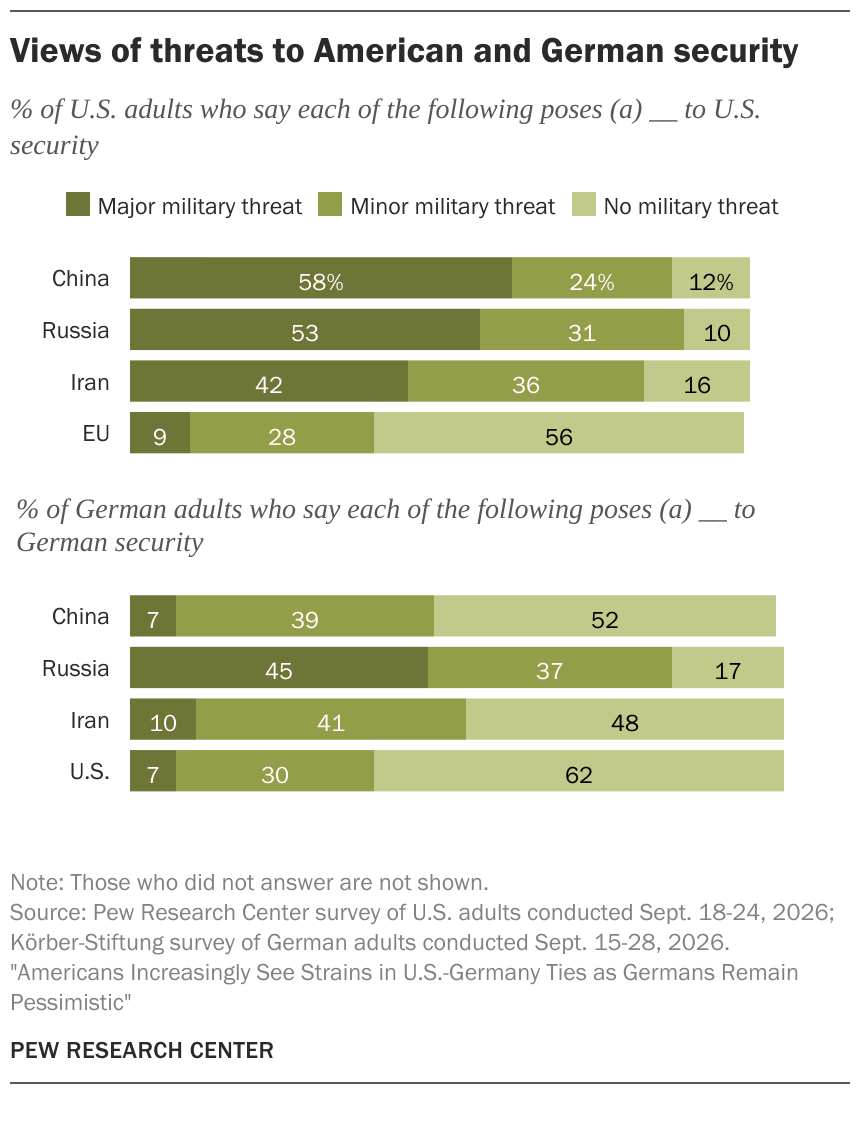
Americans remain more concerned, on balance, than their German counterparts about security threats from other countries.
“Americans Increasingly See Strains in U.S.-Germany Ties as Germans Remain Pessimistic”
| Country that may or may not pose a military threat | Country | Major military threat | Minor military threat | No military threat | Grouping |
|---|---|---|---|---|---|
| China | United States | 58 | 24 | 12 | 1 |
| Russia | United States | 53 | 31 | 10 | 1 |
| Iran | United States | 42 | 36 | 16 | 1 |
| EU | United States | 9 | 28 | 56 | 1 |
| % of German adults who say each of the following poses (a) __ threat to German security | 2 | ||||
| China | Germany | 7 | 39 | 52 | 2 |
| Russia | Germany | 45 | 37 | 17 | 2 |
| Iran | Germany | 10 | 41 | 48 | 2 |
| U.S. | Germany | 7 | 30 | 62 | 2 |
“Americans Increasingly See Strains in U.S.-Germany Ties as Germans Remain Pessimistic”
- China: 58% of Americans say China is a major threat to their nation’s security, compared with 7% among Germans. Republicans are 10 percentage points more likely than Democrats to describe China this way (64% vs. 54%).
- Russia: 53% of Americans say Russia is a major security threat, as do 45% of Germans. In Germany, CDU/CSU supporters are far more likely than AfD supporters to hold this view (67% vs. 21%). In the U.S., Democrats are 10 points more likely than Republicans to see Russia as a major security threat (59% vs. 49%).
- Iran: 42% in the U.S. see Iran as a major security threat, while 10% of Germans agree. In the U.S., Republicans are more likely to say this than Democrats (47% vs. 39%).
- U.S. and European Union: 7% of Germans see the U.S. as major security threat. Similarly, 9% of Americans describe the countries of the European Union as such. Majorities in each country do not see the other as a military threat.
More specifically on China, 64% of Americans and 60% of Germans see the country as a major economic threat, mostly unchanged from previous years.
Additionally, six-in-ten Americans see China’s rising influence in the world as mostly a bad thing for their nation, while 43% of Germans feel the same.
In recent years, the share of Germans who feel neutral about China’s growing influence has increased steadily.
In 2023, 62% of Germans said its influence was bad and 31% said it did not make a difference for their country. Today, 43% see China’s rising influence as a negative and 46% are neutral. Meanwhile, the share of Germans who say it’s a good thing has shifted only slightly (from 6% in 2023 to 10% in 2026).
Views of American troops in Germany
This year, President Donald Trump pledged to withdraw 5,000 American troops from among the approximately 35,000 troops currently based in Germany.
“Americans Increasingly See Strains in U.S.-Germany Ties as Germans Remain Pessimistic”
| Year | Country | Not important at all | Not too important | Somewhat important | Very important | Grouping |
|---|---|---|---|---|---|---|
| 2026 | United States | 5 | 10 | 34 | 46 | 1 |
| 2019 | United States | 5 | 8 | 29 | 56 | 1 |
| of German adults who say U.S. military bases with approximately 35,000 troops stationed in Germany are __ for German national security | ||||||
| 2026 | Germany | 10 | 25 | 41 | 23 | 2 |
| 2019 | Germany | 15 | 30 | 37 | 15 | 2 |
“Americans Increasingly See Strains in U.S.-Germany Ties as Germans Remain Pessimistic”
Eight-in-ten Americans say U.S. bases in Germany are somewhat or very important for U.S. national security.
By comparison, 64% of Germans say these U.S. bases are somewhat or very important for their own national security, but views vary by geography: 66% of those living in former West Germany see U.S. bases as important to their security, compared with 52% among those living in former East Germany.
Among Germans, there is an increasing sense that having American troops in their country is important for national security (up 12 percentage points since 2019).
Among Americans, 46% now see American deployments in Germany as very important to U.S. national security, compared with 56% in 2019.
Support for military assistance in Ukraine and elsewhere
More Americans support sending military assistance to Ukraine in its war with Russia (42%) than Taiwan in its struggle with China (34%) or Israel in its war with Hamas (25%). Around a quarter to a third are not sure about whether the U.S. should provide military assistance in these cases.
“Americans Increasingly See Strains in U.S.-Germany Ties as Germans Remain Pessimistic”
| Rep/Lean Rep | Dem/Lean Dem | SPD | CDU/CSU | Greens | Die Linke | AfD | |
|---|---|---|---|---|---|---|---|
| U.S. | 30 | 54 | |||||
| Germany | 64 | 67 | 73 | 61 | 11 |
“Americans Increasingly See Strains in U.S.-Germany Ties as Germans Remain Pessimistic”
Germans, for their part, are strongly opposed to military assistance for Israel (83%) or Taiwan (78%). But they are more evenly divided on Ukraine: 46% support sending military assistance and 53% oppose.
Looking at the party differences on the Ukraine conflict, Democrats in the U.S. are much more likely than Republicans to support military assistance (54% vs. 30%).
And in Germany, there is a massive gap in support for military aid to Ukraine between AfD supporters and those of other political parties. Around six-in-ten or more among supporters of the Greens, CDU/CSU, SPD and Die Linke favor sending military assistance to Ukraine, compared with 11% of AfD supporters.
Is the UN important for resolving wars and conflicts?
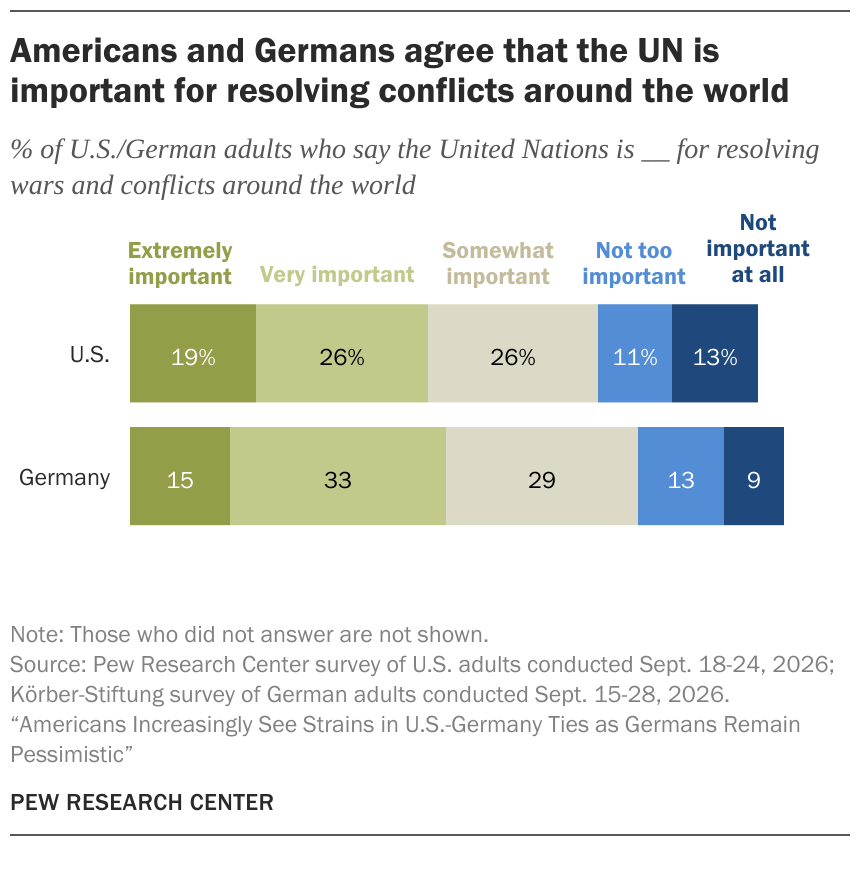
Americans and Germans generally agree that the United Nations plays an important role in resolving wars and conflicts around the world. Around half in Germany (48%) and 45% in the U.S. say that it is extremely or very important in this way.
“Americans Increasingly See Strains in U.S.-Germany Ties as Germans Remain Pessimistic”
| Extremely important | Very important | Somewhat important | Not too important | Not important at all | |
|---|---|---|---|---|---|
| U.S. | 19 | 26 | 26 | 11 | 13 |
| Germany | 15 | 33 | 29 | 13 | 9 |
“Americans Increasingly See Strains in U.S.-Germany Ties as Germans Remain Pessimistic”
Mirroring to their general attitudes toward international organizations, Democrats in the U.S. are much more likely than Republicans to say that the UN is important for resolving conflicts. Nearly six-in-ten Democrats say it is extremely or very important (58%) compared with around a third of Republicans (32%).
Similarly, 34% of AfD supporters say the UN is not very or not at all important for resolving wars and conflicts around the world, while roughly two-or-ten or fewer among the mainstream party supporters say the same.
And on a new question asking whether the rise of artificial intelligence will increase or decrease conflict around the world, both Germans and Americans are more likely to say AI will increase conflict rather than decrease it. But in the U.S., nearly four-in-ten are not sure.