
Over time, our polling has shown that Europeans who support right-wing populist parties tend to have more positive views than others when it comes to Russia and President Vladimir Putin. The opposite is true, however, for Ukrainian President Volodymyr Zelenskyy, who right-wing populists tend to view more negatively. We find similar patterns along ideological lines outside of Europe.
Here are some findings on these differences from a 37-country survey conducted Feb. 8-May 13, 2026, among 45,658 adults in 37 countries.
For more on how we classify populist parties, read Appendix B.
How right-wing populist supporters view Russia and Putin
Europeans with a favorable opinion of their country’s right-wing populist parties often hold warmer views of Russia and Putin than people with an unfavorable opinion of those parties.
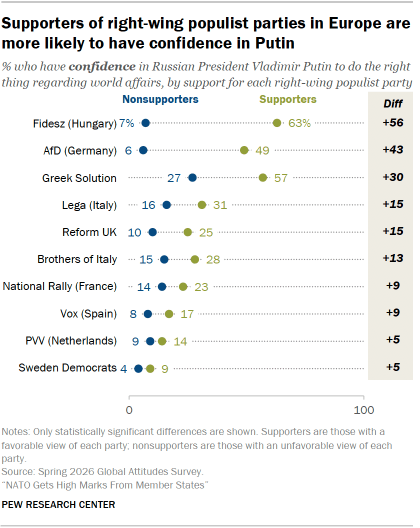
This gap is widest in Hungary, where supporters of Fidesz are significantly more likely than nonsupporters to evaluate Russia and Putin positively. (The survey was conducted prior to the 2026 Hungarian parliamentary elections.)
For example, 63% of Fidesz supporters have at least some confidence in Putin to do the right thing regarding world affairs, compared with 7% of nonsupporters – a difference of 56 percentage points. Fidesz supporters are also more likely to express a favorable view of Russia, by about the same margin (53 points).
Germans also vary greatly based on support for Alternative for Germany (AfD), with supporters about six times more likely than nonsupporters to view Russia favorably (46% vs. 8%) and roughly eight times more likely to have confidence in Putin (49% vs. 6%). A similar pattern exists across seven other European countries surveyed, though the gaps are less substantial.
How right-wing populist supporters view Zelenskyy
In some European countries, right-wing populist party supporters are also less likely than nonsupporters to have confidence in Ukrainian President Volodymyr Zelenskyy.
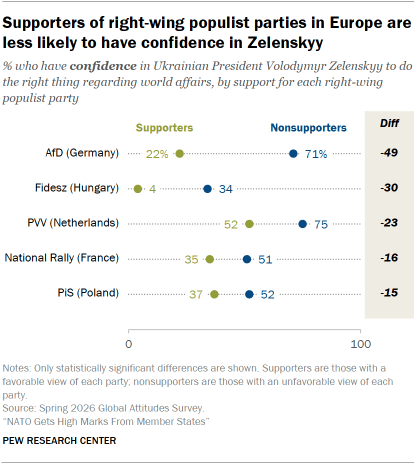
For example, in the Netherlands, roughly half of Party for Freedom (PVV) supporters are confident in Zelenskyy’s ability to do the right thing regarding world affairs, compared with three-quarters of nonsupporters.
How right-wing populist supporters view NATO
Attitudes toward NATO follow a somewhat different pattern. Right-wing populists in some European countries have especially favorable views of the organization, while in other places, they feel less positively than their peers.
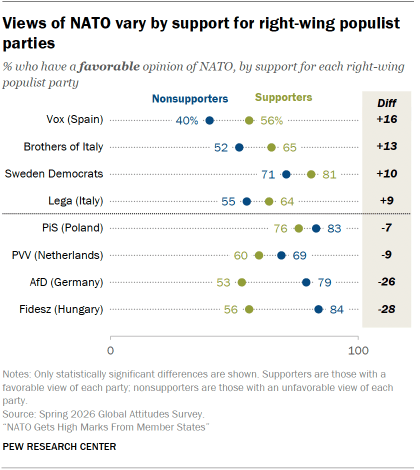
Supporters of Spain’s Vox, Sweden Democrats, Italy’s Lega and Brothers of Italy tend to express more positive views of NATO than nonsupporters. In contrast, supporters of Germany’s AfD, Hungary’s Fidesz, the Netherlands’ PVV and Poland’s Law and Justice (PiS) are less likely than nonsupporters to have a favorable opinion of NATO.
Again, the gap between supporters and nonsupporters is widest among Germans and Hungarians. Germans who support AfD are 26 points less likely than nonsupporters to express a favorable view of NATO (53% vs. 79%). And Fidesz supporters in Hungary are 28 points less likely than nonsupporters to say the same (56% vs. 84%).
Outside of Europe, views vary by ideology
Elsewhere in the world, we see similar ideological gaps on these questions.
Opinion of NATO is starkly divided along ideological lines in the United States, with liberals roughly twice as likely as conservatives to have a favorable view of the alliance (77% vs. 37%). There is a similar, though somewhat smaller, gap in Canada, with people who place themselves on the ideological left more likely than those on the right to have a positive opinion of NATO (75% vs. 61%).
American and Australian adults also vary by ideology in their views on Russia and Putin. In both countries, those on the left are less likely than those on the right to have a favorable opinion of Russia or to have confidence in Putin. Canadians on the left similarly are less likely to express confidence in Putin.
In Israel, however, the pattern is reversed, with Israelis on the ideological left more likely than those on the right to express positive opinions of both Russia and its leader. For example, 29% of those on the left have a favorable view of Russia, compared with only 2% of those on the right.
Views of Zelenskyy diverge along ideological lines in many countries. One of the widest gaps is again in the U.S., where liberals are 38 points more likely than conservatives to have confidence in the Ukrainian president (73% vs. 35%). Similar ideological patterns appear in Australia, Canada, Israel and Turkey.
But in some places, people on the left are less likely than those on the right to have confidence in Zelenskyy. This is the case in a few Latin American countries, including Argentina, Colombia and Chile.


