
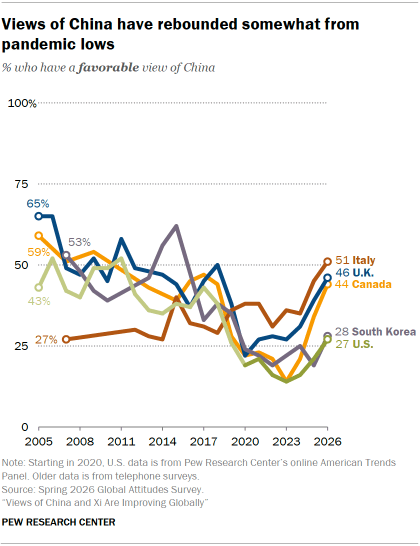
At the beginning of the decade, amid the COVID-19 pandemic, views of China were near historic lows in many countries. But in recent years, positive views have become more widespread – even reaching new highs in some places.
More people now also have confidence in Chinese President Xi Jinping to do the right thing regarding world affairs. Still, in most countries surveyed, and particularly in some of the wealthier ones, views of Xi remain more negative than positive.
In many ways, these two findings convey the broader story of how China is viewed around the world, according to a new Pew Research Center survey of more than 45,000 people in 37 countries, conducted Feb. 8-May 13, 2026:
- Public opinion of China is improving.
- Views are much more positive in the emerging economies in Latin America, Africa and parts of South and Southeast Asia than in wealthier European and East Asian countries.
- Anxieties about China remain, including concerns about its government’s respect for personal freedoms, the possibility of territorial conflict with neighbors, and interference in the affairs of other countries.
These shifts come alongside changing views of the United States. Due in part to China’s improving image – but especially due to deteriorating opinions of the U.S. – China is now seen more positively than the U.S. in 25 countries, and more people have confidence in Xi than U.S. President Donald Trump in 22 countries. Read our companion report for more on how views of China and the U.S. compare.
Favorability of China
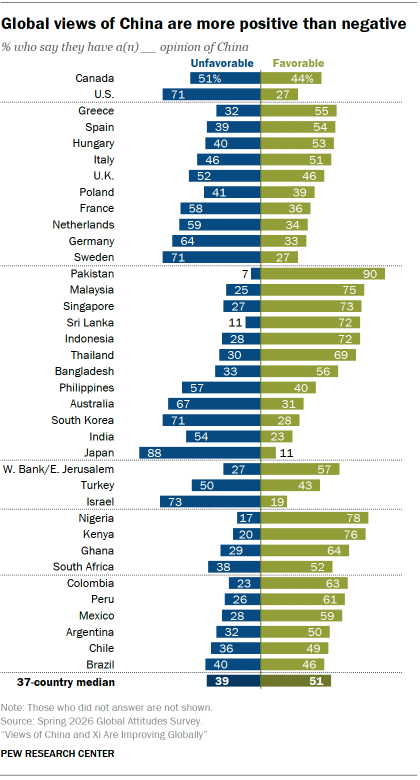
Across 37 countries surveyed, a median of 51% have a favorable view of China, while 39% have an unfavorable view.
Opinions are generally positive in sub-Saharan Africa and Latin America. They are somewhat more negative in Europe and North America.
The most positive – and the most negative – views of China are in the Asia-Pacific region. Nine-in-ten Pakistanis see China favorably, compared with just 11% of Japanese adults. Read more on views of China in the Asia-Pacific region.
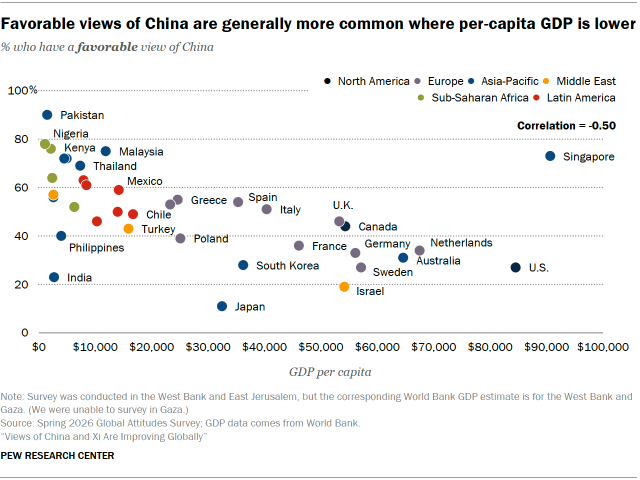
These disparate views within the Asia-Pacific region are part of a broader pattern: Views of China tend to be more negative in wealthier countries, such as Australia, Japan and South Korea. Singapore is a clear exception to this pattern, with both the highest GDP of any country surveyed and a favorability toward China that falls well above the cross-national median. Read more on views of China in high- and middle-income countries.
As has long been the case in our surveys, younger people in most countries tend to have more favorable views of China than older people. And in some countries, people who place themselves on the ideological left also tend to have more positive views of China than those who place themselves on the ideological right. (For more views by age and ideology, refer to the detailed tables in the appendix.)
Views over time
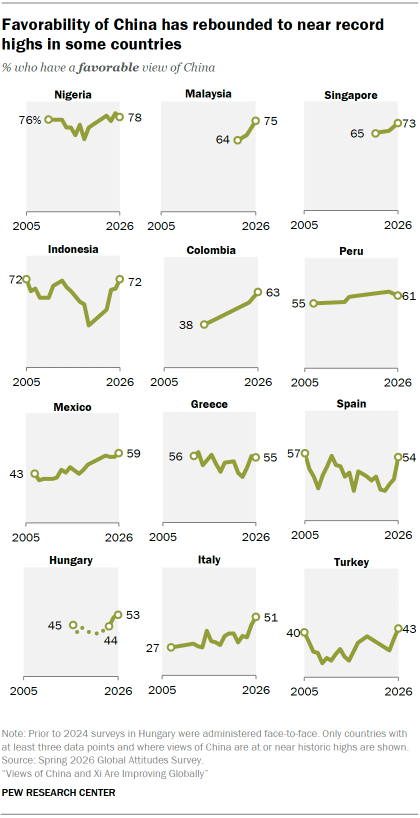
Favorability of China has increased in more than a third of countries surveyed in recent years. Many of the larger shifts have been in nations where we measured historically negative views of China in the last five years, including Australia, Canada, South Korea and Sweden.
In some places, views of China are now at or near historic highs. For example, 51% of Italians today have a positive view of China, compared with 45% in 2025 and 31% in 2022 – a rise of 20 percentage points. It’s also the first time in nearly two decades of polling that around half of Italians have seen China favorably. Similarly, in Spain, 54% of adults now have positive views of China, up 17 points since last year and the first time that Spaniards’ views of China have been net positive since 2011.
Views of China are also at or near historic highs in Colombia, Greece, Hungary, Indonesia, Malaysia, Mexico, Nigeria, Peru, Singapore, Sri Lanka and Turkey, though the length of time we have been asking the question in these countries varies. In some of these same countries, views of the U.S. are at or near record lows. Read our companion report for more on how views of China and the U.S. compare.
There are a few countries, though, where views of China have turned more negative. In Israel, for example, views of China are at historic lows – just 19% favorable, down from 33% last year and a relative high of 66% in 2019. (Center research from last year also found that few Israelis see China as helpful in working toward lasting peace between Israelis and Palestinians.)
Favorable views of China are also down in Thailand (-11 points) and South Africa (-5). But in each of these countries, more people continue to have a favorable than unfavorable view of China.
Confidence in Xi
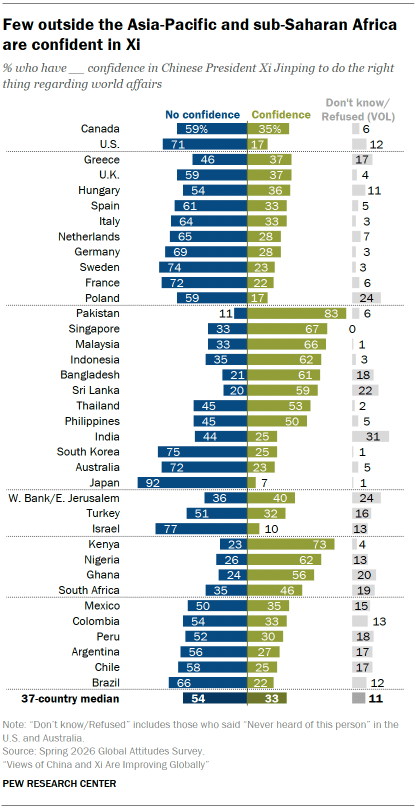
Confidence in Chinese President Xi Jinping to do the right thing regarding world affairs is similar in many ways to favorability of China:
- Confidence is highest in Pakistan and lowest in Japan and Israel.
- Positive views of his leadership are less common in wealthier countries.
- Confidence in Xi has increased in recent years in many places.
- In some countries, younger people and those on the ideological left have more confidence in Xi than older people and those on the right.
Despite recent shifts in his favor, ratings for Xi remain relatively low: Around half or more of the public view him positively in 11 of the 37 countries surveyed. Still, confidence in Xi is significantly higher than confidence in Trump in nearly two dozen countries. Read our companion report for more on how views of Xi and Trump compare.
Is China seen as respectful of the personal freedoms of its people?
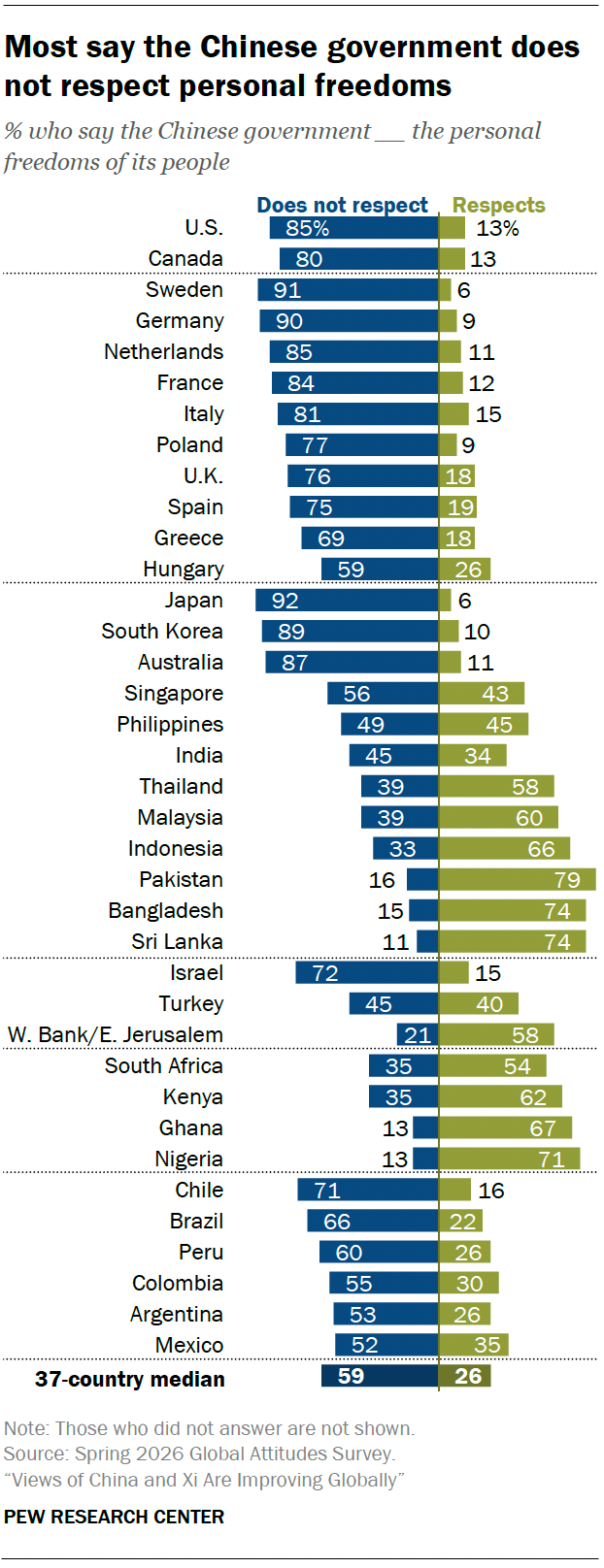
One question we have been asking for more than a decade centers on views of China’s government, and in particular, whether it respects the personal freedoms of its people.
Generally speaking, this is not an area where China is assessed positively. Only in 11 of 37 countries surveyed do around half or more say the Chinese government respects the personal freedoms of its people. In North America, almost all European nations, Japan, South Korea and Australia, around three-quarters or more say it does not respect these freedoms.
Younger adults in some places are more likely than older people to say the Chinese government respects personal freedoms. For example, 30% of British adults under 35 say this is that case, compared with 13% of those ages 50 and older.
In some countries, slightly more hold this view today than when we last asked. For example, 19% of Spaniards now say China respects the personal freedoms of its people, up from 10% in 2021.
Respect for personal freedoms is an area where views of the U.S. are more positive than views of China. But fewer now say the U.S. government respects the personal freedoms of its people than said so a few years ago. Read our companion report for more on how views of China and the U.S. compare.
China’s image in middle-income countries
Chinese foreign policy has focused significantly on middle-income countries in recent years. For example, China has built close economic and security ties with Brazil and Peru, has been a key financier of countries including Pakistan, Argentina and Indonesia, and has pursued a zero-tariff policy in Africa to compete with the Trump administration.
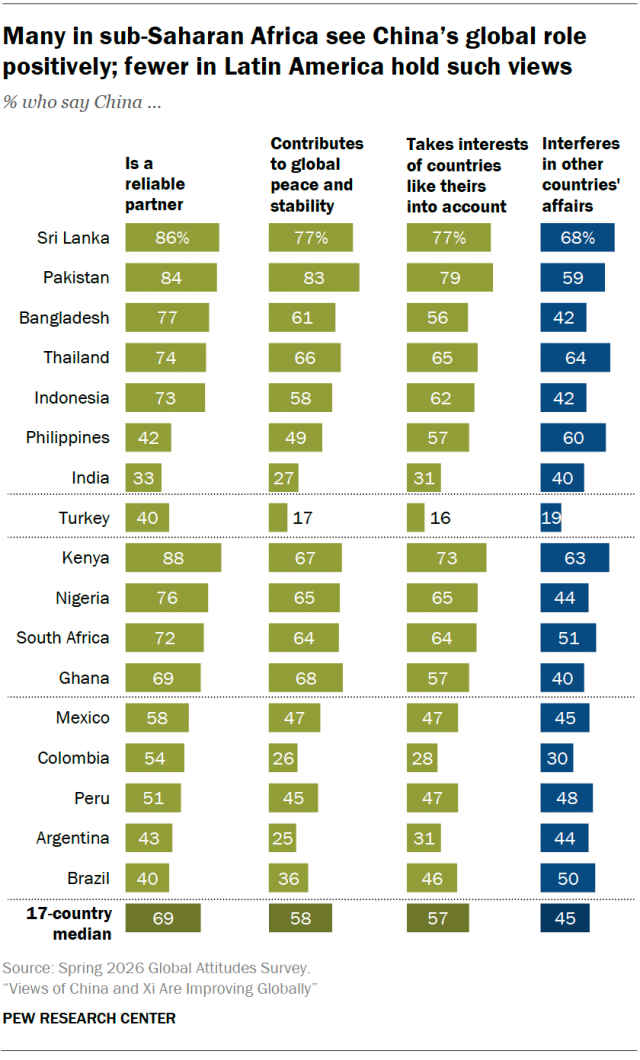
Given this dynamic, we asked additional questions in 17 middle-income countries about China’s foreign policy role and how the country is perceived as a global actor. We find that China’s image in middle-income countries is fairly strong:
- Most people say China is a reliable partner.
- More tend to say China contributes to peace and stability around the world than say it does not.
- Many think China takes the interests of countries like theirs into account when making foreign policy decisions.
Views are slightly more mixed when it comes to whether China interferes in the affairs of other countries. Shares ranging from 68% in Sri Lanka to 19% in Turkey say China interferes in other countries.
There is some regional variation: Adults in the Asia-Pacific region and sub-Saharan Africa tend to be more positive toward China on these measures than those in Latin America or Turkey. For example, around three-quarters or more in Pakistan, Sri Lanka and Kenya say China accounts for the interests of countries like their own when making international policy decisions, while 28% of Colombians and 16% of Turks agree.
India and the Philippines are outliers in the Asia-Pacific region. Only 42% of Filipinos and 33% of Indians say China is a reliable partner, compared with majorities of seven-in-ten or more in other Asia-Pacific countries. Read more on views of China in the Asia-Pacific region.
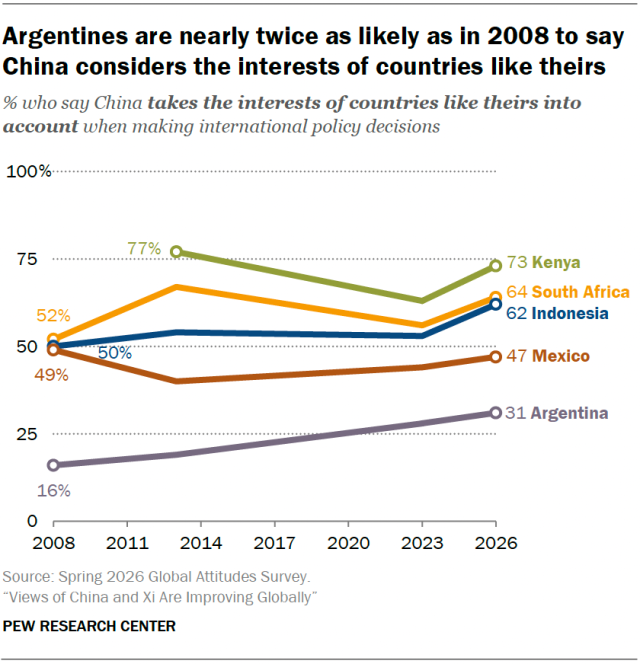
We have asked some of these questions in certain countries at previous points in time. To the degree that views have shifted, people in some places – including Argentina, Indonesia, Kenya, Mexico and South Africa – are more likely than in recent years to say China accounts for other countries’ interests. In Kenya and South Africa, more also now say China contributes to peace and stability around the world – though the opposite is true among China’s regional neighbors, including Thailand, Indonesia and the Philippines.
In Brazil, Mexico and Nigeria, fewer now say China interferes in the affairs of other countries. Notably, across all 17 of these middle-income countries, there is not one where people are more likely to say China interferes in others’ domestic affairs than to say this about the United States. For more on how views of the two superpowers compare in middle-income countries, read “People in Many Countries Now View China More Positively Than the U.S.”


