
Views of China are closely linked to how wealthy a nation is: People in high-income countries tend to have less favorable opinions of China, while those in less affluent countries tend to see China in a more positive light.
Why these countries?
We surveyed 37 countries in spring 2026, including 18 high-income countries: Australia, Canada, Chile, France, Germany, Greece, Hungary, Israel, Italy, Japan, the Netherlands, Poland, Singapore, South Korea, Spain, Sweden, the U.K. and the U.S. We also surveyed in 18 middle-income countries, as classified by the World Bank: Argentina, Bangladesh, Brazil, Colombia, Ghana, India, Indonesia, Kenya, Malaysia, Mexico, Nigeria, Pakistan, Peru, the Philippines, South Africa, Sri Lanka, Thailand and Turkey. We include the West Bank and East Jerusalem in this group for analysis, though the corresponding World Bank classification is for the West Bank and Gaza. (We were unable to survey in Gaza.)
In most middle-income countries, we conduct our surveys face-to-face, a mode that gives us more time with respondents to explore topics we might not otherwise be able to. By comparison, respondents in high-income countries tend to be surveyed over the phone or online. For more on our survey methods, read the country-specific methodologies.
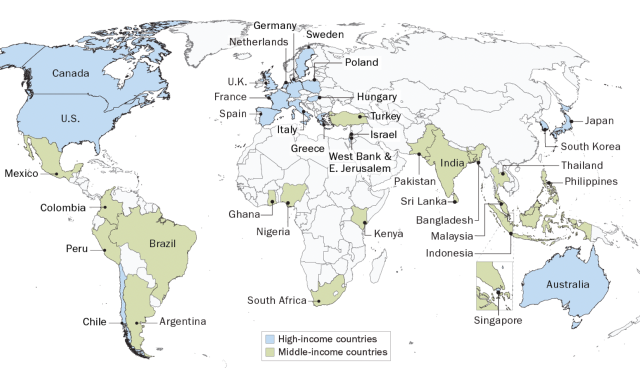
This pattern, based on surveys in 37 countries, is also evident in views of Chinese President Xi Jinping, evaluations of China’s respect for the personal freedoms of its people, concerns about potential territorial disputes, and more.
Below, we explore how attitudes about China differ in high- and middle-income countries (as defined by World Bank lending groups). Read more about views across all 37 countries surveyed.
Favorability of China
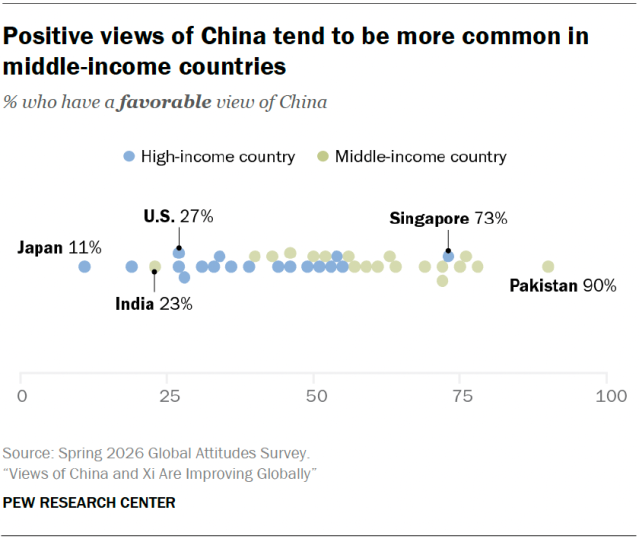
At least half of adults in most middle-income countries surveyed have a positive view of China, including around three-quarters or more in Indonesia, Kenya, Malaysia, Nigeria, Pakistan and Sri Lanka.
In many high-income countries, a majority have an unfavorable view of China, including seven-in-ten or more in Japan, Israel, the United States, South Korea and Sweden.
Confidence in Xi
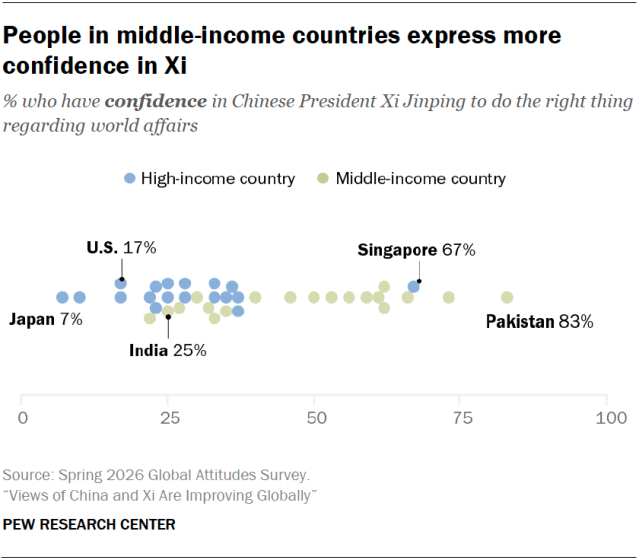
Majorities in many of the middle-income countries surveyed view Xi favorably, including around three-quarters or more in Pakistan and Kenya.
But in almost every high-income country, a majority lacks confidence in Xi, a view held by around three-quarters or more in Australia, France, Japan, Israel, South Korea and Sweden. Views of Xi are particularly low in Japan, where 92% do not have confidence in him.
Personal freedoms
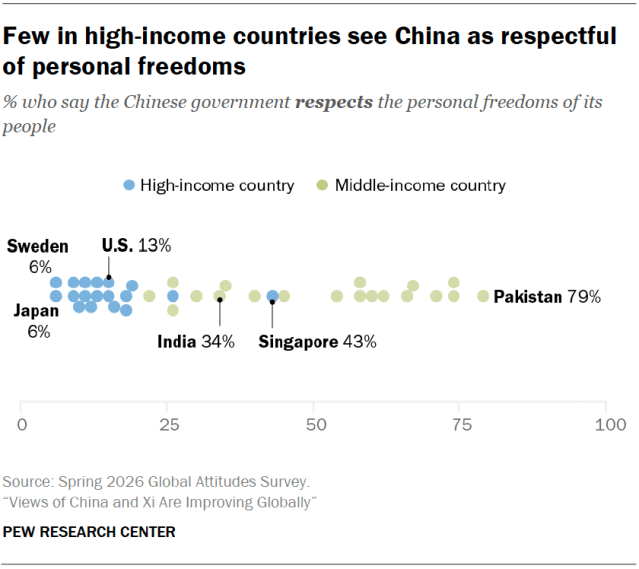
In half of the middle-income countries surveyed, majorities say the Chinese government respects the personal freedoms of its people. This includes around seven-in-ten or more in Pakistan, Sri Lanka, Bangladesh, Nigeria and Ghana. But far fewer feel this way in the Latin American countries surveyed.
Majorities in each of the high-income countries surveyed say China does not respect its people’s freedoms, including around nine-in-ten who hold this view in Japan, Sweden, Germany, South Korea and Australia.
Relationship with China
In some of the Asia-Pacific countries surveyed, we asked additional questions that touched on their nation’s relationship with China. Adults in high-income Asia-Pacific countries tend to be more likely to view China as a threat, while those in middle-income countries are more likely to describe it as an ally. Additionally, adults in high-income countries are generally more concerned about territorial disputes with China. (Outside South Korea, the data for the high-income countries in the region is from 2025.)
The Philippines is a notable exception among middle-income Asia-Pacific countries: 86% of Filipinos are concerned about territorial disputes with China, and Filipinos are more likely than any other public surveyed to describe China as a threat to their country. Read more on views of China in the Asia-Pacific region.


