
People in the Asia-Pacific region have both the most positive and most negative opinions of China. For example, 90% of Pakistanis have a favorable view of China, while 88% of Japanese have an unfavorable view.
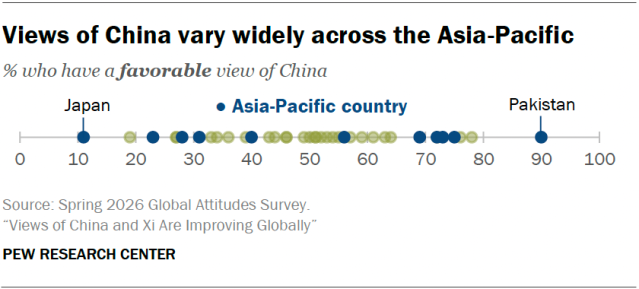
These opinions tend to diverge along economic lines. People in middle-income Asia-Pacific countries – including Indonesia, Malaysia, Pakistan and Thailand – tend to have confidence in Chinese President Xi Jinping and to think the Chinese government respects the personal freedoms of its people, while the opposite is true in wealthier Australia, Japan and South Korea. Read more on views of China in high- and middle-income countries.
As part of this regional look at China, drawn from a larger survey of 37 countries conducted this spring, we also asked people for their views on potential territorial conflicts, as well as on which country in the world is their top ally and top threat. Here, too, we find that opinions differ sharply across the region.
China as a threat and ally
In an open-ended question about which country is the top threat to their own, Filipinos are the most likely to name China (76%). China was also the most common response in Japan (53%) and Australia (52%) as of 2025, when we last asked this question there.
While China is not perceived as the top threat in South Korea – North Korea is, named by 43% of the public – it ranks second, mentioned by nearly a third (32%). The same is true in India, where 54% name Pakistan as their top threat, but China comes in second (21%).
In Bangladesh, Indonesia, Pakistan, Sri Lanka and Thailand, only around one-in-ten or fewer name China as a top threat, often ranking it below the United States. In many of these same countries, China is frequently named as a top ally in a separate open-ended question. In Pakistan, a 75% majority describe it as such.
Concern about territorial disputes
The publics most likely to name China among their greatest threats are also more concerned about territorial disputes between China and neighboring countries.
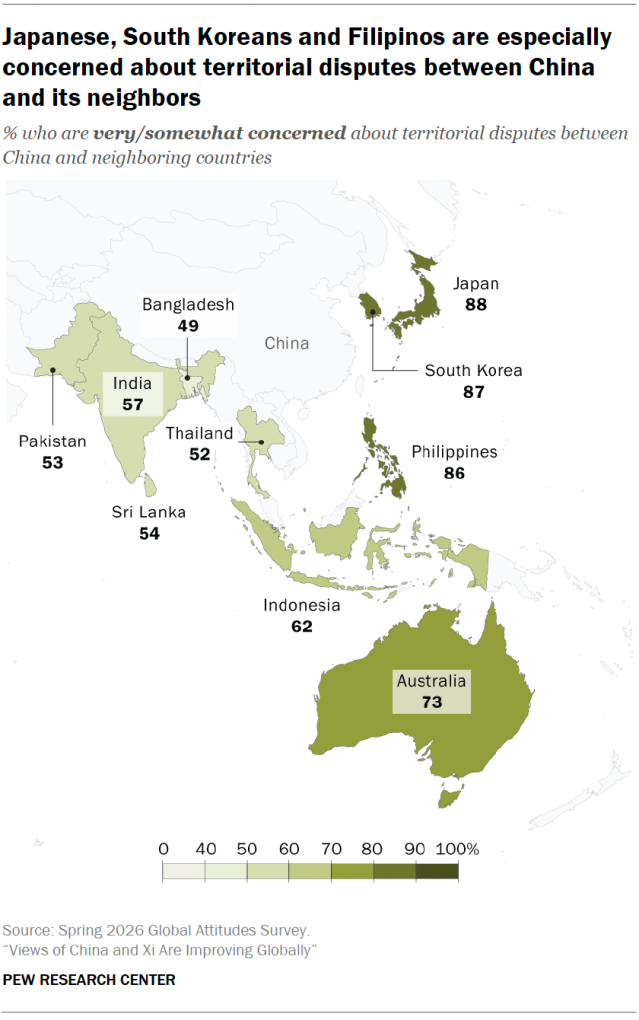
Concern about these disputes is especially strong in the East Asian countries surveyed and the Philippines, where at least eight-in-ten say they are very concerned.
These levels of concern have been high for over a decade. In Japan, the Philippines and South Korea at least eight-in-ten have been very or somewhat concerned about these disputes in surveys going back to 2014.
But concern is changing in some of the other countries surveyed, with Australian and Indian adults now less likely to express concern about territorial disputes than in 2024.
Conversely, adults in Thailand are significantly more likely to be concerned about disputes, though this share is still relatively low compared with elsewhere in the region (52% in 2026 vs. 38% in 2024).


