

Key takeaways:
- Americans are generally open to AI handling administrative and medical tasks, but they largely don’t want AI operating without human oversight.
- The largest share is open to AI – either on its own or with human review – translating for patients, and the smallest share is receptive to AI deciding on health insurance claims.
- A majority (60%) is uncomfortable with AI being used for healthcare tasks like diagnoses and treatments, double the share who says they’re comfortable (30%).
- Americans are split on whether the use of AI in health and medicine would improve or worsen patient outcomes. Young adults have grown more pessimistic since 2022.
- About half say AI would worsen the patient-doctor relationship and security of patient health information, but about three-in-ten say it could improve healthcare access. And large shares are unsure about AI’s impact.
At a time of robust discussion and research about whether artificial intelligence can do a better job than doctors, a new Pew Research Center survey finds that U.S. adults are open to AI use for certain healthcare tasks, particularly administrative work. But Americans still want a human in the loop, reviewing what AI does.
This study explores Americans’ views on how artificial intelligence may affect U.S. healthcare and their comfort with AI playing different roles at the doctor’s office. This builds on our previous research looking at AI’s impact on healthcare and health information. It’s based on a survey of 3,488 U.S. adults conducted June 22-28, 2026.
Related: Americans want transparency when AI is used in their healthcare
Americans are generally open to AI in healthcare but want human oversight
Americans’ openness to AI doing different healthcare tasks – either alone or with human review – depends on what’s at stake.
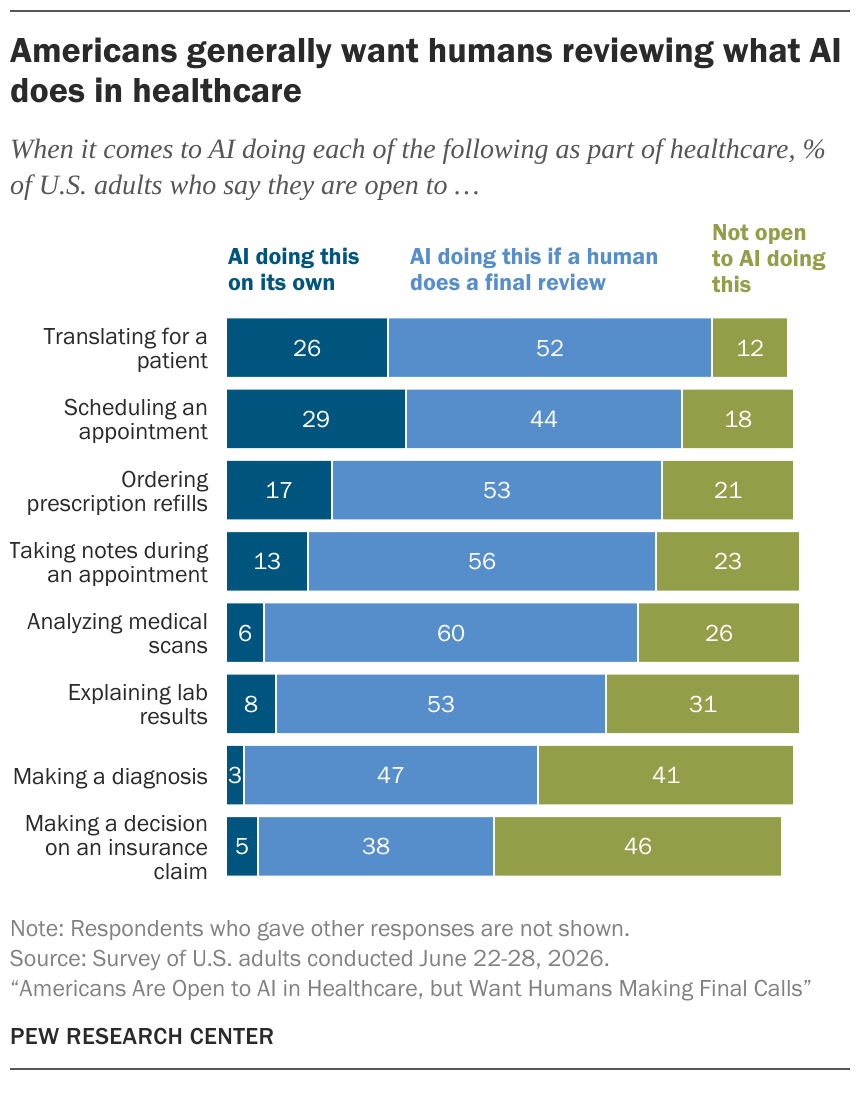
“Americans Are Open to AI in Healthcare, but Want Humans Making Final Calls”
| AI doing this on its own | AI doing this if a human does a final review | Not open to AI doing this | |
|---|---|---|---|
| Translating for a patient | 26 | 52 | 12 |
| Scheduling an appointment | 29 | 44 | 18 |
| Ordering prescription refills | 17 | 53 | 21 |
| Taking notes during an appointment | 13 | 56 | 23 |
| Analyzing medical scans | 6 | 60 | 26 |
| Explaining lab results | 8 | 53 | 31 |
| Making a diagnosis | 3 | 47 | 41 |
| Making a decision on an insurance claim | 5 | 38 | 46 |
“Americans Are Open to AI in Healthcare, but Want Humans Making Final Calls”
When asked if they are open to AI use in eight healthcare tasks we asked about, solid majorities of Americans are receptive to AI translating for patients and scheduling, either on its own or with human review. But the largest shares want a human doing a final review when AI is used for these roles.
For instance, about eight-in-ten (78%) are open to AI translating for a patient either with a human final review (52%) or AI doing this totally on its own (26%). A small share (12%) says they don’t want AI to have any part in translation.
Americans also are receptive to AI playing a role in analyzing and explaining results from medical scans and lab tests. About half or more are open to AI handling these tasks with human review.
The openness drops off for decisions that directly drive diagnoses or insurance decisions. For example, nearly half (46%) do not want AI to have anything to do with making insurance claim decisions. And just 5% are open to AI making these calls on its own, with no human review. There are similarly tepid views on AI making diagnoses on its own.
Previous Center research found a similar pattern in Americans’ expectations about being informed about AI in their healthcare: They especially wanted transparency when AI is used in more direct medical decisions, compared with back-office administrative tasks.
Greater openness among Asian Americans and those with higher education and income levels
Asian adults are more likely than those of other racial and ethnic groups to be open to AI being used for several healthcare tasks we asked about, including diagnoses and insurance decisions. For example, 65% of Asian adults are open to AI playing some role in decisions on health insurance claims, significantly higher than the shares of White (40%), Hispanic (45%) and Black Americans (39%) who are receptive. This finding aligns with previous Center research showing more positive views of AI among Asian Americans.
For all eight healthcare tasks we asked about, Americans with higher education and income levels are more likely than those with the lowest levels to be open to AI being used, either with human review or by itself. For instance, 86% of upper-income Americans are open to AI being used for prescription refills, compared with 59% of lower-income adults.
How comfortable are Americans with their own doctor using AI for things like diagnoses and treatments?
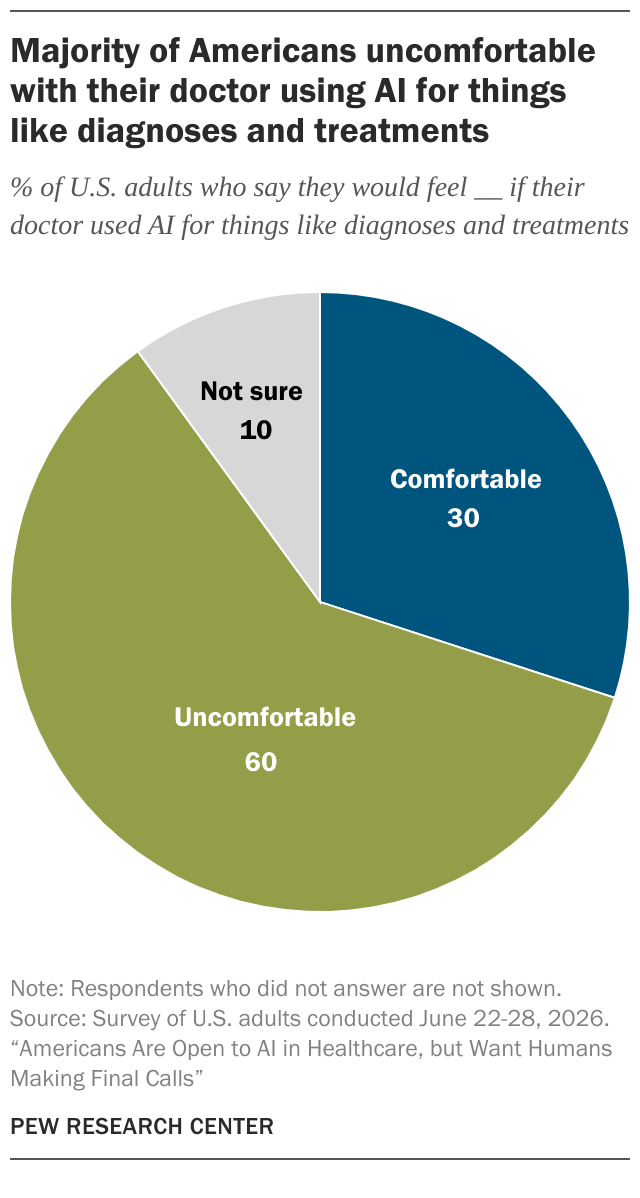
“Americans Are Open to AI in Healthcare, but Want Humans Making Final Calls”
| Share | |
|---|---|
| Comfortable | 30% |
| Uncomfortable | 60% |
| Not sure | 10% |
“Americans Are Open to AI in Healthcare, but Want Humans Making Final Calls”
Echoing their mixed reactions to AI handling higher-stakes medical decisions, a majority of Americans (60%) are uncomfortable with AI in their own healthcare for tasks like diagnoses and treatment. That’s double the share who says they’re comfortable (30%).
Americans of higher education and income levels are more likely to say they’re comfortable with AI playing this role in their healthcare. (Refer to Appendix for findings by demographic group.)
Will AI improve patient health outcomes?
Supporters say AI has the potential to transform healthcare for the better. But while Americans express some openness to AI playing a role in healthcare, they are split on whether it will lead to better patient health outcomes.
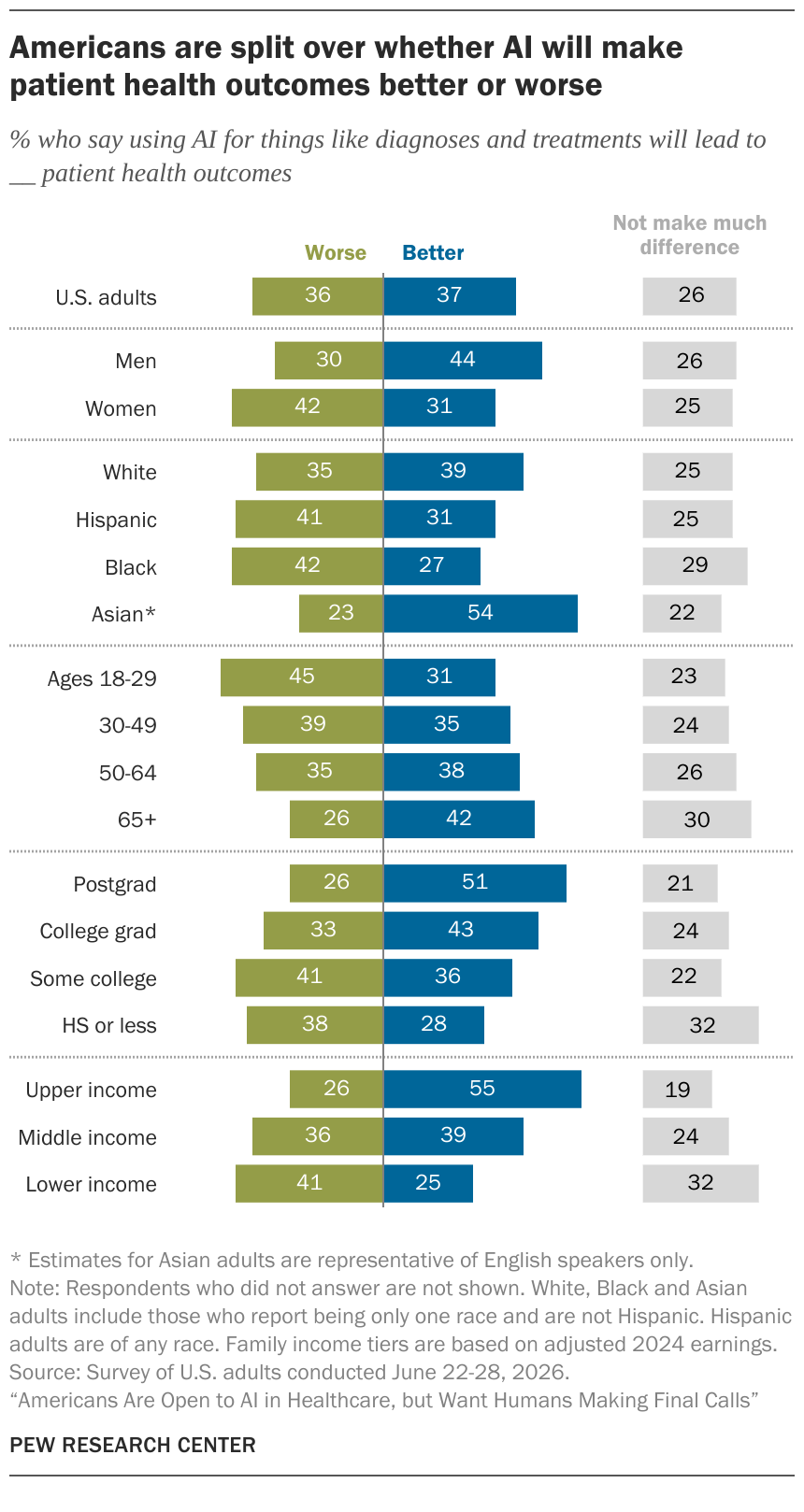
Note: Respondents who did not answer are not shown. White, Black and Asian adults include those who report being only one race and are not Hispanic. Hispanic adults are of any race. Family income tiers are based on adjusted 2024 earnings.
“Americans Are Open to AI in Healthcare, but Want Humans Making Final Calls”
| group | Worse | Better | Not make much difference | |
|---|---|---|---|---|
| U.S. adults | group1 | 36 | 37 | 26 |
| Men | group2 | 30 | 44 | 26 |
| Women | group2 | 42 | 31 | 25 |
| White | group3 | 35 | 39 | 25 |
| Hispanic | group3 | 41 | 31 | 25 |
| Black | group3 | 42 | 27 | 29 |
| Asian* | group3 | 23 | 54 | 22 |
| Ages 18-29 | group4 | 45 | 31 | 23 |
| 30-49 | group4 | 39 | 35 | 24 |
| 50-64 | group4 | 35 | 38 | 26 |
| 65+ | group4 | 26 | 42 | 30 |
| Postgrad | group5 | 26 | 51 | 21 |
| College grad | group5 | 33 | 43 | 24 |
| Some college | group5 | 41 | 36 | 22 |
| HS or less | group5 | 38 | 28 | 32 |
| Upper income | group6 | 26 | 55 | 19 |
| Middle income | group6 | 36 | 39 | 24 |
| Lower income | group6 | 41 | 25 | 32 |
Note: Respondents who did not answer are not shown. White, Black and Asian adults include those who report being only one race and are not Hispanic. Hispanic adults are of any race. Family income tiers are based on adjusted 2024 earnings.
“Americans Are Open to AI in Healthcare, but Want Humans Making Final Calls”
Some 37% of Americans say the use of AI for things like diagnoses and treatments will lead to better health outcomes. A similar share (36%) says it will lead to worse health. And 26% say AI in healthcare will not make much difference one way or the other.
The public’s views on this have largely remained unchanged since we last asked this in 2022.
Some groups are more optimistic than others
Men, Asian adults, adults 65 and older, and those with higher levels of education and income are more positive than negative about the impact of AI on patient health.
For example, 55% of upper-income adults say AI will lead to better patient health outcomes. Far fewer say it will lead to worse outcomes (26%) or will not have much of an impact (19%).
In comparison, a quarter of adults with lower incomes say the use of AI will lead to better health outcomes. A larger share (41%) says it will make it worse, and 32% don’t think it will make much difference.
Young adults have grown more pessimistic
Younger adults are among the most pessimistic about the impact of AI on patient outcomes. For example, 45% of adults under 30 say the use of AI will lead to worse health outcomes, compared with 31% who say it will lead to better outcomes.

“Americans Are Open to AI in Healthcare, but Want Humans Making Final Calls”
| Ages 18-29 | 30-49 | 50-64 | 65+ | |||||
|---|---|---|---|---|---|---|---|---|
| Better | Worse | Better | Worse | Better | Worse | Better | Worse | |
| 2022 | 44 | 29 | 39 | 32 | 33 | 39 | 34 | 33 |
| 2026 | 31 | 45 | 35 | 39 | 38 | 35 | 42 | 26 |
“Americans Are Open to AI in Healthcare, but Want Humans Making Final Calls”
But this wasn’t always the case. In 2022, younger adults were on balance more optimistic toward the use of AI in healthcare. There’s been an uptick in negativity among the youngest adults – from 29% in 2022 to 45% in 2026.
Adults ages 65 and older take the opposite view: The largest share (42%) says the use of AI will better patient health. This share has increased 8 percentage points since we last asked this in 2022.
Still, the oldest adults are not wholesale positive: 26% still say AI will worsen patient health, and 30% say it will not make much difference.
Related: Young adults in the U.S. are increasingly wary of AI, concerned it will take jobs
Hispanic and Black adults have also become more pessimistic since 2022, with the shares who say the use of AI will worsen health outcomes increasing 11 and 12 points, respectively.
Do Americans think AI will worsen or improve healthcare availability, costs and patient-doctor relationships?
AI’s impact on healthcare may extend beyond just health outcomes, potentially transforming patient-doctor relationships and access and privacy.
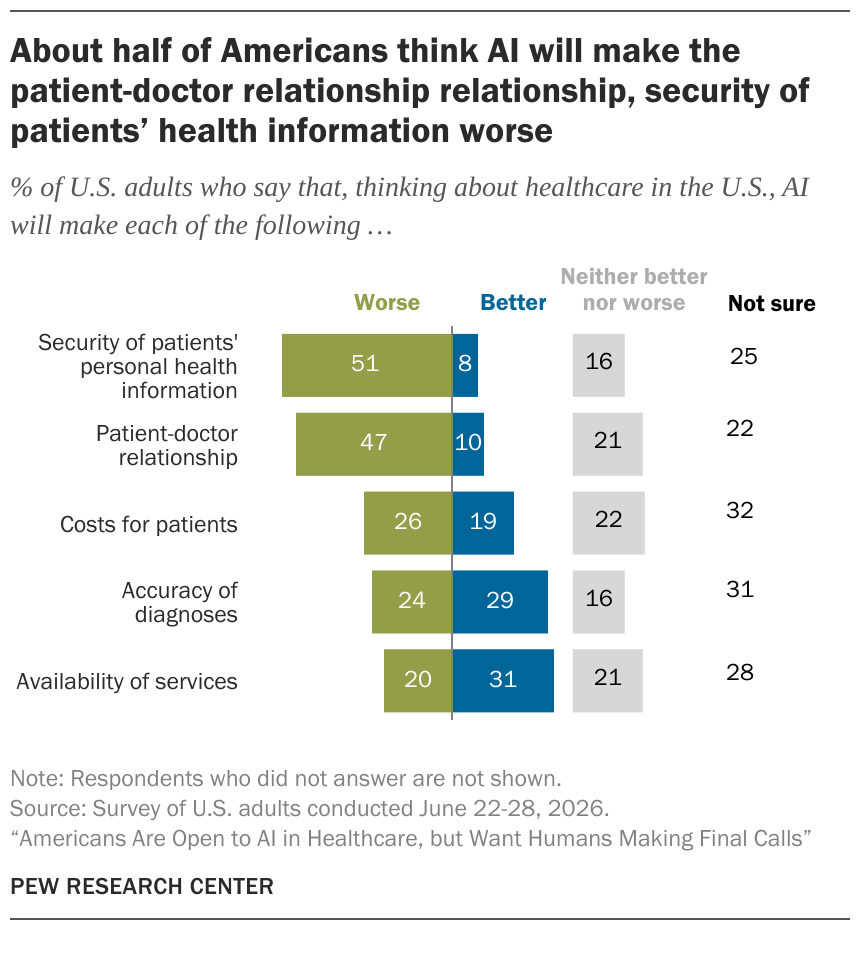
“Americans Are Open to AI in Healthcare, but Want Humans Making Final Calls”
| Worse | Better | Neither better nor worse | Not sure | |
|---|---|---|---|---|
| Security of patients’ personal health information | 51 | 8 | 16 | 25 |
| Patient-doctor relationship | 47 | 10 | 21 | 22 |
| Costs for patients | 26 | 19 | 22 | 32 |
| Accuracy of diagnoses | 24 | 29 | 16 | 31 |
| Availability of services | 20 | 31 | 21 | 28 |
“Americans Are Open to AI in Healthcare, but Want Humans Making Final Calls”
When asked about AI’s impact on five dimensions of healthcare, 22% to 32% of Americans say they aren’t sure how AI may affect them.
But when they do express opinions one way or the other, Americans are especially pessimistic about AI’s impact on the security of patients’ health information and the patient-doctor relationship.
Americans have concerns about data privacy when it comes to AI. When it comes to safeguarding sensitive patient data, Americans aren’t confident their personal information will be protected as AI reshapes healthcare. Far more say AI will make the security of personal health information worse (51%) than say it will make it better (8%).
And at a time when many see AI eroding human connection in general, 47% say AI will make the relationship between patients and their doctors worse, compared with 10% who say it will make it better.
Views of AI’s impact on the costs of healthcare also tilt negative, but by a much narrower margin: 26% say AI will make costs worse, while 19% say AI will make it better.
But it’s not all negative. Americans see benefits to the use of AI in some areas of healthcare. On the positive side, more say AI will improve access to healthcare services than worsen it (31% vs. 20%). Views of AI’s effect on the accuracy of medical diagnoses also lean more positively, though opinions are more closely divided.
Who do Americans trust to make sure AI is used in patients’ best interest?
AI is being used in healthcare faster than policies are being written to regulate it. And Americans don’t have much confidence in many institutions and actors to make sure AI is used in patients’ best interests.

“Americans Are Open to AI in Healthcare, but Want Humans Making Final Calls”
| Not too much/None | Some | A great deal/Quite a bit | |
|---|---|---|---|
| Health insurance companies | 58 | 14 | 11 |
| The federal government | 55 | 16 | 11 |
| AI companies | 50 | 18 | 16 |
| Their state government | 50 | 20 | 11 |
| Hospital leadership | 42 | 26 | 16 |
| Doctors | 25 | 34 | 26 |
“Americans Are Open to AI in Healthcare, but Want Humans Making Final Calls”
For four of six actors we asked about – health insurance companies, federal government, AI companies and state government – half or more Americans have low or no confidence they can ensure healthcare AI is putting patients first.
Americans tend to express more confidence in doctors: 26% have a great deal or quite a bit of confidence in them, while 25% have not too much or none. The largest share (34%) has some confidence in doctors.


