Pew Knight Initiative
The Pew-Knight Initiative supports new research on how Americans absorb civic information, form beliefs and identities, and engage in their communities.
Pew Research Center is a nonpartisan, nonadvocacy fact tank that informs the public about the issues, attitudes and trends shaping the world. Knight Foundation is a social investor committed to supporting informed and engaged communities. Learn more >
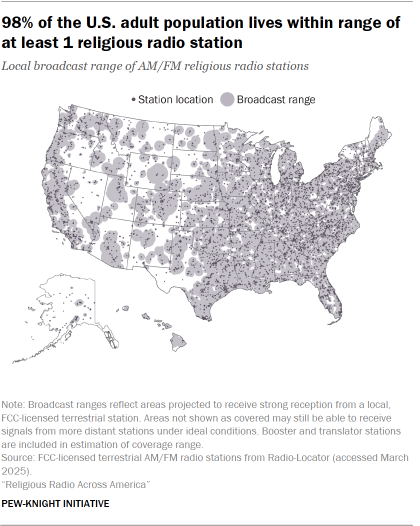
Faith-based radio has a long history in America, dating back to the earliest broadcasts of Sunday services at the beginning of the 1920s. Today, there are more than 4,000 terrestrial religious radio stations in the United States, according to a Pew Research Center analysis from the Pew-Knight Initiative. That’s about a quarter of the roughly 17,000 AM and FM stations in the U.S. that are licensed by the Federal Communications Commission. Almost all U.S. adults – 98% – live within the local coverage range of at least one religious radio station.
Against this backdrop, we set out to study the landscape of religious radio in the U.S.:
- How widespread are religious stations across the U.S. and in each state?
- Who listens to various types of religious programming and why?
- What kind of programming is broadcast on religious radio stations?
To answer these questions, we analyzed data on the location and broadcast range of every terrestrial religious radio station in the country. We also recorded and analyzed around 440,000 hours of streamed broadcasts from religious stations in July 2025, and we surveyed 5,023 U.S. adults from June 9 to 15, 2025, to understand their experiences with religious audio programming.
Key findings
- Religious radio stations can be heard in every major population center in the country, and their combined broadcast range covers most of the U.S. landmass. Most U.S. adults can tune into several different religious radio stations on the FM or AM dial from their home address. An overwhelming majority of these are Christian stations.
- 45% of U.S. adults say they ever listen to religious audio programming, and about three-quarters of those listeners at least occasionally tune in on the radio. Podcasts and streaming services are also important sources of religious programming: Seven-in-ten listeners say they get religious programming this way, and nearly all of the most popular radio shows are also available on these platforms.
- Political commentary makes up only a modest share of all broadcast content on many religious radio stations. But it’s a major focus for some stations and for some listeners. Stations that discuss politics and current events the most tend to present this material in classic “talk radio” formats like host commentary or call-in segments, rather than news reads. Their programming is also much more likely to take a stance on the issues of the day, as opposed to covering them in a neutral way.
- Religious radio programming addresses a wide range of topics through a religious lens. Stations on average spend several hours per day discussing topics like lifestyle and personal development, family and parenting, and health and wellness.
- Certain talk shows and music artists blanket the religious radio airwaves. Several popular shows are syndicated on as many as half of all religious radio stations nationwide. And the top 1% of music artists accounted for more than half of all song plays on religious radio in July 2025.
How religious radio stations describe themselves
As part of this project, we examined the website of every U.S. religious radio station that has one to learn how they describe themselves and their role.1
“Religious Radio Across America”
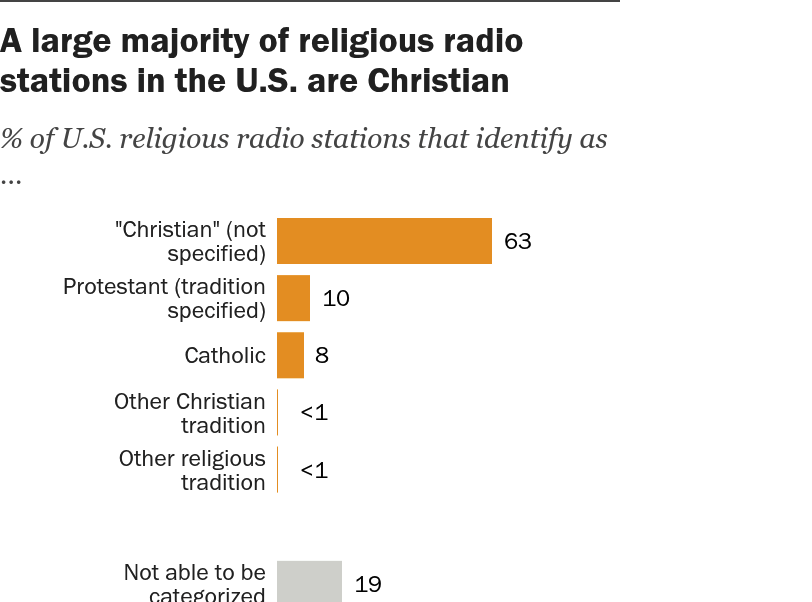
A large majority of religious radio stations in the U.S. are Christian. The largest share (63% of religious stations overall) identify as “Christian” without explicitly aligning with a tradition or denomination within Christianity. Another 10% identify with a specific Protestant denomination (such as Baptist or Pentecostal), and 8% identify as Catholic.
Only a handful of stations could be reliably identified as belonging to a different Christian tradition or to a non-Christian faith. And around one-in-five either don’t have a station website or don’t have enough information on their website to assign them to a religious tradition.
Most religious radio stations describe evangelism as part of their mission. About three-quarters (77%) of stations with an “About us” page or mission statement on their website mention evangelism or spreading the gospel as a key component.
These pages often describe the content the station broadcasts. Some of the more common descriptions include:
- “Uplifting” (36% of station websites mention this)
- “Family friendly” (21%)
- Provides guidance or life advice (19%)
- Helps listeners keep up with news and current events (11%)
These descriptions broadly align with the reasons listeners give for tuning in to religious audio programming.
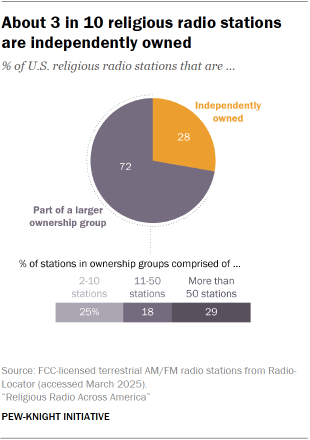
Most stations are part of larger syndicates. Around three-in-ten religious radio stations in the U.S. (28%) are independently owned. The other 72% belong to multistation ownership groups of varying sizes, according to our analysis of their FCC licensing information. Religious stations within the same ownership group often share a single online feed and broadcast the same content.
What religious radio stations broadcast
On average, religious radio stations across the U.S. devote about half their broadcast time to music (which includes everything from recorded songs to program theme music and advertising jingles) and half to spoken content. Overall, 81% of spoken content is voiced by a male speaker.2
The spoken content on religious radio largely falls into two categories: classic “talk radio” programming such as host-led discussions and commentaries, interview segments with guests and audience call-ins, and religious services or sermons. Less prominent types of spoken content include ad reads, scripted audio dramas or narratives, and live updates such as news reads, traffic or weather.
“Religious Radio Across America”
| Segment topics | Duration in hours of discussion that includes religious references or teachings | Duration in hours of discussion that does not include religious references or teachings | avg_hours_per_day_topic_total |
|---|---|---|---|
| Lifestyle and advice | 1.87 | 0.30 | 2.167255006528808 |
| News and politics | 1.46 | 0.69 | 2.142860768966119 |
| Family, parenting and education | 1.68 | 0.31 | 1.9907717056754475 |
| Health and wellness | 0.50 | 0.25 | 0.7485556227605635 |
| Pop culture and sports | 0.35 | 0.24 | 0.5822519298763266 |
| Business and finances | 0.20 | 0.24 | 0.4432889253419955 |
| Science and technology | 0.20 | 0.08 | 0.2847164910118464 |
“Religious Radio Across America”
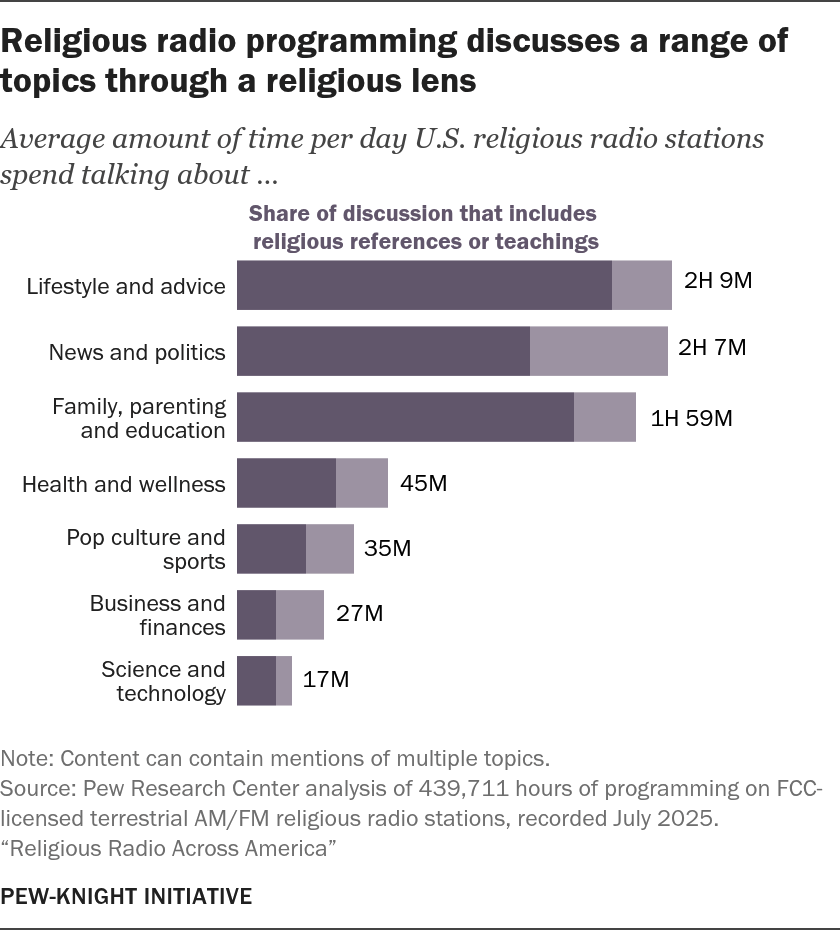
Religion is a constant throughline on these broadcasts, though it is often interwoven with other topics. The overwhelming majority of broadcast time dedicated to spoken content (86%) contains references to religion or religious teachings, even if that’s not always the primary focus. Across the religious radio landscape, that’s over 10 hours of religion-related discussion per station per day, on average.
Religious stations also discuss other issues and themes within a broadly religious context. Three topics in particular are mentioned in around two hours of programming per station per day, on average:
- Advice about lifestyle or personal development
- Social commentary or discussions of politics and current events
- Discussions of family, parenting and education
Less common subjects include health and wellness, entertainment, pop culture and sports, business and finance, and science and technology.
A few popular music artists and talk shows dominate religious radio
Religious stations play music from a wide range of artists and genres, but the most widely heard genres by far are contemporary Christian music (CCM) and worship music. A relatively small playlist of popular, established artists feature prominently: 16% of all the songs we examined over the month of July 2025 were by just 10 individuals or bands.
Similarly, the most popular talk programs appear on stations across the country. As many as half of all stations nationwide air shows like Unshackled, Turning Point and Focus on the Family. Nearly all of these shows can also be heard off the airwaves, too. Of the 100 shows that appear on the most stations nationwide, 99 of them are also available on demand online or as podcasts.
Beyond the national average, the content mix on individual stations varies widely
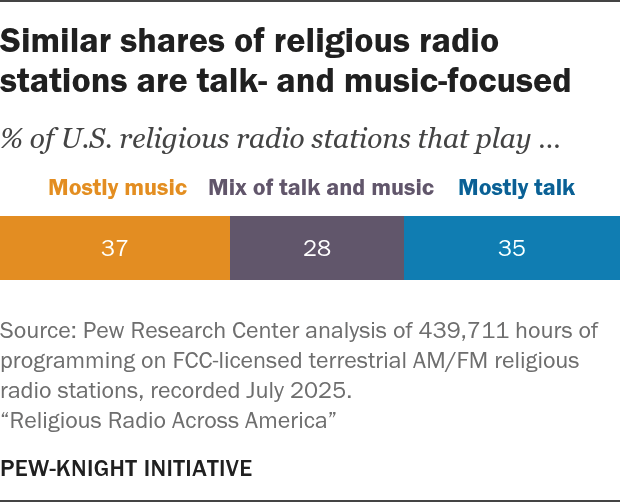
On average, U.S. religious radio stations air an even mix of music and talk, but that conceals a lot of variation between individual stations. Some 37% primarily broadcast music, while 35% focus primarily on talk programming. Another 28% play a more equal mix of the two.
“Religious Radio Across America”
| Mostly music | Mix of talk and music | Mostly talk | |
|---|---|---|---|
| Share of stations that play … | 37% | 28% | 35% |
“Religious Radio Across America”
News and politics on religious radio
Beyond how they mix music and talk programming, religious radio stations are also quite diverse in their attention to specific topics, including news, politics and current events.
In our survey of U.S. adults, most people who listen to religious audio programming do not point to news and politics coverage as a core reason for doing so. Just 14% of listeners say that keeping up with current events is a major reason they tune in to religious programming, although 40% say it’s at least a minor reason.
These survey findings may seem hard to square with the fact that religious radio stations spend around two hours a day on average discussing politics, current events and social issues. But this average hides quite a bit of station-to-station variation.
Some 30% of religious radio stations spend less than half an hour per day talking about news and politics, with many dedicating only a few minutes a day to these issues. A nearly identical share of stations (29%) devote more than two and a half hours each day to discussions of politics and current events. On some of these stations, this content is in focus for 10 or more hours per day.
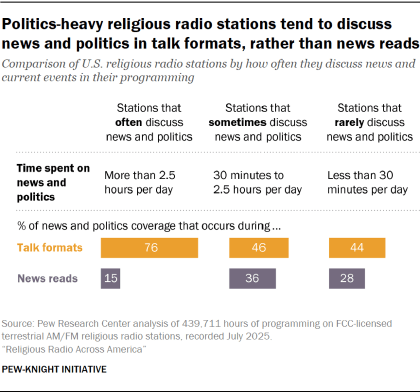
On stations that discuss news and politics often, a sizable majority of their coverage is presented in long-form talk radio formats like interviews or host commentary. On stations with less of a political focus, these topics are comparatively more likely to come up during short news reads.
Read more about how Americans view political commentary in the religious programming they listen to.
How religious radio discusses prominent political figures and issues
To better understand how religious radio stations across the country discuss the issues of the day, we analyzed around 440,000 hours of audio collected in July 2025 and looked for places where they mentioned one of 11 specific issues, entities or people:
- The economy, crime and immigration, which Americans often place among the most important issues facing the country when surveyed.
- Two social and cultural issues – abortion and LGBTQ rights.
- President Donald Trump and former President Joe Biden, as well as the Republican and Democratic parties.
- Modern-day Israel and the Palestinian territories, including references to the war in Gaza.
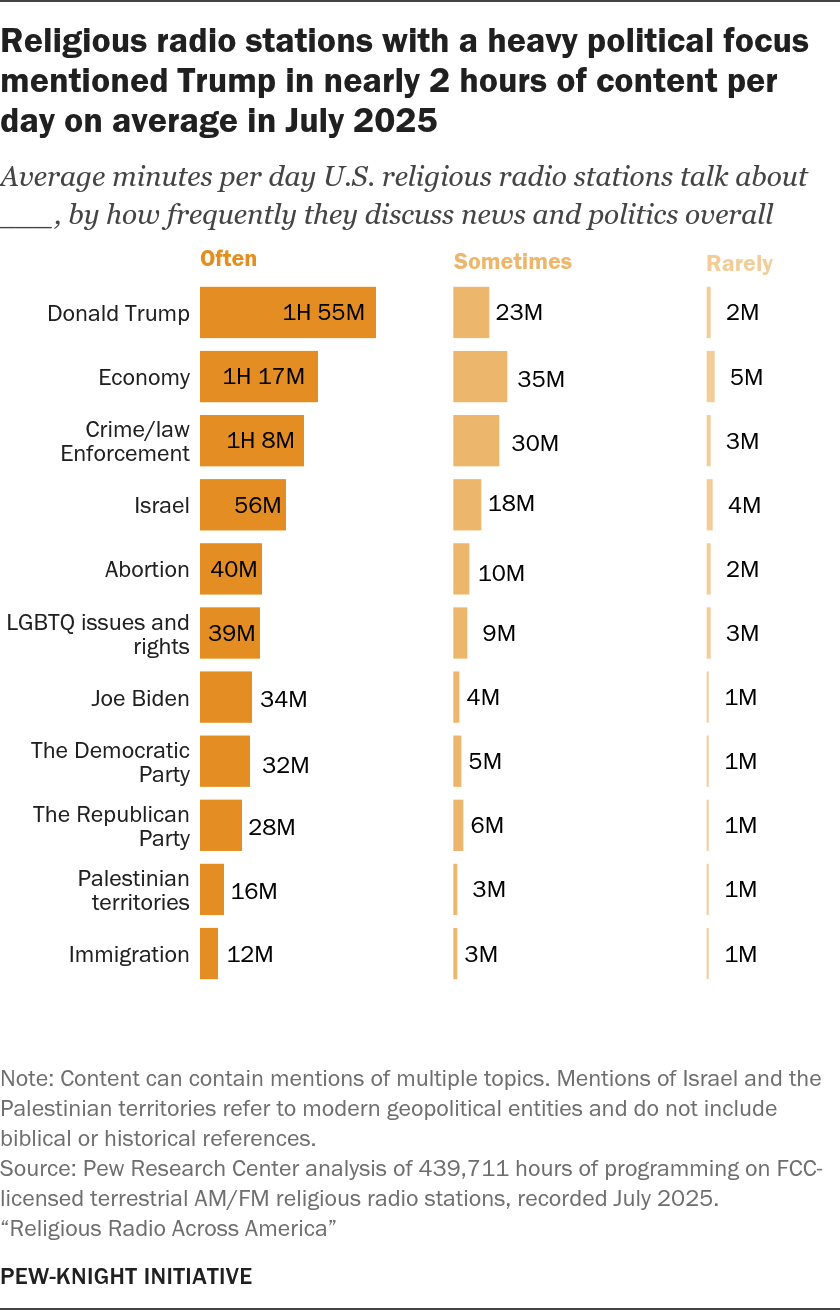
To the extent that the stations that rarely discuss news and politics mention any of these topics at all, they tend to focus on more general issues, like the economy or crime. Even so, the most commonly mentioned of these – the economy – gets five minutes of coverage on these stations in a typical day. Many other topics come up for just two minutes or less daily.
“Religious Radio Across America”
| issue | Minutes per topic on stations that often discuss news and politics | Minutes per topic on stations that sometimes discuss news and politics | Minutes per topic on stations that rarely discuss news and politics |
|---|---|---|---|
| Economy | 77 | 35 | 5 |
| Crime/law Enforcement | 68 | 30 | 3 |
| Donald Trump | 115 | 23 | 2 |
| The Republican Party | 28 | 6 | 1 |
| Joe Biden | 34 | 4 | 1 |
| The Democratic Party | 32 | 5 | 1 |
| Israel | 56 | 18 | 4 |
| Palestinian territories | 16 | 3 | 1 |
| LGBTQ issues and rights | 39 | 9 | 3 |
| Abortion | 40 | 10 | 2 |
| Immigration | 12 | 3 | 1 |
“Religious Radio Across America”
Conversely, Trump is a much more prominent and consistent focus on religious stations that often emphasize current events and politics in their programming. On these stations, Trump is mentioned in nearly two hours of coverage per day. That’s 38 minutes more than is spent discussing the economy, the second-most common topic.
Politics-heavy stations also frequently mention several topics that are discussed less often on stations with less of a political focus. In a typical day, they broadcast 40 minutes of coverage that mentions abortion, and a similar amount of their time is spent discussing LGBTQ issues. And around a half hour of their coverage mentions the Democratic and Republican parties, which come up far less frequently elsewhere on the religious radio dial.
Neutral versus opinionated discussion of political and social issues
Along with identifying whether stations mentioned these 11 topics at all, we also looked at how those discussions presented each issue:
- A neutral or factual manner, as in a traditional news read or update
- A way that takes a stance or expresses an opinion on the topic. This could include praising or criticizing an individual or group, aligning with one side of a debate, or promoting a policy position
This analysis finds that stations that discuss politics often tend to cover nearly all these issues in an opinionated way. On nine of the 11 topics we studied, the most politics-heavy stations were far more likely than others to express a stance.
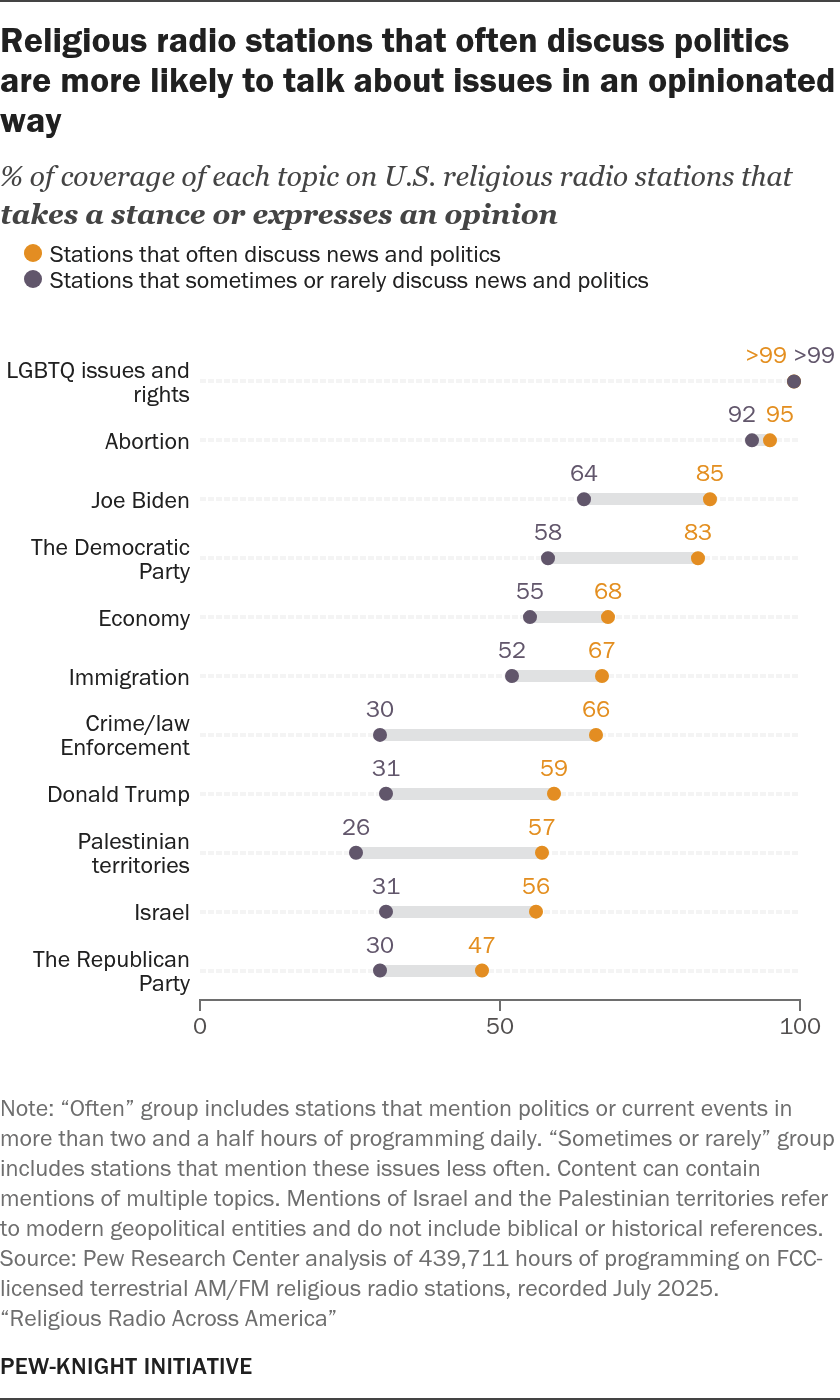
“Religious Radio Across America”
| Issue | Stations that often discuss news and politics | Stations that sometimes or rarely discuss news and politics |
|---|---|---|
| Economy | 68% | 55% |
| Crime/law Enforcement | 66% | 30% |
| Donald Trump | 59% | 31% |
| The Republican Party | 47% | 30% |
| Joe Biden | 85% | 64% |
| The Democratic Party | 83% | 58% |
| Israel | 56% | 31% |
| Palestinian territories | 57% | 26% |
| LGBTQ issues and rights | >99% | >99% |
| Abortion | 95% | 92% |
| Immigration | 67% | 52% |
“Religious Radio Across America”
The two topics where this is not true were abortion and LBGTQ rights: Not all religious radio stations discuss these issues, but the ones that do tend to take a stance, regardless of how often they discuss politics overall. Mentions of abortion were almost universally against it; mentions of LGBTQ issues were almost universally against expanded rights or acceptance for same-sex couples or transgender people.
Other findings on how religious radio stations discuss these topics include:
- Around half the time immigration is mentioned, it is presented as something that is undesirable or that should be limited. But 14% of the time, it is spoken of favorably. The remaining mentions of immigration are neutral (about 37% of the time spent discussing this issue.)
- Across all stations, about half of references to both Israel and the Palestinian territories, including the war in Gaza, are framed neutrally. However, 42% of references to Israel and Israeli leaders frame their actions and policies favorably, while 47% of references to the Palestinian territories and their leaders are unfavorable.
- Around eight-in-ten references to Biden or to the Democratic Party express negative sentiments. Fewer than 1% of mentions are positive. By contrast, most references to Trump are neutral (47%) or favorable (40%), while 13% are unfavorable. More than half of references to the Republican Party are neutral, with the remainder a roughly equal mix of favorable and unfavorable.
See the study’s methodology for more detail about how we classified the content of radio broadcasts.
Read more about: