Pew Knight Initiative
The Pew-Knight Initiative supports new research on how Americans absorb civic information, form beliefs and identities, and engage in their communities.
Pew Research Center is a nonpartisan, nonadvocacy fact tank that informs the public about the issues, attitudes and trends shaping the world. Knight Foundation is a social investor committed to supporting informed and engaged communities. Learn more >
Religious audio programming appears across a wide range of platforms, from traditional radio to podcasts and online streaming services. This chapter looks at how Americans consume this programming and the role it plays in their lives, based on a survey of 5,023 U.S. adults conducted June 9-15, 2025.
These findings are part of a larger study on religious radio in the U.S.
Religious programming Americans listen to
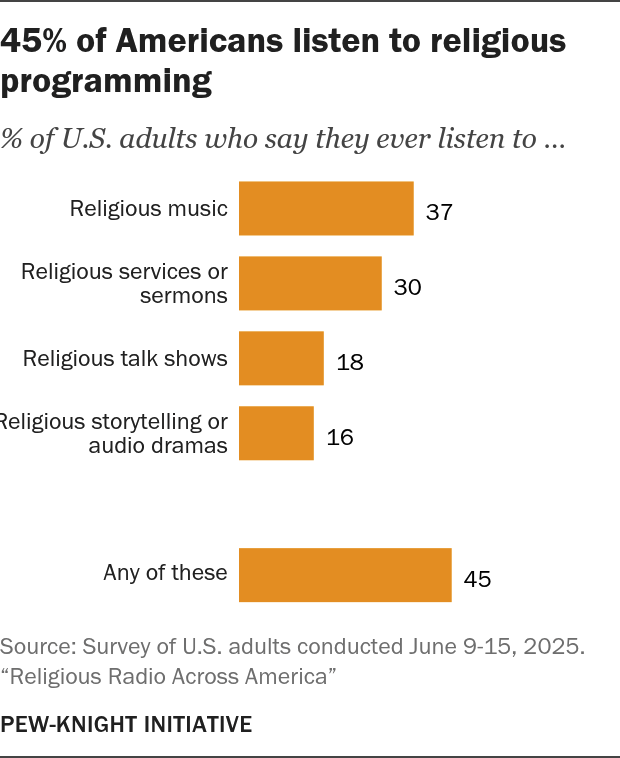
Roughly half of U.S. adults (45%) say they listen to at least one type of religious programming we asked about:
“Religious Radio Across America”
| U.S. adults who listen | group | |
|---|---|---|
| Religious music | 37% | 1 |
| Religious talk shows | 18% | 1 |
| Religious services or sermons | 30% | 1 |
| Religious storytelling or audio dramas | 16% | 1 |
| Any of these | 45% | 2 |
“Religious Radio Across America”
- Religious music (37% of adults ever listen)
- Sermons and religious services (30%)
- Religious talk shows (18%)
- Religious storytelling or audio dramas (16%)
Large majorities of White evangelical Protestants (76%) and Black Protestants (84%) say they listen to religious programming. Smaller shares of Catholics and White nonevangelical Protestants say they listen to this type of programming – about four-in-ten each.
About four-in-ten U.S. adults who identify with a religion other than Christianity (39%) say they listen to religious programming. These respondents are more likely to say they listen using online platforms than to say they tune in via AM or FM radio.
Religious “nones” – those who identify as atheist, agnostic or “nothing in particular” – are the least likely to report listening to religious programming, though 18% say they do.
Differences based on other factors tend to be more modest. For instance, nearly identical shares of adults ages 18 to 49 (44%) and ages 50 and older (47%) listen to religious programming (although those 50 and older are a bit more likely to listen to sermons and services specifically). The partisan gap is somewhat pronounced: 53% of Republicans and Republican-leaning independents listen to religious programming, as do 38% of Democrats and Democratic leaners.
Majorities of Americans across age and partisan groups identify with a religion, according to the Center’s 2023-24 Religious Landscape Study. For instance, 80% of those ages 50 and older are religiously affiliated, compared with a smaller majority of adults younger than 50 (59%). And around eight-in-ten Republicans identify with a religion, as do around six-in-ten Democrats.
When asked about the platforms they use to listen to religious programming, three-quarters of all listeners say they at least occasionally turn to AM or FM radio. A similar share (70%) listen using an online streaming or podcast platform, while 41% listen on a satellite radio service.
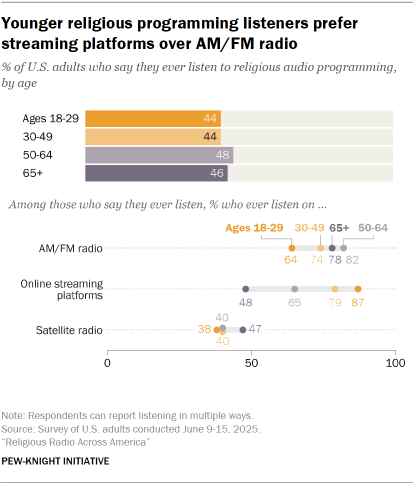
However, Americans of different ages have different listening preferences. Around eight-in-ten listeners ages 50 and older (82%) say they at least occasionally tune into an AM or FM radio station to hear religious programming. By contrast, 87% of listeners ages 18 to 29 say they listen on online streaming platforms.
Regardless of how they choose to listen, the vast majority of listeners say they consume religious audio programming at home (93%) or in a car (87%). Around half say they ever listen in public spaces (55%) or at work (51%).
Why people listen to religious programming
Some 37% of Americans who listen to religious audio programming say it is extremely or very important to their religious or spiritual lives. Another 35% say it is somewhat important, while 29% say it is either not too or not at all important.
“Religious Radio Across America”
| Reason | Major reason | Minor reason | Not a reason |
|---|---|---|---|
| It’s spiritually fulfilling or meaningful | 62% | 25% | 12% |
| It’s relaxing or calming | 51% | 32% | 17% |
| It provides me with life advice or guidance | 39% | 34% | 26% |
| It’s family friendly | 38% | 29% | 32% |
| It’s entertaining | 28% | 39% | 32% |
| To stay up to date about current events | 14% | 26% | 59% |
| Someone else is playing it | 9% | 28% | 62% |
“Religious Radio Across America”
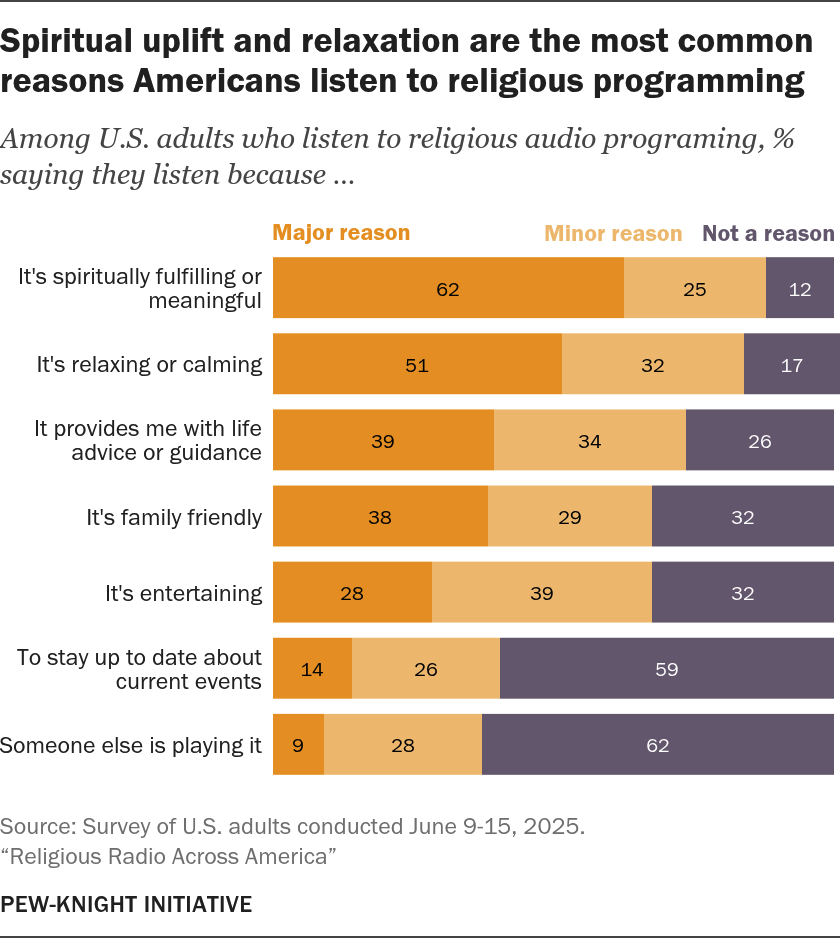
When asked why they listen to religious programming, relatively large shares of listeners cite the following as major reasons:
- It’s spiritually uplifting (62%)
- It’s relaxing or calming (51%)
- It gives them life advice or guidance (39%)
- It’s family friendly (38%)
Staying up to date with current events is generally not a big factor: 40% of listeners say this is at least a minor reason, but just 14% say it is a major one. About six-in-ten (59%) say it is not a reason they listen at all.
“Religious Radio Across America”
| Behavior | Share who have done this | group |
|---|---|---|
| Watched a movie or read a book | 52% | 1 |
| Bought something | 25% | 1 |
| Donated to a cause or political candidate | 16% | 1 |
| Made changes to financial habits, such as spending or saving | 25% | 1 |
| Started attending or switched to a new religious congregation | 15% | 1 |
| Started a new religious practice, such as praying or reading scripture | 35% | 1 |
| Any of these | 66% | 2 |
“Religious Radio Across America”
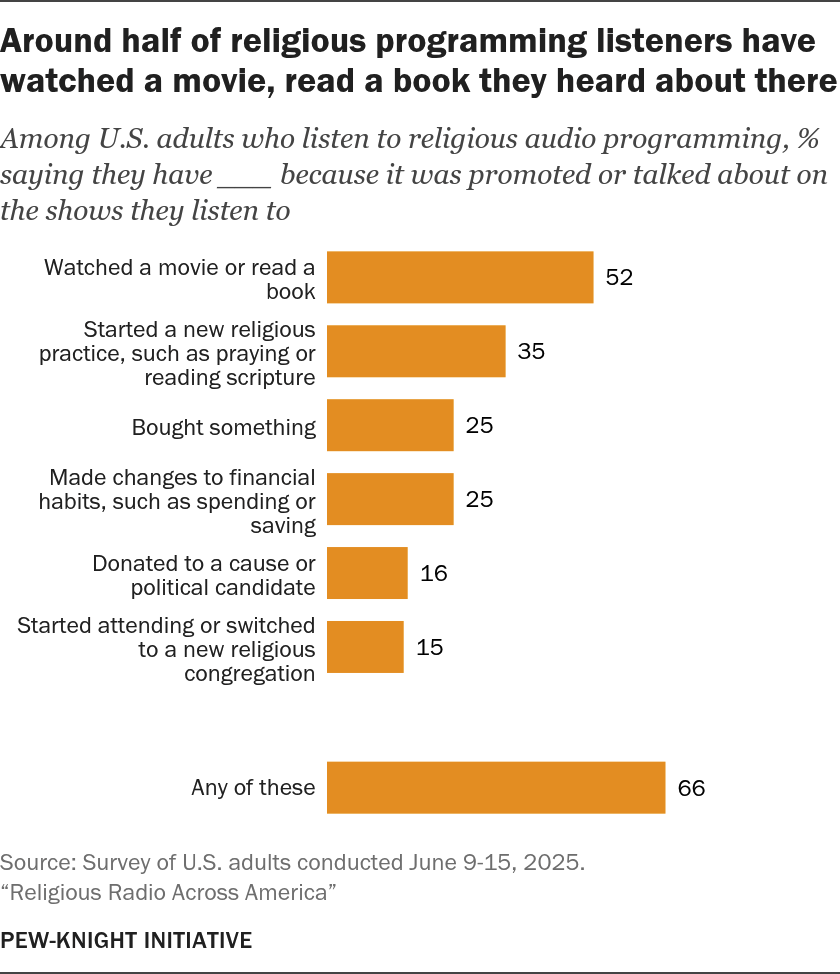
Many listeners say they have made changes to their lives or taken specific actions in response to things they heard promoted or advertised on the religious programming. Most notably, around half have watched a movie or read a book they heard about there, and around a third have started a new religious practice in their lives. A quarter of listeners bought something they heard about on these programs or made a change in their financial habits.
Around one-in-five listeners (21%) have given money directly to a religious radio station, show or podcast they listen to. This behavior is a bit more common among Republican listeners than among Democratic ones, and it is also relatively common among White evangelical Protestant listeners.
In general, listeners feel that the religious views they hear expressed in this programming broadly align with their own: 72% say the content they hear is very or somewhat similar to their personal views, and 74% say it’s similar to the views of their congregation. But this also can vary by political leaning, with Democratic listeners more likely than Republican listeners to say the views they hear differ from their own (21% vs. 13%).