Pew Knight Initiative
The Pew-Knight Initiative supports new research on how Americans absorb civic information, form beliefs and identities, and engage in their communities.
Pew Research Center is a nonpartisan, nonadvocacy fact tank that informs the public about the issues, attitudes and trends shaping the world. Knight Foundation is a social investor committed to supporting informed and engaged communities. Learn more >
About a quarter of all the FCC-licensed AM and FM radio stations in the United States are religious radio stations, and a vast majority of those are Christian.
Most of the religious stations we analyzed (63%) identify simply as “Christian” with no additional affiliation given. Another 10% identify with a specific Protestant tradition, and 8% of stations identify as Catholic radio.
Our analysis finds that Catholic stations stand out in several ways. Compared with other religious stations, Catholic radio contains more talk programming, features a different mix of formats and tends to focus on a different set of topics.
These findings are part of a larger study on religious radio in the U.S.
Where can Catholic radio be heard?
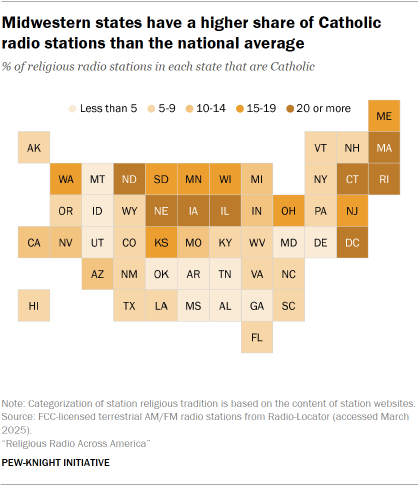
Like religious radio stations more broadly, Catholic radio stations are located across the country. But compared with stations that identify with a Protestant tradition or simply as “Christian,” Catholic stations are more concentrated in the Midwest and Northeast, and less prevalent in the South.
- 17% of all religious radio stations in the Midwest are Catholic stations, as are 12% of religious stations in the Northeast and 9% of those in the West.
- By contrast, just 5% of all religious stations in the South are Catholic stations.
Typical programming on Catholic radio
Many religious radio stations carry the same popular syndicated talk shows. For instance, about half of all stations carry Unshackled and Turning Point, and 44% of stations carry Focus on the Family. But these programs almost never appear on the broadcast schedules of Catholic stations. In fact, the typical schedule for a Catholic station has essentially no overlap with non-Catholic religious stations.

“Religious Radio Across America”
| Segment format | Catholic Stations | Other Christian Stations |
|---|---|---|
| Ads and promotions | 1.42 | 0.84 |
| Religious storytelling or audio dramas | 0.22 | 0.51 |
| Music | 2.58 | 13.28 |
| News reads | 0.66 | 0.52 |
| Other spoken content | 0.31 | 0.18 |
| Religious services | 3.74 | 3.96 |
| Talk programming | 15.14 | 4.73 |
“Religious Radio Across America”
Catholic stations also tend to play relatively little music. About half of religious radio airtime overall is dedicated to music. On Catholic stations, this share is just 11%. (These shares cover any and all musical content that might play during the day, including jingles in advertisements, program theme music and music that plays as part of a religious service.) The music that does play on Catholic radio is considerably more likely to be uncategorizable by our automated music recognition system, suggesting that much of it does not come from widely available studio recordings.
Read more about music on religious radio.
The time that Catholic stations don’t spend broadcasting music is mostly occupied by host-led talk radio formats: discussions, monologues or commentary from hosts, interviews with guests, or caller interaction and audience participation segments. On average, Catholic stations air 15 hours of talk content per day, compared with under five hours on other Christian stations. During these talk radio broadcasts:
- Catholic talk radio is more likely to include caller interaction or audience participation segments. Some 27% of talk programming on Catholic stations has these interactive elements, compared with around 8% of talk programming on other Christian stations.
- Catholic talk radio is also more likely to contain discussions of family, parenting and education. Some 25% of talk time on Catholic radio mentions these issues, compared with 18% on other Christian stations. Catholic radio is less likely to include discussions of pop culture and entertainment, mentioned in 6% of Catholic talk programming versus 13% on other Christian stations.
- And as might be expected, Catholic talk radio is more likely to include mentions of popes, both past and current. Pope Francis or Pope Leo XIV are mentioned by name in 6% of talk programming on Catholic stations, compared with 0.2% on other Christian stations.
Outside of music and talk radio formats, Catholic and non-Catholic stations spend a similar amount of time on content that we broadly categorized as religious services or sermons. And the services broadcast on Catholic stations sound different from those heard on other Christian stations, reflecting the differences between Catholic Mass and services in other Christian traditions.
There is quite a bit of overlap in the books of the Bible that are mentioned on Catholic and non-Catholic radio. The Gospels of Matthew, Luke and John, and the Hebrew scriptures of Psalms, Genesis, Exodus and Isaiah are among the 10 most-mentioned books of the Bible on both types of stations. But at the time this study was conducted, listeners were far more likely to hear references to the Book of Revelation on non-Catholic radio than on Catholic radio.