Pew Knight Initiative
The Pew-Knight Initiative supports new research on how Americans absorb civic information, form beliefs and identities, and engage in their communities.
Pew Research Center is a nonpartisan, nonadvocacy fact tank that informs the public about the issues, attitudes and trends shaping the world. Knight Foundation is a social investor committed to supporting informed and engaged communities. Learn more >
Faith-based radio stations make up a considerable part of the media landscape in the United States. More than 4,000 terrestrial religious stations broadcast throughout the country, according to a Pew Research Center analysis from the Pew-Knight Initiative – that’s about a quarter of the more than 17,000 FCC-licensed AM and FM stations in the United States. Anywhere people live across the country, there’s probably at least one religious station they can tune in to.
These findings are part of a larger study on religious radio in the U.S.
Religious radio stations are spread widely across the U.S. Every region of the country is served by both independent and syndicated stations featuring religious programming.
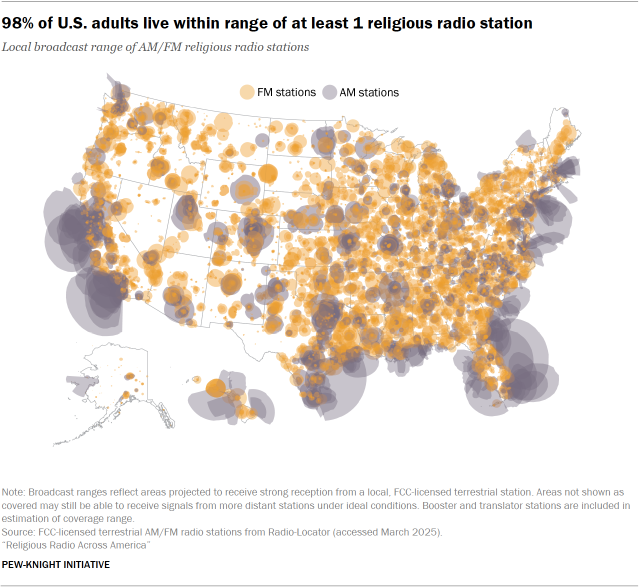
The vast majority of the U.S. adult population (98%) lives within local coverage of at least one religious radio station. On average, listeners can tune into six different religious broadcasts from their home address. About two-thirds of the country’s entire landmass – and 99% of its urban areas – is in range of at least one of these stations.
While religious radio can be heard from virtually all urban areas in the country, overall coverage by region varies.3 The highest concentration of religious radio stations is in the South, where 87% of the total landmass is served by at least one of these stations.
This is in keeping with the fact that Americans in the South tend to be more religious, on average, than those in other regions: 74% of Southerners identify with a religion, including 68% who are Christian, according to data from the Center’s 2023-24 Religious Landscape Study.
Religious radio’s geographic coverage is lower in other regions of the U.S.:
- 76% of the Midwest
- 78% of the Northeast
- 38% of the West (which notably includes a number of large, sparsely populated areas where coverage is limited)
“Religious Radio Across America”
| State | Share of stations that are religious | group |
|---|---|---|
| 1. North Carolina | 36% | 1 |
| 2. Texas | 34% | 1 |
| 3. Nebraska | 32% | 1 |
| 4. South Carolina | 32% | 1 |
| 5. Louisiana | 31% | 1 |
| 46. New Hampshire | 16% | 2 |
| 47. Massachusetts | 16% | 2 |
| 48. Vermont | 15% | 2 |
| 49. Rhode Island | 13% | 2 |
| 50. Connecticut | 12% | 2 |
“Religious Radio Across America”
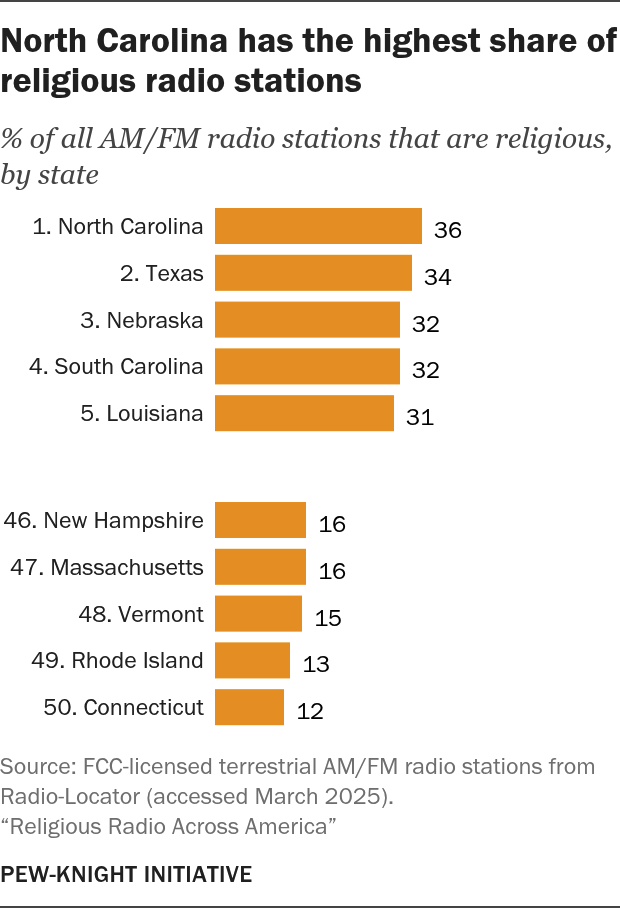
The median state in the union has 76 religious radio stations broadcasting from within its borders. Texas has the most of any state, with 433. And North Carolina has the highest concentration of religious radio: 36% of all its AM and FM stations have a religious focus. At the other end of the scale, Connecticut’s 13 religious radio stations make up just 12% of stations in the state.
Nationwide, there are around 1.3 religious radio stations per 100,000 residents. But because there are limits to how far any one radio broadcast can reach, states with small populations distributed over very large geographic areas end up with a much higher ratio of stations to residents. For example, Wyoming has 6.6 religious stations per 100,000 residents, and Alaska has 7.3.
Related: How religious is your state?
Who owns religious radio stations?
The majority of religious radio stations in the U.S. are owned by an organization that operates multiple stations, according to our analysis of the FCC licenses those stations operate under. Around three-in-ten are part of large ownership groups comprised of more than 50 individual stations. The largest of these groups is Educational Media Foundation, which operates the Air1 and K-LOVE radio networks and owns hundreds of individual stations across the country, as well as an online streaming platform and a podcast network.4
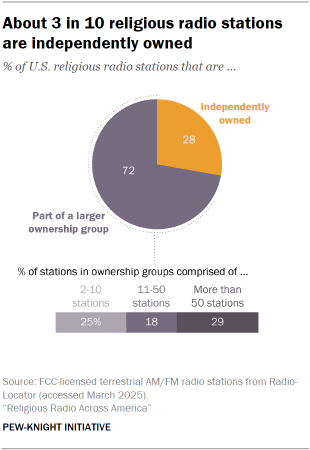
Another 42% of stations are part of small or medium-sized ownership groups, and 28% are independent – meaning they are licensed to an entity that doesn’t own any other radio stations.
While similar shares of religious and nonreligious stations belong to ownership groups, religious stations that belong to the same owner are much more likely to broadcast shared content. Most nonreligious stations that stream their broadcasts online do so from their own distinct broadcast URL, even if their licensee owns multiple stations. But the typical religious radio station that offers a web stream is one of five stations that share that same online feed.
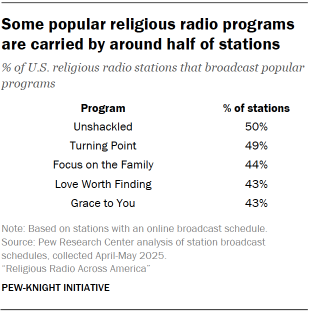
And regardless of who owns them, many religious radio stations carry the same popular syndicated shows. For example, Unshackled and Turning Point appear on the broadcast schedules of about half of all religious radio stations, and Focus on the Family appears on 44% of schedules.
Nearly all popular syndicated shows on religious radio can also be heard off the airwaves. Of the 100 most widely carried programs, 99 are available on demand as podcasts or on popular platforms such as YouTube.