
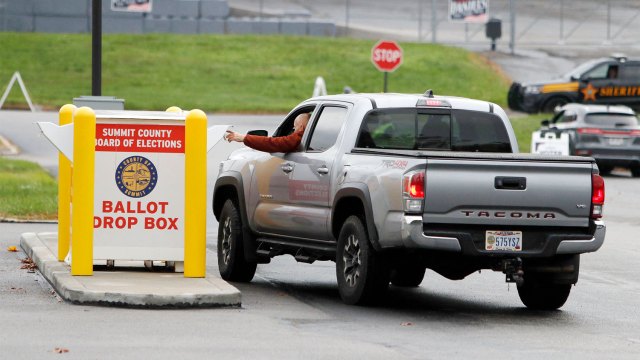
American voters generally expect the upcoming midterm elections across the country to be run and administered well, have confidence that election workers will handle ballots securely, and say the outcome will be clear after all the ballots are counted.
that …
that …
| Topic | Response | Group | Very | Somewhat | NET |
|---|---|---|---|---|---|
| If noncitizens try to cast a ballot, they will be stopped | Are confident this will happen | All RVs | 34 | 34 | 68 |
| If noncitizens try to cast a ballot, they will be stopped | Are confident this will happen | Republican candidate supporters | 16 | 28 | 45 |
| If noncitizens try to cast a ballot, they will be stopped | Are confident this will happen | Democratic candidate supporters | 52 | 38 | 90 |
| All legally qualified voters are able to cast ballots if they want to | Are confident this will happen | All RVs | 40 | 40 | 80 |
| All legally qualified voters are able to cast ballots if they want to | Are confident this will happen | Republican candidate supporters | 57 | 33 | 90 |
| All legally qualified voters are able to cast ballots if they want to | Are confident this will happen | Democratic candidate supporters | 28 | 44 | 72 |
These views are shared by similar majorities of voters who back both Republican and Democratic candidates for Congress this year.
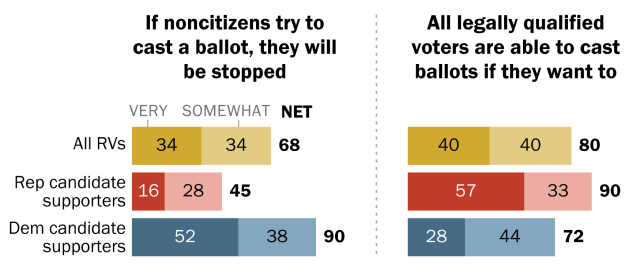
But there continue to be wide partisan differences in perceptions of both how secure elections are against noncitizens casting ballots and whether eligible citizens who want to vote are able to do so:
A new Pew Research Center survey conducted from Sept. 28 to Oct. 4, 2026, among 5,062 adults, including 3,917 registered voters, finds that about two-thirds of voters are at least somewhat confident that anyone ineligible to vote will be prevented from casting a ballot. But there is a wide partisan gap in these views:
- 90% of those who back Democratic candidates for the House of Representatives in this year’s elections are confident that if noncitizens try to vote they will be stopped.
- A far smaller share of Republican candidate backers – 45% – are confident that noncitizens will be prevented from casting ballots.
- Still, Republican voters express a higher level of confidence that noncitizens will be stopped from voting than President Donald Trump’s voters did in 2024 (35% then).
The partisan gap is reversed – and not as wide – when it comes to confidence that all legally qualified voters who want to vote can do so:
- 90% of Republican voters are at least somewhat confident in this.
- A narrower majority of Democratic voters (72%) express confidence that all qualified voters will be able to vote if they want to.
The survey finds broad bipartisan confidence that votes cast in person will be counted as voters intend.
In contrast, there is considerably less public confidence that absentee and mail-in ballots will be counted as intended.

| date | Date | Vote type | Total | Democratic candidate supporters | Republican candidate supporters |
|---|---|---|---|---|---|
| 2020-10 | Oct ’20 | In person | 91 | 90 | 92 |
| 2022-10 | Oct ’22 | In person | 84 | 95 | 79 |
| 2024-10 | Oct ’24 | In person | 85 | 93 | 77 |
| 2026-10 | Oct ’26 | In person | 79 | 81 | 84 |
| 2020-10 | Oct ’20 | By absentee or mail-in ballot | 59 | 77 | 36 |
| 2022-10 | Oct ’22 | By absentee or mail-in ballot | 62 | 88 | 37 |
| 2024-10 | Oct ’24 | By absentee or mail-in ballot | 61 | 85 | 38 |
| 2026-10 | Oct ’26 | By absentee or mail-in ballot | 53 | 64 | 42 |
Note: This survey was conducted prior to the Justice Department suing California on Oct. 15 to stop the state from counting ballots mailed to individuals who the Trump administration alleges are noncitizens.
Democratic voters are more confident than Republican voters that mail-in ballots will be counted as voters intend – but Democratic voters’ confidence in an accurate count of mail ballots is considerably lower than it has been in recent elections:
- 64% of Democratic voters say they are confident mail and absentee votes will be counted as voters intend – down from 88% in the 2022 midterm elections and 85% among Kamala Harris’ voters in the 2024 presidential election.
- 42% of GOP voters say they are confident mail and absentee votes will be counted as intended – modestly higher than in past recent elections.

| Group | Statement | Very | Somewhat | NET |
|---|---|---|---|---|
| All RVs | They are confident this will happen | 26 | 40 | 67 |
| Republican candidate supporters | They are confident this will happen | 31 | 43 | 74 |
| Democratic candidate supporteres | They are confident this will happen | 23 | 39 | 61 |
While majorities across the political spectrum say they expect the elections to be run well this year, Republican backers and Democratic backers diverge when asked in an open-ended question what – if any – concerns they have about the elections:
- 19% of Republican voters mention concerns about illegitimate voters casting ballots, or fraudulent votes.
- In contrast, Democratic voters are more likely to raise concerns about legitimate voters being denied access (10%) or interference with election administration by the Trump administration (11%).
Two-thirds of voters are confident that people who attempt to intimidate voters at polling places will be stopped, though supporters of Republican candidates for Congress are more confident about this than those who back Democrats.
Still, majorities in both groups (74% of GOP voters and 61% of Democratic voters) say they are at least somewhat confident that if people try to threaten or intimidate voters at polling places, they will be stopped. Confidence that intimidation will not be allowed is lower among liberal backers of Democratic candidates (56%) than among more moderate Democratic voters (68%).
Smaller share of voters plan to vote by mail as both in-person and drop-box use rise
In recent elections, supporters of Democratic congressional candidates have been considerably more likely than Republican candidate backers to report voting by mail or absentee ballot. That continues to be the case today: Overall, 34% of Democratic voters plan to vote by mail or absentee ballot, compared with 17% of GOP voters.
by mail

by mail
| Year | 2022 | 2026 |
|---|---|---|
| All RVs | 15 | 12 |
| Republican candidate supporters | 10 | 9 |
| Democratic candidate supporters | 22 | 15 |
But the share of Democratic voters who plan to vote this way has declined from recent elections – and specifically the share of Democratic voters who plan to return a ballot via the U.S. Postal Service.
This year, 15% of Democratic voters say they plan to vote, or have already voted, by returning a ballot through the mail. This is down from 22% four years ago and 21% in 2024.
Other key findings:
Roughly half of voters are confident that U.S. election systems are free from hacking and other technological threats. This is little different overall than in recent elections. Republican voters are more confident election systems are secure today than they were in 2024 (47% today vs. 32% two years ago), while the reverse is true for Democratic voters (60% today vs. 73% in 2024).

| Group | NET negative | Not at all | Not too | Somewhat | Very | NET positive | group |
|---|---|---|---|---|---|---|---|
| All RVs | 48 | 15 | 33 | 40 | 11 | 52 | total |
| Republican candidate supporters | 53 | 16 | 37 | 40 | 7 | 47 | party |
| Democratic candidate supporters | 39 | 11 | 29 | 44 | 16 | 60 | party |
Mail and absentee voters are much more confident in mail voting than voters who plan to cast a ballot in person. Roughly three-quarters of mail and absentee voters (76%) are confident votes cast this way will be counted as voters intend. By comparison, about half of in-person voters (47%) are confident this will happen.
Most voters are confident Americans will know who won the election within a day or two of Election Day. This includes seven-in-ten Democratic voters (70%) and a narrower majority of Republican voters (61%).
There are relatively modest racial and ethnic differences in voters’ confidence that all legally qualified voters will be able to cast ballots or that ineligible voters will be prevented from voting. Refer to the appendix for additional data by race and ethnicity.


