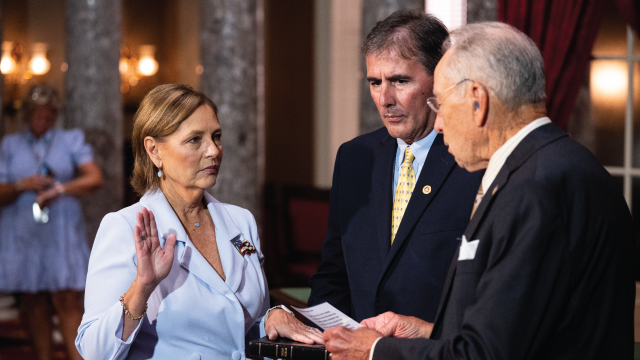
Darline Graham of South Carolina is running for a full term in the U.S. Senate after being appointed to the chamber on a temporary basis following the death of her brother, Lindsey Graham, in July. With this decision, she joins a long line of senators who have sought to turn a temporary appointment into a longer tenure.
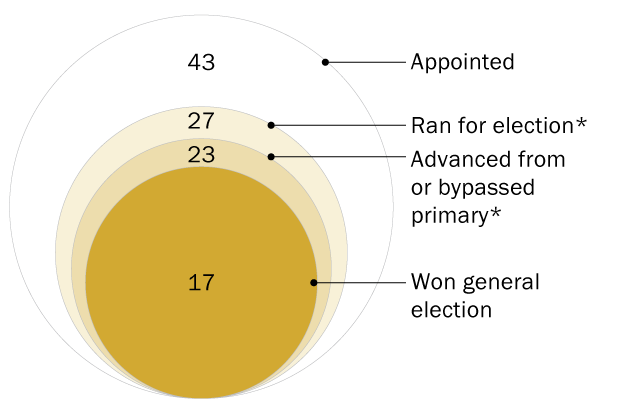
Note: “Advanced from or bypassed primary” includes elections in which a partisan primary was not held. Election outcomes are current through Aug. 6, 2026. Excludes cases where senators were initially elected but appointed early to finish the last few weeks of the outgoing lawmaker’s term.
| Count | |
|---|---|
| Appointed | 43 |
| Ran for election* | 27 |
| Advanced from or bypassed primary* | 23 |
| Won general election | 17 |
Note: “Advanced from or bypassed primary” includes elections in which a partisan primary was not held. Election outcomes are current through Aug. 6, 2026. Excludes cases where senators were initially elected but appointed early to finish the last few weeks of the outgoing lawmaker’s term.
The U.S. Senate has had 43 appointed members since 1990, and 27 of them (63%) have run to keep their seat, according to data from the Senate Historical Office.
This list includes Graham, as well as two senators appointed in January 2025 who are running in special elections this year: Jon Husted of Ohio and Ashley Moody of Florida. Husted and Moody were appointed to the seats vacated by Vice President JD Vance and Secretary of State Marco Rubio, respectively, at the beginning of the second Trump administration.
Another recently appointed senator, Alan Armstrong of Oklahoma, is not eligible to run in the regular election for his seat due to a 2021 change in the state’s Senate vacancy procedure. Armstrong was appointed in March 2026 after his predecessor, Markwayne Mullin, resigned to become Homeland Security secretary.
Related: How do states fill vacancies in the U.S. Senate? It depends on the state
In all, 15 current senators arrived in the chamber by appointment without first having been elected to their seat. (We’re excluding cases like John Cornyn and Andy Kim, who won election to the Senate and were appointed early to finish the last few weeks of the outgoing lawmaker’s term.)
Sometimes, an appointment is the start of a longer Senate career: These 15 senators have served a median of 8.6 years in the chamber, with most having been elected to at least one full term following their appointment.
| Senator | Appointment effective date | Full terms won | Years served |
|---|---|---|---|
| Darline Graham (R-SC) | 7/13/2026 | 0 | 0.1 |
| Alan Armstrong (R-OK) | 3/24/2026 | 0 | 0.4 |
| Ashley Moody (R-FL) | 1/21/2025 | 0 | 1.5 |
| Jon Husted (R-OH) | 1/18/2025 | 0 | 1.5 |
| Pete Ricketts (R-NE) | 1/12/2023 | 0 | 3.6 |
| Alex Padilla (D-CA) | 1/18/2021 | 1 | 5.5 |
| Cindy Hyde-Smith (R-MS) | 4/2/2018 | 1 | 8.3 |
| Tina Smith (D-MN) | 1/3/2018 | 1 | 8.6 |
| Tim Scott (R-SC) | 1/2/2013 | 2 | 13.6 |
| Brian Schatz (D-HI) | 12/26/2012 | 2 | 13.6 |
| Kirsten Gillibrand (D-NY) | 1/26/2009 | 3 | 17.5 |
| Michael Bennet (D-CO) | 1/21/2009 | 3 | 17.5 |
| Roger Wicker (R-MS) | 12/31/2007 | 3 | 18.6 |
| John Barrasso (R-WY) | 6/22/2007 | 3 | 19.1 |
| Lisa Murkowski (R-AK) | 12/20/2002 | 4 | 23.6 |
Most appointed senators who run end up winning
Since 1990, more appointed senators who have run to keep their seat have won than lost. Of the 24 whose elections have been decided, 17 won and seven lost (71% vs. 29%). Two of those who lost were defeated in a primary; three won their party’s nomination but lost in the general election; and two others advanced as top vote-getters in an all-candidate “blanket” primary but lost the resulting runoff.
Election outcomes haven’t always been so favorable for appointed senators. Between 1960 and 1989, the Senate had 37 appointees, 29 of whom went on to seek election. But more of those candidates lost (18, or 62%) than won (11, or 38%).
It’s not uncommon for family members to fill a Senate vacancy
Darline Graham isn’t the first Senate appointee to have a family connection to their predecessor. Historically, most appointed senators with such ties have been women replacing a husband after he died or resigned from office. In fact, well into the 1970s, this so-called “widow’s succession,” either by appointment or election, was one of the most common ways for women to enter Congress.
Since 1990, two senators have been appointed to a vacancy created by the death of their husband. Sen. Jocelyn Burdick of North Dakota chose not to seek election following the death of Quentin Burdick in 1992 and served just three months. Sen. Jean Carnahan of Missouri was appointed to succeed Mel Carnahan, who was elected posthumously in 2000. She later ran for the remainder of his term but lost in a 2002 special election.
Two other appointed senators since 1990 have succeeded their father. Both Sen. Lincoln Chafee of Rhode Island (who replaced the late John Chafee in 1999) and Sen. Lisa Murkowski of Alaska (who replaced the retiring Frank Murkowski in 2002) subsequently ran for election and won. Murkowski still holds her seat and was reelected to a fourth full term in 2022.