

“How Americans Followed the 2026 Midterm Results”
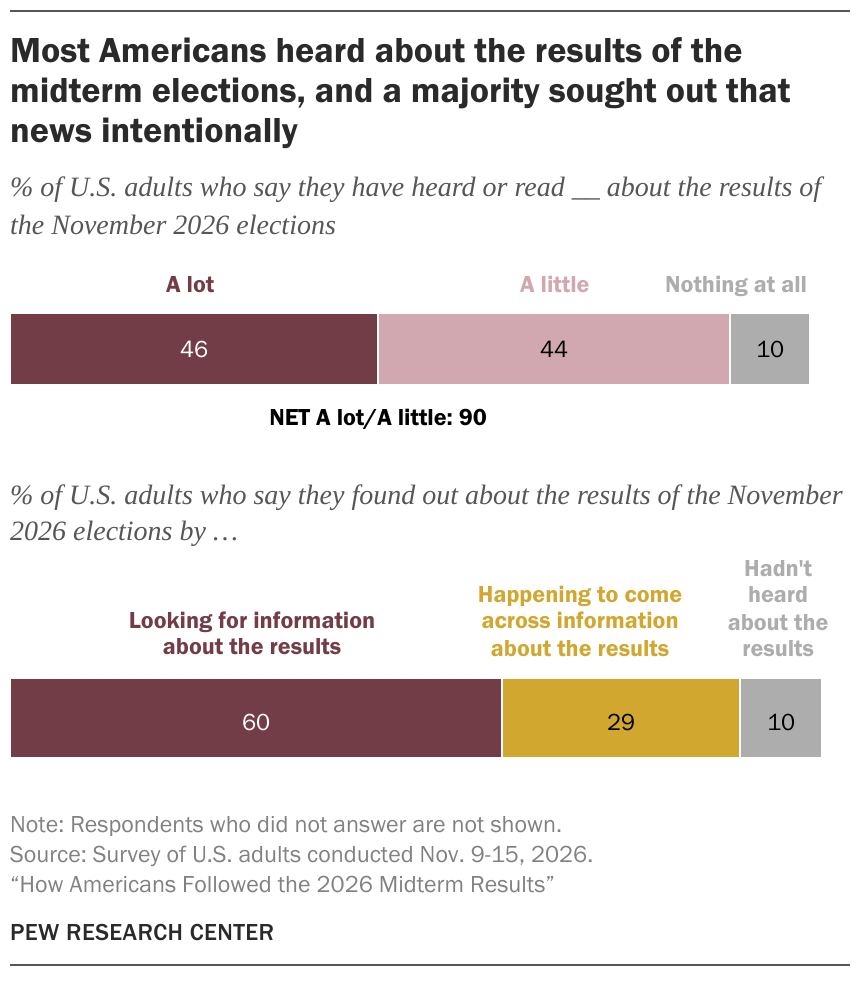
| A lot | 46 |
| A little | 44 |
| Nothing at all | 10 |
| NET A lot/A little | 90 |
| … found out about the results of the November 2026 elections by … | |
| Looking for information about the results | 60 |
| Happening to come across information about the results | 29 |
| Hadn’t heard about the results | 10 |
“How Americans Followed the 2026 Midterm Results”
Nine-in-ten Americans say they’ve heard about the results of the 2026 midterm elections, and most went looking for information about the results rather than happening to come across it, according to a new Pew Research Center survey conducted shortly after the elections.
That is notably different from how Americans say they typically get news: When it comes to news in general, the public is about evenly split between those who seek it out and those who say news finds them.
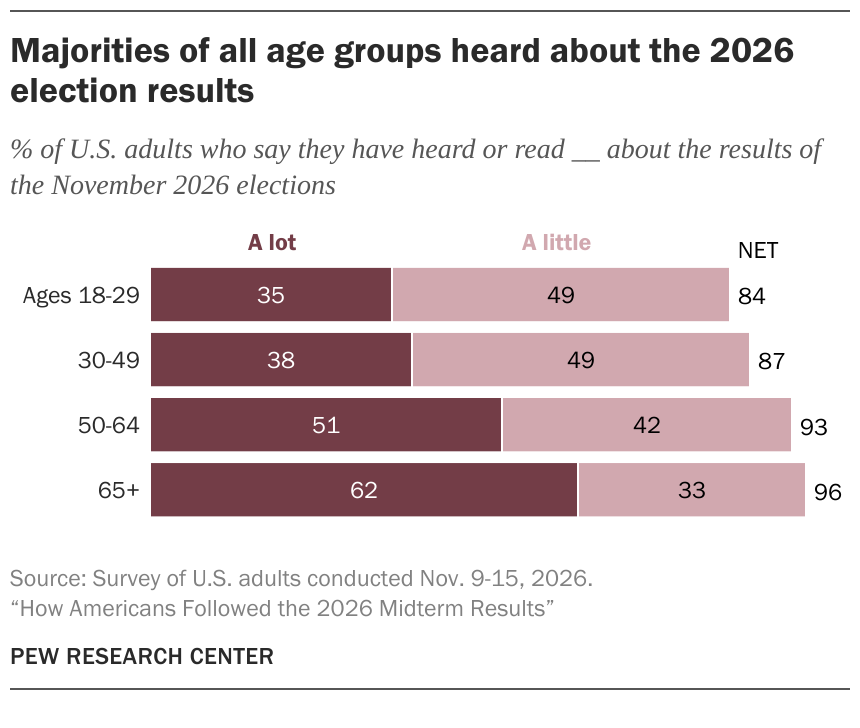
Large majorities of all age groups say they have heard at least a little about the results of the November 2026 elections, although older Americans are considerably more likely to have heard a lot.
“How Americans Followed the 2026 Midterm Results”
| A lot | A little | NET | |
|---|---|---|---|
| Ages 18-29 | 35 | 49 | 84 |
| 30-49 | 38 | 49 | 87 |
| 50-64 | 51 | 42 | 93 |
| 65+ | 62 | 33 | 96 |
“How Americans Followed the 2026 Midterm Results”
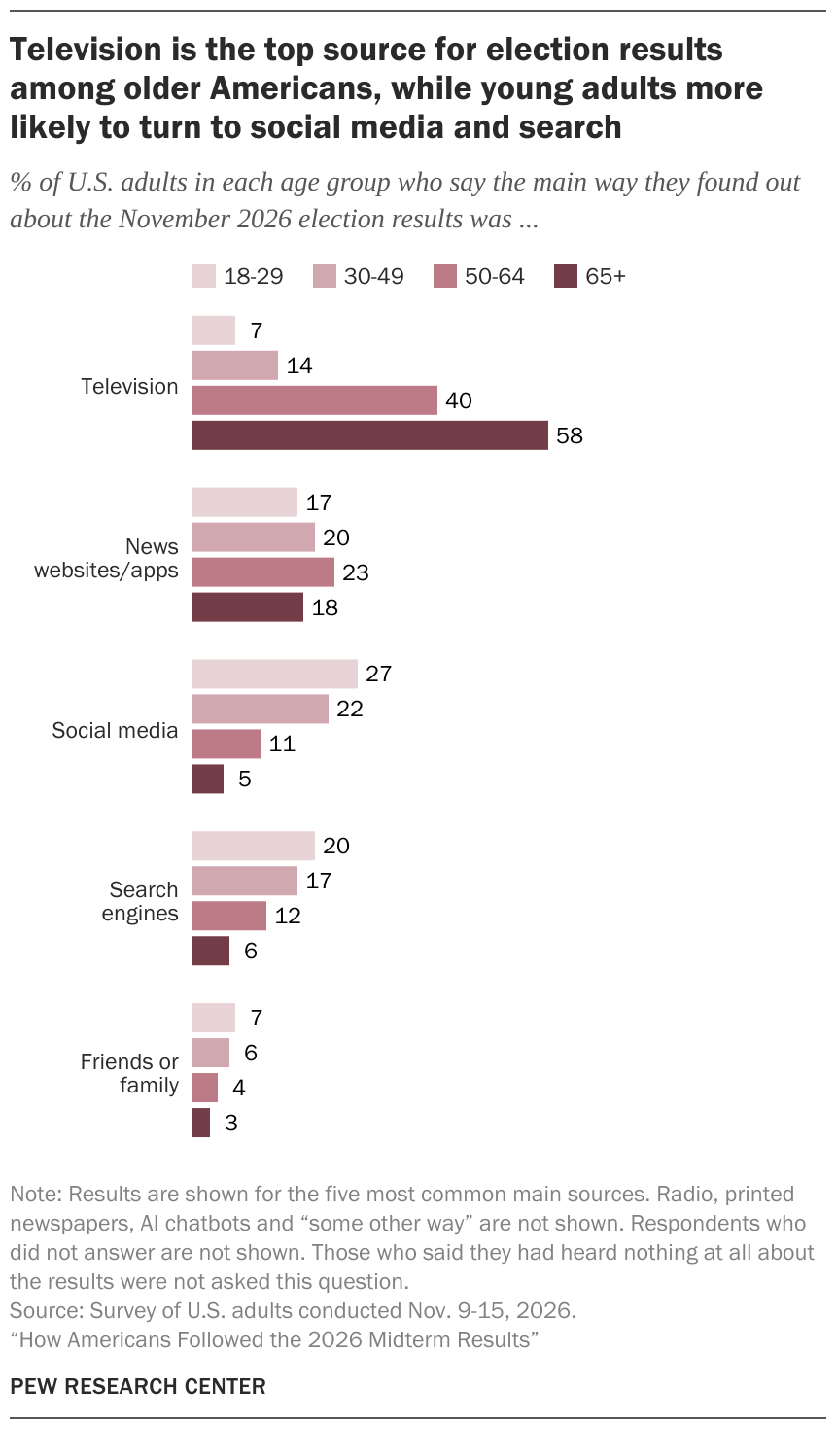
How Americans learned about the election results also differs by age: Older adults mostly got information from television, while the youngest adults cited a mix of sources that included social media, search engines, and news websites and apps.
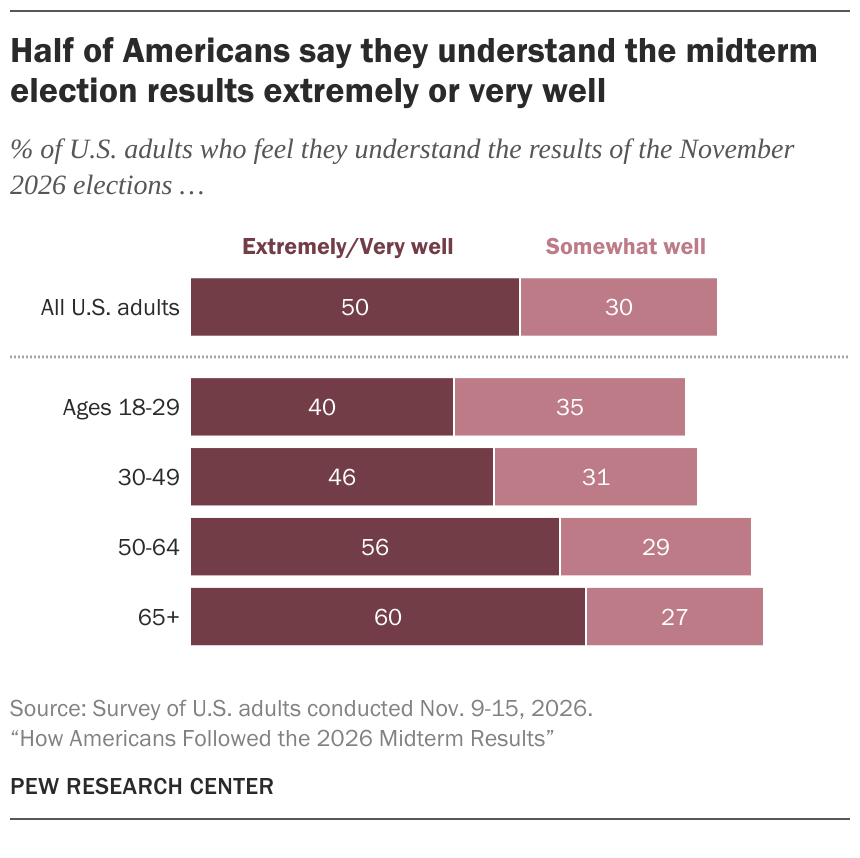
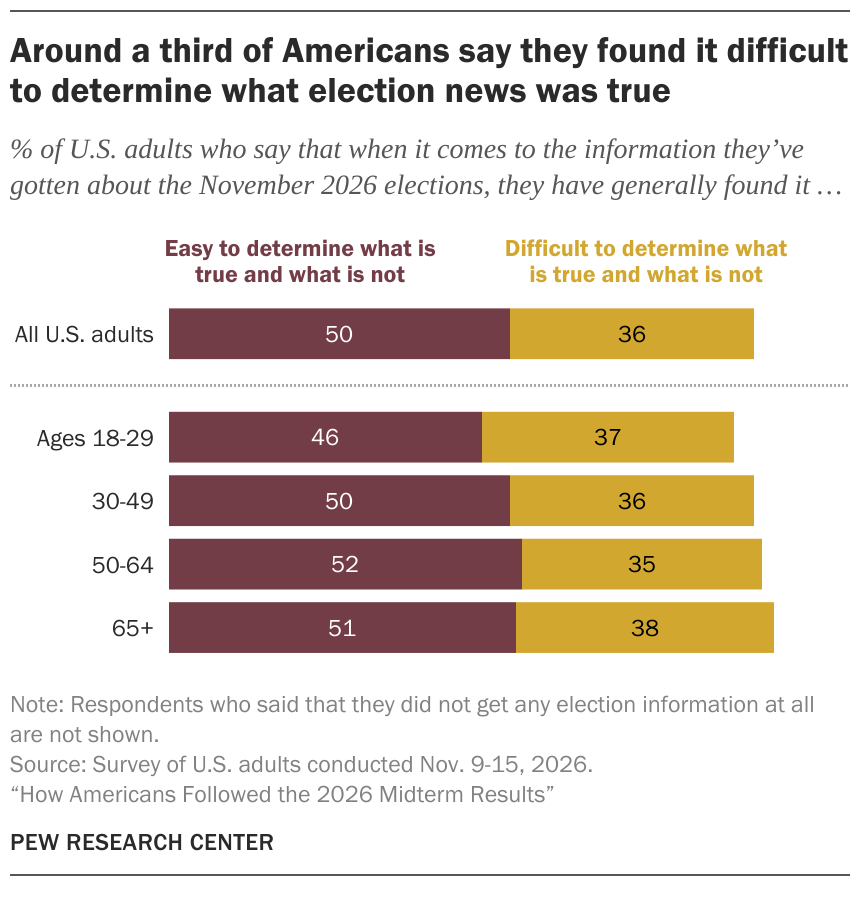
Regardless of where they heard about what happened, half of U.S. adults feel they understand the election results extremely or very well. Half of Americans also say they have generally found it easy to determine what election-related information is true.
After Democratic candidates made large gains in elections across the country, Democrats (including independents who lean Democratic) are more likely than Republicans and GOP leaners to say they have heard or read a lot about the elections, that they understand the results well, and that they found it easy to tell what is true.
More than half of Americans sought out information about the election results
Six-in-ten U.S. adults say they found out about the results of the November 2026 elections by looking for information about them. Far fewer (29%) say they happened to come across information about the election results, while 10% say they had not heard about the results at the time of the survey.
“How Americans Followed the 2026 Midterm Results”
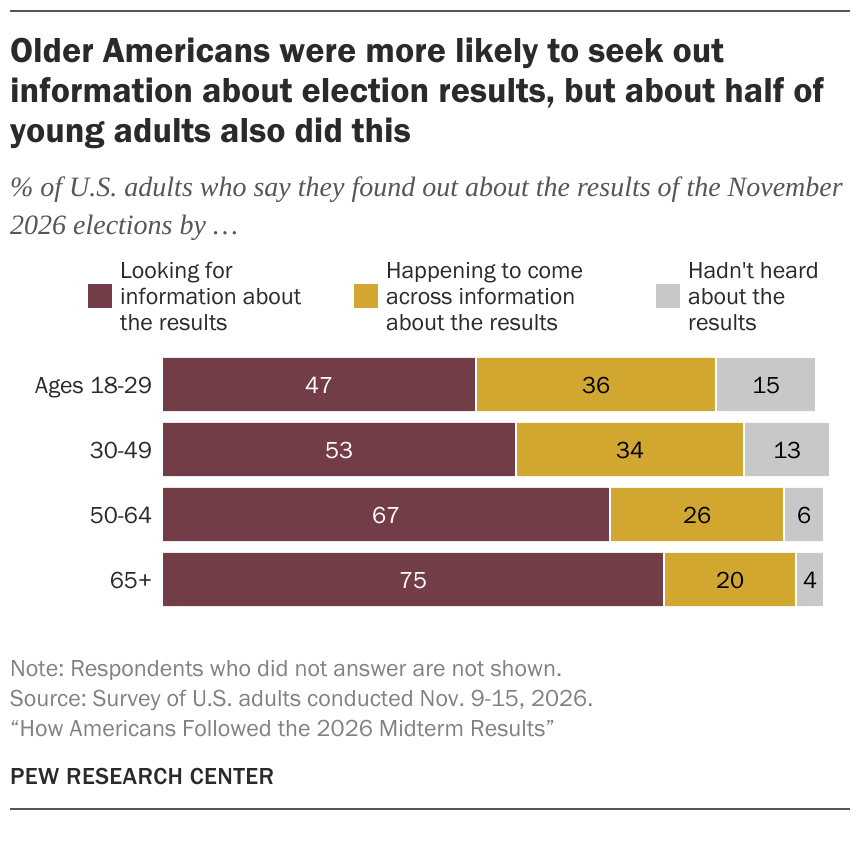
| Looking for information about the results | Happening to come across information about the results | Hadn’t heard about the results | |
|---|---|---|---|
| Ages 18-29 | 47 | 36 | 15 |
| 30-49 | 53 | 34 | 13 |
| 50-64 | 67 | 26 | 6 |
| 65+ | 75 | 20 | 4 |
“How Americans Followed the 2026 Midterm Results”
This differs from a pattern we have seen for years around news more generally. In late 2025, for example, Americans were about evenly divided between those who say they tend to look for news and those who mostly happen to come across it.
This contrast is especially striking among younger adults. In the previous survey, 73% of 18- to 29-year-olds said that they generally come across news instead of seeking it out intentionally. But when asked specifically about information about the November election results, 36% of adults under 30 say they happened to come across that information, while a larger portion (47%) say they sought it out.
Where did Americans hear about the election results?
“How Americans Followed the 2026 Midterm Results”
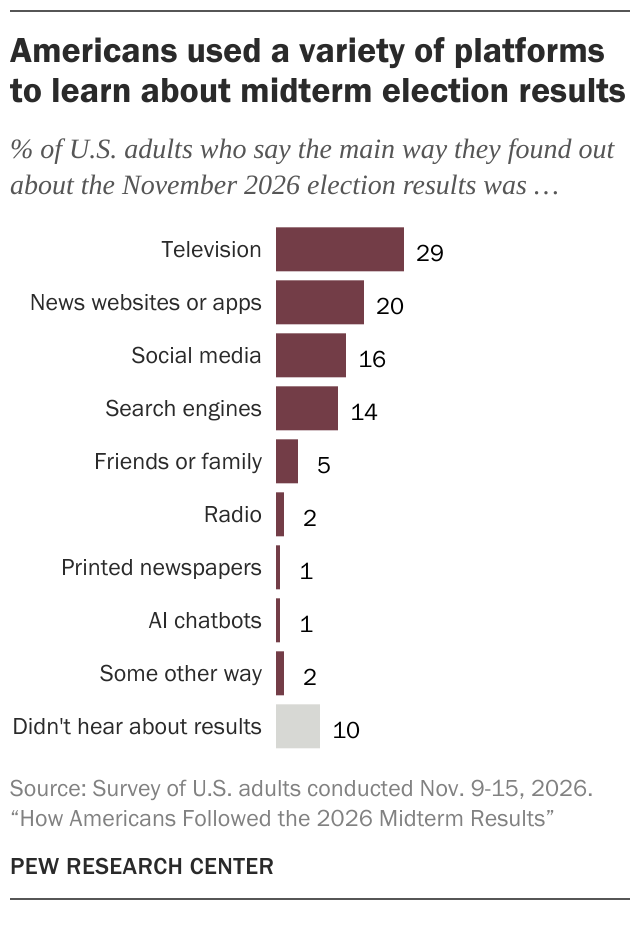
| % | |
|---|---|
| Television | 29 |
| News websites or apps | 20 |
| Social media | 16 |
| Search engines | 14 |
| Friends or family | 5 |
| Radio | 2 |
| Printed newspapers | 1 |
| AI chatbots | 1 |
| Some other way | 2 |
| Didn’t hear about results | 10 |
“How Americans Followed the 2026 Midterm Results”
Americans relied on a range of sources to learn about the election results. Roughly three-in-ten (29%) say television was their main source, while one-in-five cite news websites or apps. Smaller shares say social media (16%) or search engines (14%) were their main source, while 5% or fewer cite another way such as friends or family, radio, or AI chatbots.
“How Americans Followed the 2026 Midterm Results”
| Looking for information about the results | Happening to come across information about the results | |
|---|---|---|
| Television | 71 | 29 |
| News websites or apps | 82 | 18 |
| Social media | 38 | 62 |
| Search engines | 91 | 9 |
| Friends or family | 26 | 73 |
“How Americans Followed the 2026 Midterm Results”
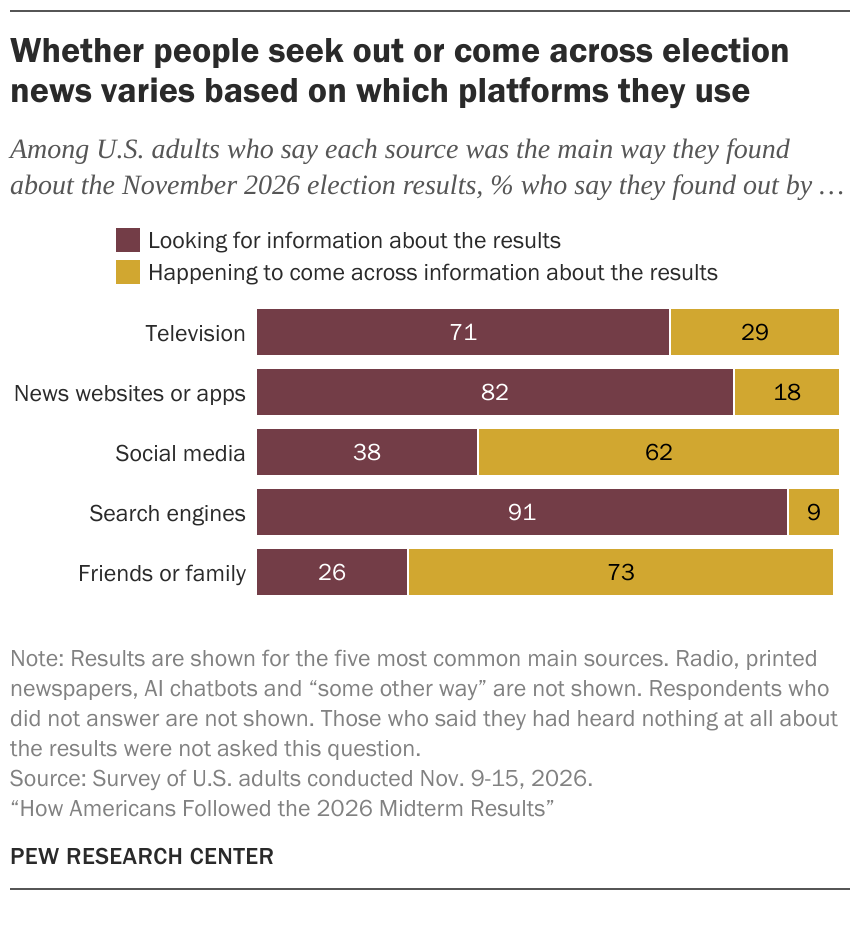
Americans who mainly got information about election results through search engines and news websites overwhelmingly say they were intentionally looking for this kind of information. For example, among those who mainly found out about the results through a search engine, 91% say they looked for information about the results. And a majority of those who mainly got that information from television (71%) also say they were intentionally looking for it.
By contrast, most of those whose main source was social media (62%) or friends and family (73%) say they happened to come across information about the results.
The main way people learned about the results differs sharply by age. The oldest Americans are by far the most likely to say television was their main source: 58% of those 65 and older say this, compared with 40% of adults ages 50 to 64, 14% of those 30 to 49 and just 7% of adults under 30.
“How Americans Followed the 2026 Midterm Results”
| 18-29 | 30-49 | 50-64 | 65+ | |
|---|---|---|---|---|
| Television | 7 | 14 | 40 | 58 |
| News websites/apps | 17 | 20 | 23 | 18 |
| Social media | 27 | 22 | 11 | 5 |
| Search engines | 20 | 17 | 12 | 6 |
| Friends or family | 7 | 6 | 4 | 3 |
“How Americans Followed the 2026 Midterm Results”
The pattern is reversed for social media. It is the most common source among those ages 18 to 29 (27%), while 5% of those 65 and older heard about the results mainly from social media. The youngest adults are also much more likely than the oldest group to say search engines were their top source (20% vs. 6%).
Similar shares across age groups turned primarily to news websites and apps, ranging from 17% of those ages 18 to 29 to 23% of those 50 to 64. AI chatbots remain a relatively rare main source for all age groups – 2% of adults under 30 cite them as their main source.
Americans’ experiences with information about the midterm results
“How Americans Followed the 2026 Midterm Results”
| Extremely/Very well | Somewhat well | Group | |
|---|---|---|---|
| All U.S. adults | 50 | 30 | group1 |
| Ages 18-29 | 40 | 35 | group3 |
| 30-49 | 46 | 31 | group3 |
| 50-64 | 56 | 29 | group3 |
| 65+ | 60 | 27 | group3 |
“How Americans Followed the 2026 Midterm Results”
Half of U.S. adults feel they understand the results of the November 2026 elections extremely or very well. Older adults are more likely than younger adults to say this, just as they are more likely to say they have heard or read a lot about the election results.
Similarly, half of Americans say it has generally been easy to determine what is true and what is not in the information they have gotten about the 2026 elections. About a third (36%) say it has been difficult to determine what is true.
“How Americans Followed the 2026 Midterm Results”
| Easy to determine what is true and what is not | Difficult to determine what is true and what is not | Group | |
|---|---|---|---|
| All U.S. adults | 50 | 36 | group1 |
| Ages 18-29 | 46 | 37 | group2 |
| 30-49 | 50 | 36 | group2 |
| 50-64 | 52 | 35 | group2 |
| 65+ | 51 | 38 | group2 |
“How Americans Followed the 2026 Midterm Results”
Democrats (including those who lean Democratic) are more likely than Republicans (and Republican leaners) to report understanding the results well and finding it easy to determine what election information is true.
These partisan differences are driven especially by liberal Democrats. Most Democrats who describe themselves as liberal say it’s been easy to determine what’s true and false in election information (74%), that they understand the results of the November 2026 elections extremely or very well (71%), and that they have heard or read a lot about the results (66%). On each measure, liberal Democrats are at least 17 percentage points higher than moderate and conservative Democrats.
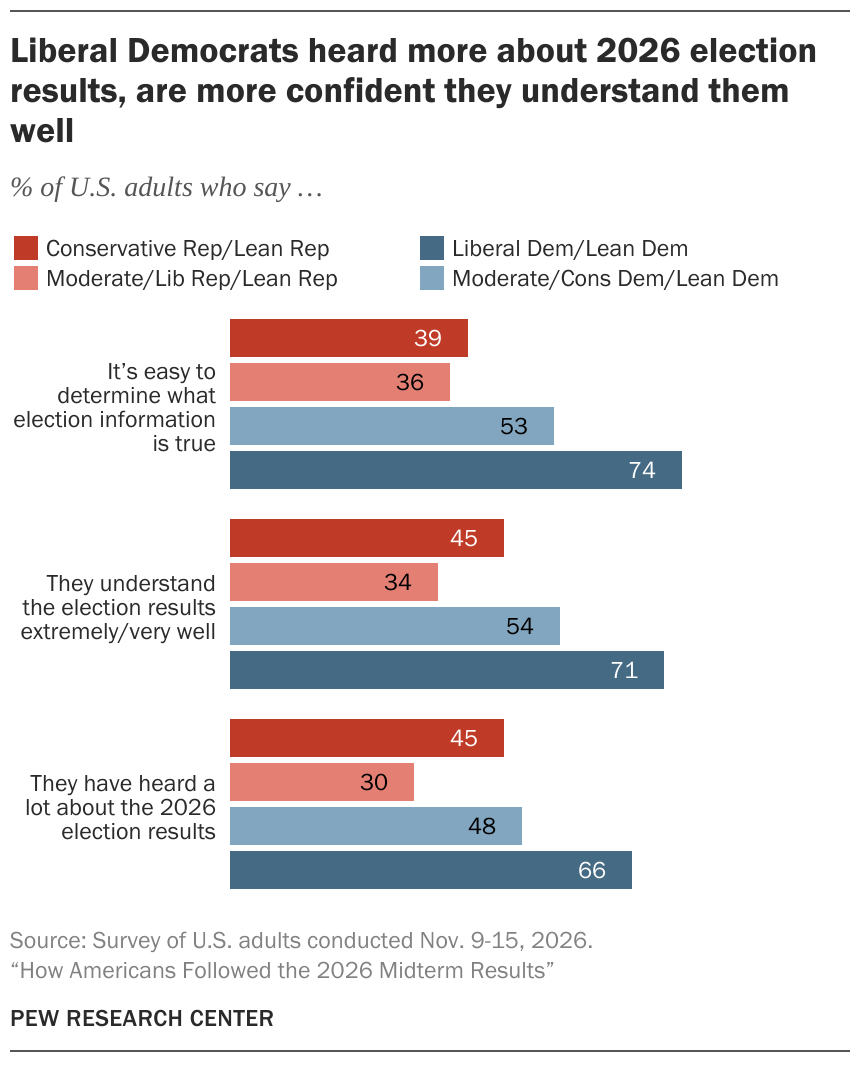
“How Americans Followed the 2026 Midterm Results”
| Conservative Rep/Lean Rep | Moderate/Lib Rep/Lean Rep | Moderate/Cons Dem/Lean Dem | Liberal Dem/Lean Dem | |
|---|---|---|---|---|
| It’s easy to determine what election information is true | 39 | 36 | 53 | 74 |
| They understand the election results extremely/very well | 45 | 34 | 54 | 71 |
| They have heard a lot about the 2026 election results | 45 | 30 | 48 | 66 |
“How Americans Followed the 2026 Midterm Results”
These questions reflect how Americans assess their own understanding and experiences with election information, rather than measuring factual knowledge of the results. And reaction to the election outcome may be part of the context for these differences: Democrats who feel excited about the results are also more likely to say they have heard a lot (68%, compared with 50% of Democrats who don’t feel this way) and that they understand the results extremely or very well (74% vs. 55% of other Democrats).
Majority of voters say it was extremely or very easy to find information needed to vote
About six-in-ten voters (58%) say it was extremely or very easy to find the information they needed to make voting decisions in the November 2026 elections. Another 32% say it was somewhat easy, and 10% say it was not too or not at all easy.
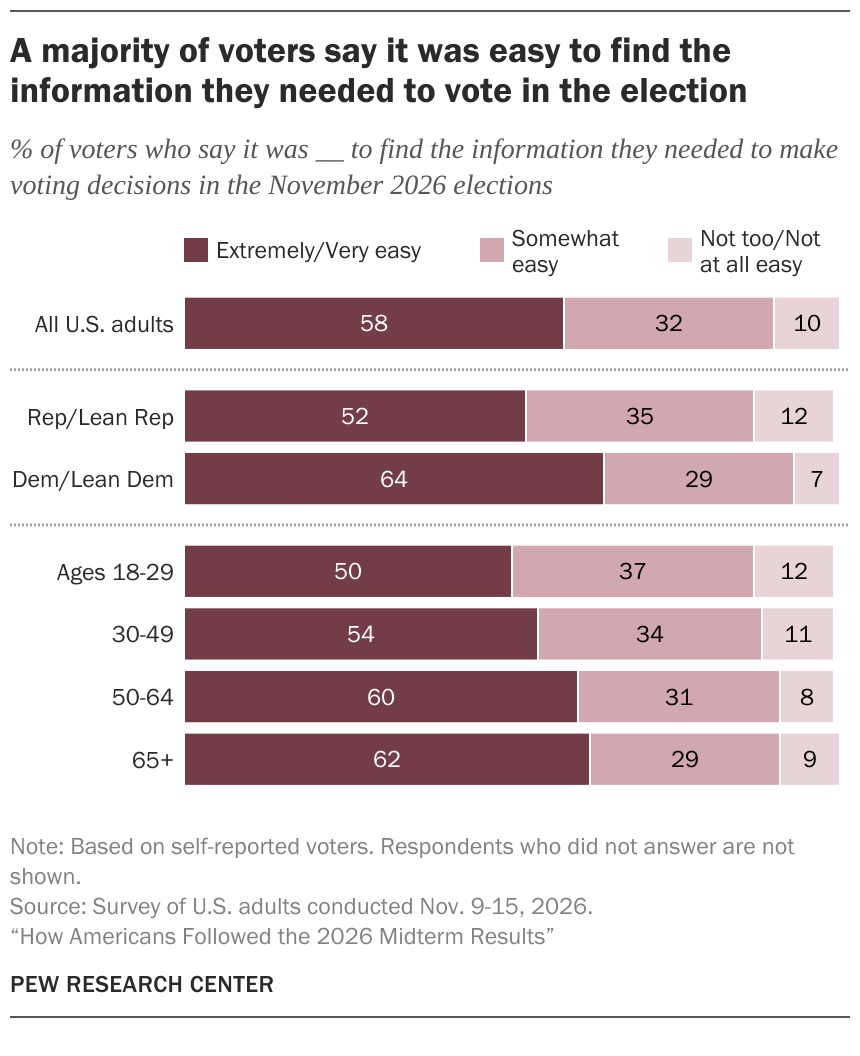
“How Americans Followed the 2026 Midterm Results”
| Extremely/Very easy | Somewhat easy | Not too/Not at all easy | Group | |
|---|---|---|---|---|
| All U.S. adults | 58 | 32 | 10 | group1 |
| Rep/Lean Rep | 52 | 35 | 12 | group2 |
| Dem/Lean Dem | 64 | 29 | 7 | group2 |
| Ages 18-29 | 50 | 37 | 12 | group3 |
| 30-49 | 54 | 34 | 11 | group3 |
| 50-64 | 60 | 31 | 8 | group3 |
| 65+ | 62 | 29 | 9 | group3 |
“How Americans Followed the 2026 Midterm Results”
Voters who identify with or lean toward the Democratic Party are slightly more likely than Republican voters to say it was extremely or very easy to find the information they needed to make voting decisions (64% vs. 52%).
Half or more of voters of all age groups say it was extremely or very easy to find the information they needed to make voting decisions


