
Americans overwhelmingly say it’s extremely or very important for people to stay informed about a range of news topics, including the healthcare system (82%), voting and election processes (82%), and what the president can and cannot do (80%). But far fewer say they’re extremely or very informed about these topics themselves, according to a Pew Research Center survey conducted in March.
The survey asked U.S. adults about 11 news topics. Majorities say it’s highly important for individual Americans to stay informed about nearly all of them – even as far fewer say they’re personally well-informed in these areas.

| They are extremely or very informed about … | It is extremely or very important for individual Americans to stay informed about … | |
|---|---|---|
| The healthcare system | 34 | 82 |
| Voting and election processes | 50 | 82 |
| What the president can and cannot do | 36 | 80 |
| Immigration and citizenship policies | 39 | 76 |
| Economic and tax policies | 24 | 75 |
| Social Security | 31 | 72 |
| U.S. foreign policy | 23 | 71 |
| Gun regulation | 33 | 69 |
| Childhood vaccine policies | 31 | 69 |
| Federal regulation of technology and media companies | 15 | 52 |
| Marijuana regulation | 23 | 31 |
For instance, three-quarters of adults say it’s extremely or very important to know about economic and tax policies, but just 24% feel highly informed themselves. Another 51% say they’re somewhat informed, while 24% are not too or not at all informed.
Older adults are more likely than younger Americans to say it’s important for people to stay informed about several topics – and to feel informed on these topics themselves. Our previous research has found that older adults are also more likely than younger adults to say it’s important to get news on a regular basis and to view following news as a civic duty.
Democrats and Republicans broadly show similar patterns in how they evaluate the importance of staying informed about various topics, as well as how informed they say they are.
But there are some modest partisan gaps. For instance, Democrats and Democratic-leaning independents are more likely than Republicans and GOP leaners to say it’s extremely or very important for people to stay informed about what the president can and cannot do (88% vs. 74%) and childhood vaccine policies (73% vs. 65%).
When it comes to feeling informed, Republicans are more likely than Democrats to say they personally are highly informed about voting and election processes (54% vs. 46%), immigration policies (44% vs. 35%) and gun regulation (39% vs. 26%).
Americans rely on many pathways to get information about different topics
Americans have a diverse information diet when it comes to keeping up with the topics asked about in our March survey.
On many topics, such as U.S. foreign policy and immigration and citizenship policies, the news media ranks as the public’s top source of information. On other topics, such as Social Security and voting and election processes, many Americans also turn to government sources.
Social media is generally a more common source of information for young adults than their older counterparts. This aligns with previous Center research showing that younger Americans are much more likely than older people to get news from social media in general.
Relatively few Americans name school or formal education as a main source of information for most topics. But 18% say it’s their top pathway for learning about the extent and limits of presidential power.
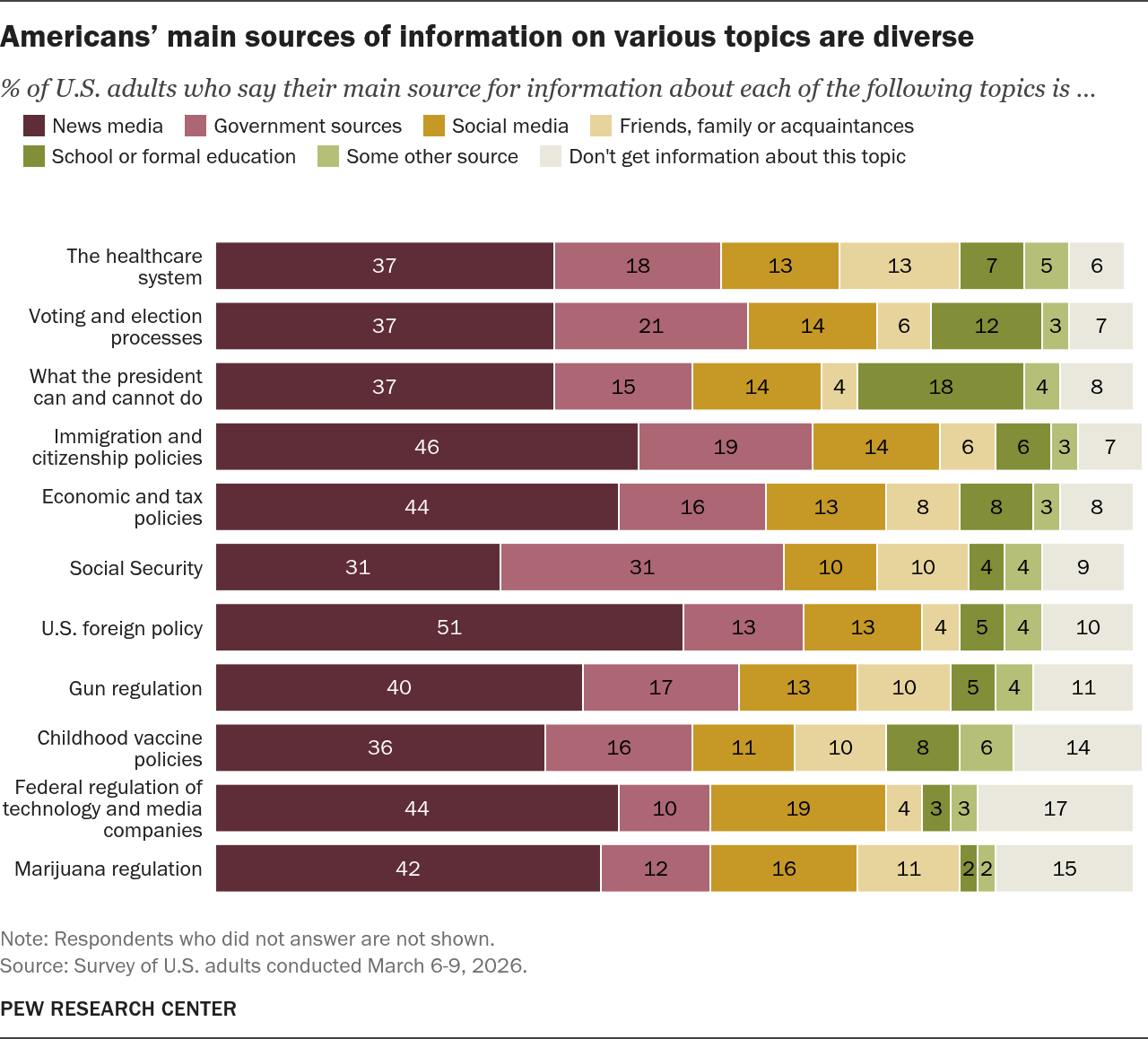
| News media | Government sources | Social media | Friends, family or acquaintances | School or formal education | Some other source | Don’t get information about this topic | |
|---|---|---|---|---|---|---|---|
| The healthcare system | 37 | 18 | 13 | 13 | 7 | 5 | 6 |
| Voting and election processes | 37 | 21 | 14 | 6 | 12 | 3 | 7 |
| What the president can and cannot do | 37 | 15 | 14 | 4 | 18 | 4 | 8 |
| Immigration and citizenship policies | 46 | 19 | 14 | 6 | 6 | 3 | 7 |
| Economic and tax policies | 44 | 16 | 13 | 8 | 8 | 3 | 8 |
| Social Security | 31 | 31 | 10 | 10 | 4 | 4 | 9 |
| U.S. foreign policy | 51 | 13 | 13 | 4 | 5 | 4 | 10 |
| Gun regulation | 40 | 17 | 13 | 10 | 5 | 4 | 11 |
| Childhood vaccine policies | 36 | 16 | 11 | 10 | 8 | 6 | 14 |
| Federal regulation of technology and media companies | 44 | 10 | 19 | 4 | 3 | 3 | 17 |
| Marijuana regulation | 42 | 12 | 16 | 11 | 2 | 2 | 15 |
Note: Here are the survey questions used for this analysis, the detailed responses and the survey methodology.