
Latinos in the United States express a mix of hope and skepticism about the American dream. Like other Americans, they are divided on whether the dream is attainable.
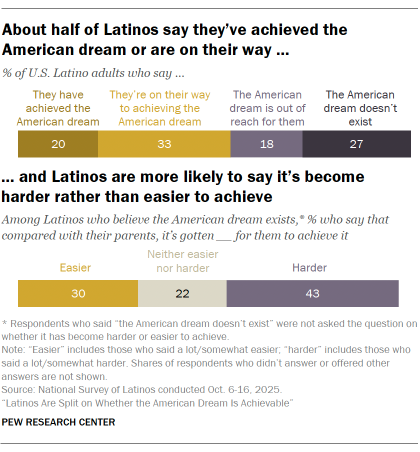
One-in-five Latinos say they’ve achieved the American dream, and 33% say they are on their way to achieving it. However, 18% say the American dream is out of reach for them – and 27% say it doesn’t exist at all.
When asked whether the American dream is harder or easier to achieve than it was for their parents, Hispanics are more likely to say it has become harder. This suggests a shift from a decade ago, when Hispanics were more likely to say the American dream was easier for them to achieve than it had been for their parents.1
Yet when it comes to Latinos’ assessments of their standard of living – a key part of how many of them define the American dream – their outlook leans more positive. Far more Latinos say:
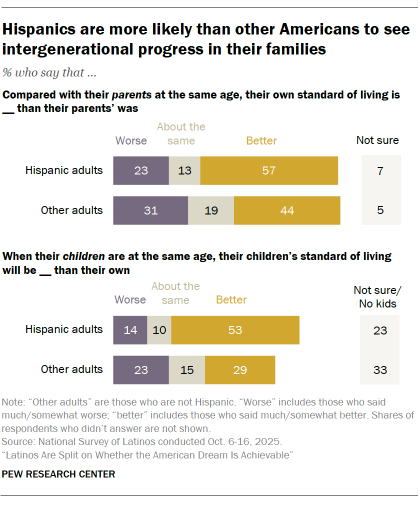
- Their standard of living is better than their parents’ (57%), rather than worse (23%).
- Their children’s standard of living will be better than their own (53%) as opposed to worse (14%).
Notably, Latino immigrants have more positive views than their U.S.-born counterparts about their and their children’s standards of living. Read more about how Latinos view their standard of living for themselves and their children, by nativity.
Latinos’ attitudes about the attainability of the American dream are roughly in line with those of other Americans, but Latinos are more upbeat about intergenerational progress. Among other U.S. adults:
- 28% say they have achieved the American dream, and 29% say they are on their way to achieving it. Another 19% say the American dream is out of reach for them, and 23% say it does not exist.
- 44% say their standard of living is better than that of their parents, and 29% expect their kids will be better off.
These findings come from Pew Research Center’s National Survey of Latinos, a nationally representative, bilingual survey of 4,923 U.S. Latino adults conducted in October 2025. It is part of our ongoing research exploring the views and experiences of Latinos, who now account for one-in-five Americans and are the nation’s second-largest racial or ethnic group.
Around the country’s 250th anniversary and in a time when most Latinos are pessimistic about their situation in U.S., this report explores how Latinos see the American dream today: their achievement of it, its meaning, its durability and their outlook on other aspects of economic mobility.
What the American dream means to Hispanics
The phrase “American dream” has been used for nearly a century to mean many different things, such as achieving financial success, securing political freedoms or living in a tolerant, multicultural society.
To better understand what the concept means to U.S. Hispanics, we asked respondents to tell us in their own words what the American dream means to them.
In this open-ended question, Hispanics most often describe the American dream in terms of financial stability, economic opportunity or homeownership. They also cite aspects like a high quality of life for themselves or their family.
Read more about how U.S. Hispanics define the American dream.
What Latinos say it takes to achieve the American dream
Latinos largely agree that hard work, motivation and access to the right opportunities are important to achieving the American dream. There is less agreement about the role of luck and chance.
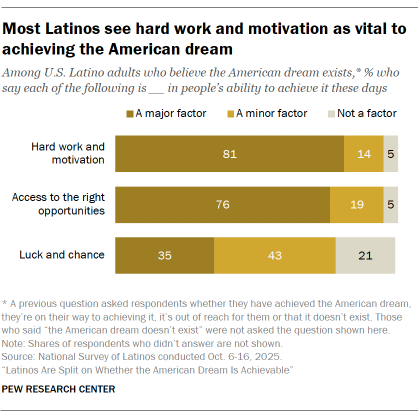
Among Latinos who believe the American dream exists – that is, those who say they have achieved it, are on their way to achieving it or that it is out of reach, and excluding those who say it does not exist:
- Large majorities say hard work and motivation (81%) and access to the right opportunities (76%) are major factors in achieving it.
- Fewer say luck and chance (35%) is a major factor.
Views of what it takes to achieve the American dream are tied to whether Latinos think the American dream is attainable
What people see as important to achieving the American dream varies by how they assess their own progress toward achieving it. Among Latinos who believe the American dream exists:
- 85% who believe they’ve achieved the American dream or are on their way each say hard work and motivation is a major factor for achieving it, higher than the share among Latinos who believe the American dream is out of reach (69%). Still, majorities of both groups say hard work and motivation are important.
- Latinos who believe the American dream is out of reach are more likely than those who think they have already achieved it to say luck and chance play a major role (43% vs. 25%).
Refer to the appendix for Latinos’ views across demographic subgroups.