
Pew Knight Initiative
The Pew-Knight Initiative supports new research on how Americans absorb civic information, form beliefs and identities, and engage in their communities.
Pew Research Center is a nonpartisan, nonadvocacy fact tank that informs the public about the issues, attitudes and trends shaping the world. Knight Foundation is a social investor committed to supporting informed and engaged communities. Learn more >
Most Americans see freedom of the press – protected by the First Amendment to the U.S. Constitution – as important to society. But their support for press freedom is far from absolute, according to a new Pew Research Center study from the Pew-Knight Initiative.
| Extremely/Very | Somewhat | A little/Not at all | |
|---|---|---|---|
| All U.S. adults | 73 | 18 | 8 |
| … but many also support limits to it in some cases | |||
| % of U.S. adults who say it is more important … | |||
| For the press to be free to report news, even if some reporting is inaccurate | To prevent inaccurate reporting, even if it limits press freedom | ||
| All U.S. adults | 45 | 53 |
While Americans largely support press freedom in principle, half or more also say the government should be able to restrict news reporting in certain cases, particularly if it endangers national security or contains inaccurate information.
In fact, when forced to choose between accuracy and press freedom, Americans are slightly more likely to choose the side of accuracy:
- 53% say it is more important to prevent inaccurate reporting, even if it limits freedom of the press.
- 45% say it is more important for the press to be free to report the news, even if some reporting is inaccurate.
Americans are also divided in how they assess the state of press freedom today. While many say the press has become less free during President Donald Trump’s second term, views differ sharply by political party. And there have been only modest changes in how concerned Americans are about potential restrictions on press freedom over the past few years – and how free they say the press is to report the news.
At this moment, Republicans and Democrats tend to raise different considerations when thinking about press freedom. Democrats often worry about direct government restrictions on the press; Republicans commonly express concerns about false information and the role of news organizations, including their control over what news people see.
These are some of the key findings of two surveys conducted in March and June 2026, each with around 3,500 U.S. adults, and 10 focus groups held in May and June 2026. To learn more about this study, read “About this research.”
Skip to:
- What does press freedom mean to Americans?
- How Americans feel about the state of press freedom today
- Are Americans as concerned about press freedom as other rights?
- How Americans view Trump’s impact on press freedom
What does press freedom mean to Americans?
Americans think about press freedom in different ways, and there is no single shared definition. While their ideas generally converge on a core theme – the ability to report or publish information freely – many focus group participants described it through practical concerns about accuracy or truth, government or corporate influence, censorship, or broader access to information.
Read more on how Americans think about press freedom in their own words.

| No | Yes | Not sure | |
|---|---|---|---|
| Poses a risk to national security | 23 | 60 | 18 |
| Contains false information | 33 | 51 | 16 |
| Clearly favors one political side | 72 | 14 | 14 |
| Is critical of the government | 77 | 10 | 13 |
When it comes to support for press freedom, there are few absolutists. There is widespread support for press freedom as a broad ideal, but specifics matter as people weigh press freedom against other factors.
Read more on where Americans view the limits of press freedom.
For instance, six-in-ten Americans say the U.S. government should be able to require a news organization to take down a news story if it poses a risk to national security, and about half (51%) say the same for stories containing false information.
Today, Republicans and GOP-leaning independents are more likely than Democrats and Democratic leaners to say the government should have this power in cases of national security (72% vs. 50%) and false information (59% vs. 45%).
“My biggest worry,” said a right-leaning focus group participant in his 40s, “is that by having full-fledged press freedom, any journalist can say anything at any time without any facts, without any evidence, claiming that that’s true or whatever their opinion piece is or their story is true. And that concerns me that that will then affect everybody who’s watching or reading it.”
In contrast, a left-leaning man in his 50s said, “Who’s the source that’s telling me that it’s an emergency? They’re citing national security concerns. How many emergencies have we had since our current president took office? Something like 27 emergencies? Like, everything’s an emergency? To me, it’s just another opportunity to clamp down on the press.”
Overall, Americans are far less likely to say the government should be able to restrict a story because it favors a political side (14%) or criticizes the government (10%), with large majorities of U.S. adults rejecting intervention in these cases.
While the First Amendment only addresses government actions, Americans respond very similarly when asked if a social media company should be able to take down a user’s post under the same circumstances. Many people support tech companies being able to remove someone’s social media post if it poses a risk to national security (67%) or contains false information (53%), but not if it is politically slanted (11%) or critical of the government (15%).
Read more on how Americans think about censorship in the U.S. today.
How Americans feel about the state of press freedom today
Most Americans (73%) say press freedom is extremely or very important to the well-being of society, a view that has been consistently expressed by about three-quarters of the public in each of the past three years. This compares with just 8% who say it is a little important or not at all important.
“It’s designed to protect all of us. It’s a point of pride of this country,” one focus group participant, a left-leaning man in his 60s, said. “And that’s not true in a lot of other countries. … It’s for the benefit to the country and its citizens, even more than the journalists.”
Majorities of both parties say press freedom is highly important, with Democrats more likely than Republicans to say this (81% vs. 66%).
| All U.S. adults | Rep/Lean Rep | Dem/Lean Dem | |
|---|---|---|---|
| The media is completely free to report the news | |||
| 2024 | 33 | 29 | 38 |
| 2025 | 33 | 42 | 25 |
| 2026 | 28 | 41 | 18 |
| They are extremely or very concerned about potential restrictions on press freedom in the U.S. | |||
| 2024 | 41 | 47 | 38 |
| 2025 | 43 | 28 | 60 |
| 2026 | 46 | 29 | 64 |
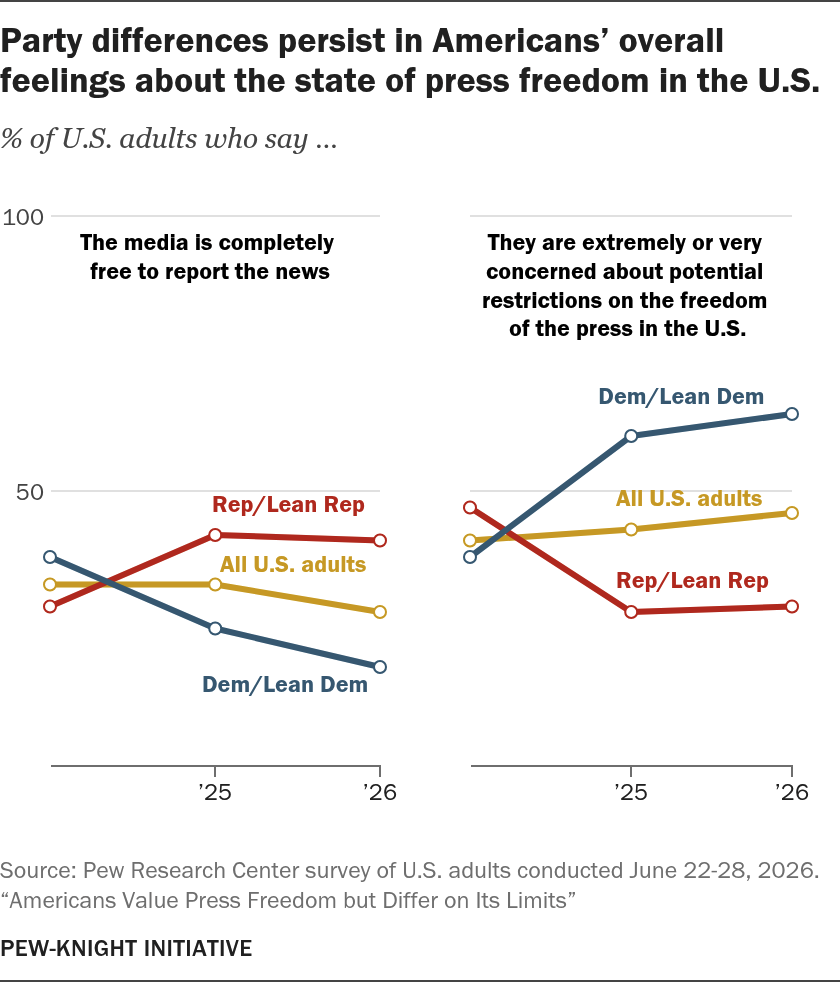
The share of Americans who say the media is completely free to report the news in the U.S. has dropped modestly from 33% last year to 28% today. About half (48%) now say the press is somewhat free, and 23% say it is not very or not at all free.
Meanwhile, the share of Americans who say they are extremely or very concerned about potential restrictions on press freedom in the U.S. has ticked up slightly, from 41% in 2024 to 46% today.
There are differences between the parties on both these questions – but those differences are the reverse of 2024, when Joe Biden was president:
- Today, Democrats are less likely than Republicans to see the media as completely free to report the news (18% vs. 41%), and far more likely to express a high level of concern about potential restrictions on press freedom in the country (64% vs. 29%).
- Partisan differences are even more apparent when including ideology. In 2026, conservative Republicans are the most likely and liberal Democrats the least likely to say the press is completely free.
Are Americans as concerned about press freedom as other rights?
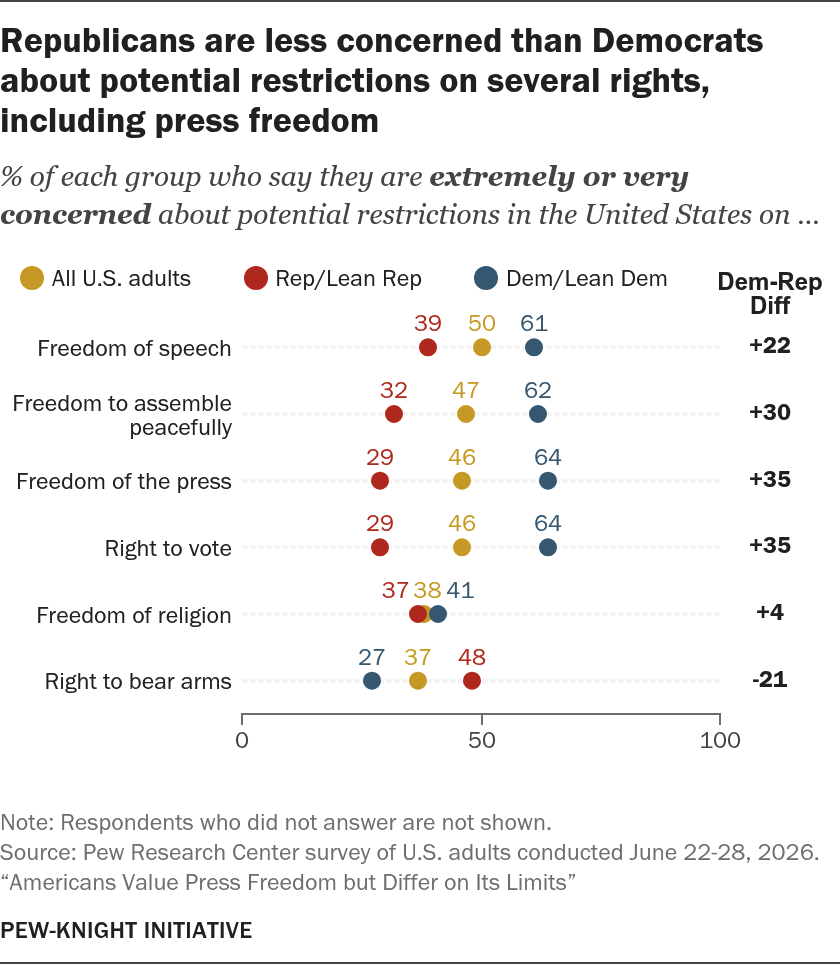
Overall, 46% of U.S. adults are extremely or very concerned about possible restrictions on press freedom. This is similar to the share who say the same about the right to vote (46%), freedom for people to assemble peacefully (47%) and freedom of speech (50%).
“Americans Value Press Freedom but Differ on Its Limits”
| All U.S. adults | Rep/Lean Rep | Dem/Lean Dem | Dem-Rep Diff | |
|---|---|---|---|---|
| Freedom of speech | 50 | 39 | 61 | +22 |
| Freedom to assemble peacefully | 47 | 32 | 62 | +30 |
| Freedom of the press | 46 | 29 | 64 | +35 |
| Right to vote | 46 | 29 | 64 | +35 |
| Freedom of religion | 38 | 37 | 41 | +4 |
| Right to bear arms | 37 | 48 | 27 | -21 |
“Americans Value Press Freedom but Differ on Its Limits”
Democrats are much more likely than Republicans to be concerned about the status of these four rights.
By contrast, Republicans are far more likely than Democrats to be concerned about possible restrictions on the right to bear arms. And the two partisan groups express similar levels of concern about potential restrictions on freedom of religion.
How Americans view Trump’s impact on press freedom
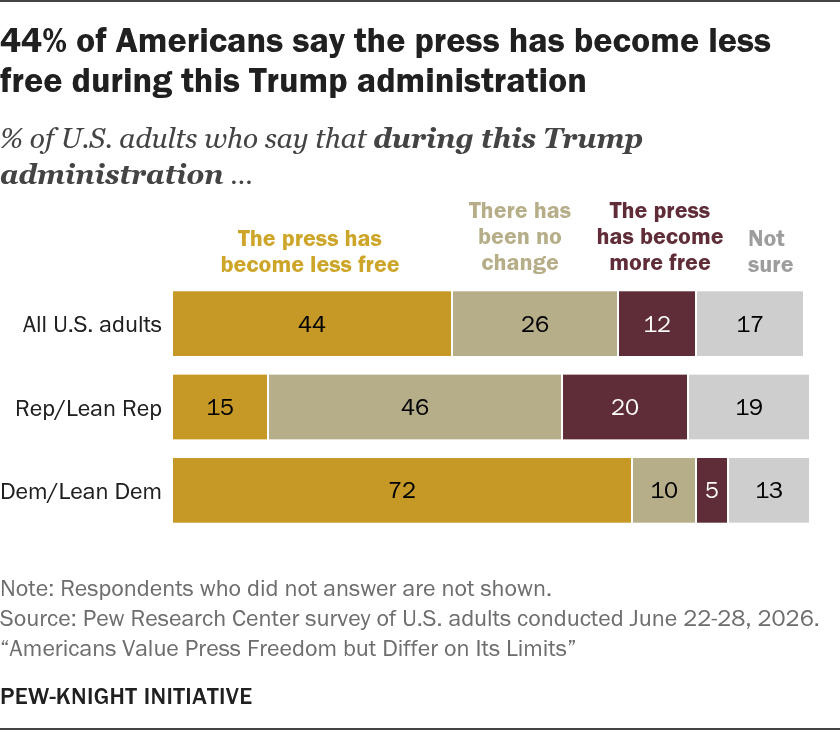
Trump has long had an adversarial relationship with the press, and Americans have noticed these tensions since early in his first term. Since Trump returned to office, his new administration has taken several actions it says are necessary and its critics view as restrictions on press freedom. These have included legal disputes with news organizations, restrictions affecting media access and efforts to identify confidential sources.
| The press has become less free | There has been no change | The press has become more free | Not sure | |
|---|---|---|---|---|
| All U.S. adults | 44 | 26 | 12 | 17 |
| Rep/Lean Rep | 15 | 46 | 20 | 19 |
| Dem/Lean Dem | 72 | 10 | 5 | 13 |
Overall, 44% of U.S. adults say the press has become less free during the second Trump administration, compared with 12% who say it has become more free. About a quarter (26%) say there has been no change, and 17% aren’t sure.
Among those who say the press has become less free under Trump, the overwhelming majority (92%) say this is a bad thing for the country.
The gap between the parties on this question is big: 72% of Democrats say the press has become less free since Trump’s return to office, compared with 15% of Republicans.
These partisan differences mirror broader disagreements in our focus groups about what Americans think threatens press freedom. For many left-leaning participants, threats come primarily from the current government’s actions to restrict journalists.
“I think the powers that be in this country don’t care as much about the Constitution as the rest of us,” a left-leaning man in his 50s said. “They will try to limit everything that they can that doesn’t slant their way or make them look good. That’s a real big problem for me.”
On the right, concerns tend to center on information gatekeeping, censorship and media bias. In the survey, one-in-five Republicans say the press has become more free during this Trump administration. And in focus groups, several right-leaning participants looked favorably upon Elon Musk’s purchase of Twitter – which one man in his 50s called “a big turning point.”
“The Biden Administration in itself was detrimental to all of this, because there was a lot of censoring,” another right-leaning man in his 50s said. “Elon Musk, he has the money, so he went ahead and bought Twitter and said, ‘Hey, we’re not going to do this anymore.’ … He opened it up so anybody that had a thought about anything could say it. And I think it started a trend back to where things need to be.”
Others pointed to Trump frequently taking questions from or interviews with reporters.
As one right-leaning man in his 60s said, “I like the fact that President Trump, at least he knows how to hold a press conference every week, versus the administration before. We got nothing. We got nothing.”
“He does do interviews on the other side, and he will call them out,” said a woman in her 50s.
Both Republicans and Democrats (70% and 74%, respectively) mostly say the Trump administration and the news media currently have a very or somewhat bad relationship.
Read more on how Americans view political and corporate influence on the news and the relationship between the government and the news media.


