
Discussions about censorship in America have taken many forms in the digital age. The Supreme Court weighed in on the government’s role in social media content moderation in 2024, and President Donald Trump issued an executive order aimed at “ending federal censorship” on the first day of his second term.
Americans have long felt that social media sites intentionally censor political viewpoints they find objectionable, while some also see “cancel culture” as a form of censorship. Today, about a third of Americans (36%) say that people who share their political views are extremely or very free to openly express those views.
“Americans Value Press Freedom but Differ on Its Limits”
| No | Yes | Not sure | |
|---|---|---|---|
| Is critical of the government | 77 | 10 | 13 |
| Clearly favors one political side | 72 | 14 | 14 |
| Contains false information | 33 | 51 | 16 |
| Poses a risk to national security | 23 | 60 | 18 |
“Americans Value Press Freedom but Differ on Its Limits”
As it pertains to news, concerns about suppression of information go beyond any single institution: Substantial shares of U.S. adults believe government actors as well as media and technology companies intentionally keep important news from reaching the public. While Republicans are much more likely than Democrats to say news organizations and journalists suppress important news, Democrats currently are most skeptical of the federal government.
At the same time, there are some situations in which Americans see certain forms of censorship as acceptable.
Many say the government should be able to force a news organization to take down a story if it is inaccurate or could endanger national security, or that social media companies should be able to take down posts for these reasons. But far fewer say either action is acceptable when it comes to posts that are politically slanted or critical of the government. And relatively few people say it is acceptable for the owner of a news organization to stop a story from being published because it goes against their political or business interests.
These findings are part of a Pew Research Center study from the Pew-Knight Initiative exploring how Americans think about freedom of the press today. Read key findings from the full study, which included two surveys of U.S. adults and a series of 10 focus groups.
Many Americans think important news is intentionally kept from the public
“Americans Value Press Freedom but Differ on Its Limits”
| Extremely often | Often | Sometimes | Rarely | Never | Not sure | |
|---|---|---|---|---|---|---|
| The U.S. government | 30 | 29 | 25 | 5 | 2 | 9 |
| News organizations | 21 | 25 | 33 | 9 | 2 | 10 |
| Social media companies | 20 | 26 | 31 | 10 | 3 | 11 |
| Individual journalists | 11 | 17 | 37 | 20 | 3 | 11 |
“Americans Value Press Freedom but Differ on Its Limits”
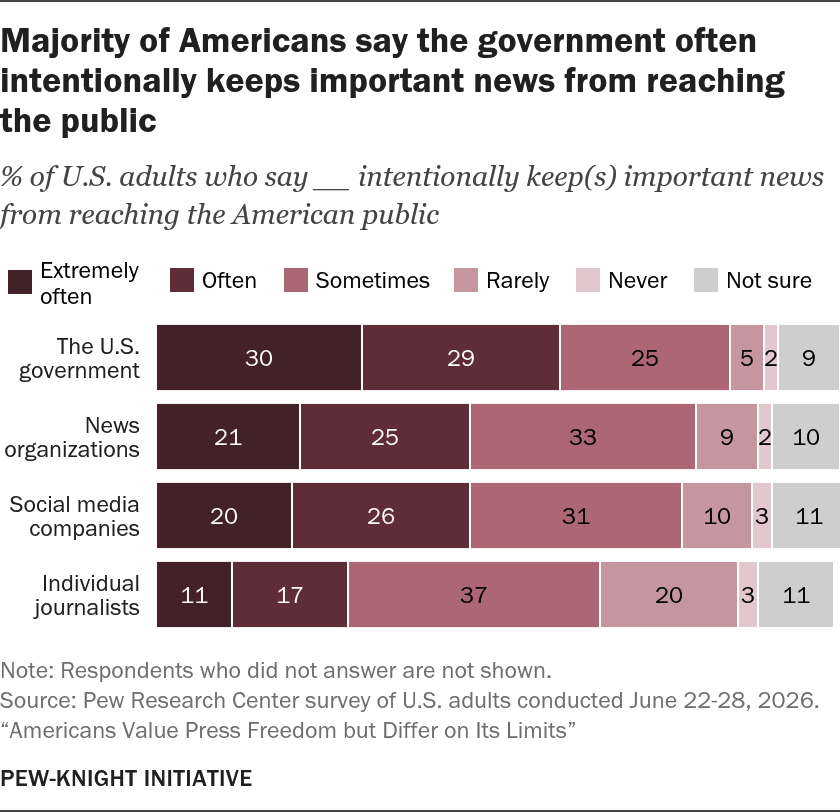
Americans are largely suspicious that major institutions keep important news from them. Three-quarters or more say the U.S. government (83%), news organizations (79%) and social media companies (76%) at least sometimes do this. This includes a majority (59%) who say the government does this extremely often or often.
Far fewer say individual journalists prevent important news from being spread extremely often or often (28%).
The suspicion that these institutional actors are intentionally keeping news from reaching the American public aligns with the fact that many Americans say news organizations are influenced by political and corporate interests – and that relatively few say the press is completely free to report the news in the U.S.
Partisan differences in perceptions of censorship
Perceptions of who is responsible for censoring information are closely tied to Americans’ political identities.
“Americans Value Press Freedom but Differ on Its Limits”
| Rep/Lean Rep | Dem/Lean Dem | |
|---|---|---|
| News organizations | 59 | 36 |
| The U.S. government | 53 | 64 |
| Social media companies | 52 | 41 |
| Individual journalists | 41 | 16 |
“Americans Value Press Freedom but Differ on Its Limits”
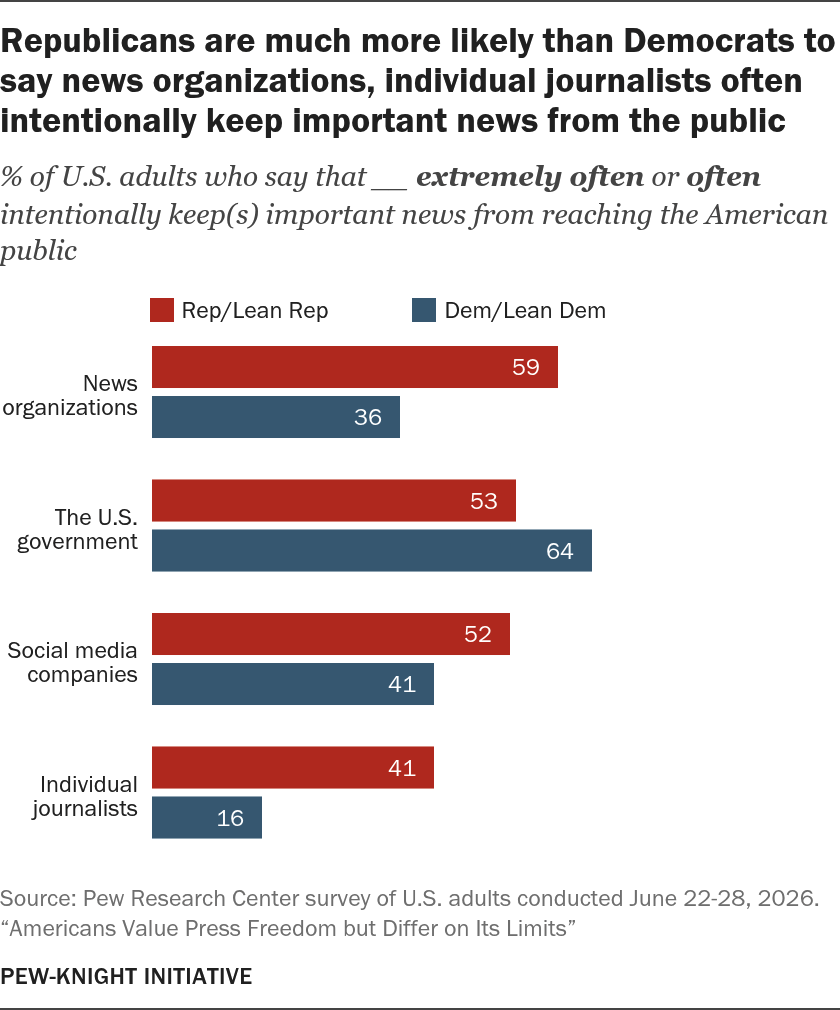
Republicans (including GOP-leaning independents) are far more likely than Democrats and Democratic leaners to say news organizations and individual journalists extremely often or often keep important news from reaching the American public.
Republicans are also more likely than Democrats to say the same about social media companies, though the gap between the two parties is smaller on that question, and several Republican focus group participants said they have experienced improvements in how specific social media companies handle content on their platforms.
Meanwhile, Democrats are more likely than Republicans to say the U.S. government intentionally keeps important news from the public. This aligns with a general trend in trust in the federal government where people in the same party as the current president are generally more likely to say they trust the federal government to do what is right.
Many Americans say the U.S. government and social media companies should be able to restrict news in some – but not all – circumstances
There are some circumstances in which Americans see censorship of the news as warranted.
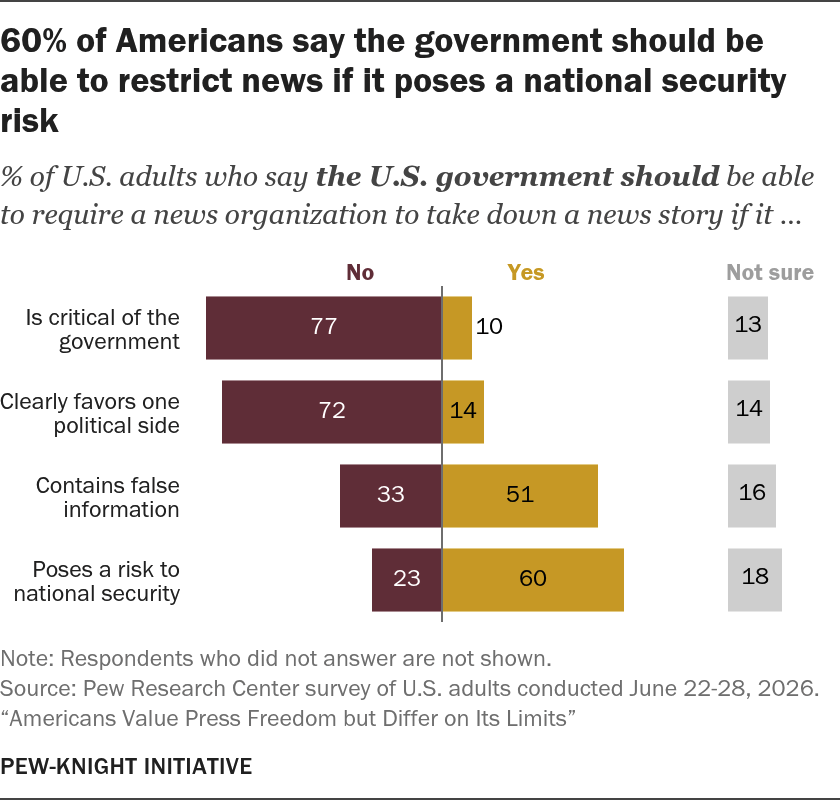
The survey asked Americans if the U.S. government should have the power to force a news organization to take down a story in four hypothetical circumstances. A majority of Americans (60%) say the U.S. government should be able to require a news organization to take down a news story if it poses a risk to national security, and about half (51%) say this should be possible if a story contains false information.

“Americans Value Press Freedom but Differ on Its Limits”
| Party | No | Yes | Not sure | |
|---|---|---|---|---|
| Is critical of the government | Dem/Lean Dem | 83 | 7 | 10 |
| Is critical of the government | Rep/Lean Rep | 75 | 12 | 13 |
| Clearly favors one political side | Dem/Lean Dem | 77 | 12 | 11 |
| Clearly favors one political side | Rep/Lean Rep | 68 | 17 | 14 |
| Contains false information | Dem/Lean Dem | 39 | 45 | 16 |
| Contains false information | Rep/Lean Rep | 28 | 59 | 13 |
| Poses a risk to national security | Dem/Lean Dem | 29 | 50 | 21 |
| Poses a risk to national security | Rep/Lean Rep | 16 | 72 | 12 |
“Americans Value Press Freedom but Differ on Its Limits”
On the other hand, most Americans say the government should not be able to take this step because a story is critical of the government (77%) or favors one political side (72%).
Majorities of both parties say the government should not be able to require a story to be removed if it’s critical of the government or favors one political side. But Republicans are more likely than Democrats to say such an action should be allowed in cases of national security (72% vs. 50%) or false information (59% vs. 45%). And adults ages 50 and older (65%) are also more likely than those under 50 (54%) to support this option in the event a news story poses a national security risk.
Focus group conversations – particularly the following dialogue between two participants in a politically right-leaning group – revealed some people’s mixed feelings when it comes to national security concerns:
Participant 1 (man, 30s): “I mean, a lot of these things could put people’s lives in danger. Military, CIA, anyone undercover, any military. We don’t know whose lives could be at danger for this. I think there’s a reason why it’s classified. It shouldn’t be distributed.”
Participant 2 (woman, 40s): “I would agree that if it was truly something that would put our country or anybody in danger, that would be totally wrong for them to publish that. However, can we trust completely that it does have to do with national security concerns? Or is this person a whistleblower, and it’s something we really should know, but they’re putting it under the blanket of ‘this is a security concern?’”
“Americans Value Press Freedom but Differ on Its Limits”
| No | Yes | Not sure | |
|---|---|---|---|
| Clearly favors one political side | 75 | 11 | 14 |
| Is critical of the government | 71 | 15 | 14 |
| Contains false information | 29 | 53 | 17 |
| Poses a risk to national security | 18 | 67 | 15 |
“Americans Value Press Freedom but Differ on Its Limits”
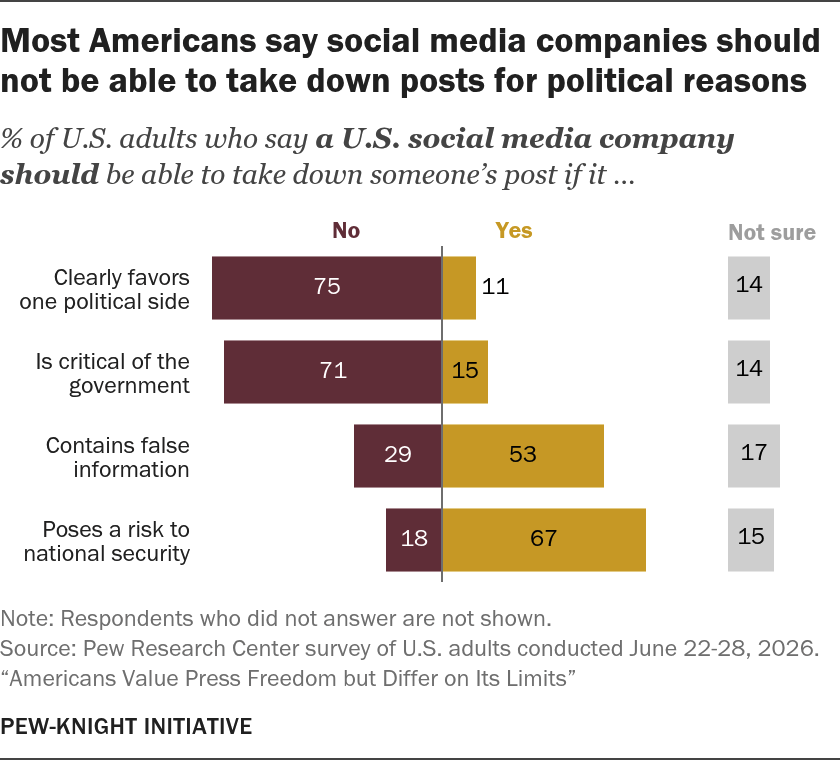
We also asked Americans whether they think a U.S. social media company should be able to take down someone’s post under each of the same circumstances.
Results were similar, with most people opposed to social media companies being able to take down posts if they are critical of the government or favor one political side. Many Americans are open to such actions over false information or national security risks.
Republicans and Democrats largely respond similarly to these questions. There is one notable exception: Democrats are modestly more likely than Republicans to say a social media company should be able to take down a post that contains false information (58% vs. 47%).
Adults ages 50 and older (59%) are also somewhat more supportive than those under 50 (49%) of social media companies having the right to remove posts with false information.
In focus groups, participants’ views reflected a tension between viewing social media companies as private businesses that can set their own rules and worrying that removing posts – even false ones – could go too far and silence free speech.
“You can’t really hold a private company to the same standard [as the government],” a left-leaning focus group participant in his 20s said. “If they set their rules, that’s what’s allowed on their platform. They’re fully within their right to be able to remove something that violates that.”
A right-leaning woman in her 20s said, “I hope that freedom of speech gets expanded to social media because now people are relying more on social media and we see it as a public square. I wish that corporations didn’t have so much control over shadow-banning you or maybe not promoting some people if they’re sharing a certain story.”
How Americans feel about owners of news organizations suppressing coverage for their business or political interests
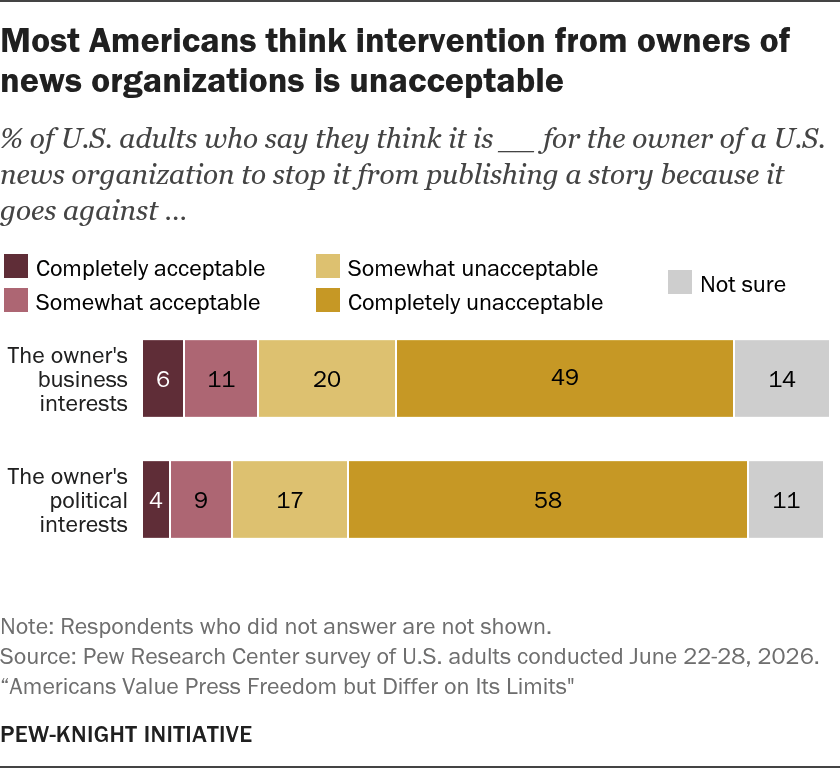
When it comes to censorship within news organizations, the survey asked Americans whether or not it is acceptable for the owner of a news organization to step in and prevent publication of a story because it goes against their business or political interests.
“Americans Value Press Freedom but Differ on Its Limits”
| Completely acceptable | Somewhat acceptable | Somewhat unacceptable | Completely unacceptable | Not sure | |
|---|---|---|---|---|---|
| The owner’s business interests | 6 | 11 | 20 | 49 | 14 |
| The owner’s political interests | 4 | 9 | 17 | 58 | 11 |
“Americans Value Press Freedom but Differ on Its Limits”
Most Americans view such actions as completely or somewhat unacceptable.For instance, 58% say it is completely unacceptable for news organizations’ owners to stop their outlets from publishing a story that goes against the owner’s political interests, and an additional 17% say this is somewhat unacceptable.
Many news organizations traditionally tried to keep a barrier between their business operations and their editorial department to ensure the independence of editorial decisions.
“People that own newspapers who are not journalists or whatever,” said a left-leaning man in his 40s. “It makes me feel very nervous about those kinds of people dictating the reporting that’s coming out in their newspapers.”
In that same group, a left-leaning man in his 50s said, “When you have individuals that are able to purchase media outlets like CBS and then control what’s going to be heard, seen, and whatnot, you have a problem.”
“Americans Value Press Freedom but Differ on Its Limits”
| The owner’s business interests | The owner’s political interests | |
|---|---|---|
| Conservative Rep/Lean Rep | 45 | 56 |
| Moderate/Liberal Rep/Lean Rep | 41 | 46 |
| Moderate/ Conservative Dem/Lean Dem | 49 | 58 |
| Liberal Dem/ Lean Dem | 66 | 78 |
“Americans Value Press Freedom but Differ on Its Limits”
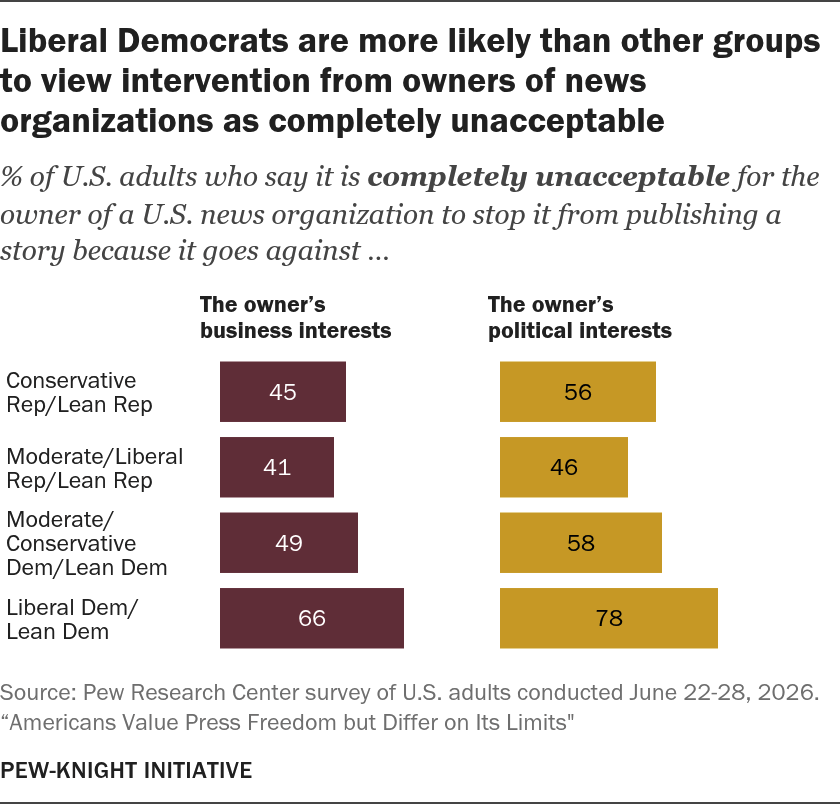
The survey found liberal Democrats are more likely than other Americans to say they think it is completely unacceptable for the owner of a news organization to nix a story because it goes against the owner’s business or political interests.
At the same time, some focus group participants expressed the view that owners maintain a right to influence the news organizations they own, drawing a distinction between private companies and government censorship.
“It’s a private entity,” a right-leaning man in his 40s said. “I wouldn’t want them to do that, but if he’s the owner, he can run his company however he wants. It’s not my place to tell them how to run it. It’s only my place whether I agree or disagree with the slant of their news.”
Do Americans think people who share their political views are free to openly express those views?
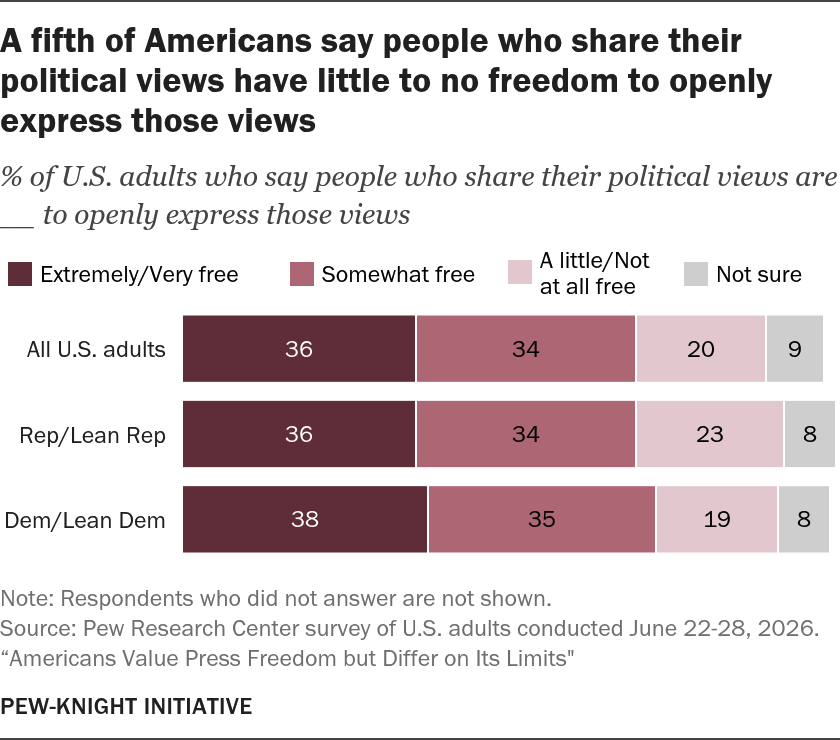
Most Americans (70%) believe that people who share their political views are at least somewhat free to openly express those views, with similar shares of Democrats (73%) and Republicans (69%) saying this. But fewer than half say people with similar views are extremely or very free to share them (36%).
“Americans Value Press Freedom but Differ on Its Limits”
| Extremely/Very free | Somewhat free | A little/Not at all free | Not sure | |
|---|---|---|---|---|
| All U.S. adults | 36 | 34 | 20 | 9 |
| Rep/Lean Rep | 36 | 34 | 23 | 8 |
| Dem/Lean Dem | 38 | 35 | 19 | 8 |
“Americans Value Press Freedom but Differ on Its Limits”
Several focus group participants discussed feeling like their voices are often silenced on social media platforms in particular.
“I think there’s definitely some censorship going on, because my Facebook account, I post a lot of political stuff, but my Facebook account has been suspended so many times,” said a right-leaning man in his 50s. “My brother has been banned for life.”


