
Before reading further: Take the quiz to see how much you know about the First Amendment and how you compare to U.S. adults.
The First Amendment to the U.S. Constitution protects several fundamental rights, including freedom of the press and free speech. To understand what U.S. adults know about the First Amendment – and press freedom in particular – we asked eight multiple-choice factual questions about what it does and does not protect.
This is part of a broader Pew Research Center study from the Pew-Knight Initiative exploring U.S. adults’ views of press freedom today. Read key findings from the full study, which included two surveys of U.S. adults and a series of 10 focus groups.
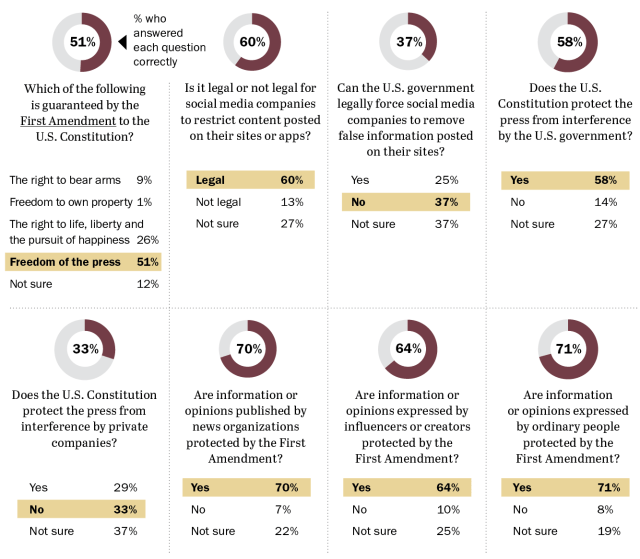
About half of U.S. adults (51%) correctly identified that the First Amendment guarantees freedom of the press. Roughly a quarter (26%) incorrectly said it protects “the right to life, liberty and the pursuit of happiness” – a phrase from the Declaration of Independence – and 9% chose the right to bear arms, which is protected by the Second Amendment.
“Americans Value Press Freedom but Differ on Its Limits”
| Answer | % answer | % who answer the question correctly | |
|---|---|---|---|
| Which of the following is guaranteed by the First Amendment to the U.S. Constitution? | The right to bear arms | 9 | 51 |
| Freedom to own property | 1 | ||
| The right to life, liberty and the pursuit of happiness | 26 | ||
| Freedom of the press (correct answer) | 51 | ||
| Not sure | 12 | ||
| Is it legal or not legal for social media companies to restrict content posted on their sites or apps? | Legal (correct answer) | 60 | 60 |
| Not legal | 13 | ||
| Not sure | 27 | ||
| Can the U.S. government legally force social media companies to remove false information posted on their sites? | Yes | 25 | 37 |
| No (correct answer) | 37 | ||
| Not sure | 37 | ||
| Does the U.S. Constitution protect the press from interference by the U.S. government? | Yes (correct answer) | 58 | 58 |
| No | 14 | ||
| Not sure | 27 | ||
| Does the U.S. Constitution protect the press from interference by private companies? | Yes | 29 | 33 |
| No (correct answer) | 33 | ||
| Not sure | 37 | ||
| Are information or opinions published by news organizations protected by the First Amendment? | Yes (correct answer) | 70 | 70 |
| No | 7 | ||
| Not sure | 22 | ||
| Are information or opinions expressed by influencers or creators protected by the First Amendment? | Yes (correct answer) | 64 | 64 |
| No | 10 | ||
| Not sure | 25 | ||
| Are information or opinions expressed by ordinary people protected by the First Amendment? | Yes (correct answer) | 71 | 71 |
| No | 8 | ||
| Not sure | 19 |
“Americans Value Press Freedom but Differ on Its Limits”
Public knowledge varies widely on other questions. Overall, people were more likely to know who is protected by the First Amendment, and less likely to know how it applies to social media and private companies.

“Americans Value Press Freedom but Differ on Its Limits”
| Group | Average number of correct answers | |
|---|---|---|
| All U.S. adults | group 1 | 4.5 |
| Men | group 2 | 5.1 |
| Women | group 2 | 3.9 |
| Ages 18-29 | group 3 | 4.6 |
| 30-49 | group 3 | 4.4 |
| 50-64 | group 3 | 4.5 |
| 65+ | group 3 | 4.3 |
| College+ | group 4 | 5.2 |
| Some college | group 4 | 4.6 |
| HS or less | group 4 | 3.6 |
| Cons Rep/Lean Rep | group 5 | 4.8 |
| Mod/Lib Rep/Lean Rep | group 5 | 3.9 |
| Cons/Mod Dem/Lean Dem | group 5 | 4.2 |
| Lib Dem/Lean Dem | group 5 | 5.4 |
“Americans Value Press Freedom but Differ on Its Limits”
For example, about seven-in-ten Americans correctly answered that the First Amendment protects information and opinions both published by news organizations (70%) and expressed by ordinary people (71%). But well below half correctly said that the government cannot legally force social media companies to remove false information (37%), and that the Constitution does not protect the press from interference by private companies (33%).
On average, some groups were more likely to answer a higher number of these questions correctly, including:
- College graduates
- Liberal Democrats and, to a lesser degree, conservative Republicans (compared with others who identify with or lean toward either party, including moderates)
- Men
Research has long shown that when answering knowledge questions, women are more likely than men to say they don’t know the answer rather than to take a guess if they are uncertain. Consistent with this pattern, we find “don’t know” responses in this survey are 5 to 16 percentage points higher among women than men depending on the question.
Few age differences in knowledge of First Amendment protections

“Americans Value Press Freedom but Differ on Its Limits”
| Ages 18-29 | 30-49 | 50-64 | 65+ | |
|---|---|---|---|---|
| First Amendment protects info and opinions expressed by ordinary people | 70 | 68 | 74 | 75 |
| First Amendment protects info and opinions expressed by influencers | 68 | 65 | 64 | 60 |
| First Amendment protects info and opinions published by news organizations | 67 | 68 | 74 | 73 |
| Social media companies can legally restrict content on sites | 63 | 61 | 61 | 54 |
| U.S. Constitution protects press from interference by government | 58 | 54 | 59 | 63 |
| First Amendment guarantees freedom of the press | 57 | 52 | 52 | 44 |
| Government can’t legally force social media companies to remove false information | 37 | 39 | 39 | 35 |
| U.S. Constitution does not protect press from interference by private companies | 36 | 37 | 31 | 28 |
“Americans Value Press Freedom but Differ on Its Limits”
Overall, we find no consistent age differences when it comes to knowledge of First Amendment protections. Younger and older Americans were about equally likely to get most of the questions right.
The biggest exception is the question about which right is guaranteed by the First Amendment. Adults ages 18 to 29 were the most likely age group to answer correctly that the First Amendment protects freedom of the press (57%), while adults 65 and older were the least likely (44%).
Similar shares of Republicans, Democrats correctly answer factual questions about freedom of the press
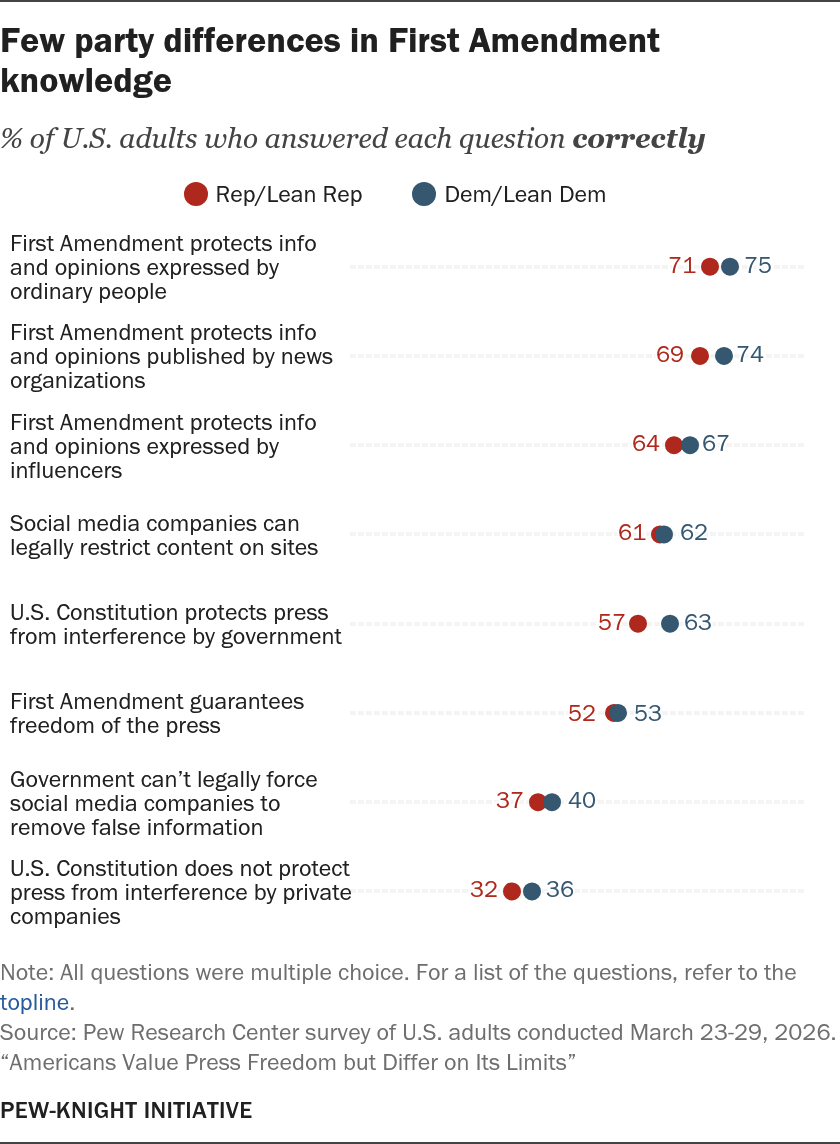
Republicans and Democrats (including independents who lean toward each party) gave correct answers to factual questions about the First Amendment at similar rates.
“Americans Value Press Freedom but Differ on Its Limits”
| Rep/Lean Rep | Dem/Lean Dem | |
|---|---|---|
| First Amendment protects info and opinions expressed by ordinary people | 71 | 75 |
| First Amendment protects info and opinions published by news organizations | 69 | 74 |
| First Amendment protects info and opinions expressed by influencers | 64 | 67 |
| Social media companies can legally restrict content on sites | 61 | 62 |
| U.S. Constitution protects press from interference by government | 57 | 63 |
| First Amendment guarantees freedom of the press | 52 | 53 |
| Government can’t legally force social media companies to remove false information | 37 | 40 |
| U.S. Constitution does not protect press from interference by private companies | 32 | 36 |
“Americans Value Press Freedom but Differ on Its Limits”
About one-in-ten among each group answered all questions correctly (10% of Democrats vs. 8% of Republicans). And the two parties are separated by no more than 6 percentage points in the shares who answered each individual question correctly. On some questions, Democrats were slightly more likely than Republicans to answer correctly, including that the U.S. Constitution protects the press from interference by the U.S. government (63% vs. 57%).
On average, conservative Republicans and liberal Democrats answered more questions correctly overall than others within each party.


