
The writers of the Constitution envisioned a free press as one of the key aspects of American democracy – but that freedom has always come along with tensions between elected officials (including presidents) and journalists.
Today, Americans across the political spectrum say the relationship between the president and the press is in a bad place. Views vary on who is to blame: Democrats largely say the press has become less free under President Donald Trump, while most Republicans say news organizations have too much political power and influence.
Amid these tensions, more than half of Americans say criticism is acceptable from politicians toward journalists, and vice versa. But a larger share say it is OK for journalists to criticize elected leaders than for those in office to criticize journalists.
At a time when their party controls the White House and Congress, Republicans are more likely than Democrats to say it is acceptable for elected leaders to criticize journalists, while Democrats are more inclined to say it is OK for journalists to criticize politicians.
These findings are based on a Pew Research Center study from the Pew-Knight Initiative exploring how Americans are thinking about press freedom today. Read key findings from the full study, which included two surveys of U.S. adults and a series of 10 focus groups.
Views on the relationship between Trump and the media
Most Americans (71%) think the Trump administration and the news media have a very or somewhat bad relationship. About one-in-five U.S. adults (17%) say the relationship between the two is neutral, and just 11% say it is very or somewhat good.

“Americans Value Press Freedom but Differ on Its Limits”
| Bad | Good | Neutral | |
|---|---|---|---|
| 2026 | 71 | 11 | 17 |
| 2025 | 64 | 11 | 22 |
“Americans Value Press Freedom but Differ on Its Limits”
The share of Americans who think President Trump and the news media have a bad relationship is up slightly from last year, when 64% expressed this view.
In focus groups we conducted with 74 everyday Americans, participants echoed this sentiment, with some referring to the current relationship between the government and the news media as “strained,” “contentious” or “volatile.”
Certain groups are more likely to say the relationship between Trump and the media is bad:
- Older Americans: 82% of U.S. adults ages 65 and older say the relationship is bad, compared with 62% of adults under 30.
- Frequent news followers: 81% of people who say they follow the news all or most of the time say this, versus 66% of those who follow the news less closely.
- People who say press freedom is highly important to society: 76% of Americans who say press freedom is extremely or very important to the well-being of society describe the relationship as bad, compared with 56% of those who don’t find it as important.
But there are no major differences by political party – Republicans and Democrats largely agree that the relationship between Trump and the media is bad. While similar shares of Americans in both parties (including independents who lean toward each party) say the relationship is bad, they often have different reasons for feeling this way.
For instance, in a 2025 survey, a majority of Republicans said that the news media has been too critical of Trump, while a similar majority of Democrats said that the Trump administration has been too critical of the news media.
While many participants in this study’s focus groups expressed dissatisfaction with what they saw as an adversarial relationship between Trump and the media, others felt more positively about it.
“I like the way he calls out the press,” one right-leaning man in his 60s said of Trump. “He knows what’s going on.”
Many Americans think news organizations hold too much power in politics

“Americans Value Press Freedom but Differ on Its Limits”
| Group | Too much | Not enough | About the right amount | |
|---|---|---|---|---|
| All U.S. adults | group 1 | 55 | 14 | 29 |
| Rep/Lean Rep | group 2 | 69 | 5 | 23 |
| Dem/Lean Dem | group 2 | 43 | 22 | 34 |
“Americans Value Press Freedom but Differ on Its Limits”
Republicans are also more likely to say that news organizations have too much power and influence in politics. About seven-in-ten Republicans (69%) express this view, compared with 43% of Democrats. Even among Democrats, this is roughly double the share who take the opposing view that news organizations don’t have enough political power (22%).
Overall, just over half of Americans (55%) think that news organizations have too much power and influence in politics today, versus 14% who say they don’t have enough. About three-in-ten (29%) say they have about the right amount of power and influence.
What criticism is acceptable between journalists and politicians?
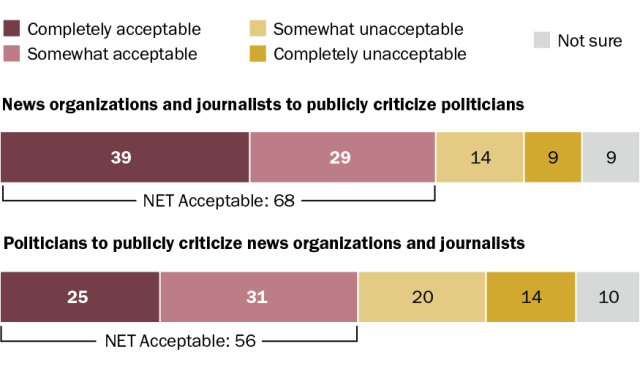
President Trump and the media have often criticized one another.
| Completely acceptable | Somewhat acceptable | Somewhat unacceptable | Completely unacceptable | Not sure | |
|---|---|---|---|---|---|
| News organizations and journalists to publicly criticize politicians | 39 | 29 | 14 | 9 | 9 |
| NET Acceptable: 68 | |||||
| Politicians to publicly criticize news organizations and journalists | 25 | 31 | 20 | 14 | 10 |
| NET Acceptable: 56 |
A 2017 Pew Research Center study found that news coverage of the early days of Trump’s first term was more negative overall compared with coverage of previous administrations. Meanwhile, Trump has long been sharply critical of the media, including calling journalists the “enemy of the people.” In 2025, the White House launched a “Media Offenders” webpage dedicated to calling out news organizations it considers biased.
Most Americans (68%) think it’s at least somewhat acceptable for news organizations and journalists to criticize politicians. A smaller majority (56%) say it’s acceptable for politicians to criticize news organizations and journalists.
A larger share of U.S. adults also say it is completely acceptable for journalists to criticize politicians than the other way around (39% vs. 25%).
“Americans Value Press Freedom but Differ on Its Limits”
| Completely acceptable | Somewhat acceptable | Somewhat unacceptable | Completely unacceptable | Not sure | |
|---|---|---|---|---|---|
| News organizations and journalists to publicly criticize politicians | |||||
| Rep/Lean Rep | 31 | 32 | 16 | 11 | 9 |
| Dem/Lean Dem | 48 | 26 | 12 | 6 | 8 |
| Politicians to publicly criticize news organizations and journalists | |||||
| Rep/Lean Rep | 33 | 34 | 15 | 8 | 9 |
| Dem/Lean Dem | 19 | 28 | 25 | 18 | 9 |
“Americans Value Press Freedom but Differ on Its Limits”
Today, Democrats are more likely than Republicans to think it’s okay for news organizations and journalists to publicly criticize politicians.
About half of Democrats (48%) – including a clear majority of Democrats who identify as liberal (63%) – say this is completely acceptable, compared with 31% of Republicans. Still, majorities of both Democrats (74%) and Republicans (63%) think it’s at least somewhat acceptable.
On the other hand, Republicans are more likely than Democrats to say that politicians publicly criticizing news organizations and journalists is at least somewhat acceptable (68% vs. 47%). A third of Republicans (including 41% of conservative Republicans) say this is completely acceptable, compared with 19% of Democrats.
When it comes to news organizations and journalists criticizing politicians, many focus group participants agreed that this comes with the territory of being a public figure. “[The press] is going to fire some arrows,” said one left-leaning man in his 50s. “If you’re going to have a position of power, you have to be willing to take those shots and stand up for yourself.”
Another participant, a left-leaning woman in her 30s, said, “A politician should be able to show that they are able to stand up to criticism and still be respectful when questioned.”
But some participants felt such criticism was uneven, and at times unacceptable. A right-leaning woman in her 60s discussed feeling like the press is harder on Trump than previous presidents: “They just totally criticize him on everything.” A left-leaning man in his 60s, discussing late-night host Jimmy Kimmel, said, “He goes overboard. He crossed the line. Whether you like Donald Trump or don’t like Donald Trump, he has deliberately gone after him and others. In America, you’re free to say what you want, but he just tends to go over the line. And I think that’s wrong.”
Participants also disagreed about politicians criticizing journalists. Many shared beliefs that the Trump administration takes its criticism of the press too far, often to the point of threatening or censoring outlets it disagrees with. But some said they liked the criticism and appreciate when Trump “calls out” news outlets.
Americans who value press freedom are more accepting of criticism in both directions
People who think press freedom is highly important to society are more likely than those who say it is less important to accept both forms of criticism.
“Americans Value Press Freedom but Differ on Its Limits”
| News organizations and journalists to publicly criticize politicians | Politicians to publicly criticize news organizations and journalists | |
|---|---|---|
| All U.S. adults | 39 | 25 |
| Among those who say press freedom is ___ important to the well-being of society | ||
| Extremely/Very important | 48 | 29 |
| Somewhat/A little/Not at all | 14 | 16 |
“Americans Value Press Freedom but Differ on Its Limits”
About half of U.S. adults who say press freedom is extremely or very important to the well-being of society (48%) think it’s completely acceptable for journalists to criticize politicians, compared with 14% of those who think press freedom is less important.
And about three-in-ten Americans who think press freedom is highly important (29%) say it’s completely acceptable for politicians to criticize journalists, about twice the share who think this among those who see press freedom as less important (16%).


