
Although chatbot use is rising in the United States, about half of U.S. adults say they never use one, according to Pew Research Center’s February survey of U.S. adults.
And for now, these non-users don’t feel like they’re missing out – most are not interested and have no plans to use chatbots soon.

Note: White, Black and Asian adults include those who report being only one race and are not Hispanic. Hispanics are of any race. Those who did not answer are not shown.
“Americans and AI 2026: Chatbots, Smart Devices and Views on Impact”
| Group | Ever use | Do not ever use | |
|---|---|---|---|
| U.S. adults | total | 49% | 51% |
| Ages 18-29 | age | 66% | 34% |
| 30-49 | age | 61% | 39% |
| 50-64 | age | 42% | 58% |
| 65+ | age | 23% | 77% |
| White | race/eth | 46% | 54% |
| Hispanic | race/eth | 49% | 50% |
| Black | race/eth | 49% | 51% |
| Asian* | race/eth | 70% | 29% |
Note: White, Black and Asian adults include those who report being only one race and are not Hispanic. Hispanics are of any race. Those who did not answer are not shown.
“Americans and AI 2026: Chatbots, Smart Devices and Views on Impact”
This is part of a broader survey on Americans’ views of and experiences with artificial intelligence (AI). To learn more, read the report overview.
Who doesn’t use chatbots
Older adults are often less likely to be the first adopters of new technologies. Chatbot use follows a similar pattern.
Roughly three-quarters of adults 65 and older say they never use chatbots. A smaller share – though still a majority – of those ages 50 to 64 say the same. Adults under 50 are the least likely to not use these tools. About four-in-ten or less report not using them.
Differences also exist by race and ethnicity. Non-adopters are more likely to be White, Black and Hispanic than Asian.
Why people aren’t using chatbots
New technologies are rarely adopted equally across populations. As chatbots are spreading into the daily lives of many, some opt out by choice while others aren’t sure how to keep up.
To better understand what’s behind non-adoption, we asked those who don’t use these tools about five potential reasons they don’t use chatbots.

“Americans and AI 2026: Chatbots, Smart Devices and Views on Impact”
| Major reason | Minor reason | NET | |
|---|---|---|---|
| Not interested in using them | 60% | 23% | 83% |
| Concerned about how their personal information will be used | 54% | 24% | 79% |
| Don’t trust them to give accurate information | 45% | 30% | 76% |
| Don’t know how to use them | 29% | 26% | 55% |
| Think others will judge them for it | 3% | 11% | 14% |
“Americans and AI 2026: Chatbots, Smart Devices and Views on Impact”
Majorities of those who don’t use chatbots say it’s due to lack of interest, privacy concerns, potential inaccuracies or not knowing how.
But there are differences in the degree to which they cite these reasons.
Six-in-ten non-adopters cite lack of interest as a major factor behind not using these tools. This is followed by concerns about data privacy and accuracy.
Less than a third point to not knowing how to use chatbots as a major reason why they don’t use it.
Few – less than one-in-five – cite fear of judgment as a reason for avoiding these tools.
Likelihood of using chatbots in the future
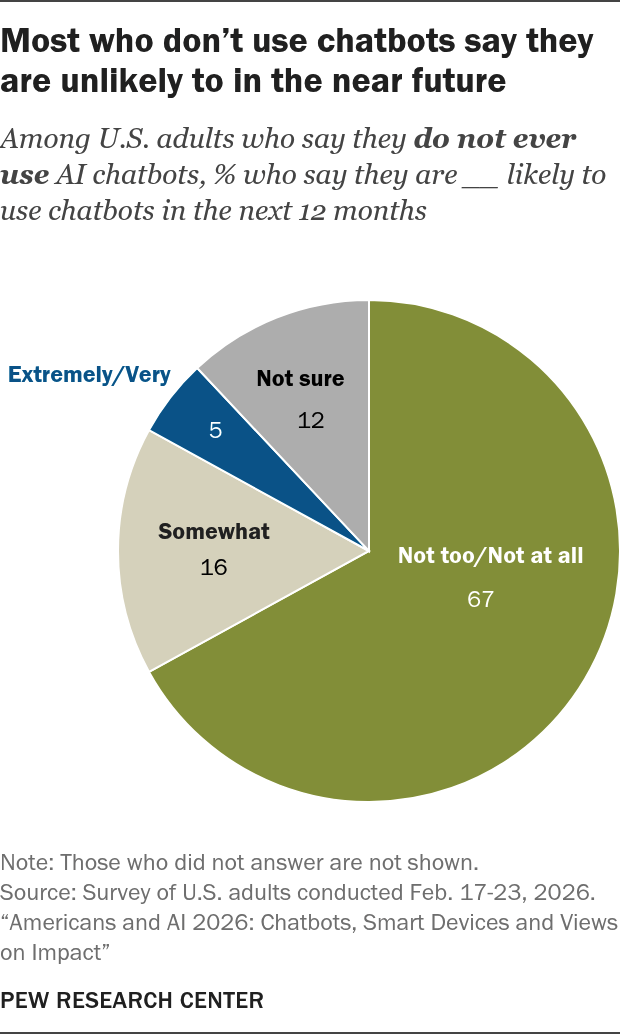
“Americans and AI 2026: Chatbots, Smart Devices and Views on Impact”
| Percent | |
|---|---|
| Not too/Not at all | 67% |
| Somewhat | 16% |
| Extremely/Very | 5% |
| Not sure | 12% |
“Americans and AI 2026: Chatbots, Smart Devices and Views on Impact”
Most who don’t use chatbots say they won’t use these tools in the near future.
Roughly seven-in-ten adults who don’t use chatbots say they’re unlikely to use the technology in the next 12 months. This includes 40% who say they’re not at all likely to.
Only 5% of chatbot non-users think it’s highly likely they’ll use a chatbot over the next year. Another 16% say they’re somewhat likely.
About one-in-ten say they’re not sure about whether they will use these tools or not.


