
The existence of artificial intelligence (AI) has moved from a question of if to when, and now. But when people think of AI, they associate it with a range of things – from chatbots to smartwatches or even science fiction.
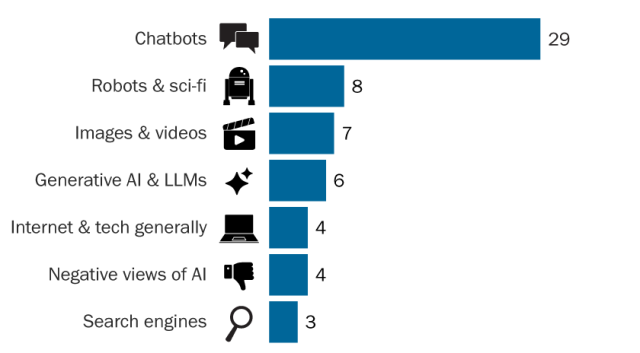
“Americans and AI 2026: Chatbots, Smart Devices and Views on Impact”
| Percent | |
|---|---|
| Chatbots | 29% |
| Robots & sci-fi | 8% |
| Images & videos | 7% |
| Generative AI & LLMs | 6% |
| Internet & tech generally | 4% |
| Negative views of AI | 4% |
| Search engines | 3% |
“Americans and AI 2026: Chatbots, Smart Devices and Views on Impact”
For the first time, Pew Research Center asked Americans: What technology comes to mind when you first think of AI?
We found that not only are more people using chatbots, this is the most common technology people first associate with AI. About three-in-ten answer with chatbots generally or name specific brands when asked about the first technology that comes to mind when thinking of AI, according to a survey of 5,119 U.S. adults conducted Feb. 17-23, 2026.
About one-in-ten mention robots and science-fiction, including films like “The Terminator” and “2001: A Space Odyssey.”
Roughly similar shares name images and videos or generative AI and large language models (LLMs) first.
Meanwhile, 3%-4% cite the internet or technology generally (e.g., computers or phones), a negative view of AI, or search engines as being top of mind.
Go to the topline for the full list of categories. This is part of a larger study of Americans about their experiences and views of AI. Jump to the main report for more.
How often do Americans think they interact with AI?

“Americans and AI 2026: Chatbots, Smart Devices and Views on Impact”
| Almost constantly/Several times a day | About once a day/Several times a week | Less often | |
|---|---|---|---|
| U.S. adults | 36% | 30% | 34% |
“Americans and AI 2026: Chatbots, Smart Devices and Views on Impact”
As AI continues to expand into different tools, some say they are regularly interacting with this technology.
Today, nearly four-in-ten U.S. adults say they engage with AI at least several times a day. This includes 7% who report doing so almost constantly.
Another three-in-ten say they do so about once a day or several times a week. And about a third report engaging with AI less often.
How aware are Americans of AI?

Note: Figures may not add up to NET values due to rounding. Those who said “nothing at all” or did not answer are not shown.
“Americans and AI 2026: Chatbots, Smart Devices and Views on Impact”
| A lot | A little | NET | |
|---|---|---|---|
| 2022 | 26% | 59% | 85% |
| 2023 | 33% | 56% | 90% |
| 2024 | 40% | 53% | 94% |
| 2025 | 47% | 48% | 95% |
| 2026* | 48% | 48% | 96% |
Note: Figures may not add up to NET values due to rounding. Those who said “nothing at all” or did not answer are not shown.
“Americans and AI 2026: Chatbots, Smart Devices and Views on Impact”
As AI becomes part of daily life, more people are calling for ways to increase AI literacy. Overall, awareness of AI is now nearly universal: 96% of adults say they know at least a little about AI.
In fact, the share who say they’ve heard a lot about AI has grown substantially over the past five years. Today, that group is about half of U.S. adults, up from 26% in 2022.

“Americans and AI 2026: Chatbots, Smart Devices and Views on Impact”
| A lot | A little | NET | |
|---|---|---|---|
| 2024 | 28% | 44% | 72% |
| 2026 | 44% | 43% | 87% |
“Americans and AI 2026: Chatbots, Smart Devices and Views on Impact”
Americans have also become far more aware of chatbots over the past couple years. Roughly nine-in-ten U.S. adults report hearing at least a little about these tools, including 44% who have heard a lot.
This is far higher than in August 2024. Then, about seven-in-ten Americans had heard of chatbots, with 28% reporting hearing a lot.
Confidence in using chatbots

“Americans and AI 2026: Chatbots, Smart Devices and Views on Impact”
| Percent | |
|---|---|
| Extremely/Very | 18% |
| Somewhat | 22% |
| Not too/Not at all | 8% |
| Does not use AI chatbots | 51% |
“Americans and AI 2026: Chatbots, Smart Devices and Views on Impact”
When it comes to the public’s confidence in using chatbots, about one-in-five adults are extremely or very confident in their ability to use a chatbot. A slightly larger share report that they are somewhat confident.
Fewer Americans lack confidence in using chatbots. About one-in-ten say they are not too or not at all confident using these tools. About half of adults do not use chatbots at all.


