
Social media offer a source of health information for many Americans, and healthcare professionals have raised concerns about non-experts spreading inaccurate or harmful medical advice online. But a Pew Research Center analysis of more than a half million social media posts from more than 6,000 health and wellness influencers from February to April 2026 finds that when it comes to medical topics, the influencers posting about them most often are healthcare professionals.
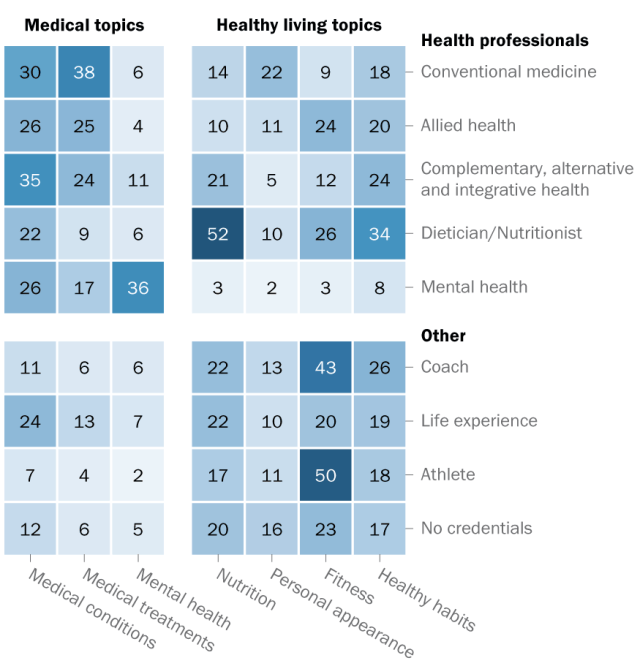
“What Do Health and Wellness Influencers Post About?”
| Background | Topic | Share |
|---|---|---|
| Conventional medicine | Medical condition | 30 |
| Conventional medicine | Professional medical treatments | 38 |
| Conventional medicine | Mental health | 6 |
| Conventional medicine | Nutrition | 13 |
| Conventional medicine | Appearance | 22 |
| Conventional medicine | Fitness | 8 |
| Conventional medicine | Healthy habits | 18 |
| Mental health | Medical condition | 25 |
| Mental health | Professional medical treatments | 17 |
| Mental health | Mental health | 35 |
| Mental health | Nutrition | 3 |
| Mental health | Appearance | 1 |
| Mental health | Fitness | 3 |
| Mental health | Healthy habits | 8 |
| Complementary, alternative and integrative health | Medical condition | 34 |
| Complementary, alternative and integrative health | Professional medical treatments | 24 |
| Complementary, alternative and integrative health | Mental health | 11 |
| Complementary, alternative and integrative health | Nutrition | 21 |
| Complementary, alternative and integrative health | Appearance | 4 |
| Complementary, alternative and integrative health | Fitness | 12 |
| Complementary, alternative and integrative health | Healthy habits | 23 |
| Allied health | Medical condition | 26 |
| Allied health | Professional medical treatments | 25 |
| Allied health | Mental health | 4 |
| Allied health | Nutrition | 10 |
| Allied health | Appearance | 11 |
| Allied health | Fitness | 24 |
| Allied health | Healthy habits | 20 |
| Coach | Medical condition | 11 |
| Coach | Professional medical treatments | 6 |
| Coach | Mental health | 6 |
| Coach | Nutrition | 22 |
| Coach | Appearance | 13 |
| Coach | Fitness | 43 |
| Coach | Healthy habits | 26 |
| Athlete | Medical condition | 7 |
| Athlete | Professional medical treatments | 4 |
| Athlete | Mental health | 2 |
| Athlete | Nutrition | 17 |
| Athlete | Appearance | 11 |
| Athlete | Fitness | 50 |
| Athlete | Healthy habits | 18 |
| No credentials | Medical condition | 12 |
| No credentials | Professional medical treatments | 6 |
| No credentials | Mental health | 5 |
| No credentials | Nutrition | 20 |
| No credentials | Appearance | 16 |
| No credentials | Fitness | 23 |
| No credentials | Healthy habits | 17 |
| Dietician/Nutritionist | Medical condition | 21 |
| Dietician/Nutritionist | Professional medical treatments | 9 |
| Dietician/Nutritionist | Mental health | 6 |
| Dietician/Nutritionist | Nutrition | 52 |
| Dietician/Nutritionist | Appearance | 10 |
| Dietician/Nutritionist | Fitness | 26 |
| Dietician/Nutritionist | Healthy habits | 33 |
“What Do Health and Wellness Influencers Post About?”
Influencers who describe themselves as healthcare professionals tend to post much more often about topics like medical conditions, mental health or treatments requiring the supervision of a doctor. These topics are much rarer in the feeds of health and wellness influencers who do not claim a medical credential or background.
Similarly, posts about nutrition most often come from self-described nutritionists while those about mental health are most prevalent in the feeds of those who cite a background in the field. And athletes and coaches tend to gravitate toward posts about fitness.
Influencers who primarily point to their life history in their bios often share their own experiences with a medical condition. This group posts about medical conditions at about the same rate as conventional medical professionals.
On the other hand, influencers who don’t describe an area of expertise tend to shy away from medical topics – but don’t avoid them entirely. Some 16% of health and wellness influencers do not describe any particular background or expertise in their site bios. For the most part, these influencers tend to focus on topics like nutrition, fitness or improving physical appearance. But around one-in-ten of their posts talk about medical conditions.
Some topics are more widespread. For instance, developing and maintaining healthy wellness habits is a mainstay in the feeds of influencers from a variety of backgrounds.
Which influencers warn of health harms and cite outside sources?
Our analysis found that 11% of posts from health and wellness influencers warn of specific health harms, while 9% cite outside sources in their posts while making a health claim. Influencers who describe themselves as researchers are far and away the most likely to cite outside sources, doing so in 30% of their posts.
Other groups that mention direct health harms in a relatively large share of their posts include those who describe themselves as:
- Complementary, integrative and alternative health professionals (22%)
- Researchers (21%)
- Conventional medical professionals (20%)
These topics are less prevalent in the feeds of influencers who don’t list any credentials or who describe themselves as coaches or athletes. Both these topics appear in 7% or fewer of posts from these groups.
How these influencers discuss men’s and women’s health
For the most part, similar shares of men and women discuss the topics we measured in at least one post. But there are notable differences in the shares of each group who discuss men’s and women’s health specifically.
“What Do Health and Wellness Influencers Post About?”
| Topic | Men | Women | Diff |
|---|---|---|---|
| Women’s health | 30 | 58 | -27 |
| Men’s health | 24 | 7 | 17 |
| Longevity | 41 | 30 | 11 |
| Mental health | 50 | 58 | -8 |
| Personal appearance | 58 | 66 | -8 |
| OTC medications or supplements | 62 | 69 | -7 |
| Life experience | 70 | 77 | -7 |
| Health policy | 27 | 20 | 6 |
| Nutrition | 64 | 70 | -6 |
| Fitness | 74 | 70 | 4 |
| Healthy habits | 79 | 84 | -4 |
| Medical conditions | 78 | 77 | 2 |
| Medical treatments | 69 | 68 | 1 |
“What Do Health and Wellness Influencers Post About?”
Women are nearly twice as likely as men to ever discuss women’s health in their posts, while roughly three times as many men as women ever mention men’s health.
And notably, among influencers who are men, a larger share discusses women’s health (30%) than men’s health (24%).
Menopause and perimenopause are common themes in posts about women’s health and from influencers who are women. About one-in-five posts that mention women’s health also include some discussion of menopause.
Outside of these two topics, larger shares of men ever discuss longevity and life extension (41% of men vs. 30% of women). And a somewhat larger share of women ever discuss mental health (58% vs. 50%) or improving physical appearance (66% vs. 58%).

