In 2022, Pew Research Center conducted a survey of 19 mostly high-income countries, where we asked respondents whether social media had been a good or bad thing for democracy.
“Across the Globe, People Increasingly Say Social Media Is Harming Democracy”
| Year | U.S. | Canada | France | Germany | Greece | Hungary | Netherlands | Poland | Spain | Sweden | U.K. | Japan | South Korea |
|---|---|---|---|---|---|---|---|---|---|---|---|---|---|
| 2022 | 64 | 47 | 51 | 41 | 35 | 22 | 54 | 15 | 35 | 32 | 48 | 23 | 32 |
| 2026 | 64 | 55 | 65 | 61 | 43 | 42 | 70 | 35 | 47 | 47 | 56 | 43 | 38 |
“Across the Globe, People Increasingly Say Social Media Is Harming Democracy”
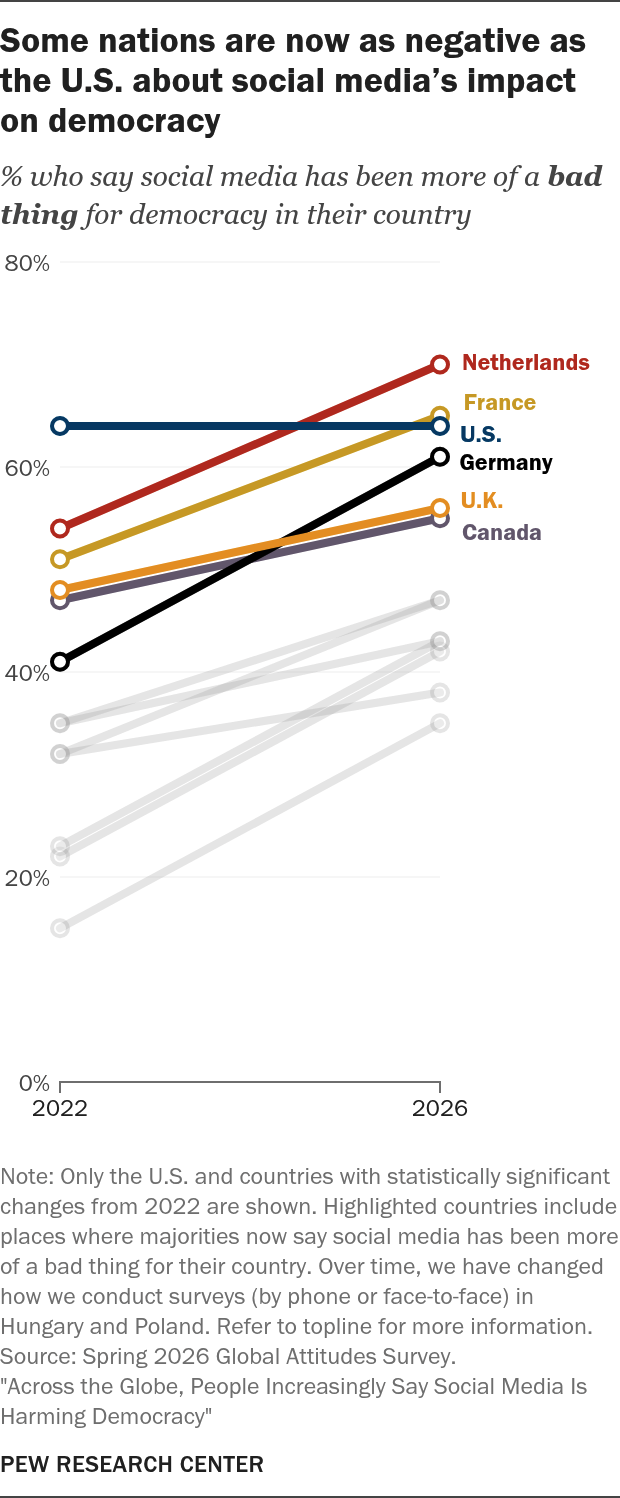
The United States was by far the most negative nation polled: 64% of Americans said it had been bad for democracy, 10 percentage points higher than the second-most negative country at the time, the Netherlands.
This year, we conducted a 37-nation survey in which we asked the same question. Once again 64% of Americans say social media is harming their democracy. However, while views held steady in the U.S., attitudes in many other countries turned significantly more negative. In many ways, people in other countries are catching up with Americans’ grim take on the effects of social media.
In fact, people in the Netherlands are now more likely than Americans to say social media has been bad for democracy: 70% of the Dutch hold this view today, up from 54% four years ago.
French and German views now closely mirror those in the U.S., and negative evaluations of social media have also increased notably in the United Kingdom and Canada.
Overall, the new survey finds that the share of the public who believes social media has been bad for democracy has grown in 16 of the 26 countries where data from either 2022 or 2023 is available.
These findings are part of a larger report on views of social media and its impact on democracy and individuals.
How do Americans compare with others around the world on attitudes toward social media?
Even though other countries are catching up, Americans still have some of the most negative views about social media’s impact on politics and the information environment.
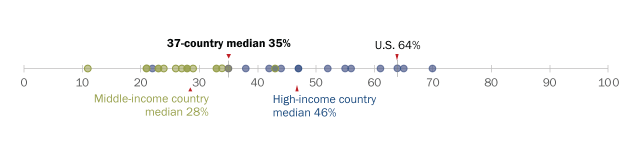
The 64% of Americans who say social media’s impact on democracy has been bad is much higher than the median of 35% who express this view across the 37 nations we surveyed this year.
“Across the Globe, People Increasingly Say Social Media Is Harming Democracy”
| Country | Bad thing | World Bank classification |
|---|---|---|
| U.S. | 64 | High-income |
| Canada | 55 | High-income |
| France | 65 | High-income |
| Germany | 61 | High-income |
| Greece | 43 | High-income |
| Hungary | 42 | High-income |
| Italy | 44 | High-income |
| Netherlands | 70 | High-income |
| Poland | 35 | High-income |
| Spain | 47 | High-income |
| Sweden | 47 | High-income |
| U.K. | 56 | High-income |
| Australia | 52 | High-income |
| Bangladesh | 28 | Middle-income |
| India | 23 | Middle-income |
| Indonesia | 43 | Middle-income |
| Japan | 43 | High-income |
| Malaysia | 27 | Middle-income |
| Pakistan | 33 | Middle-income |
| Philippines | 23 | Middle-income |
| Singapore | 22 | High-income |
| South Korea | 38 | High-income |
| Sri Lanka | 35 | Middle-income |
| Thailand | 21 | Middle-income |
| Israel | 22 | High-income |
| Turkey | 35 | Middle-income |
| West Bank / East Jerusalem | 35 | Middle-income |
| Ghana | 21 | Middle-income |
| Kenya | 24 | Middle-income |
| Nigeria | 11 | Middle-income |
| South Africa | 28 | Middle-income |
| Argentina | 35 | Middle-income |
| Brazil | 29 | Middle-income |
| Chile | 43 | High-income |
| Colombia | 33 | Middle-income |
| Mexico | 26 | Middle-income |
| Peru | 34 | Middle-income |
| Middle-income country median | 28 | Middle-income |
| High-income median | 46 | High-income |
| 37-country median | 35 |
“Across the Globe, People Increasingly Say Social Media Is Harming Democracy”
In general, people in high-income nations tend to be more negative about the influence of social media than those in middle-income countries. Still, even compared with most other high-income publics, Americans are relatively negative.
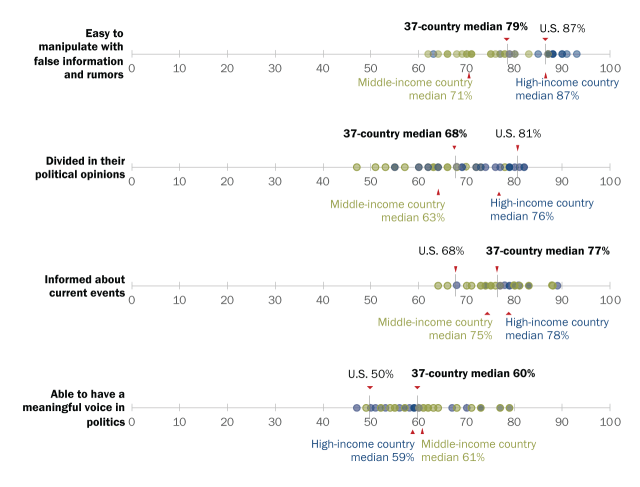
And on questions about specific potential effects of social media, Americans often stand out for their bleak assessment. They are among the most likely to think access to the internet and social media has made people more divided in their political views, and among the least likely to say it has made people more informed about current events or able to have a meaningful voice in politics.
“Across the Globe, People Increasingly Say Social Media Is Harming Democracy”
| Country | Informed about current events | Divided in their political opinions | Easy to manipulate with false information and rumors | Able to have a meaningful voice in politics | World Bank classification |
|---|---|---|---|---|---|
| U.S. | 68 | 81 | 87 | 50 | High-income |
| Canada | 74 | 77 | 87 | 58 | High-income |
| France | 77 | 69 | 88 | 59 | High-income |
| Germany | 80 | 82 | 87 | 57 | High-income |
| Greece | 79 | 69 | 87 | 47 | High-income |
| Hungary | 74 | 79 | 85 | 59 | High-income |
| Italy | 74 | 62 | 88 | 51 | High-income |
| Netherlands | 83 | 82 | 93 | 57 | High-income |
| Poland | 79 | 79 | 88 | 70 | High-income |
| Spain | 77 | 80 | 87 | 73 | High-income |
| Sweden | 83 | 72 | 90 | 67 | High-income |
| U.K. | 77 | 79 | 91 | 53 | High-income |
| Australia | 74 | 79 | 90 | 52 | High-income |
| Bangladesh | 64 | 55 | 66 | 54 | Middle-income |
| India | 66 | 51 | 62 | 55 | Middle-income |
| Indonesia | 77 | 55 | 66 | 55 | Middle-income |
| Japan | 89 | 64 | 88 | 79 | High-income |
| Malaysia | 71 | 53 | 68 | 49 | Middle-income |
| Pakistan | 74 | 62 | 70 | 68 | Middle-income |
| Philippines | 74 | 66 | 70 | 71 | Middle-income |
| Singapore | 81 | 60 | 77 | 59 | High-income |
| South Korea | 80 | 74 | 79 | 77 | High-income |
| Sri Lanka | 73 | 63 | 78 | 62 | Middle-income |
| Thailand | 88 | 78 | 83 | 79 | Middle-income |
| Israel | 80 | 55 | 63 | 73 | High-income |
| Turkey | 75 | 66 | 71 | 64 | Middle-income |
| West Bank / East Jerusalem | 88 | 73 | 87 | 62 | Middle-income |
| Ghana | 83 | 63 | 76 | 77 | Middle-income |
| Kenya | 70 | 47 | 64 | 60 | Middle-income |
| Nigeria | 80 | 60 | 69 | 73 | Middle-income |
| South Africa | 76 | 57 | 71 | 60 | Middle-income |
| Argentina | 75 | 72 | 80 | 52 | Middle-income |
| Brazil | 73 | 64 | 78 | 60 | Middle-income |
| Chile | 74 | 73 | 80 | 56 | High-income |
| Colombia | 77 | 68 | 77 | 63 | Middle-income |
| Mexico | 81 | 64 | 75 | 57 | Middle-income |
| Peru | 80 | 70 | 75 | 61 | Middle-income |
| Middle-income country median | 75 | 63 | 71 | 61 | Middle-income |
| High-income median | 78 | 76 | 87 | 59 | High-income |
| 37-country median | 77 | 68 | 79 | 60 |
“Across the Globe, People Increasingly Say Social Media Is Harming Democracy”
However, the U.S. looks similar to other high-income nations when we ask whether access to the internet and social media has made it easier to manipulate people with false information and rumors: 87% of Americans hold this view, the same as the median percentage across the high-income countries surveyed.
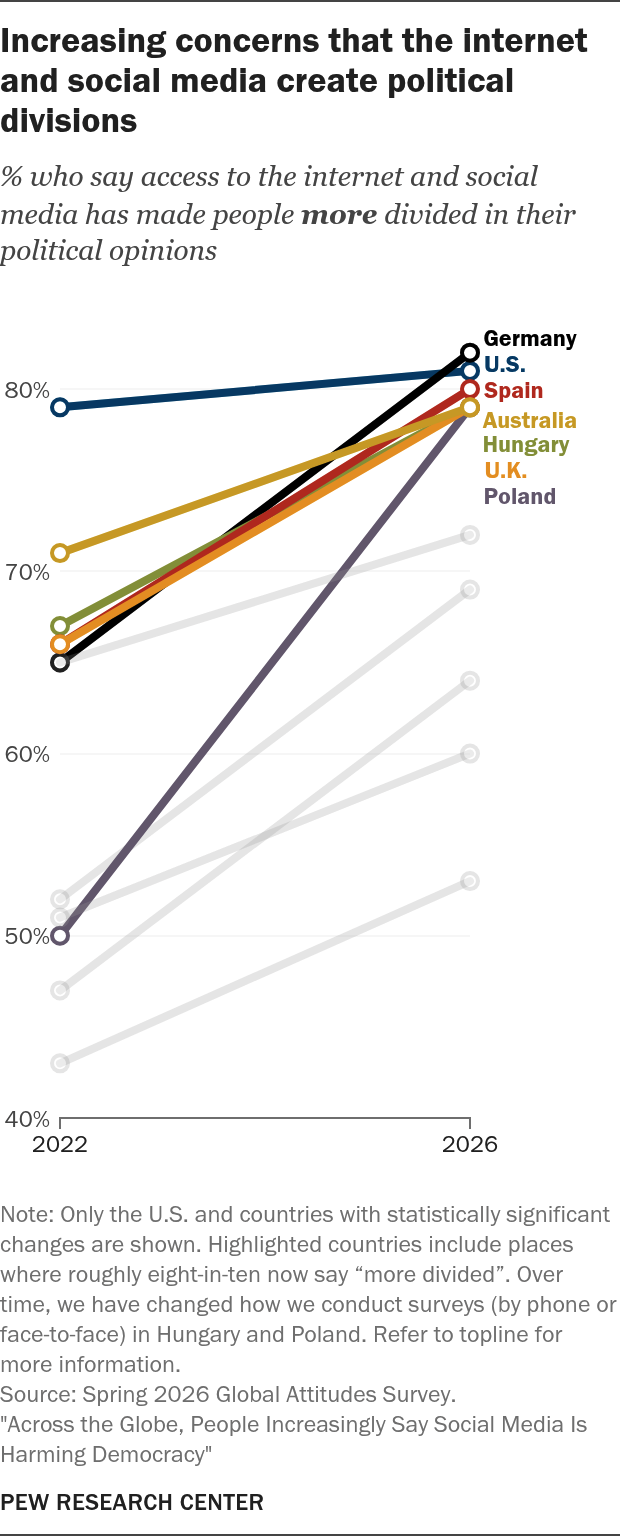
“Across the Globe, People Increasingly Say Social Media Is Harming Democracy”
| U.S. | France | Germany | Hungary | Poland | Spain | Sweden | U.K. | Australia | Japan | Malaysia | Singapore | |
|---|---|---|---|---|---|---|---|---|---|---|---|---|
| 2022 | 79 | 52 | 65 | 67 | 50 | 66 | 65 | 66 | 71 | 47 | 43 | 51 |
| 2026 | 81 | 69 | 82 | 79 | 79 | 80 | 72 | 79 | 79 | 64 | 53 | 60 |
“Across the Globe, People Increasingly Say Social Media Is Harming Democracy”
On these questions, too, there is evidence that some other nations are catching up with the U.S.
Today, 81% of Americans believe social media has amplified political divisions, essentially unchanged from 79% in 2022.
However, the share of the public that holds this opinion has risen in other countries, including Australia, Germany, Hungary, Poland, Spain and the U.K. Today, roughly eight-in-ten in these nations believe social media is contributing to political divisions.
Similar shares in Canada and the Netherlands say social media is contributing to political divisions, though these have not changed significantly since 2022.
Overall, this view has become more common in 11 of the 18 countries where trend data is available, and has remained about the same in the other seven.
Do Americans use the same social media platforms as others around the world?
The survey asked respondents whether they use five social media platforms: Facebook, Instagram, Snapchat, TikTok and X (formerly known as Twitter). The results show that usage patterns in the U.S. resemble what we see in many other countries.
Of the five platforms we asked about, Facebook is the most popular among Americans, followed by Instagram and TikTok. For all three, the U.S. falls very close to the 37-country median.
Similarly, 18% in the U.S. say they use X, same as the median of 18% across the 37 countries in the survey. However, Americans are more likely than many others to use Snapchat (26% in the U.S., compared with a 37-country median of 18%).
Social media use varies significantly by age around the world, and again, patterns in the U.S. often resemble other nations. Just as in most other countries, Americans ages 18 to 34 are more likely than those in older age groups to use Instagram, Snapchat, TikTok and X.
However, in the U.S. and several other high-income nations, 35- to 49-year-olds are the most likely to use Facebook. In middle-income countries, those under 35 tend to be the most likely to use this platform.
Read more of our research on how Americans use social media.