
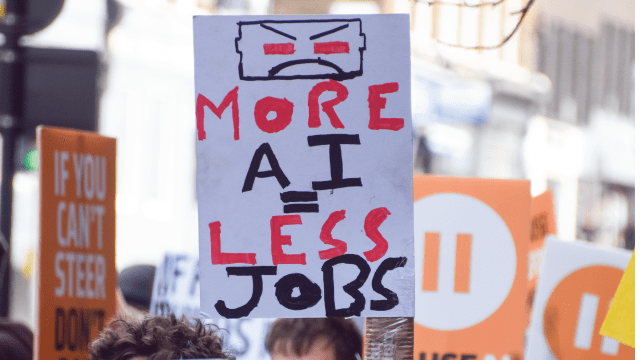
As policymakers, business leaders and experts engage in a rapidly moving debate about the potential economic impacts of artificial intelligence, ordinary citizens around the world are concerned. In 34 of 37 countries Pew Research Center surveyed earlier this year, people tend to believe AI will lead to fewer jobs rather than more jobs.
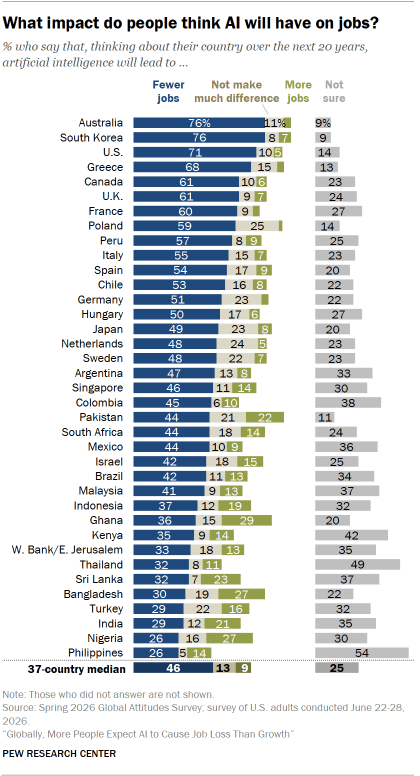
Still, opinion on this and other AI-related topics may still be taking shape: In many places, about a fifth of adults or more are unsure how AI will impact their country’s jobs. This share reaches around four-in-ten or more in some middle-income nations (as classified by World Bank lending groups).
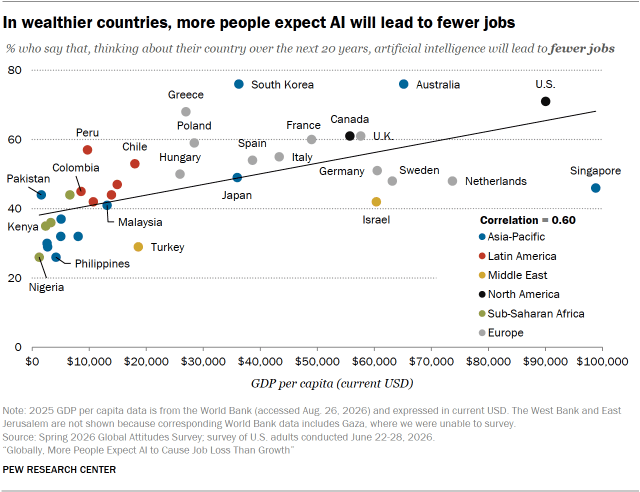
Indeed, worries tend to run particularly high in countries with higher gross domestic product per capita. For example, in some wealthy nations like Australia, South Korea and the United States, around seven-in-ten adults or more say AI will result in job loss over the next 20 years. In the U.S. – the only country where we have asked this question before – the share who hold this view has increased 7 percentage points in two years.
Views by age
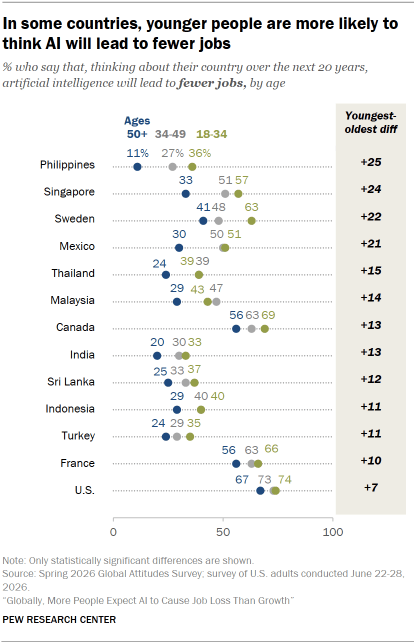
In a number of countries, concern about AI-related job loss is more common among young adults (those ages 18 to 34) than older adults (those ages 50 and older). This is the case in high-income nations like Canada, France, Singapore and Sweden, as well as in middle-income nations like India, Indonesia and Malaysia. (In turn, older adults in some countries are more likely to be unsure how AI will impact jobs.) Read more on global views of AI by age.
In the U.S., where we also asked this question in 2024, concern about job loss from AI has increased the most among Americans ages 18 to 34.
Related: Young adults in the U.S. are increasingly wary of AI, concerned it will take jobs
Views by gender
In 11 mostly high-income countries, women are more likely than men to say AI will lead to fewer jobs. For example, in France, women are 10 percentage points more likely than men to hold this view.
Views by education and household income
In many of the middle-income countries surveyed, people with higher household incomes and more education are more likely to say AI will lead to fewer jobs over the next 20 years. Much of this difference is related to people with lower incomes and less education being more likely to say they are unsure how AI will affect jobs. Read more on how people in middle- and high-income countries view AI.
Views by awareness
In around half of the countries surveyed, people with high AI awareness – that is, those who have heard or read a lot about it – are more likely than people with less awareness to say the technology will result in job loss. (People with less AI awareness are generally more likely to be unsure.) Read more about who is aware of AI.
Do people think AI will affect inequality?
On balance, people are more likely to say AI will increase rather than decrease the gap between the rich and the poor. Still, relatively large shares in many places are either unsure or say AI will not affect inequality in their country much.
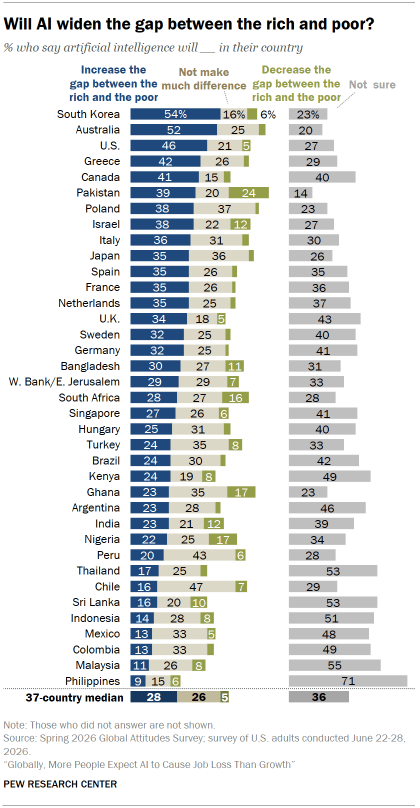
Concerns about inequality, much like concerns about job loss, are related to GDP per capita. Many of the same relatively wealthy countries where people are especially likely to believe AI will cost jobs also have particularly large shares who say it will increase inequality. For example, in South Korea, Australia, the U.S., Greece and Canada, around four-in-ten adults or more say AI will increase the gap between the rich and the poor.
Once again, fairly large shares in many middle-income countries are unsure, though on this question the same is true in some high-income countries like Germany and Singapore.
Few people overall think AI will decrease economic inequality. There is no country in which more than one-in-four hold this view – and in 29 nations, that figure is in single digits.
Views by ideology
Ideology plays a role in these views. In eight of the 28 countries where we measure political ideology, we find that people on the left are more likely than those on the right to say AI will increase the gap between the rich and the poor. (Past Center research has found that people who place themselves on the left tend to be more concerned about inequality in general.)
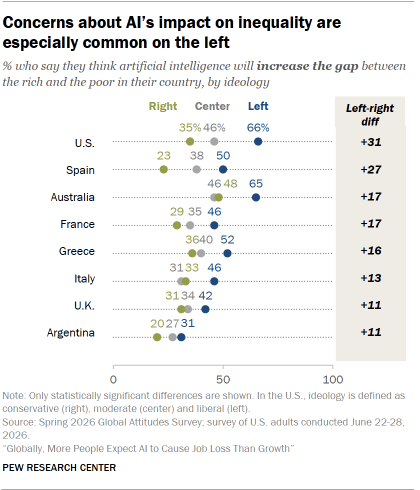
Liberals in the U.S. are 31 points more likely than conservatives to say AI will increase inequality – one of the largest ideological gaps we observe.
Views by age
Age also plays a role. In the U.S., adults under 35 are much more likely than those ages 50 and older to say AI will increase the gap between the rich and the poor (56% vs. 38%), once again among the largest gaps we measured. Younger people are also more likely to hold this view in Australia, Canada, Poland and Singapore.
The pattern is reversed, however, in Argentina, Chile, Hungary, Italy and Peru, where older people are more likely to say AI will increase the wealth gap.
Views by education and household income
In about a third of the countries surveyed, people with more education and higher household incomes are more likely than their counterparts to say AI will contribute to inequality.
Concern and excitement about AI
There are mixed feelings around the world about the increased use of AI in daily life: Across 37 countries, a 37% median are more concerned than excited, while a 41% median are equally concerned and excited. This dual sense of concern and excitement is the most common sentiment in around half of the countries surveyed. Israel is the only nation in which more people are primarily excited than primarily concerned.
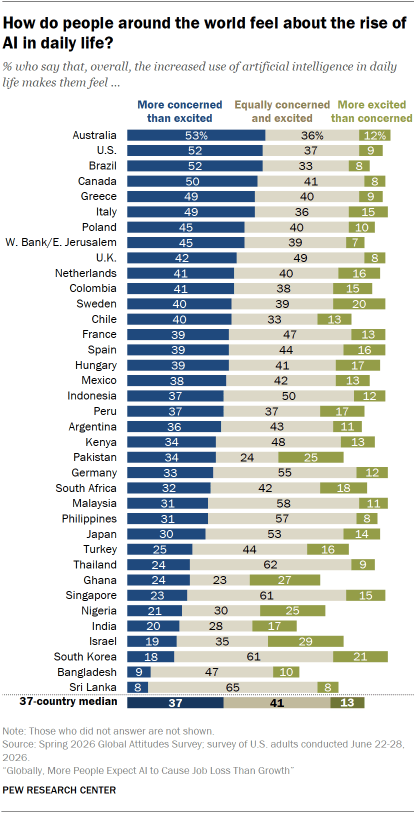
Several nations with high levels of general concern about AI – such as Australia, Canada, Greece, Italy, Poland and the U.S. – also stand out for having large shares who are worried about job loss and increased inequality.
But the same is not true in all nations surveyed. For example, South Koreans are among the most likely to forecast AI-related job loss and increased inequality. But they are among the least likely to say they are primarily concerned about the technology. Rather, a majority of South Koreans (61%) say they are equally concerned and excited, and 21% even say they are primarily excited.
Views by awareness
In many countries, people with higher awareness of AI – meaning they have heard or read more about the technology – tend to feel more optimistic about it.
Take Germany as an example: Among Germans who have heard a lot about AI, 26% are more concerned than excited about it, 59% are equally concerned and excited, and 15% are more excited than concerned. Among Germans who have heard a little or nothing at all about AI, 41% are primarily concerned, 51% are equally concerned and excited, and 8% are primarily excited. (In many countries surveyed, people who are less aware of AI are also less likely to provide a response.) Refer to the appendix for detailed tables.
Views by age
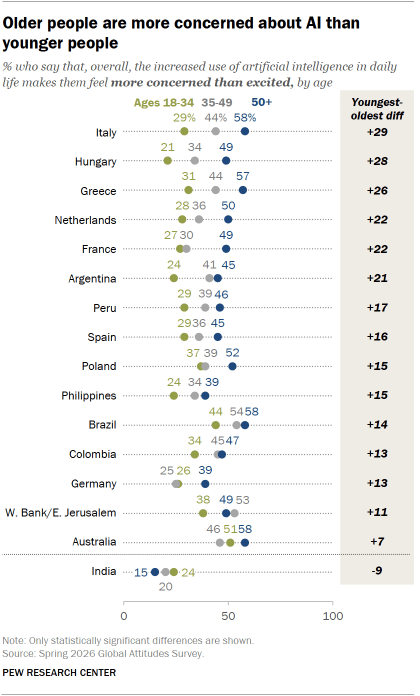
In 15 of the countries polled, people ages 50 and older are more likely than those ages 18 to 34 to be primarily concerned about AI. Older adults also tend to be less likely than their younger peers to have heard or read a lot about the technology in many places.
Views by education and household income
The same trend is seen among people with less education and lower household income, who themselves are less likely to have high AI awareness and more likely to express concern. Read more about changes in AI awareness.
Concerns about AI are changing in some important ways
First, apprehension about AI is growing in some countries. The share of adults who say they are more concerned than excited about the technology has gone up since last year in Sweden (+9 percentage points), Poland (+8), the Netherlands (+7), Hungary (+6) and Australia (+4).
In the U.S., views have been relatively stable over the past year, but concerns are up significantly since 2021.
Second, concern in some places appears to be growing among young people in particular.
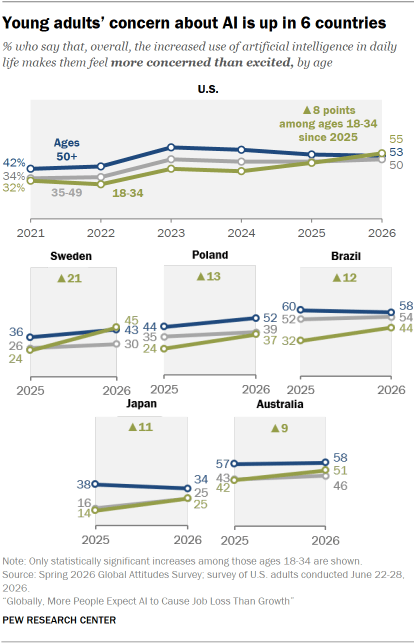
We have been tracking attitudes toward AI in the U.S. longer than in other countries. Our surveys have shown that, while concerns about AI have risen among Americans in all age groups, they have grown sharply among young adults in the last couple of years.
Since 2024, the share of Americans ages 18 to 34 who are more concerned than excited about AI has jumped from 40% to 55%. Today, those under 35 are as likely as those ages 50 and older to say they are primarily concerned – a notable departure from five years ago, when older people were somewhat more concerned.
In Sweden, too, the gap in concern between the oldest and youngest adults has essentially disappeared over the past year. Young adults in Poland, Brazil, Japan and Australia have also become more likely to say they are primarily concerned, though their older counterparts remain more likely to express this view.
Concern has also grown among adults ages 50 and older in a few places. This is the case in Poland and Sweden, where concern is also up among young people, but also in France, Hungary and the Netherlands.


