
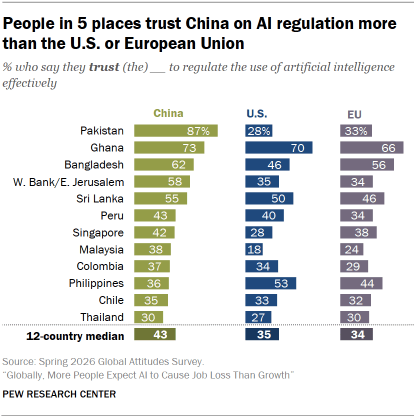
In 12 countries Pew Research Center surveyed this year, we asked people how much they trust the United States, China and the European Union to effectively regulate artificial intelligence. Across these 12 countries, a median of 43% trust China to regulate AI, 35% trust the U.S. and 34% trust the EU.
We also asked people whether they trust their own country to effectively regulate AI. In half of the nations surveyed, people trust their country more than China, the U.S. or the EU.
We asked these same questions in a different set of 25 countries in spring 2025. At that time, we found that people tended to most trust the EU to effectively regulate AI, followed by the U.S., then China. As is the case in this year’s survey, most people trusted their own country.
This analysis is part of a broader study on how people around the world view AI. It is based on a survey of 13,696 adults in 12 countries conducted Feb. 8-May 13, 2026.
Trust in China, the U.S. and the EU to regulate AI
In five of the 12 places surveyed – Bangladesh, Malaysia, Pakistan, Sri Lanka, and the West Bank and East Jerusalem – China is the country people trust most to regulate AI.
Singaporeans are most trusting of China and the EU. In Chile and Thailand, people trust China, the U.S. and the EU at roughly the same rate.
In Ghana, Peru and Colombia, people are about equally trusting of the U.S. and China.
The Philippines is the only country surveyed where the U.S. is more trusted than both China and the EU.
The countries where we asked this question are mostly middle income, as classified by World Bank lending groups. In a separate analysis about attitudes toward China, based on a survey of 37 high- and middle-income countries, we found that people in middle-income nations tend to view China more positively than those in high-income nations.
Trust is tied to overall favorability
Across all 12 countries surveyed, people who view China, the U.S. or the EU favorably in turn express greater trust in these actors to effectively regulate AI when compared with people who view them unfavorably. For example, 57% of Peruvians with a positive view of China trust the country to regulate AI, compared with 26% of those with a negative view of China.
Related: Views of China and Xi Are Improving Globally | Trump Gets Negative Reviews Internationally as Fewer Say U.S. Is a Reliable Partner
This pattern also existed in 2025, when we asked people in 25 countries how much they trusted China, the U.S. and the EU to effectively regulate AI.
Trust by awareness
Trust in China, the U.S. and the EU as regulators is often related to overall awareness of AI. People who have heard or read more about the technology express greater trust in other countries to regulate it than those who have heard or read less.
For example, 76% of Sri Lankans who have heard or read a lot about AI trust the EU, compared with 44% of Sri Lankans who have heard or read less. (In most places where we see this pattern, people who have heard or read less about AI are more likely to say they are unsure.)
Trust in own country to regulate AI
Across the 12 countries surveyed, the share of people who trust their country to effectively regulate the use of AI is largest in Pakistan and Bangladesh. In both countries, about eight-in-ten hold this view.
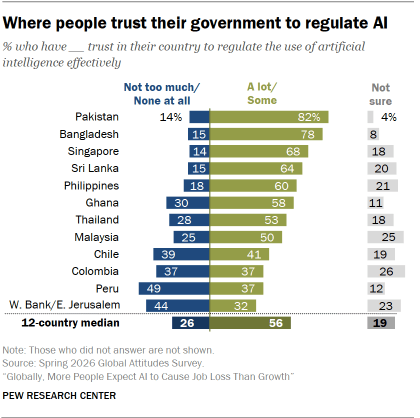
Conversely, roughly four-in-ten or fewer in Chile, Colombia, Peru and the West Bank and East Jerusalem say the same.
However, in some places, many people express uncertainty: About a quarter of adults or more in Malaysia, Colombia and the West Bank and East Jerusalem say they are not sure.


