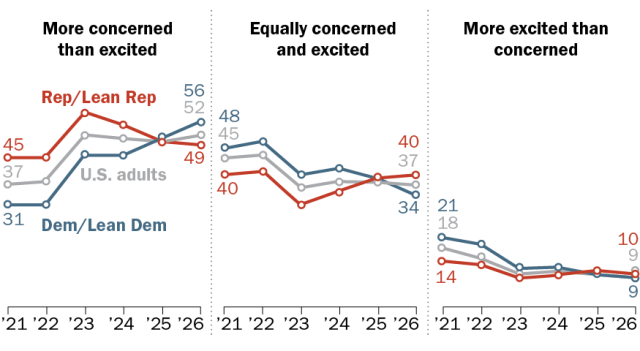
For the first time, Democrats are now more likely than Republicans to be concerned about the growing role of artificial intelligence in daily life and its potential to take jobs.
| Group | U.S. adults | Rep/Lean Rep | Dem/Lean Dem | |
|---|---|---|---|---|
| 2021 | More concerned than excited | 37 | 45 | 31 |
| 2022 | More concerned than excited | 38 | 45 | 31 |
| 2023 | More concerned than excited | 52 | 59 | 46 |
| 2024 | More concerned than excited | 51 | 55 | 46 |
| 2025 | More concerned than excited | 50 | 50 | 51 |
| 2026 | More concerned than excited | 52 | 49 | 56 |
| 2021 | Equally concerned and excited | 45 | 40 | 48 |
| 2022 | Equally concerned and excited | 46 | 41 | 50 |
| 2023 | Equally concerned and excited | 36 | 31 | 40 |
| 2024 | Equally concerned and excited | 38 | 35 | 42 |
| 2025 | Equally concerned and excited | 38 | 39 | 39 |
| 2026 | Equally concerned and excited | 37 | 40 | 34 |
| 2021 | More excited than concerned | 18 | 14 | 21 |
| 2022 | More excited than concerned | 15 | 13 | 19 |
| 2023 | More excited than concerned | 10 | 9 | 12 |
| 2024 | More excited than concerned | 11 | 10 | 12 |
| 2025 | More excited than concerned | 10 | 11 | 10 |
| 2026 | More excited than concerned | 9 | 10 | 9 |
In a June Pew Research Center survey of U.S. adults, 56% of Democrats said they are more concerned than excited about AI’s increased use in daily life, compared with about half of Republicans. (Democrats and Republicans include independents who lean toward each party.)
This reflects movement in both parties:
- Democrats have grown more wary of AI: Among Democrats, the share who say they are more concerned than excited about AI has risen from 46% in 2023 to 56% today. And their concern is up 25 percentage points since 2021.
- Fewer Republicans are concerned about AI: Since 2023, the share of Republicans who say this has fallen 10 percentage points to 49%.
These changes are largely driven by those at the ends of the ideological spectrum. Among liberal Democrats, concern about the increased use of AI rose from 45% in 2023 to 63% today. During the same period, it dropped 14 percentage points among conservative Republicans. Views among moderate and conservative Democrats, as well as among moderate and liberal Republicans, have not changed significantly since 2023.
These findings come as AI emerges as a midterm election issue. Candidates in both parties are debating the development of data centers, government regulation for AI and its impact on jobs.
Americans overall have become more concerned than excited about AI’s growing presence in recent years. About half of U.S. adults now say this, up from 37% in 2021. Few adults are more excited than concerned, while just over a third say they’re equally concerned and excited.
How will AI affect jobs?
In another shift, Democrats are now more likely than Republicans to predict that AI will lead to fewer jobs over the next 20 years (75% vs. 68%).

| Group | Fewer jobs | Will not make much difference | More jobs | |
|---|---|---|---|---|
| 2024 | U.S. adults | 64 | 14 | 5 |
| 2026 | U.S. adults | 71 | 10 | 5 |
| 2024 | Rep/Lean Rep | 70 | 13 | 4 |
| 2026 | Rep/Lean Rep | 68 | 11 | 7 |
| 2024 | Dem/Lean Dem | 58 | 16 | 7 |
| 2026 | Dem/Lean Dem | 75 | 8 | 4 |
This is a change from two years ago, when more Republicans than Democrats expected AI-related job losses.
Since then, the share of Democrats who think AI will lead to fewer jobs has risen 17 percentage points, while Republicans’ views have changed little.
Relatively few Americans in either party believe that AI will lead to more jobs or that it won’t make much of a difference.
Note: Here are the questions used for this analysis, the topline and the survey methodology.