Almost three years after the start of the Israel-Hamas war, Israelis and Palestinians are pessimistic about the prospect of peaceful coexistence between them.
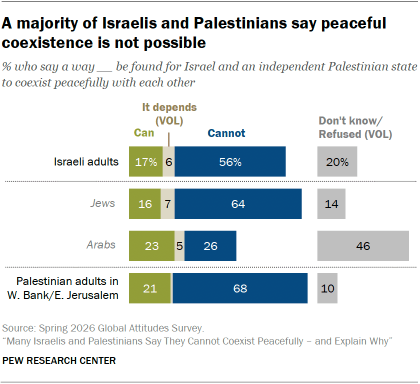
In a Pew Research Center survey conducted this spring, we asked Israelis and Palestinians in Israel and the West Bank and East Jerusalem, respectively, whether a way can be found for Israel and an independent Palestinian state to coexist peacefully with each other.
Only about one-in-five Israelis (17%) and Palestinians (21%) say Israel and a Palestinian state could exist together in peace. Majorities in both places – 56% in Israel and 68% in the West Bank and East Jerusalem – don’t think a two-state solution to the Israeli-Palestinian conflict is possible.
Read more about how views of the two-state solution have changed over time.
We then asked them to explain, in their own words, why they answered the way they did.
Among the relatively few Israelis and Palestinians who said peaceful coexistence is possible:
- Some express a personal interest in peace or say people on both sides want peace.
- Others see peace between Israel and an independent Palestinian state as the inevitable conclusion to their conflict.
- A few argue that a diplomatic two-state solution is preferable to a single state for both peoples.
- Some say peace is achievable under certain conditions, such as rebuilding trust, making concessions or mustering the political will to come to an agreement.
Among the majorities of Israelis and Palestinians who say peace between Israel and an independent Palestinian state is not possible:
- Some say the conflict between them is intractable because they are fighting over land they believe cannot (or should not) be divided, and their religious and cultural differences position them as eternal enemies.
- Many talk about the violence between them, both historical and more recent, expressing fear and distrust.
- Israelis explain that an independent Palestinian state would pose an existential threat to Israel and its people, while Palestinians see the Israeli occupation of the West Bank and East Jerusalem as the biggest obstacle to peace between them.
- Smaller shares blame their leaders or say there is no partner for peace because the other side does not want peace.
For more, read “Why do some Israelis and Palestinians think Israel and an independent Palestinian state can coexist peacefully?”
For more on how we analyzed these open-ended responses, read our coding methodology.
The survey took place in the spring of 2026, during the Iran war. Fieldwork began while hostilities were ongoing and continued after the declaration of an initial ceasefire on April 7.
In Israel, we surveyed 1,001 people from April 5 to May 6. In the West Bank and East Jerusalem, we surveyed 1,038 people from March 30 to April 28. We were not able to survey in Gaza in 2026.
In addition to asking about coexistence, we asked Israelis and West Bank and East Jerusalem Palestinians about their attitudes toward the U.S. providing military aid to Israel and humanitarian aid to civilians in Gaza, as well as about their views of the Iran war.
Why do some Israelis and Palestinians think Israel and an independent Palestinian state can coexist peacefully?
Small shares of the populations in both Israel (17%) and the West Bank and East Jerusalem (21%) say a way can be found for Israel and an independent Palestinian state to coexist peacefully.
When asked why they think so, some Israelis and Palestinians offer similar reasons: Both see peace between two states as the inevitable conclusion to their conflict and acknowledge that a diplomatic peace process would bring about clearly-defined borders and independence from each other.
But there are also some differences in their open-ended responses. Palestinians tend to emphasize the benefits of peace, such as economic prosperity for both peoples, while Israelis explain that peace is possible under certain conditions, like increased trust or political will.
Among those who say peaceful coexistence is possible, an interest in peace is a common sentiment. Some say that they personally want peace or – in the words of one respondent – that “both sides want to live in peace.” And others see peace as an imperative, saying, “we must make an effort.”
In addition, some point to interpersonal relationships between the two sides as evidence that they can coexist. “Just as Arabs and Jews live in harmony in Jaffa, so it is possible between countries,” said one Jewish Israeli woman. And a Palestinian woman expressed similar reasoning, saying, “There are friendships between Arabs and Jews, and peace can be achieved.”
“We need to find the path to peace for the sake of our children and their children.”
Jewish man, 29, Israel
“We tried coexistence before and it was successful.”
Man, 27, West Bank/East Jerusalem
“We complement each other in work, trade and security, so that we may live together.”
Woman, 18, West Bank/East Jerusalem
In the West Bank and East Jerusalem, some recalled periods of trust and cooperation in the past. “We used to coexist and could accept each other,” said one Palestinian man. “Previously, coexistence and peace existed, and peaceful coexistence is possible now, just as it was before,” said another.
Many Palestinians stress the economic benefits peace would bring. Peace is “the way to improve the economic situation of the Palestinians,” one Palestinian woman said. Others mention the economic interdependence between the two peoples: “We work for them, they need Palestinian labor,” said one Palestinian man, adding, “We share the same economy and the same currency that Israel uses.”
Palestinians are more likely than Israelis to explain, in their own words, that peace between two states can be achieved because they see it as a desirable outcome. This is the most common theme in the open-ended responses from people in the West Bank and East Jerusalem who say a two-state solution is possible.
Another theme among those who think peaceful coexistence can happen is the inevitability of peace. About equal shares in both Israel and the West Bank and East Jerusalem frame coexistence as the only option in their explanations, saying there is “no other choice” or “no alternative.”
This sense of inevitability is rooted in the belief that neither group is going anywhere. “We must learn to live together on this land. No one will disappear,” said a Jewish Israeli man, while a Jewish Israeli woman explained that in her view, “peace is an existential necessity for both sides.”
Though they are not necessarily excited at the prospect of peace between Israel and an independent Palestinian state, a few people in both places recognize that they have little say in the matter. “Sooner or later, a Palestinian state will be established,” said one Jewish Israeli man. And in the West Bank and East Jerusalem, some see coexistence between two states as “a reality that is imposed on us,” in the words of one Palestinian man. “It is not possible to object,” said a Palestinian woman.
A few also took a long historical view, offering observations such as “every war eventually ends in peace,” and expressing that it’s time to “prevent unnecessary bloodshed.” One Palestinian woman noted that eventually, “the ongoing cost of conflict becomes higher than the cost of coexistence.” And a Jewish Israeli man commented, “In the end, we must reach the long-awaited peace. How many more people will die on both sides before realizing there is no choice and an agreement must be reached?”
“We have no choice but to coexist and find another solution.”
Man, 43, West Bank/East Jerusalem
“Neither side is going from here. It is necessary to learn to live together.”
Jewish man, 57, Israel
“In the end, every conflict in the world ends with a peace agreement, and the only question is how many more people will die by then.”
Jewish woman, 34, Israel
When explaining their views in their own words, small and roughly equal shares of Palestinians and Israelis say a diplomatic solution of two independent states is the most logical or viable option. For example, one Arab Israeli woman said there is “a clear political solution: a Palestinian state alongside the state of Israel.”
Some Israelis embrace a two-state solution because they reject any scenario in which both peoples share the same state. “I believe that we must separate from the Palestinians,” said one Jewish Israeli man. “I don’t care if they have [an independent state] as long as they live apart from us,” said another.
Similarly, some Palestinians expressed a strong preference for separation, saying “there should be two countries” so that “we’re on our own and they’re on theirs.” And one Palestinian woman emphasized her desire for “non-interference by Israelis in Palestinian affairs.”
“There are reasonable people on both sides, and a solution can be found to achieve a state for each people.”
Man, 45, West Bank/East Jerusalem
“We must give them a Palestinian state, otherwise there will always be war between us.”
Jewish woman, 62, Israel
“International law supports a two-state solution, peaceful coexistence and stability.”
Woman, 36, West Bank/East Jerusalem
Some assert their belief that both peoples have a right to statehood, so there should be “two states for two peoples.” One Jewish Israeli man referred to Palestinians as “a people without definition and without freedom,” while another asserted that “the Palestinians should be allowed to live in their own country.” “There will be a state for them, and a state for Palestine,” said a Palestinian woman.
Others focus on the availability of land. According to one Palestinian man, “The lands of Palestine are vast and can accommodate both Jews and Palestinians.” An Israeli Arab woman similarly said, “Palestine is a large and fertile land, and we can share it.” “Each nation will receive its own territory and we will live in peace,” said a Jewish Israeli woman.
Some Israelis and Palestinians cite past diplomacy as a valuable model. In Israel, one Jewish man said “it’s possible to reach an agreement like the one signed in Oslo.” And an Israeli Arab man pointed to “peace according to the Oslo Accords” as a pathway toward future coexistence. Others stress the importance of sticking to “internationally agreed borders,” with several Palestinians calling for two states “within the 1967 borders.”
Some in Israel and the West Bank and East Jerusalem used the survey question as an opportunity to lay out pre-conditions for peace or “certain conditions that are acceptable” for a two-state solution.
Broadly, they call for “compromises and building trust that does not exist.” They acknowledge that both Israelis and Palestinians have a responsibility to act, and they say coexistence is possible “if both sides compromise on their extreme positions” and “gaps are bridged.” One Arab Israeli woman suggested peace is achievable through “direct communication [and] joint projects.”
Some stress the importance of changing “the way of thinking and education of both peoples,” starting with the next generation. One Arab Israeli woman asserted that “the current situation of killing and destruction cannot continue if we educate children on accepting others.” And according to a Jewish Israeli man, peace can be attained by “educating the next generation of both peoples to coexist in the same region of land.” “If hatred were eradicated, the Jews and Palestinians would each have their own independent state,” said a Palestinian man.
Others say that peace is contingent on “significant concessions … by both sides.” For instance, one Jewish Israeli woman said there must be “a solution to the core issue of Jerusalem.”
Some Palestinians and Arab Israelis say that coexistence will be possible “when Israel withdraws from the occupied territories” and after the “evacuation of all settlements in the West Bank and Gaza.” For one Palestinian man, “peace is possible if … the number of settlements is reduced,” and a Palestinian woman suggested that “it is possible to coexist when the checkpoints are opened and the workers return to Israel.”
“The values of the younger generation need to be changed. No more hatred and destruction from the Palestinians. On the Israeli side too, education for more tolerance and acceptance of others.”
Jewish woman, 43, Israel
“If we know how to overcome the settlers and the Ben Gvirs and the Smotrichs. Dismantle the settlements and lift the siege on miserable Gaza.”
Jewish woman, 65, Israel
“This can be achieved through international support, provided that the Palestinian economy is supported.”
Woman, 19, West Bank/East Jerusalem
Some Israelis believe that peace can happen if the people in charge are replaced. One Jewish Israeli man commented that Palestinians and Israelis alike “suffer from a bad and undemocratic government.” “Extremists on both sides must be restrained,” said another. An Arab Israeli man said coexistence is possible, but “only if this extremist government is gone.”
Some mention specific people or groups. “If we remove [Prime Minister] Netanyahu and the Ben Gvir government, we will turn to the Palestinians to make peace,” said a Jewish Israeli man.
Others focus on Palestinian leaders, including one Jewish Israeli woman who sees a path to peace “by strengthening moderate elements as an alternative to Hamas.”
Others say international intervention is a prerequisite. One Arab Israeli woman believes that “strong security guarantees” would make peaceful coexistence more likely, and another stated that “the intervention of other countries … like the United States of America” would be necessary. One Jewish Israeli man advocated for “strong involvement of powerful Arab countries, such as the Gulf states,” while an Arab Israeli man predicted that “if UN resolutions are implemented, peace will prevail.”
Some Palestinians and Israelis believe the road to peace begins with ending current fighting. “Stop the violence between the two sides and protect civilians,” said an Arab Israeli man.
Why do most Israelis and Palestinians think peaceful coexistence is not possible?
Most Israelis and Palestinians say a two-state solution is not a viable option. Over half of the people surveyed in Israel (56%) and roughly seven-in-ten in the West Bank and East Jerusalem (68%) cannot see a way for Israel and an independent Palestinian state to coexist peacefully.
When asked to explain their answer, Israelis and Palestinians say coexistence is not possible because their differences are too great to overcome. People on both sides agree that they are enemies with competing belief systems who are fighting over the same land, and some also mention the violence between them, which has culminated in the most recent war. Small shares in both places accuse the other side of rejecting peace.
But there are points of disagreement about why they cannot coexist, in their own words. While Israelis explain that an independent Palestinian state would pose a threat to Israel, many Palestinians in the West Bank and East Jerusalem say coexistence is not an option while they live under Israeli control.
One of the top reasons that Israelis and Palestinians alike say peaceful coexistence is not possible is disagreement over the land.
Some think there is not enough land to split. For example, one Palestinian woman said that “Palestine cannot be divided into two states.” Another said that “there cannot be two peoples when there is no room for two peoples.” Israelis express similar sentiments – saying, for example, that “Israel does not have enough territory to divide into two states” or that “there is no land to establish a Palestinian state.”
In both places, there are people who believe they are the only rightful owners of the land. One Jewish Israeli woman said, “This is our land alone,” and another stated that “the Holy Land belongs only to the Jewish people and was given to them by God.” Similarly, some Palestinians say Israel “stole our land” and that “the homeland belongs to the Palestinians.”
“It is impossible for there to be more than one state on the same land; it will either be Israel or Palestine.”
Woman, 29, West Bank/East Jerusalem
“This land was promised to the chosen people by the creator of the world, and we are not allowed to give away a grain of sand from the Holy Land.”
Jewish man, 79, Israel
“Because we are the rightful owners of the land … Palestine belongs to us.”
Woman, 35, West Bank/East Jerusalem
Some Palestinians and some Israelis also assert that the other side “want(s) the whole country,” and that “they are not willing to compromise.” “In my opinion, the Palestinians want all of our land,” said one Jewish Israeli woman. “They received territories but they want the entire land of Israel,” said a Jewish Israeli man. On the Palestinian side, one woman said that peaceful coexistence “will be very difficult because Israel wants a Greater Israel from the river to the sea.” Another commented that “we cannot live together because Israel wants the land for itself.” “They have a plan to expel the people from their land and control the entire region,” said a Palestinian man.
On the subject of the land and who controls it, a considerable share of Palestinians and some Arab Israelis consider the Israeli occupation of the West Bank a major obstacle to coexistence. “Israel is an occupying power,” said one Palestinian man. “It has imposed control over the Palestinians,” said another. Israelis “occupy our land, besiege us, and control our natural resources,” a Palestinian woman said.
Palestinians also describe unemployment and Israeli checkpoints in the West Bank and East Jerusalem as significant issues. “They are an occupying force who took our land and separated us from each other with checkpoints,” said one Palestinian man. “Checkpoints close the roads, and workers are unemployed,” said another while one Palestinian woman contended that “the presence of barriers and the lack of job opportunities” prevent peace from taking hold.
“Is there, or will there be in the future, a Palestinian state? I don’t think so. Settlements in the West Bank have swallowed up all the land.”
Arab man, 39, Israel
“There can be no peace and tranquility while there are settlements in the West Bank, lawlessness, and Israeli ministers supporting settlers’ violence.”
Arab man, 52, Israel
“It is an occupied country, there is no security, movement between cities is difficult, and there are checkpoints.”
Woman, 19, West Bank/East Jerusalem
Palestinians and Arab Israelis see Jewish settlements in the West Bank as another obstacle to coexistence. “Settlement activity has left no room for the establishment of a Palestinian state,” said one Arab Israeli man. A Palestinian woman expressed concern that “the settlements are increasing every day.” Weighing the likelihood of an independent Palestinian state, one Israeli Arab woman said, “The settlers have destroyed that possibility.”
In the West Bank and East Jerusalem, some also mention dealing with “harassment” and “crimes committed by the [Israeli] army.” Several respondents described Israel targeting Palestinian homes as a form of collective punishment, with one woman stating that “[they] come and want to demolish the houses and take the land.” Another Palestinian woman listed “the displacement, the seizure of homes, the demolition of homes and so on,” adding, “How can there be peace after all this?”
For more on Palestinian views of life in the West Bank and East Jerusalem, read “About 9 in 10 Palestinians in West Bank and East Jerusalem see Israeli checkpoints as a major problem”.
Some Jewish Israelis, on the other hand, fear that an independent Palestinian state would pose a threat to Israel. “The establishment of a Palestinian state would be just a step on the path to the destruction of the state of Israel,” said one Jewish Israeli woman. “Israel will have no security alongside a Palestinian state if, God forbid, such a state is established,” said a Jewish Israeli man. Another Jewish Israeli man contended that the creation of two independent states would “turn Israel’s reality into a never-ending war of survival.”
Some are concerned about Palestinian armament. “With statehood, they will receive much more international support and legal weapons and will be able to attack us even more easily on a regular basis,” said a Jewish Israeli man. A Jewish Israeli woman said, “They are constantly shooting at us from Gaza, so it really doesn’t make sense to give them a state so they grow even stronger.”
Others think Israel lacks the territorial depth to defend itself against a Palestinian state. “Israel will have to give up Judea and Samaria, which are very important regions of land,” explained one Jewish Israeli woman, referring to the West Bank. A Jewish Israeli man similarly dismissed the idea of “giving up the territories that protect us today,” saying it would mean “we’ll return to frequent attacks.”
Many Israeli Jews who dismiss a two-state solution believe that a Palestinian state would necessarily be an enemy of Israel. “Their leaders want to eliminate Israel,” said a Jewish Israeli man. “It is not appropriate for Israel to have another Arab and terrorist state next door,” said another.
“I am not willing to take the risk that the Palestinians, after they receive a state, will attack us after they become stronger and arm themselves, and the border will pass not far from my home.”
Jewish man, 43, Israel
“The establishment of a Palestinian state and recognition by many countries will add political power to it to continue the struggle against Israel, especially without the territories, which will be handed over to the Palestinian side, and which protect Israel.”
Jewish woman, 46, Israel
“A Palestinian state will never be established. They don’t want to live next to us, but in our place.”
Jewish man, 57, Israel
A shared history of violence is another major reason for skepticism on both sides. People surveyed in Israel and in the West Bank and East Jerusalem are about equally likely to mention it when explaining, in their own words, why coexistence is not possible.
“We have been at war with Israel for 75 years,” said one Palestinian woman. “They occupied us, took our land, and are killing us,” said another.
“The Arabs want to drown us in the sea since the state [of Israel] was established,” said a Jewish Israeli woman.
To many Jewish Israelis, the recent war in Gaza is evidence that peaceful coexistence is not an option. “As things stand today, after all the last three years, this is simply not going to happen,” said one Jewish Israeli woman. “A couple I know were killed on Oct. 7, and since then I have been strongly opposed to the establishment of such a state,” said another. “There is no forgiveness for the Oct. 7 massacre,” said a Jewish Israeli man.
Palestinians in the West Bank and East Jerusalem also mention the war. “After what happened in Gaza and the attack on the Jews … hatred increased between us,” explained one Palestinian woman. “There will be no peace after they killed and slaughtered us,” said a Palestinian woman. A Palestinian man contended that coexistence is out of the question given “the amount of blood spilled, the number of victims and the destruction that occurred.”
“Since what happened on Oct. 7, I have lost all faith in the Palestinian people and in the two-state solution for both peoples.”
Jewish man, 36, Israel
“Palestine is a land of war; there will never be peace there.”
Woman, 64, West Bank/East Jerusalem
“They took our land and killed the people, and that’s enough. My brother was killed.”
Woman, 31, West Bank/East Jerusalem
Some Palestinians specifically call out the violence they face in the occupied West Bank. One Palestinian woman explained that she does not believe in peaceful coexistence because of “the settlers’ violence and their treatment of Palestinian citizens.” Others similarly referred to “the savagery of the settlers,” the “lack of security caused by settler attacks” and “beatings and assaults on Palestinians.”
Meanwhile, some Jewish Israelis express fear of attacks by Palestinians. “The Arabs in the villages around us are only thinking about how to harm and kill us,” said one Jewish Israeli woman. Another said, “The Arabs here in [a nearby Palestinian town] would really be happy to kill us, so bringing them a state near us is a joke.”
Many Israelis and Palestinians accuse the other side of violent intentions. “The Jews want war,” said one Palestinian woman. “[The Arab] will always be waiting for the right moment with a knife behind his back,” said a Jewish Israeli man.
Some believe the violence will never stop because, in the words of one Palestinian man, “there will always be blood between us.”
Indeed, distrust between Israelis and Palestinians is commonly cited as a reason the two peoples cannot coexist. One Arab Israeli woman explained that peace is not possible because of a “lack of trust that has accumulated over decades of bloodshed, displacement and wars.” A Jewish Israeli woman offered a similar diagnosis: “There can be no peace without trust.”
Some people in both Israel and the West Bank and East Jerusalem say the other side is not trustworthy. “You cannot trust the Jews,” said one Palestinian man. “They have been breaking covenants since the time of the Prophet,” added another. Some Israelis express parallel thoughts about Palestinians. “There is no point in making peace agreements with them that they will not abide by,” said one Jewish Israeli man. Another concluded, “They always lie.”
Some express personal, individualized fears. “I’m afraid and don’t want to make peace with the Arabs after Oct. 7,” said one Jewish Israeli woman, while another confessed that “whenever they’re around, I feel scared and stressed.” “There is no safety in living with them,” said a Palestinian woman.
Those who reject the possibility of peaceful coexistence fairly commonly cite a fundamental incompatibility between the two peoples.
Cultural incompatibility is mentioned by a few. Some Jewish Israelis talk about the two groups having “completely different worldviews.” Some Palestinians agree, offering statements such as, “It’s impossible, since they are a different people from us.”
Many Israelis and Palestinians point to religious enmity in particular. One Arab Israeli man explained that, in his view, “peace is impossible because it is a war of religion and belief.” “In our religion, there is no coexistence with Jews,” a Palestinian woman added. Multiple people in the West Bank and East Jerusalem predicted that the conflict will continue “until the Day of Judgment.” And a Jewish Israeli woman offered a similar explanation: “We are destined to fight with the Ishmaelites until redemption comes.”
Some people on both sides also view religious ideology as the root of the conflict. “There is no ideological agreement between us and them,” said one Palestinian man. Another offered a similar assessment, saying, “This is an ideological war; Israel cannot allow Islam to exist.” “The ideology … of Muslims obligates them to fight non-Muslims,” said a Jewish man.
“No, because of religious differences. They want war, not peace.”
Woman, 29, West Bank/East Jerusalem
“The hatred is so great that it cannot be overcome, perhaps for another 100 generations.”
Jewish man, 44, Israel
“No one recognizes the existence and values of the other side.”
Jewish man, 79, Israel
Both sides also cite a general sense of hatred, with some Israelis asserting that Palestinians “hate” Jews, and some Palestinians talking about Israelis’ “hatred” toward them.
Some claim it’s bred at a young age. “They are taught from infancy to hate Jews,” one Jewish Israeli man said of Palestinians. Another said that Palestinians are “educating generations to hate and destroy Israel.” This reasoning was also found in the West Bank and East Jerusalem. “They don’t like us and are raised in schools to hate us,” said one Palestinian woman.
Some go so far as to reject the other side’s claim of a national identity. “The God of Israel gave this holy land to the Jewish people only and not to you, the so-called Palestinian people,” said a Jewish Israeli woman. “The land is our land and they do not exist,” said one Palestinian woman. Another agreed, declaring that “there is no country called Israel.”
Others believe the other side will never recognize their legitimacy or right to statehood. One Jewish Israeli man said, “The Palestinians think we don’t deserve the right to exist, so why give them anything?” And in the words of a Jewish Israeli woman, “They deny our existence.” Meanwhile, some Palestinians offer similar assessments, such as, “The Jews are not accepting of the Palestinians.” One Palestinian man said, “They have the idea … that only they deserve to live and have a right to life.”
When explaining in their own words why peace between two states would not be possible, Palestinians spoke about the fundamental incompatibility between the two groups more often than Israelis did.
Some Israelis and Palestinians believe peace is not possible because one or both sides don’t want it. This topic came up about as often in open-ended responses collected in Israel as it did those collected in the West Bank and East Jerusalem.
Several Jewish Israelis offered opinions along the lines of “the Palestinians do not want peace” and “they are not interested in peace with us.” “I don’t think Arabs have the slightest desire to live in peace,” argued one Jewish Israeli woman. Another talked about previous attempts at peace negotiations: “For 30 years we offered them a peace agreement and they refused, so why should it be different now?”
“All citizens of Israel pray for peace to come. They will give all their wealth for peace. But the Palestinians don’t want peace.”
Jewish woman, 65, Israel
“I don’t believe in peace, a waste of time and energy.”
Jewish man, 65, Israel
“The problem with Israel is that it doesn’t want peace or coexistence.”
Man, 42, West Bank/East Jerusalem
Similarly, some Palestinians say Israel does not want peace. “They, by their very nature, do not want peace. We have taken the initiative for peace more than once, but they do not respond,” said one Palestinian woman. A Palestinian man agreed, saying, “If they wanted to coexist, they would have done so a long time ago.” Another Palestinian man expressed frustration at the dynamic, saying “It’s very difficult because Israel doesn’t want it and we don’t have the power to make a decision.”
Several Israeli Arabs contend that their own country is not doing enough to bring about peace. “The Jewish people don’t want peace with the Palestinians. They only want wars,” said one Arab Israeli woman. An Arab Israeli man similarly said that “the extremist Jewish population does not want peace or coexistence.”
But other Israeli Arabs blame Palestinians for making peaceful coexistence impossible. “The Palestinians aren’t even thinking about peace,” said an Arab Israeli man.
Some Israelis acknowledge their own disinterest in peace. One Jewish Israeli man said, “Peace with the Arabs is not something I believe in,” while another admitted, “I don’t believe in coexistence with them.” One Palestinian man shared a similar sentiment: “After everything Israel has done, it wants peace? Ridiculous.”
A small share of individuals in both Israel and the West Bank and East Jerusalem talk about the lack of leadership and political will to make peaceful coexistence a reality.
“With such corrupt and ineffective leaders, no country can enjoy security and peace,” said one Arab Israeli woman, without clearly indicating whether she was talking about Israeli leaders, Palestinian leaders or both. Some Jewish Israelis spoke about Palestinian leaders, offering comments such as, “They don’t have courageous leadership to do something like that” and “There’s no leader there who can be talked to.”
Some called out specific leaders by name. “There are no politicians in Israel like [Yitzhak] Rabin, nor on the Palestinian side, like Yasser Arafat,” noted one Arab Israeli woman. Two Palestinian men in the West Bank and East Jerusalem referred specifically to Israeli Prime Minister Netanyahu, saying coexistence could not happen because of “Netanyahu’s rejection of peace” and “the current Israeli government”. “Netanyahu is refusing peace with us,” one of them said.
“Peace is impossible because there are no courageous, non-extremist leaders. I desire that.”
Arab man, 64, Israel
“The war has rendered a functioning state impossible, and the extremist government has eliminated any chance of establishing a Palestinian state.”
Man, 54, West Bank/East Jerusalem
“The Palestinians do not have the leadership that will take them to this place of peace and a good life.”
Jewish man, 35, Israel
More generally, several Palestinians said peace is not possible owing to the state of Israeli politics. “Israel is moving towards extremism,” said one Palestinian man. Yet others believe Israel already is extremist: “The current Israeli government is a far-right Israeli government that does not want coexistence and wants to displace the Palestinian people by all means,” said another Palestinian man.
A few Arabs in Israel expressed similar ideas about their government. One said that peace “was possible a few years ago” but that “today the extreme right controls the state; there will never be peace.” Another said that “peace is impossible with this extremist and racist government in place.”
A handful of Israeli Jews talked about the lack of political will, on both sides, to bring about a peaceful solution to the conflict. “The possibility of peace exists in theory, but its practical realization requires extraordinary political will for changes that have not yet matured,” said one Jewish Israeli woman. “The Palestinian Authority and Hamas both want to destroy … the Jewish people, and there is no political entity or group with which a real peace agreement can be reached,” said another.
While lack of leadership and political will is a relatively minor theme in both places, Israelis mention this topic slightly more often than Palestinians in their open-ended explanations.
Who is undecided, or did not provide an answer?
In addition to the people who say coexistence is possible and those who say it is not possible, some Israelis and Palestinians volunteered that “it depends,” said they don’t know or refused to answer.
In Israel, a total of 20% of all respondents did not answer the question, including 46% of the Israeli Arab respondents. In the West Bank and East Jerusalem, 10% declined to answer. Those who declined to answer the question were not asked to explain why.
However, people who volunteered “it depends” (6% of respondents in Israel and 1% in the West Bank and East Jerusalem) received the same follow-up question as those who said “yes” or “no,” asking them to explain why they gave that answer.
Some people on both sides said “it depends” because peace is contingent on the other side. A few Israeli Jews explained that Palestinians would need to change their minds about Israel’s right to exist. One Jewish Israeli woman said, for example, that peace can be achieved by “educating future generations of Palestinians not to hate Israel and … desire to destroy it.”
Other Jewish Israelis say Palestinians must accept that the two peoples will have to share the land. “If they get rid of the fantasy of one big country, it’s possible,” said a Jewish Israeli man. “It depends on their desire to live with us in true peace,” said one Jewish Israeli woman.
In the view of some Israeli Arabs and Palestinians in the West Bank and East Jerusalem, a two-state solution depends on Israel. According to one Palestinian woman, peaceful coexistence is possible “if Israel commits to not violating the rights of the Palestinians.” Others are more explicit with their suggestions for what Israel needs to do, offering answers such as, “Withdraw from the West Bank, stop the attacks and halt settlement construction.”
Some Israelis and Palestinians say peace depends on both sides. “If both parties are serious and willing to compromise on some issues, this is possible,” said one Arab Israeli woman. “Each side must make concessions,” according to an Arab Israeli man.
Some stress that leaders have a responsibility to resolve the conflict. But others question whether either side is truly interested in peace at the moment. “It depends on a mutual desire to reach an agreement, and today we are far from that,” said one Jewish Israeli woman.
And there are those who place their confidence in someone other than Israelis and Palestinians. “Maybe America will put pressure on both sides,” said another Jewish Israeli woman. Similarly, some stress the importance of “intermediaries” or “major powers” to provide oversight and security guarantees. And still others look to a higher power: “It depends on God’s will,” a third Jewish Israeli woman said.
How have views of the two-state solution changed over time?
Since 2013, we have been asking Israelis whether a way can be found for Israel and an independent Palestinian state to coexist peacefully.
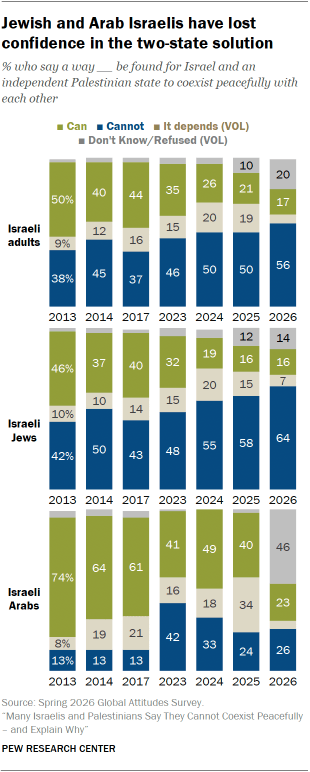
In 2025, the share of Israelis who said coexistence was possible reached its lowest point in our surveys. In 2026, this share has not changed significantly. But for the first time in our polling, more than half of people surveyed in Israel (56%) say coexistence is not possible.
A fifth of Israelis did not answer – double the share that opted out of the question last year.
Views among Jewish Israelis are largely unchanged from last year: 16% say a two-state solution is possible, while a majority (64%) say it is not possible. Smaller shares say it depends or do not answer (7% and 14%, respectively).
Around half of Arab Israelis (46%) declined to answer this year, either saying they don’t know or refusing the question outright. Those who did provide a substantive answer are divided, with roughly equal shares saying peaceful coexistence is possible (23%) and not possible (26%).
The share of Arab Israeli who say a way can be found for Israel and an independent Palestinian state to coexist peacefully, and the share who volunteer “It depends,” have declined since we last asked the question in 2025.