To better understand how Israelis and Palestinians in Israel and in the West Bank and East Jerusalem, respectively, view the United States’ involvement in the conflict between them, Pew Research Center asked people in both places whether the U.S. is providing too much, not enough or about the right amount of military assistance to Israel. We posed a similarly worded question about the amount of humanitarian aid the U.S. is providing to Palestinian civilians in Gaza.
When did the surveys take place?
Pew Research Center surveyed in Israel from April 5 to May 6, 2026, and in the West Bank and East Jerusalem from March 30 to April 28, 2026. Our field period began while the U.S. and Israel were at war with Iran and continued following the declaration of an initial ceasefire on April 7.
These questions are part of a larger survey of Israelis and Palestinians conducted this spring.
U.S. military assistance to Israel
Since World War II, the U.S. has sent more foreign assistance to Israel than to any other country. In fiscal year 2025 (the most recent fully reported year), the U.S. disbursed over $3 billion to Israel, primarily in military assistance.
Views in Israel
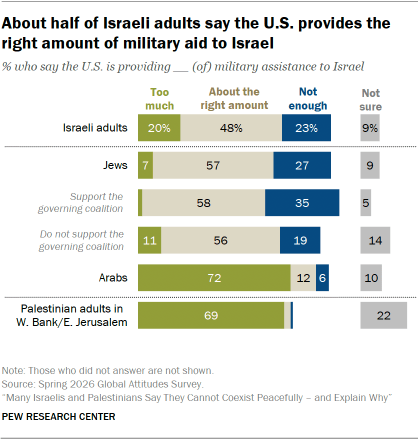
Roughly half of Israeli adults (48%) say the U.S. is providing about the right amount of military assistance to their country. Smaller shares view the U.S. as providing too much military aid (20%) or not enough (23%).
Views vary widely between Jews and Arabs in Israel:
- Among Jewish Israelis, a majority (57%) say the U.S. is providing their country with the right amount of military assistance. Far fewer say it’s providing too much (7%).
- Israeli Jews who support Prime Minister Benjamin Netanyahu’s governing coalition are more likely than those who don’t support it to say the U.S. is not providing enough military aid (35% vs. 19%).
- Nearly four-in-ten of the youngest Israeli Jews (ages 18 to 34) say the U.S. is not providing enough military assistance, compared with about a quarter or fewer of older Jews who take the same position.
- Meanwhile, the vast majority of Israeli Arabs (72%) say the U.S. is providing Israel with too much assistance – and this is the case across all age groups.
Jewish Israelis express more favorable views of the U.S. than Arab Israelis do (96% vs. 19%) and are more likely to say they have confidence in Trump to do the right thing regarding world affairs (79% vs. 13%). Approval of the way Trump has handled the conflict in Gaza is also higher among Jewish Israelis (57%) than among Arab Israelis (14%). For more information, refer to our recent report on global views of the U.S.
Views in the West Bank and East Jerusalem
A majority of Palestinians in the West Bank and East Jerusalem (69%) say the U.S. is providing too much military assistance to Israel. Very few Palestinians say the U.S. is providing about the right amount of military aid to Israel (3%) or not enough (1%). A quarter or so say they are not sure.
U.S. humanitarian aid to Palestinian civilians
The U.S. also provides humanitarian aid to Palestinians in Gaza through direct bilateral channels and the United Nations Relief and Works Agency (UNRWA). They also previously provided aid through the now-defunct Gaza Humanitarian Foundation (GHF). In fiscal 2025, about $496 million in total foreign assistance was disbursed directly to the West Bank and Gaza, a large share of which was humanitarian assistance.
Views in Israel
Around half of Israeli adults (52%) say the U.S. is providing too much humanitarian aid to Palestinian civilians in Gaza. Smaller shares of Israelis say the U.S. is providing about the right amount of aid (18%) or not enough aid (19%).
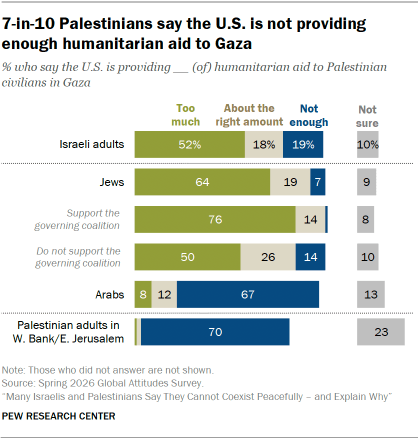
Most Israeli Jews say the U.S. provides too much aid to Gaza (64%). Only 8% of Israeli Arabs share this view. Instead, a majority of them say the U.S. doesn’t provide enough aid to Palestinian civilians (67%).
Among Israeli Jews, those who support Netanyahu’s governing coalition are more likely to say the U.S. is providing too much humanitarian assistance in Gaza (76%) than those who do not support Netanyahu’s coalition (50%).
About three-quarters of younger Israeli Jews – those between the ages of 18 and 34 (74%) – say the U.S. is providing too much aid, compared with six-in-ten or fewer older Jews who say the same.
Views in the West Bank and East Jerusalem
Seven-in-ten Palestinians in the West Bank and East Jerusalem say the U.S. is not providing enough humanitarian aid to civilians in Gaza. An additional 23% say they are not sure. Very few say the U.S. provides too much (1%) or the right amount (2%) of humanitarian aid to Gaza.