
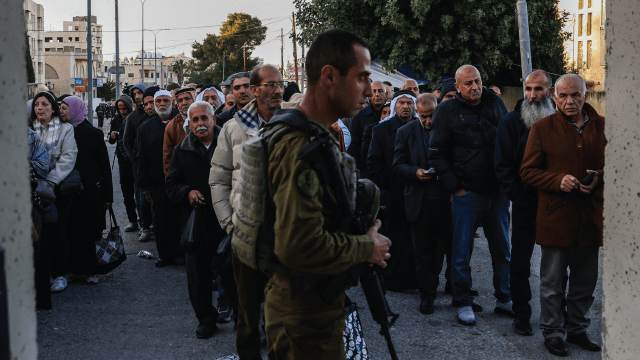
Palestinians in the West Bank and East Jerusalem overwhelmingly view Israeli checkpoints as a major problem for them and their families, according to a Pew Research Center survey conducted in the spring. Large majorities also say job opportunities, crime and the quality of education are major problems.

| Major problem | Minor problem | Not a problem at all | |
|---|---|---|---|
| Israeli checkpoints | 92 | 4 | 3 |
| Opportunities for work | 85 | 8 | 6 |
| Crime | 75 | 8 | 14 |
| Quality of education | 72 | 13 | 15 |
| Quality of health services | 47 | 32 | 21 |
| Access to electricity | 44 | 26 | 30 |
| Access to water | 43 | 27 | 30 |
| Availability of food | 41 | 32 | 28 |
| Adequate housing | 31 | 22 | 46 |
Israeli checkpoints separate Palestinians from Israeli territories and other Palestinian territories. These barriers – which have become more common since the Oct. 7, 2023, Hamas attack on Israel – can make it more difficult for people living in the West Bank and East Jerusalem to commute to work and access healthcare.
Overall, checkpoints are the top concern out of the nine topics we asked about in the survey. More Palestinians in the West Bank (93%) than in East Jerusalem (85%) cite checkpoints as a major problem, but in both places, it is still one of the main concerns. We were not able to survey Palestinians in Gaza due to security concerns.
When did the survey take place?
Pew Research Center surveyed in the West Bank and East Jerusalem from March 30 to April 28, 2026. We were unable to survey in Gaza. Our field period began while the U.S. and Israel were at war with Iran and continued following the declaration of an initial ceasefire on April 7.
Israeli checkpoints also came up when we asked Palestinians in an open-ended question why peaceful coexistence between Israel and an independent Palestinian state is possible or not possible. For example, one Palestinian woman cited “the presence of checkpoints and harsh living conditions” as a reason coexistence is not possible. Others said checkpoints have “separated us from each other” and made it difficult to move between cities.
Other respondents linked checkpoints to ‘‘the lack of job opportunities for Palestinians,” with one saying, “It is possible to coexist when the checkpoints are opened and the workers return to Israel.” Another said, “They should open the crossings and allow workers to enter and work; this way there will be no problems.” Others said coexistence could become possible “when job opportunities are provided for young people,” or by “ending the internal and external division … and creating job opportunities.”
To read more about Israeli and Palestinian views on the possibility of peaceful coexistence between Israel and an independent Palestinian state, read “Many Israelis and Palestinians Say They Cannot Coexist Peacefully – and Explain Why.”
Other key problems in the West Bank and East Jerusalem
A large majority of Palestinians in the West Bank and East Jerusalem (85%) also say that opportunities for work are a major problem for them and their families, making it the second most common concern after Israeli checkpoints.
Opportunities for work are particularly a concern for those with lower incomes. Nine-in-ten Palestinians whose household incomes are at or below the West Bank and East Jerusalem median say job opportunities are a major problem, compared with 78% of Palestinians with higher household incomes.
While there was modest economic growth in the West Bank and East Jerusalem in 2025, the unemployment rate was 27.5% at the end of last year, according to the most recent available estimates from the World Bank. That was among the highest documented unemployment rates in the world.
Palestinians in the West Bank and East Jerusalem are also the least satisfied with their economic situation out of the 37 places around the world that we surveyed in 2026: Only 10% say the current economic situation in Palestine is either very good or somewhat good. Nine-in-ten say it is very bad or somewhat bad.

| Lower income | Higher income | Lower-higher diff | Grouping | |
|---|---|---|---|---|
| Availability of food | 50 | 28 | 22 | 1 |
| Access to electricity | 51 | 34 | 17 | 1 |
| Quality of education | 79 | 63 | 16 | 1 |
| Access to water | 49 | 34 | 15 | 1 |
| Opportunities for work | 90 | 78 | 12 | 1 |
| Quality of health services | 51 | 40 | 11 | 1 |
| Adequate housing | 34 | 27 | 7 | 1 |
| Israeli checkpoints | 92 | 92 | 0 | 1 |
| Crime | 74 | 77 | -3 | 2 |
In addition to voicing concerns about checkpoints and jobs, many Palestinians in the surveyed areas say crime is a major problem. Similar shares in the West Bank (75%) and East Jerusalem (77%) view crime as a major issue, as do majorities of Palestinians across all ages and income levels.
About three-quarters of Palestinians in the West Bank and East Jerusalem also say the quality of education is a major issue (72%). This concern is a bit more common among those with lower household incomes than among those with higher household incomes (79% vs. 63%).
About half of Palestinians or fewer in the West Bank and East Jerusalem see the quality of health services, access to electricity, access to water and availability of food as major problems for them and their families. Lower-income Palestinians are more likely to view these as major issues.
Overall, adequate housing is the least common concern of those we asked about. Far more Palestinians in East Jerusalem (54%) than in the West Bank (28%) view housing as a major problem. In East Jerusalem, hundreds of Palestinian households are facing eviction and many homes have been demolished. Some Palestinians also have difficulty obtaining housing permits necessary to build new homes in the city.
Note: Here are the survey questions used for this analysis, along with responses, and the survey methodology.