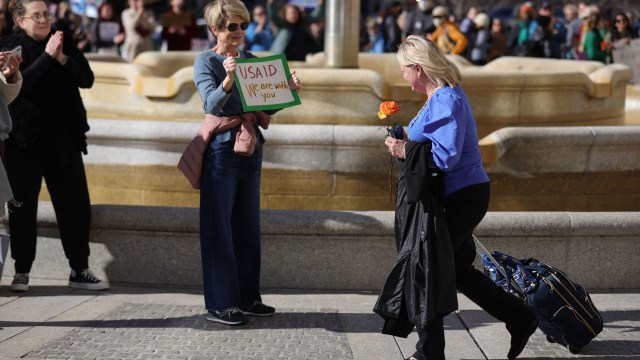
U.S. assistance to foreign countries fell to its lowest level in more than two decades in the fiscal year that ended Sept. 30, 2025, according to a Pew Research Center analysis of federal data. And it’s on track to be even lower this fiscal year.
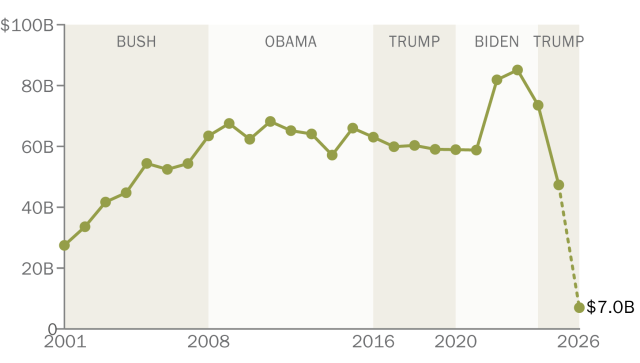
Federal agencies disbursed $47.3 billion in foreign aid in fiscal 2025, about $26 billion less than in fiscal 2024, according to data from ForeignAssistance.gov. Adjusted for inflation, that was the lowest amount of foreign aid since fiscal 2004. (The federal fiscal year runs from Oct. 1 to Sept. 30. For instance, fiscal 2026 began on Oct. 1, 2025, and will end on Sept. 30 of this year.)
| Year | Inflation-adjusted 2025 dollars |
|---|---|
| 2001 | $27,452,589,169 |
| 2002 | $33,574,220,222 |
| 2003 | $41,679,351,739 |
| 2004 | $44,755,469,931 |
| 2005 | $54,387,912,454 |
| 2006 | $52,433,442,656 |
| 2007 | $54,352,109,142 |
| 2008 | $63,442,239,254 |
| 2009 | $67,527,855,967 |
| 2010 | $62,337,204,197 |
| 2011 | $68,185,101,698 |
| 2012 | $65,162,240,573 |
| 2013 | $64,080,618,824 |
| 2014 | $57,126,966,212 |
| 2015 | $65,998,056,961 |
| 2016 | $63,019,829,376 |
| 2017 | $59,886,929,276 |
| 2018 | $60,308,178,185 |
| 2019 | $59,023,593,423 |
| 2020 | $58,920,046,618 |
| 2021 | $58,783,234,437 |
| 2022 | $81,867,562,423 |
| 2023 | $85,108,137,461 |
| 2024 | $73,510,670,840 |
| 2025 | $47,317,850,037 |
| 2026 | $6,969,294,181 |
And as the Trump administration has dismantled much of the United States’ aid infrastructure, the amount of aid flowing to other countries continues to dwindle. The government has given out just shy of $7 billion in foreign aid in fiscal 2026 as of July 1. That’s the most recent data available, covering three-quarters of the current fiscal year.
Between fiscal years 2008 and 2021, the annual level of aid spending (in constant 2025 dollars) varied from $57 billion to $68 billion. For most of that time, foreign assistance represented roughly 1% of total federal expenditures.
Foreign assistance spiked in fiscal years 2022 to 2024, driven largely by aid to Ukraine after the Russian invasion in February 2022. Inflation-adjusted assistance peaked at $85.1 billion in fiscal 2023.
In fiscal 2025, by contrast, foreign assistance was 0.67% of total federal spending, and so far in fiscal 2026 it’s just 0.09% of estimated spending.
The types of aid spending listed on ForeignAssistance.gov includes funds, goods, services and technical assistance. This data doesn’t, however, reflect most arms sales or transfers of military equipment to foreign countries.
Who receives U.S. foreign aid?
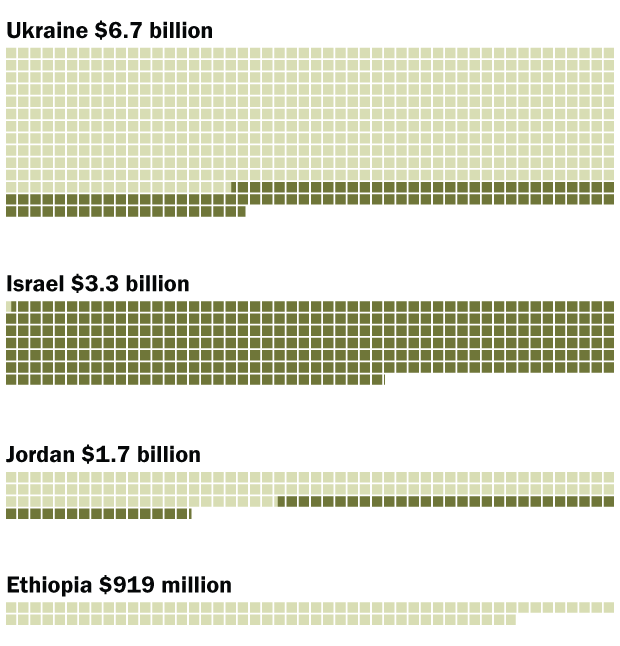
Fiscal year 2025 was the fourth straight year in which Ukraine received more U.S. aid than any other country. Ukraine received about $6.7 billion, about $3.5 billion less than it had received in fiscal 2024, or a 34.1% decrease. More than two-thirds of that aid (69.0%) was economic assistance, while 18.7% was military and security aid.
So far in fiscal 2026, Ukraine has received just $214.4 million in U.S. aid, virtually all of it economic or humanitarian.
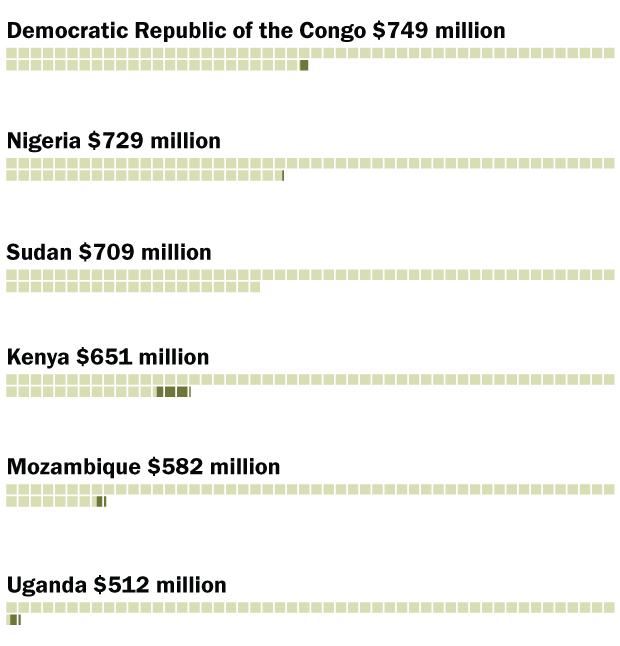
After Ukraine, the countries that received the most U.S. aid in fiscal 2025 were Israel ($3.3 billion) and Jordan ($1.7 billion). Aid to Israel that year was 51.4% less than in fiscal 2024, but aid to Jordan was down just 5.2%.
| $10 million in nonmilitary foreign aid | |
| $10 million in military foreign aid |
| Country | Nonmilitary | Share nonmilitary | Military | Share military | Total |
|---|---|---|---|---|---|
| Ukraine | $5,685,638,458 | 84.9% | $1,011,759,817 | 15.1% | $6,697,398,275 |
| Israel | $5,168,106 | 0.2% | $3,305,572,360 | 99.8% | $3,310,740,466 |
| Jordan | $1,223,434,748 | 74.0% | $428,830,611 | 26.0% | $1,652,265,359 |
| Ethiopia | $919,244,202 | 100.0% | $0 | 0.0% | $919,244,202 |
| Democratic Republic of the Congo | $741,085,432 | 99.0% | $7,623,870 | 1.0% | $748,709,302 |
| Nigeria | $727,352,321 | 99.8% | $1,436,542 | 0.2% | $728,788,863 |
| Sudan | $709,141,579 | 100.0% | $0 | 0.0% | $709,141,579 |
| Kenya | $623,953,530 | 95.8% | $27,142,578 | 4.2% | $651,096,108 |
| Mozambique | $575,042,671 | 98.8% | $7,023,153 | 1.2% | $582,065,824 |
| Uganda | $503,916,202 | 98.4% | $8,098,428 | 1.6% | $512,014,630 |
Nearly all aid to Israel in fiscal 2025 was military and security assistance. Aid to Jordan was spread mostly between economic (46.5%), military and security (26.1%), and education and social services (10.6%).
As of July 1, ForeignAssistance.gov had recorded $965.7 million in assistance to Jordan in fiscal 2026, which is the most aid to any individual country in the current fiscal year. The next-largest amounts have gone to the West Bank and Gaza ($325.3 million) and Ethiopia ($286.7 million).
Besides programs and projects in individual countries, American aid also funds programs that operate regionally or even globally. In fiscal 2025, about 26.5% of foreign assistance ($12.5 billion) went to global programs, while 7.7% ($3.6 billion) funded regional activities.
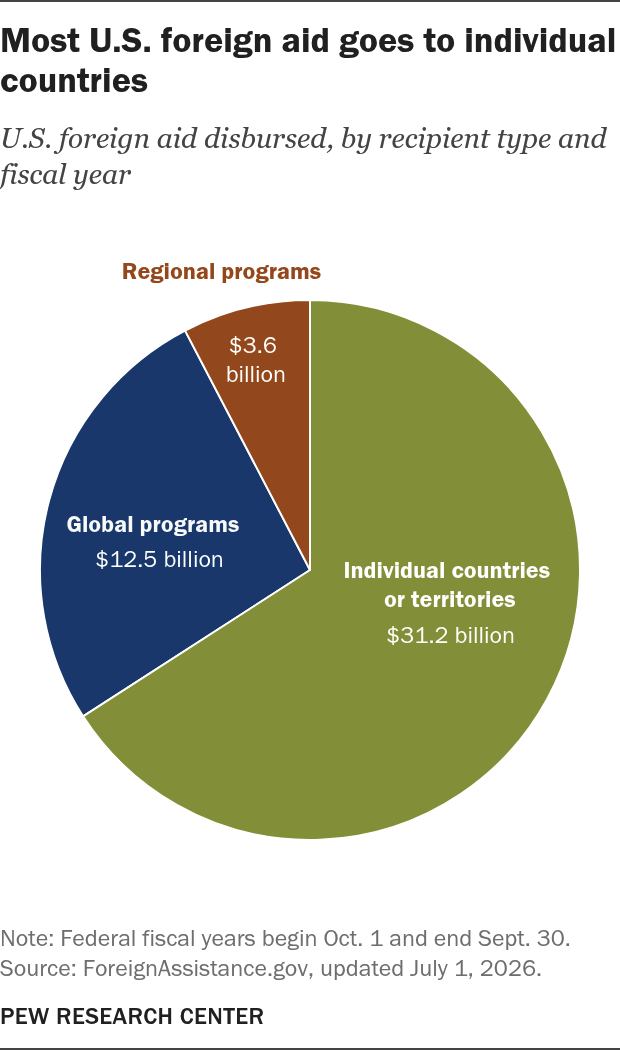
| Category | Amount | Share |
|---|---|---|
| Global programs | $12,520,140,002 | 26.5% |
| Individual countries or territories | $31,175,504,603 | 65.9% |
| Regional programs | $3,622,205,432 | 7.7% |
What is U.S. foreign aid money used for?
Historically, the biggest slice of U.S. foreign aid was often for military and security programs – a broad category that covers training for military and police forces, operations against terrorism and drug trafficking and conflict resolution efforts. As recently as fiscal 2024, more than a quarter of all foreign assistance spending went to such endeavors.
But in fiscal 2025, not only was military and security aid cut by nearly $11 billion (from $18.2 billion to $7.3 billion), but it accounted for just 15.5% of total aid. That was the smallest share since fiscal 2001, which is as far back as the data on ForeignAssistance.gov goes.
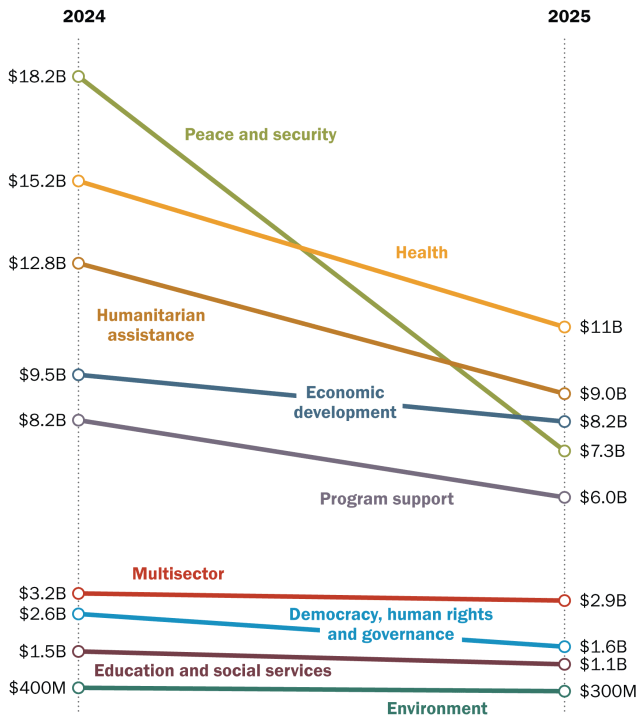
| Category | FY 2024 | FY 2025 |
|---|---|---|
| Peace and security | $18,246,109,424 | $7,316,232,703 |
| Democracy, human rights and governance | $2,559,249,213 | $1,603,516,069 |
| Health | $15,195,389,746 | $10,933,117,708 |
| Education and social services | $1,464,870,401 | $1,089,634,504 |
| Economic development | $9,538,913,204 | $8,173,362,740 |
| Environment | $403,744,280 | $304,089,021 |
| Humanitarian assistance | $12,795,168,725 | $8,987,429,153 |
| Program support | $8,214,865,626 | $5,961,564,088 |
| Multisector | $3,157,868,883 | $2,948,904,051 |
| Total | $71,576,179,502 | $47,317,850,037 |
Public health initiatives received the largest share of foreign aid spending last year, at 23.1%. This category includes funds for combatting HIV/AIDS, malaria, flu and other diseases; promoting maternal and child health; building clean water and sewer systems; and so on. Such programs received a total of $10.9 billion in fiscal 2025, down from $15.2 billion in fiscal 2024.
Economic development aid represented 17.3% of foreign assistance last year, up from 13.3% in fiscal 2024, despite falling by nearly $1.4 billion in absolute terms.
The rest of the fiscal 2025 aid dollars funded a variety of other work in areas such as education, environmental protection, disaster relief and democracy promotion.
Related: What do people in middle-income countries think about cuts to U.S. humanitarian aid?