Latinos in the United States broadly view living standards as improving across generations – both when looking back at their parents and looking ahead for their children.
Overall, immigrant Latinos hold more positive views about intergenerational economic progress than those born in the U.S. At the same time, immigrants are less likely than the U.S. born to say the American dream has become harder to achieve. Many Latinos define the American dream in economic terms, such as financial stability, economic opportunity and homeownership.
These findings come from Pew Research Center ’s National Survey of Latinos, a nationally representative, bilingual survey including 4,923 U.S. Latino adults, conducted Oct. 6-16, 2025. Read key findings from the survey.
Hispanic immigrants are more likely than U.S.-born Hispanics to see improving living standards
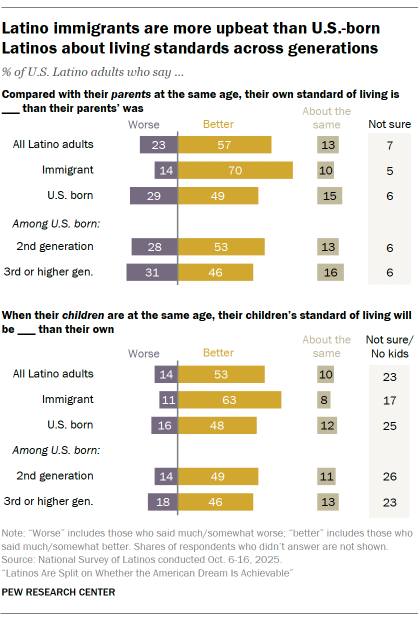
Hispanic adults share broadly positive views about how standards of living have improved for themselves and are likely to improve for their children. Immigrants are more upbeat than U.S.-born Hispanics across these measures.
When comparing their own standard of living with their parents’:
- 70% of immigrant Latinos say their standard of living is better than that of their parents at the same age, while about half of U.S.-born Latinos (49%) say the same.
- Among U.S.-born Latinos, 53% of second-generation adults (those with at least one immigrant parent) say their standard of living is better than their parents’, while 46% of third or higher generation adults (those with both parents born in the U.S.) say the same.
When comparing their children’s standard of living with their own:
- Immigrant Latinos (63%) are also more likely than U.S.-born Latinos (48%) to say their children’s standard of living will be better than their own.
- Among U.S.-born Latinos, views are similar across the second generation and third or higher generation.
How do Latino immigrants compare with other U.S. immigrants?
Optimism among Latino immigrants mirrors a similar pattern in the rest of the U.S. population: Immigrants are generally more hopeful about their economic future than U.S.-born adults.
Even so, Latino immigrants are more optimistic than other U.S. immigrants.
- 70% of Latino immigrants say their own standard of living is better than that of their parents, compared with 59% among other U.S. immigrants.
- 63% of Latino immigrants say their children’s standard of living will be better, while 35% of other U.S. immigrants say this.
Refer to the appendix for detailed tables showing responses by more Latino subgroups and how they compare with other U.S. adults.
Has the American dream become harder to achieve? Latinos born in the U.S. are more likely to say yes
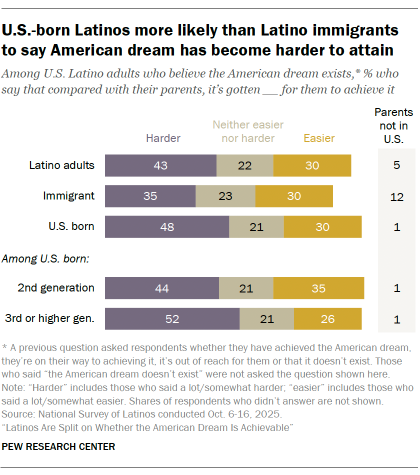
Overall, Latino immigrants and U.S.-born Latinos are about as likely to say they have achieved the American dream. But attitudes toward whether the American dream has become harder or easier to achieve vary across immigrant generations:
- 48% of U.S.-born Latinos say the American dream is now harder to achieve than it was for their parents, while 35% of immigrant Latinos say the same.
- Among U.S.-born Latinos, 52% of the third or higher generation say the American dream has become harder to achieve, while 44% of the second generation say the same.