

Most Americans say it’s important to be healthy, but fewer think they are doing a good job at managing their own health. They also report significant challenges figuring out the best way to reach their health goals: Around half of the public says they struggle to know which health information is accurate, and most have encountered conflicting advice about their health.
The vast majority of U.S. adults turn to health care providers for guidance through this confusing landscape. But four-in-ten U.S. adults (and half of those under 50) now get health and wellness information from social media influencers and podcasts.
To learn more about who these influencers are and how they present themselves to the world, we identified 6,828 individuals with at least 100,000 followers on YouTube, TikTok or Instagram that regularly post about health and wellness and analyzed their social media profiles. We paired this analysis with two surveys of U.S. adults that asked about their experiences with health and wellness influencers. Some of the key findings:
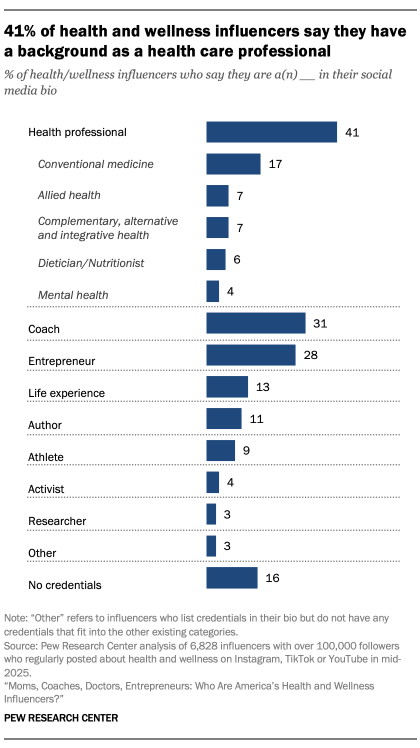
- Health and wellness influencers claim a wide range of backgrounds from inside and outside the world of medicine: 41% describe themselves as some sort of health care professional, and around three-in-ten each say they are coaches (31%) or entrepreneurs (28%).
- Around two-thirds of these influencers are women. But men are more heavily represented for certain backgrounds (like doctors) and among the most popular health and wellness influencers.
- Many draw on their life experiences. Health and wellness influencers who are women are especially likely to cite their background as a parent.
Who gets health and wellness information from influencers?
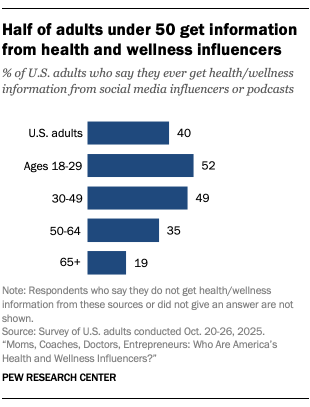
Four-in-ten U.S. adults – and half of those under the age of 50 – say they ever get health and wellness information from social media influencers or podcasts. This is similar to the share who at least sometimes gets health information from social media in general.
Certain groups are particularly likely to say they get health and wellness information from these influencers, including adults under 50; Black, Hispanic and Asian Americans; and those without health insurance.
Refer to Appendix A for a table showing detailed breakdowns of different groups.
Where are health and wellness influencers found online?
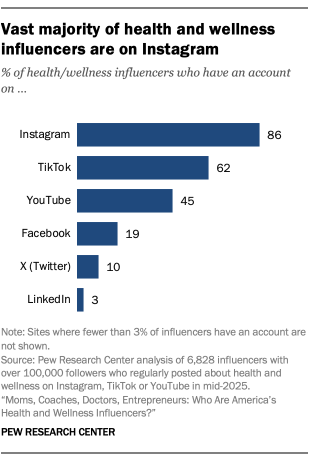
Health and wellness influencers tend to congregate on social media sites that are centered around images or videos, rather than text.
Nearly all of the influencers we studied have an account on Instagram (86%), and substantial shares have accounts on video-focused sites like TikTok (62%) and YouTube (45%).
These influencers are less likely to be on other sites. About one-in-five are on Facebook (19%) and one-in-ten are on X (formerly Twitter). A number of other sites contain small shares of them (3% or less each). Most health and wellness influencers don’t maintain a particularly broad presence: The accounts we looked at for this study maintain an account on just two social media sites on average.
This reflects a different outreach strategy than the one many news influencers follow. A 2024 Pew Research Center study found that 85% of those influencers were on X, while 50% were on Instagram and 44% were on YouTube.
Of course, social media aren’t the only way for an influencer to reach their audience. About one-in-ten (12%) host a podcast, and 2% have a Substack or Medium newsletter.
How do health and wellness influencers on social media describe their expertise?
Most Americans who get health and wellness information from social media influencers say they typically come across this content rather than actively seek it out. When encountering a post in this way, viewers may wonder: Who is this person? Do they know what they’re talking about? Why should I trust them?
One way to answer these questions is to click through to the profile of the person who created the post. In that limited space, the creator can share a bit about themselves: information like their training (if any), what they do for a living or the kinds of life experiences they have. Some influencers offer a lot of information about themselves, while others simply describe the type of content they make.
Our analysis finds that many health and wellness influencers describe themselves as some sort of health care professional – but a majority do not. Some 41% mention a health care profession in their profile.
This category includes a range of specialties, some of which are outside the traditional Western medical establishment. And some influencers are included in more than one of these specialties:
- Conventional medical professionals like doctors, dentists and nurses. (17% of influencers fall into this category.)
- Allied health professionals like physical therapists or pharmacists (7%)
- Complementary, alternative and integrative health professionals, such as functional medical practitioners, naturopaths, chiropractors or massage therapists (7%)
- Dieticians and nutritionists (6%)
- Mental health professionals, including psychiatrists and social workers (4%)
Health care professional is the most common profession or background we found in these influencer profiles. But other types of expertise are common as well:
- Coaches: 31% of these influencers describe themselves as coaches, such as diet, fitness and/or life coaches. Many offer one-on-one services or guides.
- Entrepreneurs: 28% are entrepreneurs or business owners. These accounts typically mention a wellness studio or medical practice they own or the licensed products or treatments they offer.
- Those who cite their life history or experience: 13% mention things like a medical condition they have or have had, their journey to lose weight or improve their fitness, or their experience as a caregiver.
An influencer’s profession can be a reason for their audience to trust them, but 16% of health and wellness influencers on social media do not mention anything about their background or expertise in their bios. Many of these profiles contain very little text or include descriptions of the content they post rather than listing credentials.
What share of health and wellness influencers are men or women?
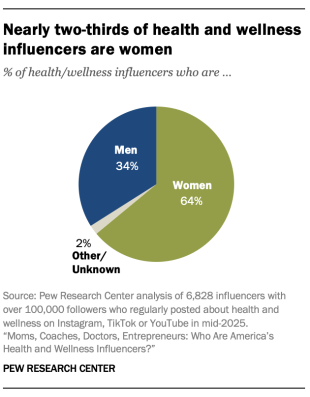
Women are huge drivers of health care spending decisions in America compared with men. Health and wellness influencers reflect that gender dynamic: 64% of these influencers are women, while 34% are men. This is nearly the opposite of the gender split in a 2024 Center study of news influencers (63% of whom were men).
How men and women signal their expertise
There are relatively few differences in how men and women who are health and wellness influencers describe their backgrounds and expertise. However, there are some differences around certain categories.
Women are especially likely to cite their life experiences in their social media account bios. Some 16% of health and wellness influencers who are women do this, nearly double the share among men (9%).
Specifically, references to parenthood are a common differentiator between men and women. Women are about three times as likely to describe themselves as some variation of “mom” or “mother” (17%) than men are to mention their role as a father (6%). This includes both generic references to being a parent (“Mom of two”) as well as references that connect parenthood to their expertise in a particular field or topic (“ADHD mom”).
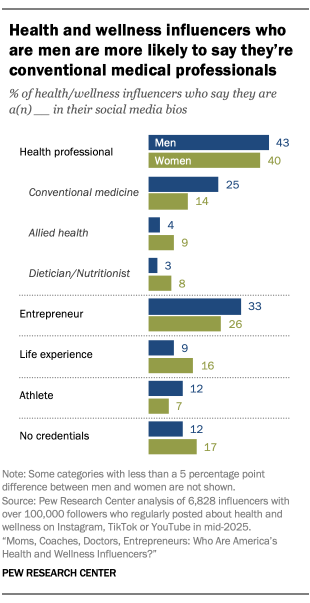
In contrast, health and wellness influencers who are men are more likely to say they are a conventional medical professional (such as a doctor). Among these social media influencers, 25% of men mention these credentials, 11 percentage points higher than the share among women (14%). Slightly larger shares of men than women also mention their experience as an athlete or entrepreneur.
Beyond the broad category of conventional medical professional, health and wellness influencers who are men are more likely to describe themselves using specific terms like “doctor” (14% of men vs. 6% of women mention these in their bios) or “surgeon” (8% vs. 1%). Plastic surgeons particularly stand out in this regard: Of all the accounts that mention plastic surgeon in their bios, 85% are men.
How many followers do popular health and wellness influencers have?
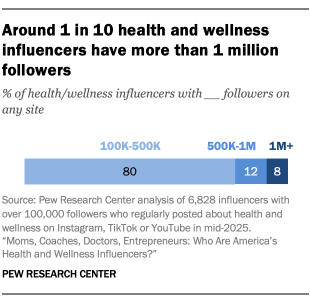
All of the social media influencers included in this analysis have at least 100,000 followers on Instagram, TikTok or YouTube. But a notable share has attracted an even wider audience. Some 8% have at least 1 million followers on their most-followed account.
Just under half of these high-follower influencers are men (46%), which is more than the share of men among all health and wellness influencers (34%).


