The migration of audiences toward digital news advanced to a new level in 2011 and early 2012, the era of mobile and multidigital devices. More than three-quarters of U.S. adults own laptop or desktop computers, a number that has been stable for some years.1 Now, in addition, 44% of adults own a smartphone, and the number of tablet owners grew by about 50% since the summer of 2011, to 18% of Americans over age 18.

Each of these technologies offers a separate set of features, conveniences and potential uses. But less is known to date about how people use these devices — whether they behave differently on different platforms and what the move to mobile might mean for news and journalism and the notion of a common experience or public square. Past research found much of the desktop news experience was built around search — people looking for what they need or want to know right now, which tilted influence (and revenue) toward aggregators such as Google. To what degree is that true in mobile? Have apps (or applications) and social media networks altered that? And do consumers favor one way of accessing news on their tablet, another their desktop and yet another on a smartphone?
A new survey of more than 3,000 U.S. adults by the Pew Research Center’s Project for Excellence in Journalism finds that rather than gravitating toward one device, a growing number of Americans are becoming multiplatform digital news consumers. These “digital mavens” get news on all their devices — and even more so if they own all three types of devices. In other words, digital devices appear to be an additive experience.
The data also find that the reputation or brand of a news organization, a very traditional idea, is the most important factor in determining where consumers go for news, and that is even truer on mobile devices than on laptops or desktops. Indeed, despite the explosion in social media use through the likes of Facebook and Twitter, recommendations from friends are not a major factor yet in steering news consumption.
There are some signs that the way people interact with news on mobile devices is quite different than news behavior on the desktop/laptop computers. Data from Localytics, a client-based mobile analytics firm, analyzed by PEJ reveals that people spend far more time with news apps on the smartphone and tablet, visit more pages at a sitting, and return more frequently than they do on conventional computers. That data reinforce findings from previous PEJ research in 2011 that people read more long-form news articles and go to new news sources on tablets.
Taken all together, the growing body of data suggests that the move toward mobile holds some promising options for news producers, including increasing the amount of overall news being consumed.
To capitalize on that potential, however, the industry will need to do a better job than it did in the desktop realm of quickly coming to understand audience behavior and developing technology and revenue models to adapt to it.
Among the major findings of this research:
- The majority of Americans now get news through at least one digital, web-based device. While the desktop or laptop computer remains the primary digital platform for news (54% of Americans get news there), the number of consumers who get news on multiple digital devices is growing. Nearly a quarter of U.S. adults, 23%, now get news on at least two devices–a desktop/laptop computer and smartphone, a computer and a tablet, a tablet and a smartphone, or on all three.
- The most common way that people get news is by going directly to a news organization’s website or app. About a third of desktop/laptop news consumers and smartphone news consumers get news this way “very often.” Even more tablet news users, 38%, follow this path. On desktop/laptop computers, going to a news site directly is statistically tied with search (30%). Yet even these numbers may understate those seeking out news home pages. Previous PEJ studies have shown that many people who access news through search engines are typing in some variation of the home page name, not searching by topic across different news sources.
- Social media, while clearly a part of the digital news experience, is not nearly the driver of news that many have suggested. Just 9% of digital news consumers follow news recommendations from either Facebook or Twitter “very often” on at least one of the devices asked about here. Of the two networks, Facebook garners about twice as many news followers than Twitter. Still, though, the rapid growth is striking. As written about in the Digital chapter of this report the percent of traffic that comes to news sites from social media platforms increased 57% since 2009.
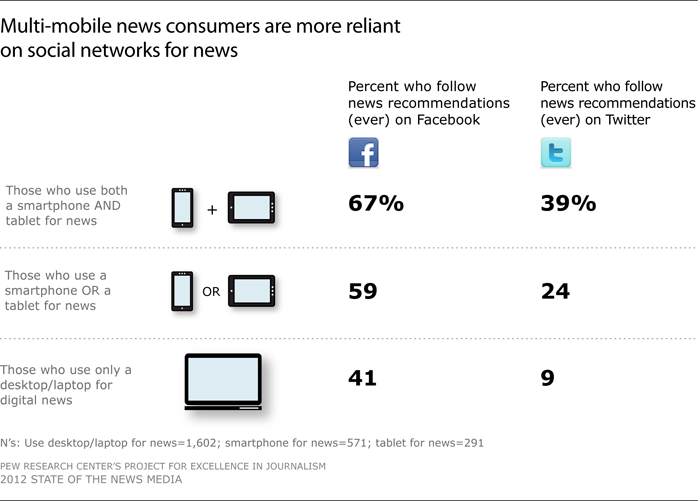
- For those who get news on both the smartphone and tablet, social networking is a much more popular way to get news. Among that group (13% of all digital news consumers), fully two-thirds (67%) have ever gotten news recommendations from Facebook. That compares to 59% who get news on just one of those devices and 41% who only get digital news via the desktop/laptop. Similarly, 39% follow news recommendations on Twitter, compared with 24% who just use a smartphone or a tablet and 9% who use only the desktop/laptop.
- Consumers who still only get digital news on the desktop/laptop computer have a very different set of behaviors. This group is less likely to get news in any of the ways asked about in the survey than those who get some digital news on a smartphone, a tablet or both. Only about half (48%) get news using key word search “very or somewhat often” compared with at least 70% of those who use a smartphone, tablet or both for news. Similarly, 54% go directly to news websites or apps somewhat or very often, while 80% or more of those who get news on other devices do so.
- Commercial data tracking online usage reinforce the findings of this survey. Localytics shared its proprietary data with researchers involved in this study, and that information shows that people using mobile devices tend to spend more time with news on mobile devices than they do on computers. They go to news sites more often, spend more time per session and read more articles per session.
Ownership
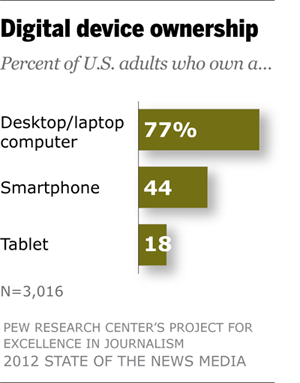
More than three-quarters of U.S. adults (77%) own a laptop or desktop computer. That number has remained stable since 2007.
What is growing now instead is mobile. Fully 44% of adults own a smartphone, and a little less than half of that number own tablet computers (18%). That tablet ownership grew 50% from the summer of 2011 when it was at 11% to January of 2012 when this survey was taken.
Much of this mobile ownership is occurring among computer owners who are adding mobile devices to their digital collection. And in many cases they have added both smartphones and tablets.
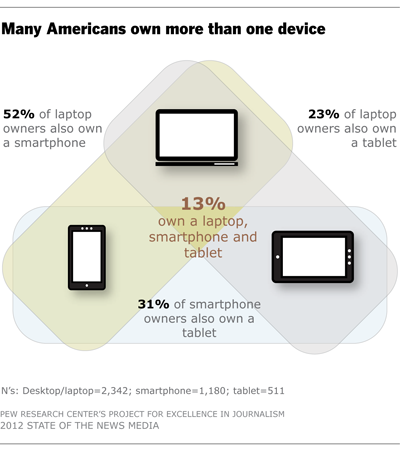
Over half, 52%, of desktop/laptop owners now also own a smartphone and roughly a quarter, 23%, own a tablet computer (while 43% own just the desktop/laptop computer).
Smartphone owners are even more likely than others to be digital omnivores. Almost a third (31%) of those who own smartphones also own a tablet computer. And more than one in ten Americans, 13%, now own all three.
News Use on Digital Devices
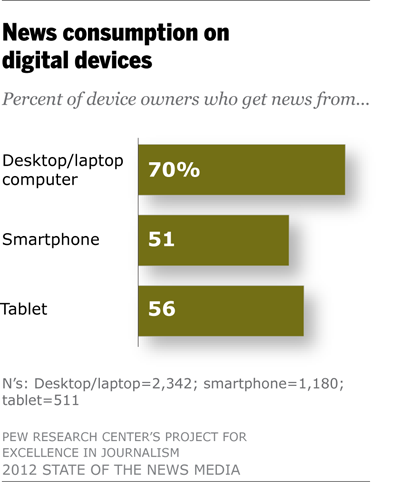
The data also reveal that news is a substantial part of what people do on each of these devices. Fully 70% of desktop/laptop owners report getting news on their computers. Half of smartphone owners (51%) use their phones for news. A majority of tablet owners (56%) use the devices for news. (A third of all U.S. adults, 32%, gets news digitally only on a laptop or desktop.)
The evidence also increasingly hints that the level of news consumption on mobile devices is especially heavy. For instance, the 56% of tablet owners who say they get news on those devices is on par with the percentage who in our 2011 survey said they get news on their tablet every day (53%). And the data from the mobile analytics firm Localytics, which are discussed more below, offer further evidence that people use mobile devices for news more often and for longer sessions.
Many analysts have wondered whether the release of lower-cost versions like the Kindle Fire at the end of 2011 would alter the population and decrease the portion of news users. The survey data suggest that a solid portion of the tablet population still uses the new device for news.
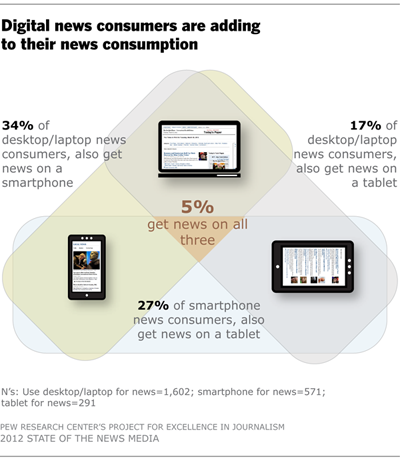
For most with multiple devices, there is not a single place for news. People who acquire mobile devices appear to be using them to get news on all their devices. This also suggests they may be getting more news more often. About a third, 34%, of desktop/laptop news consumers now also get news on a smartphone. About a quarter, 27%, of smartphone news consumers also get news on a tablet. While this smartphone/tablet news consumer group is small, just 6% of the population over all, it is a large percentage of those who own smartphones and tablets; fully 44% of people who own both kinds of devices use both for news. What’s more, most of those individuals (78%) still get news on the desktop or laptop as well.
While there is no single digital news device, there is a primary one. For now, the desktop/laptop still reigns as the place people get most of their digital news. Fully 82% of people who get news on a computer say that is where they get most of their digital news. But much of that may mainly come from the computer being their only digital option. Again, about half of that group (43% of all desktop/laptop owners) does not own another device.
When people add mobile devices to their digital inventory, the research suggests these newer devices begin to be their primary digital news source.
Smartphone news users are now nearly split between their laptop and smartphone as their primary news platform; 46% still get most of their news on the desktop/laptop; 45% get most on their smartphone. Another 7% of these smartphone owners say they get most of their news on a tablet. Early tablet news users are moving in the same direction, but remain somewhat more reliant on the laptop or desktop computer. Of tablet owners, 47% still get most of their digital news via desktops or laptops, while a third, 34%, have already transitioned to consuming most of their news on the tablet.
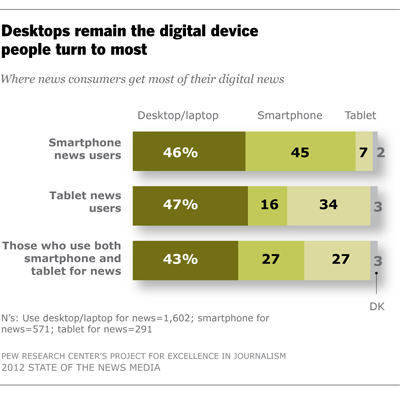
And how about the cross-mobile omnivores? Of that small but growing population, the 6% of adults who get news on a smartphone and tablet, their behavior was similar. Over all, 43% of this most connected group said they still get most of their digital news on the desktop/laptop while the smartphone and tablet draw equal crowds, 27% each.
In short, as we have seen with other technology shifts, consumers are drawn to newer forms and may even make them their primary mode, but they are not abandoning older forms altogether. Instead their news experience widens and deepens.
The Path of the News
One pressing question for the news industry is how news behavior differs on different devices. And that starts with how people find and access the news stories they get. Is search as much a starting place on smartphones as it is on the desktop? To what extent are news organization apps where people begin, an option that offers some potential for subscriptions and suggests a high degree of brand loyalty? And what about the social networks on each? Is Facebook becoming the central news portal on mobile devices?
The survey reveals that brand matters on every device, and seems to matter the most on the tablet. For all three digital platforms, the most common method for accessing digital news now is by going directly to a news website or app. And that has been helped by the advent of mobile. A third of those who get news via the laptop or desktop say they go directly to a news organization’s website “very often” as do a third of smartphone news consumers and 38% of tablet news consumers.
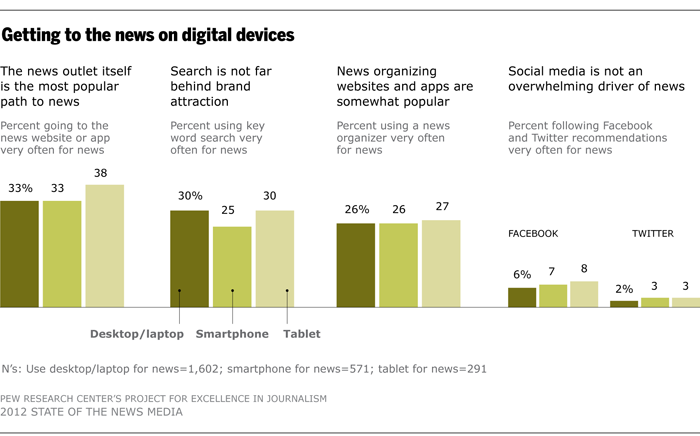
Search is not far behind as a path to news. One–in-three desktop/laptop news users get news on those devices via search very often. That is the same percentage who say they rely heavily on search to get news on their tablet computer. Search was less prevalent on smartphones, with a quarter turning to it very often (tied with apps that organize news from multiple sources).
Yet there is some evidence that these numbers may undercount the power of home pages and brand, and overstate the implication that people might be searching news by topic or event. A detailed analysis by PEJ in 2011 of behavior online through Nielsen data finds that the home page is overwhelmingly the place where most visitors arrive online, even those who come via search engines. That suggests that many people who come to news sites via search are typing in the name of a news organization rather than a particular story or even a topic.
The new survey data also found that a new cohort of news organizers or apps that curate and present news to users, such as Topix or Flipboard, was gaining a sizable place in news consumption. For each device, about a quarter of those news consumers report using news organizing sites or apps like Topix or Flipboard to get news stories.
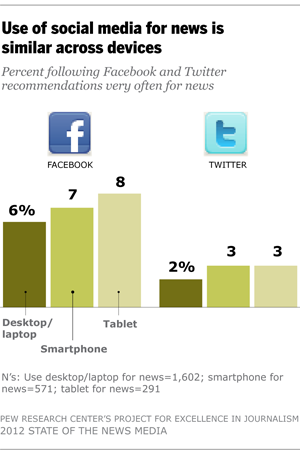
At the same time, social media recommendations are not nearly as significant a driver of news as brand and search. Contrary to what some have suggested, consumers are not yet heavily reliant on Facebook or Twitter for their news.2 In total, just 9% follow news recommendations very often from either Facebook or Twitter on any of the three devices. This breaks down to 10% on the tablet computer, 8% on smartphones and 7% on desktop/laptop.
Facebook has the larger role of the two with 6% of people saying they use it “very often” to get news on desktop/laptops, 7% on smartphones and 8% on tablets. Only about half as many reported following recommendations very often via Twitter.
This peer-to-peer sharing or recommending of news does appear to be an emerging trend, however, and may become a part — if not soon a primary part — of news consumption. If one adds to the tally those who say they follow these recommendations “sometimes” to the one in ten who say they do it “very often” the number increases about three-fold. For both smartphones and tablets, more than a quarter, 27%, follow recommendations from Facebook at least somewhat often. Nine percent for each device follow Twitter news recommendations at least somewhat often. On the desktop/laptop the percentages come to 22% for Facebook and 5% for Twitter.
Thus for now, social recommendations are also becoming an added rather than an alternative way that people get news and may, in effect, be another form of expanding civic behavior rather than merely changing it.
Is News Behavior Habit Rather Than Device-Driven?
Some of the similarities in how people use different devices raised another question in our minds: whether what is determining behavior on the digital platform is the device or the ingrained habits of the user. In other words, do people carry with them from one device to the next the habits in the way they get news stories? Do those who rely on search a great deal on the desktop/laptop also use it a good deal on the smartphone?
It is hard to draw firm conclusions from this survey of early habits. Still, when we dug deep into the two most common methods for getting news — direct news websites and search — the suggestion that emerges is that behavior, rather than device, may play a large role in how people get their news. And that may offer some hope for established news organizations.
Among desktop/laptop news users who go directly to news organization websites for news very or somewhat often, 73% also go directly to news organization websites on smartphone very or somewhat often and 81% go directly to the news websites on tablet very or somewhat often.
For desktop/laptop owners who get news through a key word search for news very or somewhat often, the correlation is slightly less strong: 67% search for news on smartphone very or somewhat often and 76% search for news on tablet very or somewhat often. This group was more likely to go directly to news organizations on the smartphone and on the tablet.
The Mobile News Omnivores & the Desktop/Laptop Holdouts
Although only 6% of those surveyed get news on both their smartphone and tablet devices, this group offers a unique perspective of those that are adopting multiple forms of mobile technology to enhance their news experience.
One area where this group stands out even from those that get news on either the tablet or the smartphone is in their use of social networks for news. Fully two-thirds (67%) of those who consume news on both their smartphone and tablet follow news recommendations on Facebook. That compares to 59% who get news on just one of those devices and 41% who get digital news only via the desktop/laptop. Similarly, 39% ever follow news recommendations on Twitter, compared with 24% who just use a smartphone or a tablet and 9% who use only the desktop/laptop. When on Twitter, this multimobile group is more likely to follow news stories from news organizations or individual journalists, 37% do so compared with 30% of those who use one of the other device and 18% of those who use only a desktop/laptop for digital news.
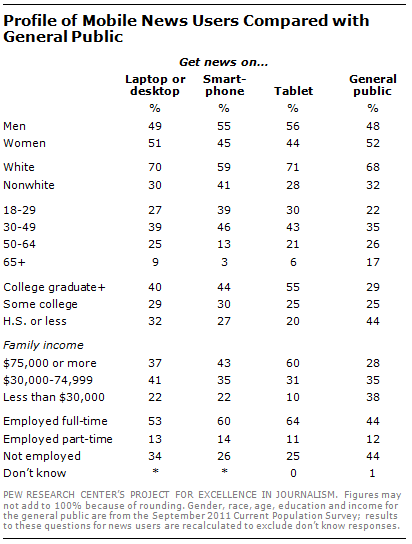
In terms of demographics, these multidevice users are more male, 59%. They are also more educated – 61% have completed college, compared with 44% of those who use one device and 35% who use just a desktop/laptop). And they tend to reside in suburban communities as opposed to rural or urban settings.
In contrast, those who only use a desktop/laptop digital news stand out for being less active news consumers over all. This group is less likely than those who get some digital news on the smartphone, their tablet or both to use each of the pathways to news asked about in the survey. Only about half (48%) get news using key word search very or somewhat often compared with at least 70% of those who use a smartphone, tablet computer or both for news. Similarly, 54% go directly to news websites or apps somewhat or very often, while 80% or more of those who get news on other devices do so. Facebook, by far, has the larger imprint for the desktop/laptop holdouts than Twitter (41% get news via Facebook versus 9% who do so via Twitter).
Demographically, the desktop/laptop holdouts tend to be older and live in rural settings.
Demographics of Digital News Users
In a survey PEJ conducted in 2011 in collaboration with The Economist Group, we found early tablet news users to be more middle-aged, earn higher incomes and be more highly educated than the population over all. The proliferation of lower-priced tablet options has not changed the demographics much. The young – 18-to-29-year-olds – now make up a greater portion of tablet news consumers, but they remain largely in the high-income, high-education brackets. One other demographic that emerged is a greater Northeast and Midwest contingent.
Data from Other Sources
All of these findings, which hint that mobile is adding to and expanding rather than replacing news behavior, are reinforced by other data we have seen that track online behavior. One client-based firm that tracks behavior on smartphones and tablets, Localytics, has shared its data with us.
While its data cover just a select mix of mobile news apps, the findings reveal that people spend more time per session with news on mobile devices than they do on computers, and read more articles per session and more articles per month. Comparing this data to data collected on news website behavior suggests on average that users return to news apps more than five times as often over the course of the month and spend a minute longer per session.
Part of the heightened news activity may be tied to the enhanced experience of apps. Certainly another factor that makes mobile an addition to news consumption could be the convenience of the devices. They are in your pocket or at your side on the sofa in the evening, making it possible to look at news when you otherwise might have been doing something else, or perhaps are still doing something else.
News companies, particularly those in magazines, have told us they are seeing something similar in their own usage data.
About the Survey
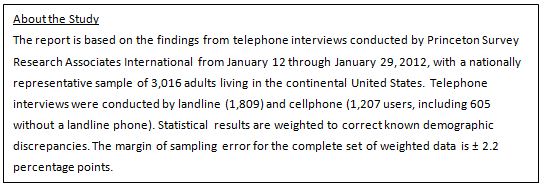
This report, Mobile Devices and News Consumption, is based on aggregated data from three telephone surveys conducted in January 2012 (Jan. 12-15, Jan. 19-22 and Jan. 26-29) with national samples of adults 18 years of age or older living in the continental United States. Interviews were conducted with a total of 3,016 adults (1,809 respondents were interviewed on a landline telephone, and 1,207 were interviewed on a cellphone, including 605 who had no landline telephone). The survey was conducted by interviewers at Princeton Data Source under the direction of Princeton Survey Research Associates International. A combination of landline and cellphone random digital dial samples was used; both samples were provided by Survey Sampling International. Interviews were conducted in English. Respondents in the landline sample were selected by randomly asking for the youngest adult who was at home. Interviews in the cellphone sample were conducted with the person who answered the phone, if that person was an adult 18 years of age or older.
The combined landline and cellphone sample are weighted using an iterative technique that matches gender, age, education, race, Hispanic origin and region to parameters from the March 2011 Census Bureau’s Current Population Survey and population density to parameters from the Decennial Census. The sample also is weighted to match current patterns of telephone status, based on extrapolations from the 2011 National Health Interview Survey. The weighting procedure also accounts for the fact that respondents with both landline and cellphones have a greater probability of being included in the combined sample and adjusts for household size within the landline sample. Sampling errors and statistical tests of significance take into account the effect of weighting. The following table shows the sample sizes and the error attributable to sampling that would be expected at the 95% level of confidence for different groups in the survey:
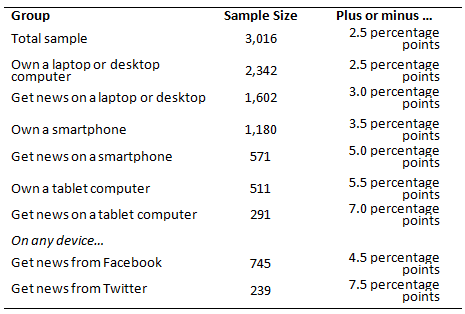
Sample sizes and sampling errors for other subgroups are available upon request.
In addition to sampling error, one should bear in mind that question wording and practical difficulties in conducting surveys can introduce error or bias into the findings of opinion polls.