Beyond Red vs. Blue: The Political Typology
Our typology sorts the public into nine groups based on their political and cultural values, not their party – painting a picture of American politics with far more than two colors.
Numbers, Facts and Trends Shaping Your World
Read our research on:

Our typology sorts the public into nine groups based on their political and cultural values, not their party – painting a picture of American politics with far more than two colors.

Our latest politics data every month
All
Publications
Blacks and whites in the U.S. disagree over police performance and differ on the causes of fatal encounters between blacks and police.
Our new survey focusing on contraception, same-sex marriage and transgender rights finds the public closely divided over some – though not all – of these issues.
The U.S. public expresses a clear consensus on the contentious question of whether employers who have religious objections to contraception should be required to provide it in health insurance plans for their employees.
After the June 2013 leaks by Edward Snowden about NSA surveillance of Americans’ communications, Pew Research Center began an in-depth exploration of people’s views and behaviors related to privacy. Here’s what we learned.
Voters who support Hillary Clinton and Donald Trump offer a variety of reasons why they do so, ranging from the candidates’ issue positions to their personal backgrounds.
Two years into his term as prime minister, Indians’ fervor for Narendra Modi continues and optimism about India’s direction and economy is on the rise.
The Indian public sees Prime Minister Narendra Modi favorably and India’s role in the world expanding, but there is a growing partisan divide on Modi’s record.
Despite the technological potential to help humans live longer and stronger, many U.S. adults are not ready to embrace these possibilities.
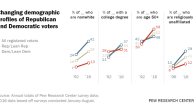
Ahead of the presidential election, the demographic profiles of the Republican and Democratic parties are strikingly different.
Our typology sorts the public into nine groups based on their political and cultural values, not their party – painting a picture of American politics with far more than two colors.
Take our quiz to find out which one of our nine political typology groups is your best match.
Pew Research Center’s in-depth study of its survey respondents who voted in the 2024 election examines turnout, voting patterns and demographics.
In this interactive feature, explore how changes between the 2020 and 2024 elections in how – and whether – people voted helped to return President Trump to office.