Beyond Red vs. Blue: The Political Typology
Our typology sorts the public into nine groups based on their political and cultural values, not their party – painting a picture of American politics with far more than two colors.
Numbers, Facts and Trends Shaping Your World
Read our research on:

Our typology sorts the public into nine groups based on their political and cultural values, not their party – painting a picture of American politics with far more than two colors.

Our latest politics data every month
All
Publications
Thirty years ago, a wave of optimism swept across Europe as walls and regimes fell, and long-oppressed publics embraced open societies, open markets and a more united Europe. Three decades later, a new Pew Research Center survey finds that few people in the former Eastern Bloc regret the monumental changes of 1989-1991.
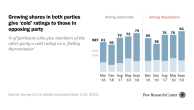
Division and animosity between the two political parties in the U.S. has deepened. Most partisans view the other side as ‘closed-minded’; Republicans see Democrats as ‘unpatriotic.’
For many, “socialism” is a word that evokes a weakened work ethic, stifled innovation and excessive reliance on the government. For others, it represents a fairer, more generous society.
The circumstances were very different during the Clinton impeachment crisis, and so was U.S. public opinion about the push for impeachment.
About a quarter of teens who identify with a religion and attend public school say they regularly pray before eating lunch at school.
Religion in public schools has long been a controversial issue. The U.S. Supreme Court ruled in 1962 that teachers and administrators cannot lead prayers in public schools, and a decision in 2000 barred school districts from sponsoring student-led prayers at football games. At the same time, the court has held that students retain a First […]
More than 55 years after the Supreme Court issued its landmark ruling striking down school-sponsored prayer, Americans continue to fight over the place of religion in public schools. Questions about religion in the classroom no longer make quite as many headlines as they once did, but the issue remains an important battleground in the broader […]
Americans express overwhelmingly favorable opinions of federal agencies like the Postal Service, the National Park Service, NASA and the Centers for Disease Control and Prevention (CDC) despite historically low levels of public trust in the federal government.
The first full fiscal year of the Trump administration saw large increases in the number of people arrested and criminally prosecuted for immigration offenses.
Amid questions over e-cigarettes and public health, here’s a look at what data shows about vaping in the U.S.
Our typology sorts the public into nine groups based on their political and cultural values, not their party – painting a picture of American politics with far more than two colors.
Take our quiz to find out which one of our nine political typology groups is your best match.
Pew Research Center’s in-depth study of its survey respondents who voted in the 2024 election examines turnout, voting patterns and demographics.
In this interactive feature, explore how changes between the 2020 and 2024 elections in how – and whether – people voted helped to return President Trump to office.